
Read this guide in
LABEL RISK CHECKLIST
Sweetener Labeling Requirements: US, EU and Canada
Sweetener label checklist for the US, EU and Canada: ingredient order, sweetener declarations, polyol notes, documents.
For cross-border sweetener projects, the first label risk is assuming one market's rule travels with the formula. It usually does not.
Use this checklist to screen the market and ingredient questions alongside sample development. It covers ingredient order, sweetener declarations and the supplier information needed for a local label review; a good-tasting sample and a printable label are separate decisions.
One formula needs separate market checks
Start with the country of sale, the actual food category and the complete commercial ingredient. A supplier specification supports the review, but it does not establish that every ingredient or use is permitted in every market.
| Market | Ingredient-list starting point | Separate label question |
|---|---|---|
| United States | Common or usual names and weight order under 21 CFR 101.4; a conditional low-percentage grouping is available. | Check the actual material, intended use, nutrition treatment and proposed claims separately. |
| European Union | Article 18 weight order, with applicable exceptions. | Annex III sweetener declarations and the destination Member State’s language requirements need their own review. |
| Canada | B.01.008.2 weight order, component declarations and listed exceptions. | Check sweetener-specific declarations, bilingual requirements and the applicable nutrition-symbol assessment. |
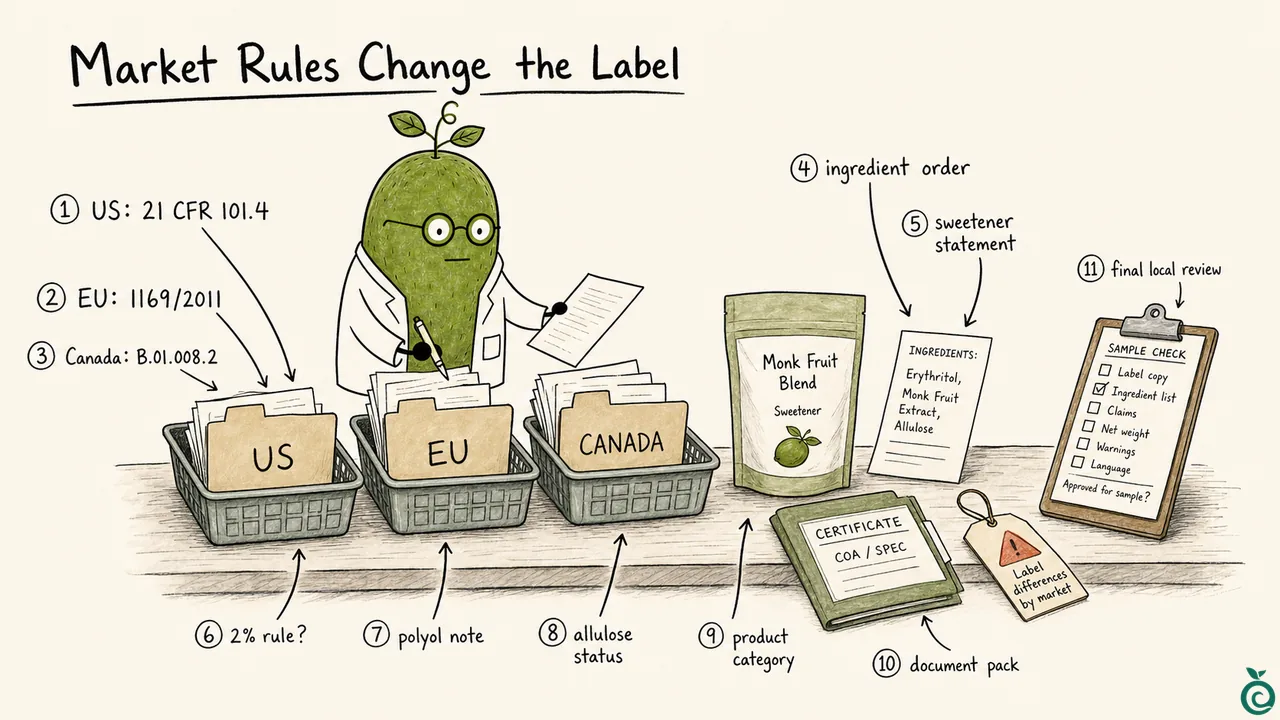
United States: the 2% option has conditions
21 CFR 101.4 generally requires common or usual ingredient names in descending order by weight. Under paragraph (a)(2), ingredients present at 2% or less may be listed at the end without that descending order when preceded by an appropriate quantifying statement. The stated threshold can be 2%, 1.5%, 1% or 0.5%; no ingredient covered by the statement may exceed it. This does not remove ingredients from the declaration or rank their sweetness. A small amount of a high-intensity sweetener can contribute substantial sweetness, while a heavier carrier contributes most of the blend mass. Use the complete composition supplied for the chosen material rather than inferring a formula from a retail label.
European Union: check the food name as well as ingredients
Article 18 requires an ingredient-list heading containing the word ingredients and generally orders ingredients by weight at the time of use. Annex III adds the checks below for the specified authorised sweeteners. These declarations are not a substitute for checking additive permissions and food-category conditions.
| Formula condition | Annex III check |
|---|---|
| Authorised sweetener(s) | “with sweetener(s)” accompanies the food name. |
| Added sugar(s) plus authorised sweetener(s) | “with sugar(s) and sweetener(s)” accompanies the food name. |
| Aspartame or aspartame-acesulfame salt | The phenylalanine statement depends on whether the ingredient is identified only by its E number or by its specific name; use the applicable wording in point 2.3. |
| More than 10% added authorised polyols | The laxative-effect statement in point 2.4 applies; this is not a blanket warning rule for every polyol-containing food. |
Accompanying the food name is a placement requirement; do not treat it as a universal instruction to put every statement on the front. Article 15 also requires language easily understood in the destination market, and Member States may stipulate official languages.
Canada: use Canadian exceptions and current packaging rules
B.01.008.2 generally orders ingredients by their proportion by weight before combination. Its component and end-of-list exceptions are specific: listed food additives may qualify, for example, while ingredients of additive preparations are excluded from that particular exception. It is not a general permission to move every ingredient below 2% to the end. CFIA’s sweetener guidance also distinguishes ordinary prepackaged foods from table-top sweeteners. For example, a table-top sweetener containing aspartame, sucralose, acesulfame-potassium or neotame needs a per-serving sweetness statement expressed as an equivalent amount of sugar. Aspartame has its own phenylalanine statement requirements. Do not copy one sweetener’s declaration onto every blend. Check mandatory English and French information, subject to the applicable exemptions. For the nutrition symbol, assess saturated fat, sugars and sodium against the applicable thresholds and exemptions rather than assuming a reduced-sugar product is exempt. The transition ended on December 31, 2025, with compliance required from January 1, 2026; the official guide separately addresses products imported, manufactured or packaged at retail before that date.
Sweetener type changes the review
High-intensity sweeteners, rare sugars, polyols, fibres and carriers do different jobs. Monk fruit or stevia may mainly lift sweetness; allulose may affect body and nutrition-panel assumptions where allowed; polyols may trigger market-specific warnings; carriers may affect serving size and ingredient order. Review the complete system, not just one sweetener name.
Three common label mistakes
The most common mistakes are using a U.S. allulose assumption for every market, reading a 2 percent or low-percentage group as a sweetness ranking, and approving artwork before the final formula, serving size and target market are fixed. Ingredient permission, ingredient-list wording, nutrition calculations and front-label claims are separate checks. A nutrition-panel treatment in one market does not grant ingredient permission elsewhere. A supplier COA describes the tested lot; it does not approve the buyer’s complete artwork.
Supplier documents: connect each file to the chosen material
Ask for the product specification, COA, allergen statement, production route or ingredient identity notes where relevant, halal or kosher files if required, export documents and the intended ingredient declaration support. The exact file set depends on the chosen formula and the target market. Keep the material identity and revision consistent across the sample, specification and draft ingredient statement. Request relevant files for the actual product rather than collecting certificates that refer to a different grade or site.
| Supplier input | What the buyer should connect it to |
|---|---|
| Specification and complete ingredient identity | The selected grade, production route where relevant, blend components and carriers, and the formula revision being reviewed. |
| Lot COA | The actual sample or shipment lot and its specification; keep analytical results separate from proposed label claims. |
| Allergen and composition statements | The chosen material and current composition, including relevant components of compound ingredients. |
| Requested certification or export documents | The product, site, scope and validity that the buyer’s market or customer needs; availability is confirmed for the selected route. |
| Draft pack and formula revision | The final formula, serving basis, package, destination languages and claims that the buyer’s qualified reviewer will assess. |
Start with the market, product and one label question
Tell Hengliyuan the intended country of sale, the product you are making and the question you need to resolve: ingredient order, a sweetener name, a polyol statement, an allulose direction or a proposed claim. We can discuss the material and sample direction while you collect the remaining information. A full recipe, completed artwork, confirmed order quantity and finished document pack are not needed for the first conversation. Add known packaging, quantity, required documents and sample needs as available. Final artwork review follows the selected formula and pack; supplier support is not legal approval of the finished label.
References and review scope
Reviewed October 18, 2026 against the official sources linked above. EUR-Lex identifies April 1, 2025 as the current consolidated version of Regulation 1169/2011 at this review. This checklist covers selected sweetener-related procurement questions; it is not a complete packaging checklist or approval of a material, use, claim or finished label. Have the buyer’s qualified target-market reviewer check the final formula and artwork before printing.
Common questions
Can a U.S. ingredient statement be reused for the EU?
Have it reviewed for the destination market. Similar weight-order principles do not make the sweetener declarations, language, permitted use or proposed claims interchangeable.
Discuss a label-sensitive sampleDoes the U.S. 2% option mean low-level ingredients can be omitted?
No. Paragraph (a)(2) changes the descending-order requirement for qualifying ingredients listed at the end with the specified quantifying statement. It does not itself remove the ingredient-declaration requirement.
Discuss a label-sensitive sampleWhen does the EU require with sweetener(s)?
Annex III links this statement to foods containing authorised sweeteners and requires it to accompany the food name. Added sugars plus sweeteners have a different statement.
Discuss a label-sensitive sampleDoes Canada let every ingredient under 2% move freely?
No. Apply the Canadian categories and conditions in B.01.008.2, including the rules for components. Do not transfer the U.S. low-percentage grouping to a Canadian label.
Discuss a label-sensitive sampleIs a low-sugar product automatically exempt from Canada’s nutrition symbol?
No. The assessment also covers saturated fat and sodium, with applicable thresholds, exemptions and prohibitions. Check the actual product and the current official guide.
Discuss a label-sensitive sampleDoes a supplier specification or COA approve the retail label?
No. Those files support material and lot review. They do not establish compliance of the buyer’s complete formula, nutrition panel, claims and package artwork.
Discuss a label-sensitive sampleShould we wait for a complete label before discussing samples?
No. Start with the market, product and one question. Screen the ingredient direction early, develop the sample in parallel where appropriate, and have the final formula and artwork reviewed before printing.
Discuss a label-sensitive sample