
Read this guide in
INGREDIENT LIST GUIDE
Food Label Ingredient List Order: Why Late-Listed Sweeteners Drive Sweetness
Why a late-listed sweetener can drive sweetness: compare weight with a clearly marked example, understand label exceptions, and review supplier samples.
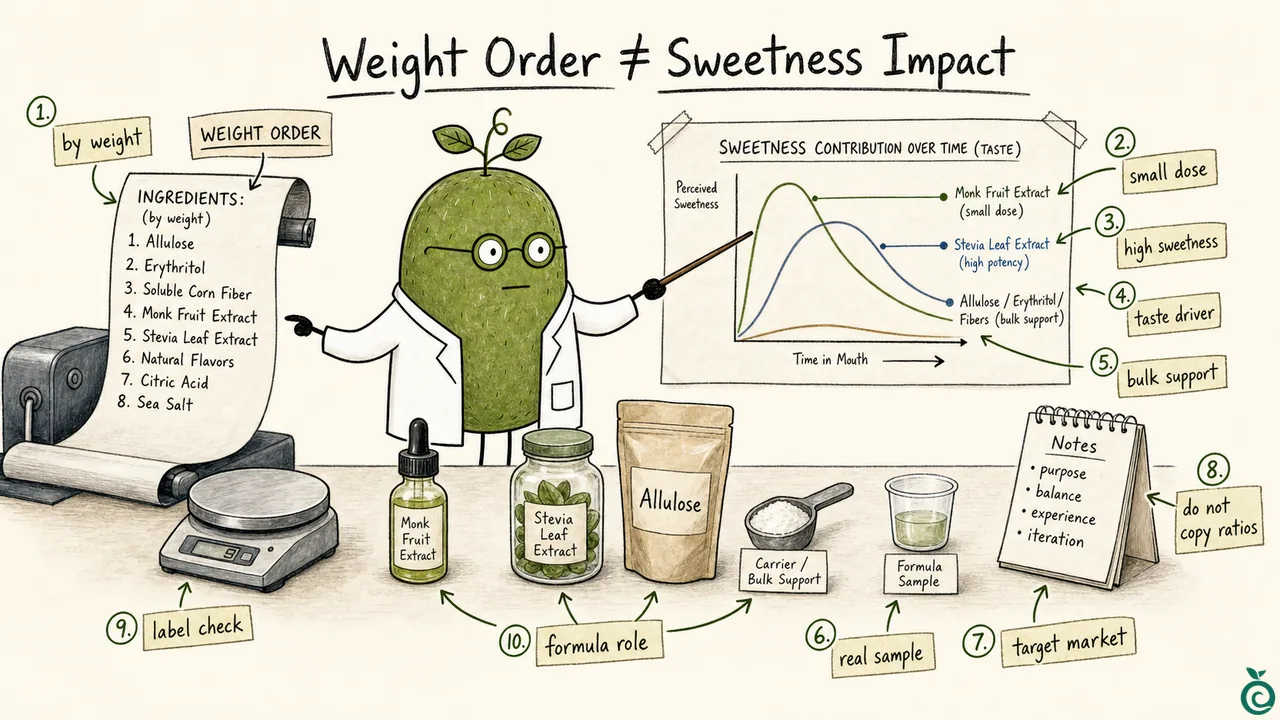
Ingredient lists are usually weight lists, not sweetness maps. A sweetener can appear near the end of a label because only a small physical amount is used, while still carrying much of the perceived sweetness.
Our factory view is straightforward: judge a sweetener by its job in the finished product, not by how high its name sits on the pack. Check the ingredient grade, the dose and the taste in your real base before deciding whether a sample fits.
The rule starts with weight
For a U.S. label review, 21 CFR 101.4 is a useful starting point: ingredients are generally listed by common or usual name in descending order of predominance by weight. EU Regulation 1169/2011 Article 18 uses the same practical idea for the Union market. Canada Food and Drug Regulations B.01.008.2 also starts from proportion by weight. These rules tell buyers how the ingredient statement is organized; they do not measure sweetness contribution.
Sweetness is not measured by label position
FDA explains that high-intensity sweeteners are many times sweeter than sucrose, so smaller amounts may be needed to reach the same sweetening effect. That is why a low-dose ingredient can sit near the end of the list but still shape first sweetness, peak sweetness, lingering sweetness or aftertaste. Label position also cannot tell you whether a particular grade has the taste profile you need.
An illustrative 100 g example
Assume two fictional ingredients: A has a relative sweetness of 1 and B has a relative sweetness of 200. A weighs 99 g and B weighs 1 g. For this simple linear illustration only, nominal sweetness units equal mass multiplied by the assumed relative sweetness; the shares are each ingredient’s units divided by the total.
| Illustrative ingredient | Mass | Assumed factor | Nominal units / share |
|---|---|---|---|
| A | 99 g / 99% | 1× | 99 × 1 = 99 / 33.1% |
| B | 1 g / 1% | 200× | 1 × 200 = 200 / 66.9% |
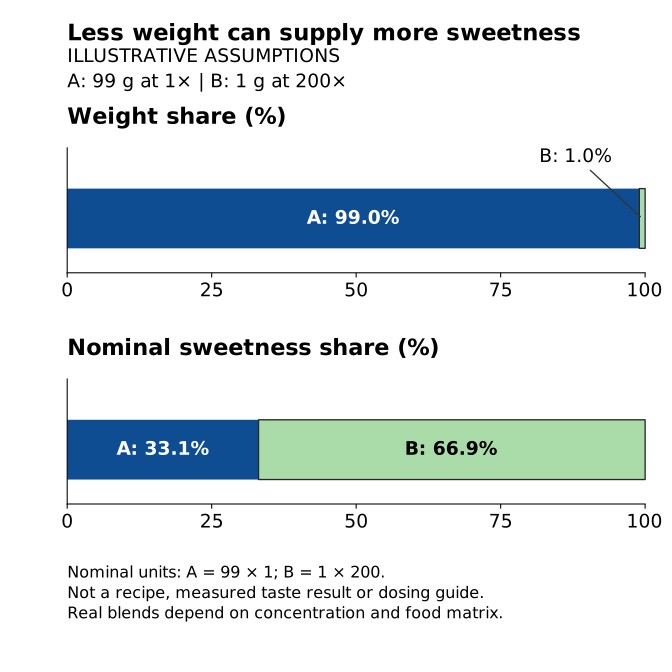
Real sweetness is not reliably additive in this way: concentration, the food matrix and interactions between ingredients can change the result. The assumed 200× factor is not a specification for any Hengliyuan product; use the actual grade and a sensory trial to choose a dose.
A low-dose sweetener can still be the taste driver
Monk fruit extract and stevia glycosides are often used for sweetness lift, while allulose, polyols, fibers, maltodextrin or other carriers may contribute bulk, body, serving weight or powder handling. If a buyer only reads the order, a formula with a small amount of high-intensity sweetener can be misunderstood as a formula where that sweetener is unimportant.
Do not infer the formula from the label
A label usually does not reveal the complete formula. Some ingredient percentages may be declared or required, including under EU quantitative ingredient declaration rules, but those disclosures still do not supply every proportion or processing condition. In the United States, eligible ingredients at 2% or less may appear at the end in a different order when the required qualifying statement is used. This is not a universal rule that every ingredient below 2% can be listed anywhere. Canada has its own listed exceptions, including certain food additives. Do not apply one market’s exception to another market’s label.
Read the label, then ask the right question
Before approving a sample, separate three decisions: which ingredient supplies sweetness, which ingredient supplies bulk or mouthfeel and which label claim the target market can support. A natural sweetener story does not automatically create a compliant claim, and a sugar-reduction formula still needs nutrition, ingredient naming and local review.
| What the buyer sees | What it tells you | What to check next |
|---|---|---|
| A sweetener near the end | Often a small amount by weight; market exceptions may affect order | Grade, use level and taste in the finished base |
| A bulk ingredient first | It may supply much of the mass | Its own sweetness, solids, mouthfeel and handling role |
| A highlighted ingredient percentage | The stated amount of that ingredient on the applicable basis | Other ingredients and process details remain unknown |
| A natural or sugar-reduction claim | A proposed positioning or label statement | Full composition, nutrition and destination-market requirements |
What to ask before approving a sample
Start with the target market, food category and the label question you need to resolve. Send a clear ingredient list and any available supplier specification, then explain the sweetness, aftertaste or mouthfeel you want to change. A competitor label is useful context, but we cannot reconstruct its formula from the order alone. For a sample comparison, keep the base and serving size consistent and record each sample’s grade and dose. Where relevant, note pH, solids, flavor, mineral load, heat treatment and storage. Taste against your current control at the intended serving temperature; check onset, peak, finish and body separately. This is the practical route from reading a label to choosing an ingredient.
Technical references
Reviewed October 16, 2026. These official sources explain ingredient order, selected exceptions and high-intensity sweeteners. A finished label still needs review for its destination, food category and complete composition. The numerical example above is an independent illustration, not data from these sources.
Common questions
Does a sweetener near the end of the ingredient list mean it is unimportant?
No. A small amount of a high-intensity sweetener can contribute much of the sweetness or affect the finish. Its position does not measure its sensory importance.
Discuss this requestDoes the first ingredient supply the most sweetness?
Not necessarily. It generally contributes more weight under the applicable ordering rules, but weight and sweetening power are different. Bulk ingredients can also supply sweetness, so check both roles.
Discuss this requestCan I calculate a competitor’s formula from its label?
Usually not. Some percentages may be disclosed, but ingredient order alone does not reveal all proportions, grades or processing conditions. Use it to frame questions, not as a ratio sheet.
Discuss this requestDoes the 2% exception apply everywhere?
No. The U.S. rule requires a qualifying statement for eligible ingredients. Other markets have their own exceptions and declaration requirements. Check the destination-market rule.
Discuss this requestCan I use the chart as a blending recipe?
No. It uses fictional ingredients and assumed sweetness factors to explain arithmetic. It does not predict measured sweetness, establish a legal use level or specify a product grade.
Discuss this requestWhat should I send Hengliyuan for a label-sensitive sample?
Start with your target market, food category, ingredient list and the taste or label question. Share available specifications and sample requirements; packaging, quantity and document needs can be clarified as the project develops.
Discuss this request