
Read this guide in
SAUCE FORMULATION GUIDE
Sugar-Free Tomato Sauce & Ketchup: Acidity, Viscosity & Heat Testing Guide
Plan low-sugar ketchup trials with separate pH, acidity, Brix, flow and serum-separation records. Compare sweeteners before and after the actual heat process.
Start with your actual tomato sauce or ketchup and a retained control. Matching sweetness is only the first check: removing sugar can also change body, flow, water distribution and how sharp the sauce tastes.
Our starting point is to separate the sweetener decision from the acid, structure and process decisions. A sample that tastes right before heating can still pour differently or release serum after cooling and storage.
Use the checks below to prepare a useful sample comparison. “Sugar-free” in the product brief does not by itself establish a finished-pack claim; review the target market and finished-product composition separately.

Start with first principles: sweetness is one job
Sugar or syrup can contribute sweetness, soluble solids, body, water behavior, gloss and flavor balance. Monk fruit or stevia can supply sweetness at low use levels, but contribute little replacement mass. Decide what will replace the removed solids and water balance before treating the sweetener dose as a complete formula. Allulose, fiber, starch or another carrier needs its own suitability and market review.
Name the finished sauce before choosing a blend
Name the finished product: ketchup, cooking sauce, dipping sauce or another condiment. Record the tomato paste or pulp, dilution water, current sugar or syrup, salt, vinegar or other acid source and any starch or gum. State the package and whether the product is chilled or intended for unopened ambient storage after a defined process. A fruit topping can use a similar trial structure, but needs its own formula and acceptance criteria.
Measure acidity and solids as different questions
Keep measured acidity and perceived sourness separate. pH and titratable acidity answer different questions; record the titration endpoint and reporting basis when using titratable acidity. A refractometer reading in a mixed sauce is not a direct measurement of grams of sugar. The 2019 stevia–maltitol ketchup study found lower Brix and dry matter with greater substitution, without a significant difference in pH or syneresis. That supports measuring the outputs separately, rather than assuming that every sugar reduction makes ketchup more acidic.
| Check | Record with each result | What the result can tell you |
|---|---|---|
| pH and titratable acidity | Sample temperature, preparation and pH method; titration endpoint, unit and acid-equivalent basis if used | Keep acid measurements separate from sweetness and perceived sharpness. |
| Brix / soluble solids | Instrument, temperature/correction and sample preparation; report °Brix as measured | Track the soluble-solids direction; do not relabel it as total sugar. |
| Bostwick flow | Distance, unit (mm or cm), elapsed time, sample temperature and loading method | Compare flow only under the same test conditions; a shorter distance means less flow in that test. |
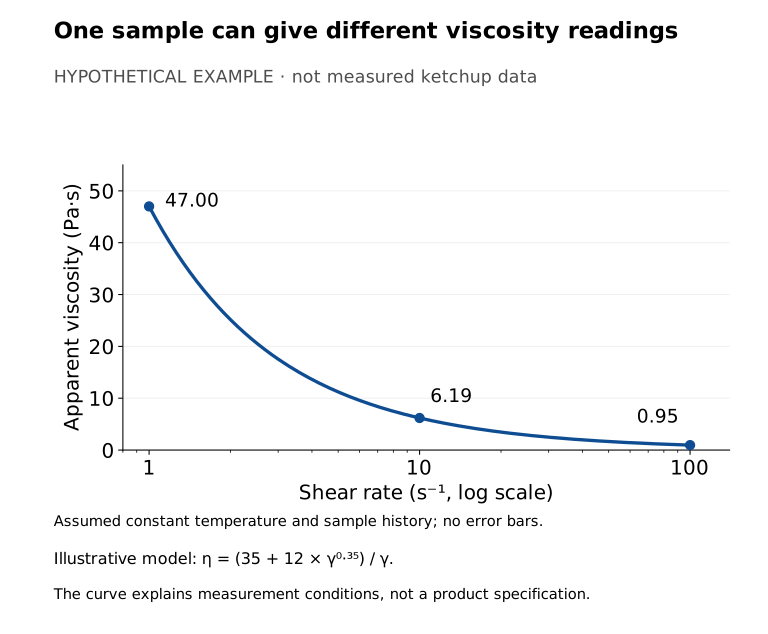
| Apparent viscosity | Instrument/geometry or spindle, speed or shear rate, temperature and sample history | A viscosity number needs its method. A spindle speed is not a universal shear-rate conversion. |
| Serum separation | Undisturbed jar, drained-mass or centrifuge method; time, temperature, sample size and calculation | Keep one method throughout. Height percentage and drained-mass percentage are different results. |
Treat viscosity and serum separation as physical checks
Read the method before comparing two “viscosity” reports. In the 2025 model study, Bostwick distance was measured at 20°C for 30 seconds, while apparent viscosity was determined at 25°C and a shear rate of 10 s⁻¹. Those are different measurements. The samples were shear-thinning, so a value taken at one shear rate cannot describe every pouring, pumping or resting condition.
Define serum separation before calculating a percentage
Keep an undisturbed retained sample for appearance checks. For drained-mass testing, record serum mass divided by initial sample mass, multiplied by 100; for a jar-height method, record the serum-layer height divided by total sample height, multiplied by 100. Neither number can be substituted for the other. Mixing the jar before observation can hide the separation you wanted to record.
The 2025 paper used a screen-tube drainage method over six weeks. Its ingredient models are useful evidence that physical stability depends on the whole system; they are not finished commercial ketchup recipes. In particular, adding vinegar introduces water as well as acid, so an effect cannot automatically be assigned to pH alone.
Run the heat step before you call the sample stable
Record the actual mixing, concentration and heat history, then compare samples after cooling to the same agreed test temperature. Log batch mass or yield, added water and final solids as well as time and temperature: evaporation can change consistency independently of the sweetener. Keep cooling time, measurement delay and mixing history consistent. If hot-fill, pasteurization or retort is used, record the real process rather than treating these as interchangeable steps.
Check sweetness, sourness, color, flow and separation before processing and after cooling, then at the agreed storage checkpoints. Keep unopened and opened-container trials separate. A good-looking sample or short storage screen does not establish a safe process or shelf life; those need the finished product’s own validation.
Build a small matrix that explains the result
Keep the current product or an agreed benchmark. First compare sweetness directions while holding the base, acid system and process steady. Then test a defined solids or structure change if body is missing; assess acid or flavor adjustments as a separate direction. Record all formula differences, even when one trial has to change more than one ingredient.
| Trial question | Keep comparable | Read before choosing the next sample |
|---|---|---|
| Which sweetener gives the right taste? | Tomato base, acid system, salt, process and serving temperature; document the replacement of removed mass | Sweetness, sourness balance and aftertaste, with physical checks recorded separately. |
| What restores the missing body? | Chosen sweetness direction and acid system; record added water and solids | Brix/solids, flow or viscosity and separation using fixed methods. |
| Does the result survive processing and storage? | Defined formula, process, fill and package; independent retained samples where testing is destructive | After cooling and at agreed times: taste, color, flow, separation and package observations. |
Agree checkpoints and acceptance criteria before judging results. Day 0, 7, 14, 21 or 35 can be screening points for a particular project; they are not a default shelf-life schedule. Use the existing sauce scorecard to keep the formula, method and observation linked to the sample code.
What the research supports
Use the linked studies to select measurements and understand their limits. Neither study approves a sweetener specification, gum dose, heat process or finished-product claim. Keep the market, recipe, package and agreed test method with the actual sample results.
Common questions
Can monk fruit or stevia replace all the sugar in ketchup?
They can supply sweetness. They do not replace all of the removed solids, water balance or body at the same low use level. Test the complete replacement system in your tomato base and actual process.
Discuss this requestDoes low-sugar ketchup always become more acidic?
No. Measured pH, titratable acidity and perceived sourness are separate outputs. Keep the base and acid system documented, and assess taste at a consistent serving temperature.
Discuss this requestCan I use Brix as the sugar content?
Do not assume they are equivalent in a mixed sauce. Other dissolved ingredients influence the refractometer reading. Use the appropriate composition or laboratory method for a total-sugar result.
Discuss this requestCan Bostwick distance replace a viscosity specification?
Not directly. Bostwick reports flow distance under its test conditions; apparent viscosity depends on the instrument and shear conditions. Agree the method, temperature, timing and units before comparing reports.
Discuss this requestHow should I report serum separation?
Name the method and calculation. A visible layer-height percentage, screen-drained mass percentage and centrifuge result are different measurements. Keep sample size, storage time and temperature with the result, and observe retained jars before mixing.
Discuss this requestWhat should buyers send before requesting a sauce sample?
Send your target market, sauce category, tomato base, sugar-reduction goal and main issue. Add the current sugar/acid system, solids direction, heat process, package, storage plan and control results when available. Quantity, documents and sample needs can follow when known.
Discuss this request