
Read this guide in
LABEL AND DOCUMENT GUIDE
Monk Fruit Ingredient List Guide: How to Declare Monk Fruit Extract on Food Labels
How to list monk fruit extract on ingredient labels: naming, market-specific rules, certificates and files food brands need.
Declare the actual ingredient or full blend composition using the names required in the destination market. A pure monk fruit extract, a juice material and a carrier-based sweetener blend need different identity checks; “monk fruit sweetener” alone does not establish the correct ingredient list.
Monk fruit sweetener projects can slow down when formula, label wording and document needs are discussed too late. Buyers may have a good sample but still need ingredient-list details, product files and market-specific checks before launch.
This guide helps brands prepare better questions before requesting samples, quotation, OEM packaging or supplier qualification files.
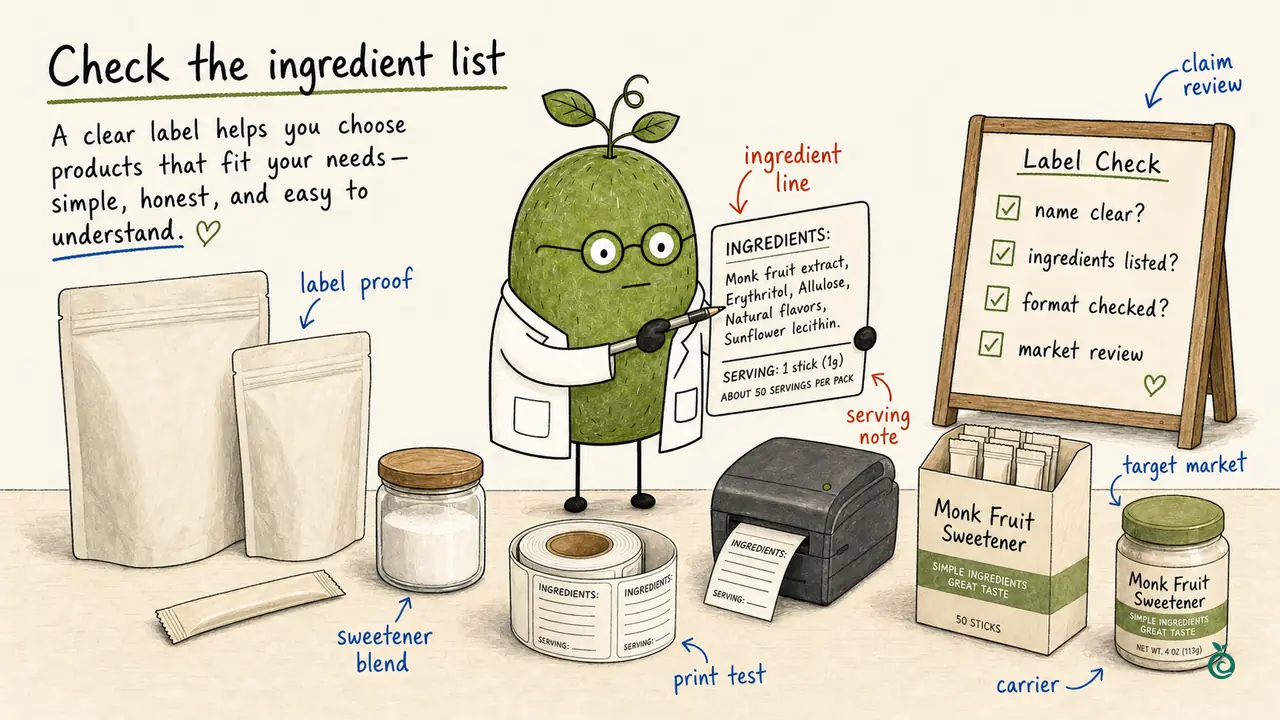
Ask for the exact formula identity
Confirm whether the sample is pure monk fruit extract, a standardized Mogroside V extract, a sweetener blend, a granulated product, a syrup direction or a finished private-label product. The ingredient list depends on the exact product.
Separate ingredient names from claims
Ingredient declaration, natural sweetener wording, sugar-free claims, no added sugar claims and nutrition statements are different questions. Buyers should check local rules before using claim language on packaging or online listings.
Connect label checks to target market
A U.S. ecommerce product, Indonesia retail pack, Middle East halal project, EU ingredient supply project and Southeast Asia distributor order may need different wording, certificates and document sets.
Prepare documents before artwork
Useful files may include specification, ingredient composition, shelf life, storage conditions, food safety certificates, halal documents, test information, production or export records and packaging details.
Check packaging specification early
Stick packets, jars, pouches, bulk bags and beverage powder sachets may need different net weight, serving instruction, carton mark and label-language decisions. Packaging affects both quotation and label review.
Turn label questions into a clear inquiry
When asking a supplier for help, include target market, product type, packaging specification, estimated quantity, required certificates or documents and whether samples are needed.
Example ingredient names are identity checks
Write the ingredient statement from the full formula and the destination-market rules. A label on a comparator is useful for asking questions, but it is not evidence that the same name is lawful for your material or use. Obtain the exact identity and composition first. If the purchasing item is a blend, identify its constituent ingredients, including any carrier; listing only the ingredient that supplies most of the sweetness can leave the composition unclear. The examples below show naming questions, not approved artwork. “Monk fruit extract” and “luo han guo extract” may describe a botanical source in supplier files, but a synonym does not establish legal status, purity or permitted use. A juice concentrate and a whole-fruit powder have different composition and process identities. Ask the local reviewer to reconcile the specification, supplier declaration and proposed label rather than choosing the shortest name.
| Material identity | Example wording to review | Check before use |
|---|---|---|
| Pure extract | Monk fruit extract / luo han guo extract | Botanical identity, extraction route and lawful market name |
| Carrier-based blend | Constituent ingredients in required order | Full composition and local ingredient-list rules |
| Juice material | Actual juice or concentrate identity | Process, composition and intended food category |
| Whole-fruit powder | Actual whole-fruit powder identity | Composition and applicable market classification |
Market review record
Keep ingredient permission separate from ingredient naming. A food can use familiar English wording and still need an intended-use or market-access assessment. The US FDA GRAS notice route applies to the notified substance and conditions; it is not an approval of every extract or blend sold under the same commercial name. EU novel-food and additive questions depend on the specific material and food use. For Indonesia and China, obtain the current local classification and labeling review for the selected finished product rather than extending a foreign notice to those markets. Record the official source, the date checked and the reviewer’s conclusion next to the formula version. If the material route changes, reopen that row. A change from whole-fruit powder to a purified extract, or from extract to a multi-ingredient blend, can change the question that needs an answer. Treat “to be confirmed” as an open action before artwork approval.
| Market | Source and identity review | Naming action |
|---|---|---|
| US | FDA notice / guidance for the exact substance and use | Confirm lawful ingredient names and full composition |
| EU | Current Union rules, novel-food / additive assessment where applicable | Confirm permitted route before label wording |
| Indonesia | Current BPOM review for the material and finished food | Confirm local name and product classification |
| China | Current national food standards and applicable permissions | Confirm material identity and Chinese declaration |
Documents checklist before artwork sign-off
Use a document register tied to the selected product. A factory certificate establishes its stated site and scope; a batch COA establishes reported measurements for one batch. Neither substitutes for the full ingredient declaration or proves a finished-product sugar claim. Check the issuing organization, product or site, dates and the scope relevant to the purchase. Keep storage and shelf-life information with its packaging condition. A number for one material or unopened pack does not automatically apply after opening or after formulation into a finished food. For claims, calculate or test the complete product as required by the market and record the basis. Ask for clarification while the formula and pack can still change, then approve the artwork against the agreed final version.
| File | Match to | Open question |
|---|---|---|
| Specification | Quoted material, form and grade | Acceptance items and methods |
| Batch COA | Sample or delivery batch | Assay basis and measured results |
| Composition declaration | Full formula and carriers | Ingredient order and naming |
| Certificate where required | Named site / product and current scope | Applicability to this purchase |
| Storage / shelf life | Material and packaging condition | Unopened and after-opening instructions |
| Artwork review | Final formula and destination market | Claims and mandatory wording |
Review note
Reviewed October 2, 2026.
Common questions
What should I ask before writing a monk fruit ingredient list?
Ask for the exact product identity, ingredient composition, specification, carrier system, intended use, shelf life, storage conditions and target-market document needs.
Can one label wording work in every market?
No. Ingredient names, claims, nutrition panel treatment and certificate needs can differ by target market, product type and sales channel.
Should label checks happen before or after samples?
Basic label and document needs should be discussed early, then confirmed before final formula, packaging, quotation and artwork approval.
Can Hengliyuan support label document discussion?
Hengliyuan can discuss available product, factory, food safety, halal, test and export files based on target market, product type, packaging specification and order plan.
