Read this guide in
Monk fruit extract specifications
Total Mogrosides vs. Mogroside V: How to Compare Specifications
Compare Mogroside V with total mogrosides, evaluate 25% and 50% extracts, read assay and COA results, and check grade changes in your food or beverage.
Mogroside V is a sweet cucurbitane triterpene glycoside found in monk fruit (Siraitia grosvenorii). It is one constituent of total mogrosides, not another name for the whole extract. A 50% Mogroside V extract, a 50% total-mogrosides extract and a high-purity laboratory standard describe different materials.
Buyers should not compare “50% total mogrosides” with “50% mogroside V” as if they were the same grade. Across suppliers, first align the measured constituent, test method and reporting basis, product form and carrier, sample reference and matching batch COA. Then compare quotations and results from trials in the intended application.
The illustration depicts sample jars and composition notes on a specification-review bench. Its composition sketches are conceptual and supply no measured extract proportions.

What is Mogroside V, and what does its name identify?
The V is the Roman numeral five. The individual compound has CAS 88901-36-4 and molecular formula C60H102O29; its molecular weight is approximately 1287.4 g/mol. These identifiers describe the molecule. A commercial monk fruit extract also contains other constituents, so the same marker CAS on two sales sheets does not establish identical composition or suitability for food use.
- PubChem compound identity
- FUJIFILM Wako original reference-standard listing
- EFSA technical assessment: identity of the extract and individual constituents
| Description on the offer | What you are comparing | First document to check |
|---|---|---|
| Mogroside V assay, e.g. at least 25% or 50% | The named constituent in a supplied extract | Grade specification, assay basis, full ingredients and selected-lot COA |
| Total mogrosides, e.g. 80% | A method-defined combined measure | Which compounds or equivalent responses the method includes |
| Extract ratio, e.g. 10:1 | A stated starting-material-to-extract ratio | Ratio definition, process and separate assay; it is not 10% Mogroside V |
| Mogroside V analytical reference standard | A laboratory calibration or identification material | Intended-use statement and the standard’s own certificate; it is not a food formulation ingredient |
For example, FUJIFILM Wako lists a 95.0+% HPLC Mogroside V standard in a 50 mg format for food analysis and labels it for research use. Its analytical purpose does not become an edible-ingredient approval because the word “food” appears in “food analysis.”
What else is included in total mogrosides besides mogroside V?
Total mogrosides is not a single substance, but the sum of several mogrosides. Mogroside V, often abbreviated as MV, is just one of them. Other representative constituents reported in monk fruit and its extracts include:
- Public FDA GRN 629 submission
- Comparative study of the composition of differently dried monk fruit products
- EFSA information on monk fruit extract composition
- View monk fruit extract specifications
| Constituent | English name |
|---|---|
| Mogroside III and related constituents, such as mogroside IIIE | Mogroside III, Mogroside IIIE |
| Mogroside IV | Mogroside IV |
| Mogroside VI | Mogroside VI |
| Siamenoside I | Siamenoside I |
| 11-oxo-mogroside V | 11-oxo-mogroside V |
| Isomogroside V | Isomogroside V |
The relationship can therefore be understood as follows: total mogrosides is a combined measure covering mogroside V and other mogrosides; mogroside V is one individual measure within that group. These are representative constituents, not a fixed formula with identical proportions in every extract, nor a complete list used by every total-mogrosides assay. Check the relevant analytical method and report to establish which constituents are included for a particular product. Constituent names are based on the public FDA GRN 629 submission, a comparative study of differently dried monk fruit products, and EFSA information on monk fruit extract composition. These sources explain constituent names; they do not represent measured results for any Hengliyuan batch. GRN 629 is a historical submitted dossier; its FDA evaluation was subsequently ceased at the notifier’s request. Its use here is limited to constituent identification, not proof of market authorization.
Why is 50% total mogrosides not the same as 50% mogroside V?
“50% total mogrosides” means that the mogrosides included under the relevant assay total 50%. The proportion of mogroside V must be checked in its individual test result; it cannot simply be assumed to be 50%. “50% mogroside V” means that this one constituent accounts for 50%. Other mogrosides may also be present, so it cannot be assumed that total mogrosides is only 50%.
| Specification wording | What the percentage means | What cannot be directly concluded |
|---|---|---|
| 50% total mogrosides | The combined content of the mogrosides included in the assay is 50% | Mogroside V also reaches 50% |
| 50% mogroside V | The content of mogroside V alone is 50% | Total mogrosides is only 50%, or no other mogrosides are present |
These figures explain the distinction between measures; they are not test results for a particular batch. On a real COA, also distinguish a specification limit such as “≥50%” from the measured batch result. The specification column states the requirement; it is not automatically the numerical result for that lot.
Five-batch composition data show what a grade number leaves out
EFSA’s 2019 assessment reports applicant-submitted composition results from five batches of each of five extract grades. In the named 25% grade, measured Mogroside V ranged from 25.96% to 26.53%; in the named 50% grade, it ranged from 51.03% to 51.81%. The stated grade and the actual batch result were different numbers. Other constituents also changed across the submitted extracts.
| Named extract grade | Mogroside V: reported range (%) | 11-oxo-mogroside V: reported range (%) |
|---|---|---|
| 25% | 25.96–26.53 | 4.98–5.24 |
| 40% | 40.95–41.95 | 6.36–6.56 |
| 45% | 46.11–46.82 | 8.52–8.72 |
| 50% | 51.03–51.81 | 9.36–9.68 |
| 55% | 55.96–56.68 | 9.87–10.11 |
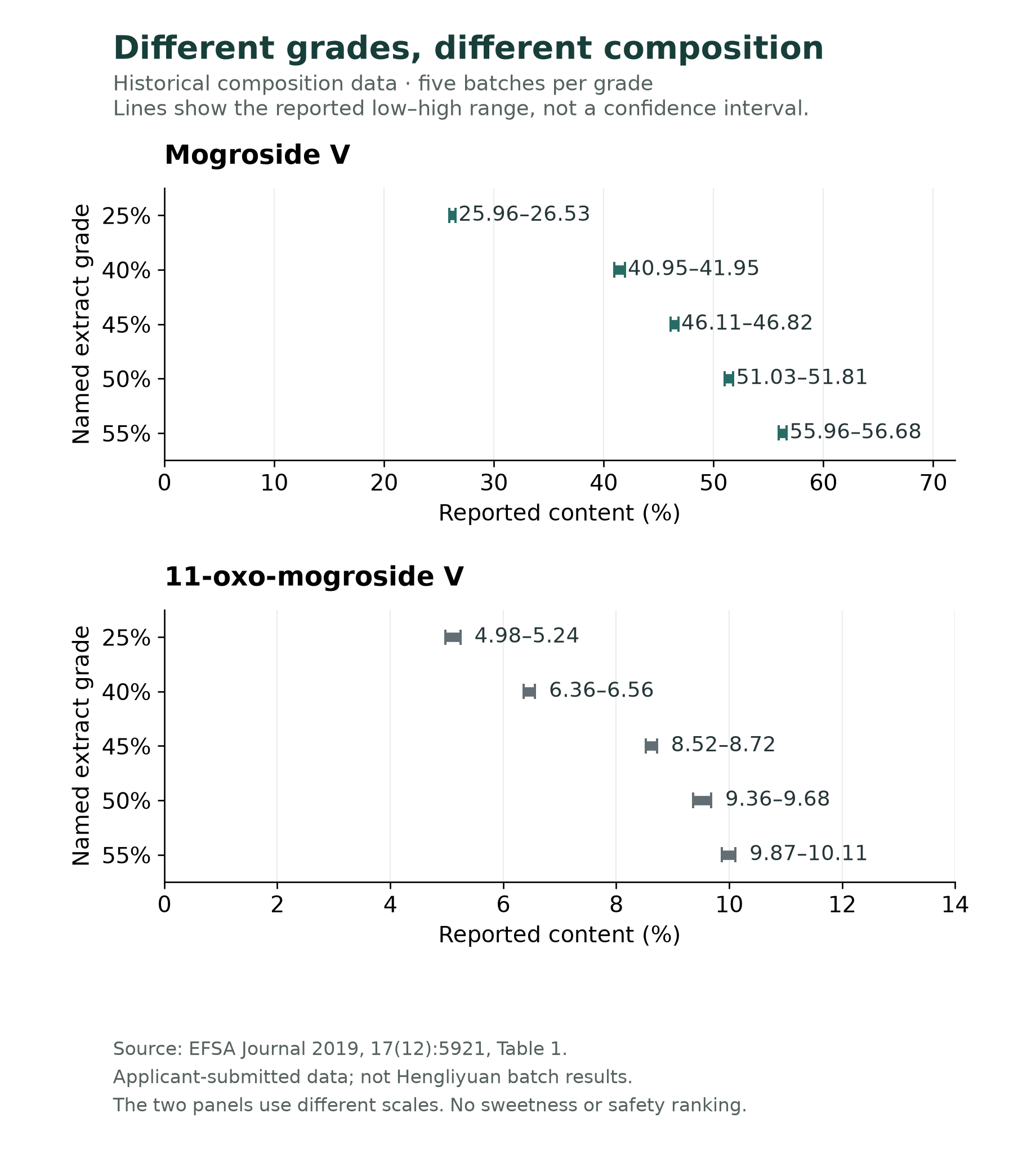
These are historical submitted composition data, not universal grade requirements, Hengliyuan test results or a taste comparison. The ranges are not means, standard deviations or confidence intervals. Do not sum the separate lower or upper bounds to reconstruct one batch: the table does not identify which component results occurred together. A higher Mogroside V percentage alone also does not establish better sensory performance.
Equal total-mogrosides content can still mean different compositions
Even when two ingredients have the same total-mogrosides content, their proportions of mogroside V and other mogrosides may differ. The total percentage alone does not establish identical composition. Likewise, equal mogroside V content does not mean that other constituents and all product parameters are identical. Compare the full specifications and batch-specific test documents, rather than just one number on a quotation. Customers who require a defined mogroside V content should request that measure explicitly. If total mogrosides is required, specify the assay requirements. Hengliyuan can help confirm specifications against the measures the customer actually needs. The fraction outside Mogroside V is not automatically maltodextrin, another added carrier or waste. It can include other native constituents. Ask for the complete composition and carrier declaration; do not infer the answer from 100 minus the V percentage. Likewise, a marker assay does not establish the full nutritional composition.
HPLC, UV and peak area: ask what the percentage measures
HPLC separates compounds; UV can describe a detector or a different assay approach. “HPLC-UV” is a valid combined description, so it is misleading to treat every mention of UV as automatically inferior to HPLC. What matters is whether the method identifies and quantifies the requested constituent or defined total with a suitable reference standard.
- PhytoLab original example certificate, pages 1–3
- EFSA section 3.1.4: extract method and the then-missing food-method information
| Result or method wording | What to resolve before comparing |
|---|---|
| Mogroside V by HPLC | Method reference/version, identification, calibration standard, calculation and reporting basis |
| Total mogrosides by UV | Assay procedure, reference compound and whether the result is expressed as an equivalent response |
| Total mogrosides by chromatography | Named included peaks, calibration/response treatment and summation rules |
| Chromatographic area purity | Whether water, solvents and non-detected material are excluded from the denominator; do not automatically read it as mass fraction |
| Conforms or passes | The accepted limit and method; request a numerical result where the buying decision requires one |
| Finished-food assay | Matrix recovery and sample preparation for that food; an extract method alone does not establish a finished-drink method |
There is a useful real document example: PhytoLab’s public example certificate for Mogroside V reference substance 80498 lists HPLC area purity as 100.00% and calculated content as 98%. The certificate explains that water, residual solvents and inorganic impurities enter its mass-balance calculation, and quantitative calculations should use absolute purity rather than area purity alone. This is an analytical-standard example, not a COA for edible monk fruit extract. Its “Example only” label must stay with the example.
As supplied or dry basis: a 50% result needs a denominator
A percentage is incomplete until its basis is clear. Ask whether the result applies to the material as supplied, dry matter or another specified basis. Moisture and loss on drying are not automatically interchangeable: loss on drying can include substances other than water, depending on the method.
| Explicitly hypothetical example | Calculation | Meaning |
|---|---|---|
| 50.0% Mogroside V on a dry basis; 4.0% moisture by a compatible method | 0.500 × (1 − 0.040) = 0.480 | 48.0% in the as-supplied material under those assumptions |
| 48.0% as supplied; the same 4.0% moisture | 0.480 ÷ 0.960 = 0.500 | 50.0% on that dry basis |
| A separate document only says “loss on drying ≤5%” | No measured moisture or agreed correction basis | Do not silently replace the lot’s result with a calculated dry-basis number |
These are denominator examples, not batch data. A listed maximum moisture limit is also different from the measured moisture of the lot. If two laboratories disagree, have them compare the same retained sample, method, reference-standard correction and reporting basis before treating the difference as evidence of adulteration or a grade failure.
Read the COA as a batch record
Check the product identity, grade, batch number and report date together. Separate the specification limit, actual result and method reference; a generic specification sheet describes a product requirement, while the batch COA reports the identified lot. Confirm the manufacturer and COA issuer for the material being supplied. For the assay, request the measured constituent, method reference or version and reporting basis. The word HPLC alone does not establish that two reports use the same procedure. Ask whether the percentage is reported on the supplied material, a dry basis or another stated basis, and clarify the relevant moisture or drying result before making any correction. Do not silently compare different bases as if they were identical. Keep the evaluated sample code and lot with its COA. If the proposed supply lot differs, confirm the applicable batch documents and whether the change requires another application check. A favorable sample result describes the material tested; it does not identify every later supply lot. For purchasing, separate specification approval, sample acceptance and release of the actual supply lot. Request any required document before the stage where its absence would block the decision; do not wait until shipment to discover that the promised material lacks the agreed assay basis.
Four public supply examples: compare documents rather than grade names
Public supplier documents make the comparison concrete. The examples below belong to the named suppliers, not to Hengliyuan; their packaging, limits and availability do not establish our offer.
- Monk Fruit Corp original extract-grade list
- Total Ingredients original THX1871 specification
- MarkNature original total-mogrosides and V specification
- TR Nutritionals original dated 50% specification
| Original supplier example | Useful information actually provided | What still needs confirmation |
|---|---|---|
| Monk Fruit Corp MFC-E25P and MFC-E50 | Separate 25% and 50% Mogroside V product identities, alongside other grades | Current full specification, lot results and performance in your base; a grade list is not a controlled taste trial |
| Total Ingredients THX1871, March 2026 specification | Mogroside V at least 25.0% by HPLC, moisture at most 5.0%, and at least 95% passing 80 mesh | A supplied-lot COA and full method/basis; a specification limit is not the actual assay result |
| MarkNature 80% total-mogrosides listing | The same specification also names Mogroside V at least 30% | 80% total and 30% V are different measures on one offer, not interchangeable purity claims |
| TR Nutritionals 50% extract specification, revision December 20, 2017 | A named HPLC assay of at least 50.0%, particle analysis and bulk-density information | Whether that historical revision remains applicable to the material currently offered; request the current controlled document |
Notice how “80 mesh” can hide different acceptance wording, and how a dated specification can remain easy to find long after its issue. Keep the document version, issuer, sample identity and order lot together. A website table headed “COA result” without a traceable lot and report date is not enough to identify your shipment.
A formulator case: a blend is a different comparison from a purer extract
In a July 15, 2025 technical comparison, Icon Foods describes its MonkSweet LS4 as a blend of monk fruit extract and Reb M stevia, contrasted with V25, V40 and V50 extracts. Its comparison table describes LS4 as containing less than 10% Mogroside V plus steviol glycosides. This is a useful illustration of why the highest V percentage is not the only way to develop a sweetener system.
The article’s sensory and efficiency conclusions are the supplier’s claims. The displayed comparison does not provide a full sensory protocol, panel size, tested concentrations or uncertainty with which to reproduce a universal ranking. Its table and bar chart also give different sweetness numbers for V25 and V40, so we do not use those graphics as a dose calculator. For your project, identify every sweetener in the system and compare actual taste-approved use levels, label requirements and cost in the same base. A blended system cannot be treated as a single-variable purity trial.
Switching 25% to 50%: what the mass calculation can establish
If both results are measured on the same as-supplied mass basis, you can first match the amount of Mogroside V. The relationship is extract mass × assay fraction = Mogroside V mass. This is a bookkeeping starting point for a trial, not a sensory substitution rule.
- Scale a measured pilot dose while keeping the basis explicit
- Compare extract and retail sweetener blends
| Hypothetical 100 kg final batch | 25.0% extract | 50.0% extract |
|---|---|---|
| Supplied extract added | 100 g | 50 g |
| Mogroside V mass | 100 g × 0.25 = 25 g | 50 g × 0.50 = 25 g |
| Supplied extract concentration | 1,000 mg/kg (0.10%) | 500 mg/kg (0.05%) |
| Mogroside V concentration | 250 mg/kg | 250 mg/kg |
Both calculations assume a 100 kg final mass, so adjust the rest of the formula to keep that denominator unchanged. The changed extract mass, other mogrosides and accompanying components are not identical; equal Mogroside V mass does not prove equal sweetness, aftertaste, color or solubility. Keep the sample identity, concentration basis and complete formula with each result. A concentrated extract also does not replace sugar’s bulk, water contribution, freezing-point effect or browning behavior at the same spoonful. Where sugar is removed, evaluate those functions separately. The example use levels above are chosen only to show the arithmetic, not recommended doses or permitted-use limits.
Changes in content affect taste as well as sweetness
When helping customers select ingredients, Hengliyuan does not recommend choosing an extract solely by its content level. A change in content changes taste as well as sweetness. When switching specifications, do more than recalculate dosage: compare samples in the actual food or beverage to confirm that the overall taste meets requirements. Content figures help describe an ingredient, but do not replace application trials. If your current product does not taste as expected, tell us its specification, intended use and what you want to improve. Hengliyuan can suggest selection and adjustment options, which can then be checked through practical trials.
Compare the grades in the product you intend to sell
Set a reference sweetness in the complete base, then compare candidate grades at adjusted doses. Keep acidity, other sweeteners, flavors, solids, temperature and process fixed wherever possible. Record sweetness onset, intensity, linger and unwanted notes separately; a single “better taste” score hides the reason for the choice.
| Application | What to hold and record | What the assay alone cannot answer |
|---|---|---|
| Clear acidified beverage | Base and pH, addition order, dissolution, actual heat process, clarity/color and taste at serving temperature | Whether haze, color or aftertaste will remain acceptable after processing and storage |
| Dairy or plant-protein drink | Protein/fat system, flavors, processing, equal-sweetness target and chilled/ambient evaluation | Whether the grade masks or emphasizes the base’s bitterness and astringency |
| Dry drink mix or sachet | Carrier and complete blend, weighing/premix sequence, particle distribution and reconstitution | Whether a small dose is evenly distributed or settles during handling |
| Bakery or frozen dessert | The entire sweetener/bulking system, water, solids and process, followed by cooled or frozen product assessment | Whether matching sweetness also preserves texture, yield and shelf-life performance |
For a change in grade, retain both an assay-matched comparison and a taste-adjusted comparison when useful. The first helps isolate composition questions; the second determines the use level needed for the product brief. Neither turns a small internal trial into a published customer case or a universal ranking of 25% versus 50%.
Keep stability claims tied to the tested material and conditions
EFSA’s 2019 assessment describes several different stability submissions. A 55% extract lost less than 3% Mogroside V after three months at 37°C and 75 ± 5% relative humidity, and after twelve months at 25°C and 60 ± 10% relative humidity. A separate 25% extract model was not stable at pH 1, while tests at pH 3, 6 and 12 covered four weeks at 2–8°C. These are not interchangeable storage protocols.
The assessment states that no finished-food stability data were provided in that submission. It also describes thermal model tests, which do not make every drink, baking process or shelf life validated. Ask for the selected grade’s storage conditions and package, then check the actual product’s heat exposure, pH, packaging and required life. An unchanged Mogroside V assay alone does not establish unchanged flavor, microbiological quality or commercial shelf life.
A specification or a GRAS notice number is not market approval
For a US food project, match the material’s identity, manufacturing process, composition and intended use with the applicable regulatory basis. Do not use “FDA approved” as shorthand for a supplier’s GRAS position or for a filed notice. Food use, dietary-supplement use and laboratory use are separate decisions.
- FDA original response: GRN 629 evaluation ceased
- EFSA 2019 assessment and its conclusion
- Match ingredient identity with market-specific label and document review
The GRN 629 submission linked in the constituent discussion is useful as a historical technical dossier. FDA’s response, dated August 9, 2016, says the notifier withdrew it to change product profiles and specifications, and FDA ceased evaluation effective July 15, 2016. It is therefore not a “no questions” letter for that notice. A table inside the submission does not override the response letter. Likewise, EFSA’s 2019 composition tables are not an authorization for those grades; that assessment concluded the submitted toxicity database was insufficient to conclude on safety for the proposed additive use. Use the data here for the stated technical comparison and confirm current destination-market status separately for the exact material. A buyer’s intended use cannot be approved from the Mogroside V percentage alone.
When two reports or samples disagree, choose the next check
Use the difference to select a controlled comparison. Avoid changing the grade, carrier, dose and flavor system together and then attributing the outcome to one assay number.
| Observed difference | Next check |
|---|---|
| 48% on one report and 50% on another | As-supplied/dry basis, measured moisture, standard correction, method and sample identity |
| Same V result, different taste or color | Other composition, carrier/process history, equal-sweetness dose and full-base comparison |
| Solution assay passes, finished drink seems weaker | Weighing and dilution records, matrix recovery, actual processing and sensory conditions |
| Good bench sample, inconsistent dry production blend | Premix dilution, mixing uniformity, segregation and retained samples from the actual run |
| Stored material changes or clumps | Seal/package history, humidity, storage and selected-lot retest; do not infer shelf-life extension from a single passing assay |
Compare quotations after aligning the material
First align the analyte, method and reporting basis, product form, carrier declaration, specification and relevant batch/sample reference. Then compare currency, quotation date, pack size, quantity, delivery terms and the costs included in the offer. A lower price per kilogram is not an application-cost comparison when the materials require different tested use levels. Do not calculate the inclusion rate from assay alone and call the taste equivalent. Keep the matched application result with the cost discussion. The existing cost-in-use guide explains how to compare the complete ingredient system at its intended use level. For a deliberately hypothetical chemistry-only comparison, USD 80/kg ÷ 0.25 = USD 320 per kg of Mogroside V, while USD 140/kg ÷ 0.50 = USD 280. Those are invented prices and a constituent-cost calculation, not quotations or proof of cheaper sweetening. In the illustrative 100 kg batch above, the extract costs would be USD 8 and USD 7 respectively; if the taste-approved doses differ, recalculate from those actual use levels and include delivery, waste and rejected output. The lower assay-normalized cost need not be the lower cost of an acceptable product.
Hengliyuan offers multiple specifications and customization
Hengliyuan offers monk fruit extracts at various content levels and can discuss customization to customer requirements. The current product page lists a 50% mogroside V sample reference and a 20%–60% range for content requests. Customers who already know their targets can state their specific mogroside V or total-mogrosides requirements. Those who have not selected a specification can describe the intended use and taste requirements so we can help choose samples. Before placing a purchase order, confirm the analytical parameters, methods, content calculation basis, specification sheet and COA for the supplied batch. Available specifications and current stock are confirmed separately; packaging, quantity and lead time are discussed for the order.
Common questions
Is mogroside V part of total mogrosides?
Yes. The existing constituent table lists representative mogrosides. Which constituents are included in a particular total-mogrosides result depends on the analytical method and report; the table is not a fixed composition for every extract.
Discuss this requestCan total-mogrosides content be converted directly to mogroside V content?
Not from the total percentage alone. You need the individual mogroside V result or an appropriately determined composition under the relevant method. Do not relabel total mogrosides as Mogroside V on a purchase sheet.
Discuss this requestWhy can two ingredients both marked 50% differ?
Check whether 50% refers to total mogrosides or Mogroside V, and whether it is a stated limit or a batch result. Align the method, reporting basis, product form, carrier and other requirements before comparing quotations.
Discuss this requestDoes a specification of at least 50% mean the batch tested exactly 50%?
No. A minimum requirement and a measured batch result are different entries. Read the result for the identified lot and confirm the method and basis used.
Discuss this requestShould the evaluated sample and supply batch have the same reference?
Keep both references traceable. If the supply lot changes, confirm its batch documents and decide whether the application check needs to be repeated. Do not attach a sample result to an unidentified later lot.
Discuss this requestCan Hengliyuan discuss customized content levels?
Yes. Send the requested Mogroside V or total-mogrosides measure, application and target market. We will check the matching specification, documents and sample options for the actual material; current availability and order terms are confirmed separately.
Discuss this requestIs Mogroside V the same as monk fruit extract?
No. It is one named constituent. The extract is a mixture; its full composition, assay and intended use still need to be identified. A laboratory standard is a different supplied material.
Discuss this requestCan I halve the dose when switching from 25% to 50% Mogroside V?
Halving the mass matches Mogroside V only when the assay fractions and reporting bases support that calculation. It does not establish equal taste or finished-product behavior. Adjust and test the complete formulation.
Discuss this requestDoes 100% HPLC area mean 100% Mogroside V by mass?
Not automatically. Area purity and absolute mass content can differ because water, solvents or other components may not enter the area calculation. Use the identified method and the reference standard’s certified correction.
Discuss this requestCan I compare dry-basis and as-supplied assay results directly?
First reconcile their denominators with the measured moisture and agreed method. A maximum loss-on-drying limit alone is not the lot-specific moisture correction.
Discuss this requestDoes a higher Mogroside V grade always taste better?
The assay describes one constituent. Compare the grades at appropriate doses in your actual base, including onset, linger, unwanted notes, color and process stability. Higher content is not a universal sensory ranking.
Discuss this requestDoes GRN 629 prove FDA issued a no-questions letter?
No. FDA’s August 9, 2016 response says the notifier withdrew GRN 629 to change profiles and specifications and the agency ceased evaluation. Read the actual response and verify the applicable basis for the proposed material and use.
Discuss this request