Read this guide in
Hengliyuan Applications and Selection
Monk Fruit Extract Supplier Guide: Sample Evaluation, Specifications & Taste
Evaluate monk fruit extract samples: match batch documents, distinguish fixed-dose from equal-sweetness tests, and compare cost at the accepted use level.
When a factory purchases monk fruit extract, sample evaluation typically covers three areas: checking quality specifications against the raw material standard, confirming the assay specification for mogroside V or total mogrosides, and then verifying sweetness and taste in the internal formula. Once the specifications and application performance meet the requirements, procurement cost can be compared based on actual usage.
Customers requesting monk fruit extract samples from Hengliyuan usually already have their own formula or R&D process. They can provide the required assay, test items and application requirements, and Hengliyuan can then discuss the relevant sample specification and supporting documents for the factory's internal evaluation.
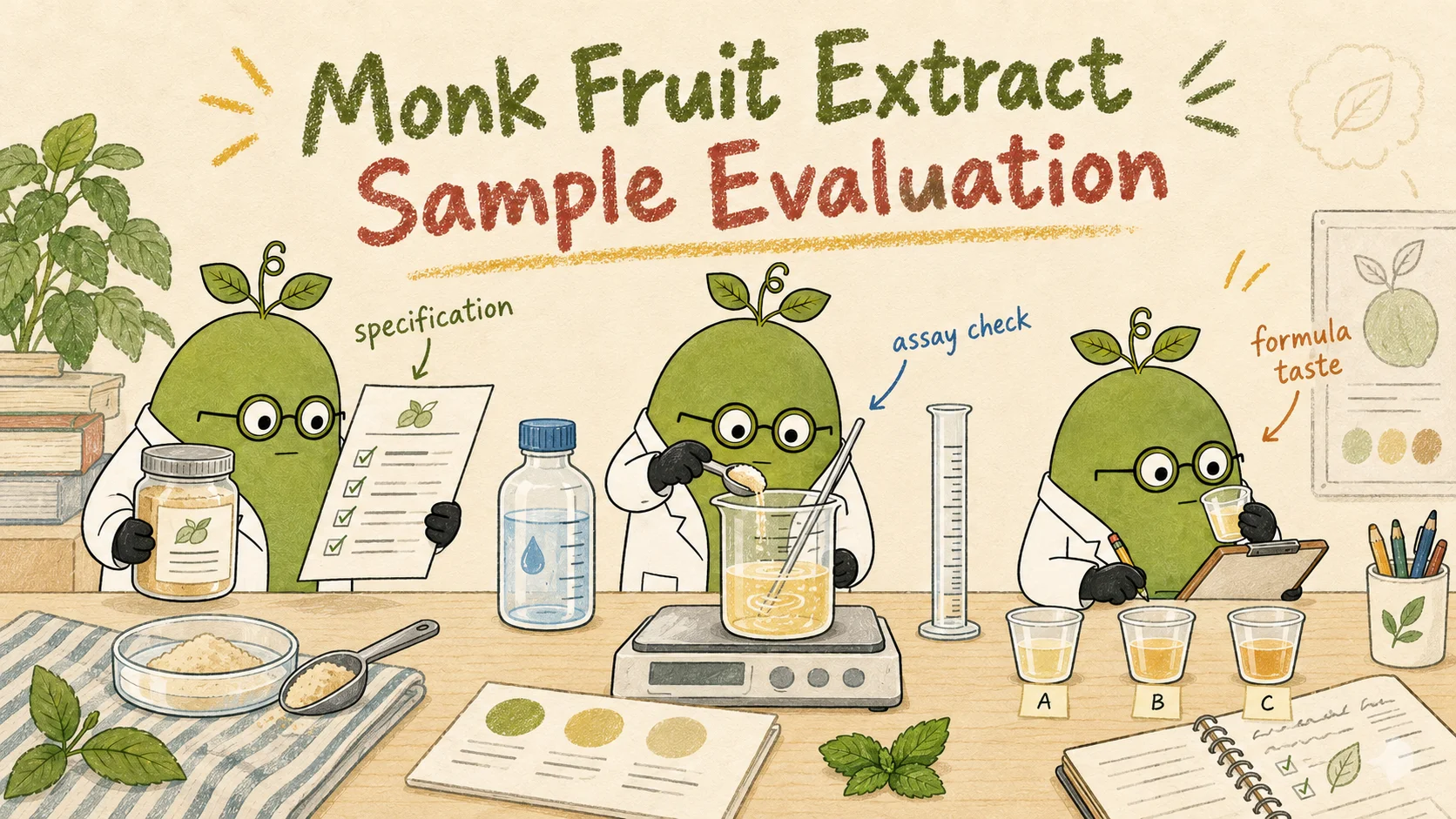
Specification checks, assay results and in-formula taste answer different selection questions. The illustration separates those tasks; its beaker and tasting cups do not depict an analytical assay method or supply measured results.
Start with the factory’s raw material requirements
Factories with an internal raw material standard can provide Hengliyuan with the required specifications and acceptance criteria. Sample evaluation should follow those requirements rather than relying only on the product name or a single assay value.
| Assessment area | Questions to confirm |
|---|---|
| Raw material identity and composition | Is it the required monk fruit extract, and does it contain a carrier or other ingredients? |
| Assay specification | Is the label for total mogrosides or mogroside V? What are the required value and the batch result for each? |
| Test basis | Do the test method, unit and assay basis match the factory's requirements? |
| Other quality indicators | Which required physicochemical, microbiological and contaminant items must be checked under the factory's raw material standard? |
| Application performance | Do sweetness, initial mouthfeel, aftertaste and overall flavor in the existing formula meet expectations? |
The specification sheet describes the agreed technical requirements, while the certificate of analysis (COA) for the relevant batch shows the test results for the listed items. Both documents should correspond to the sample received. If an item required for incoming acceptance is not included in the available documents, it should be discussed and confirmed first; missing data cannot be treated as proof of compliance. The required items, limits and test methods should follow the purchasing requirements and applicable standards confirmed by both parties. A generic set of specifications should not be applied directly to every customer.
Read the specific assay carefully; do not compare percentages alone
Total mogrosides and mogroside V are different specifications. Total mogrosides refer to the combined assay of multiple mogrosides measured under the applicable test basis, while mogroside V is one individual component. Therefore, total mogrosides at 50% and mogroside V at 50% are not the same specification and should not be compared directly on price. If the factory requires a mogroside V assay, select samples against that specification; if it requires total mogrosides, confirm the relevant test basis as well. Even when two samples show the same mogroside V assay, their other ingredients, quality specifications and taste may not be identical. Assay is one selection criterion; the complete specification and relevant batch documents must also be considered. Hengliyuan offers monk fruit extract in multiple specifications and can discuss customization according to the customer's requirements. A factory with a defined assay requirement can provide it directly; a factory still screening specifications can discuss the sample direction against its target formula.
Once the specifications fit, compare actual taste in the internal formula
For a factory with an existing formula, sample evaluation should focus on its own product. Tasting in water can be a preliminary observation, but suitability for the finished product must be confirmed in the original formula and process conditions. When helping customers select a product, Hengliyuan does not recommend choosing an extract based only on assay. Different specifications may differ in more than sweetness; their mouthfeel and aftertaste may also change. If the factory wants to replace the current raw material directly, it can first observe the change in sweetness and taste at the original addition level. If it wants to compare samples at the same target sweetness, it should find the appropriate addition level for each sample and then compare the initial mouthfeel, aftertaste and harmony with the original flavor. These comparisons answer different questions: the first asks whether the existing dosage can be retained; the second asks which sample best meets the product requirements after reaching the target sweetness. Clarify the purpose before testing so the result can support a formulation decision.
| Comparison purpose | What stays fixed | What the result can answer |
|---|---|---|
| Retain the current addition level | Keep extract addition by mass, final product basis, base formula, process and serving conditions the same. | Whether the new sample works at the existing dose; different sweetness is part of the result. |
| Compare at the same target sweetness | Keep the same reference and application conditions, then find and record each sample’s dose for that target. | How aftertaste, mouthfeel and flavor compare once the agreed sweetness is reached; the doses may differ. |
Keep the current sugar or ingredient control with each comparison and use coded samples where practical. Record the actual preparation, final product mass or dilution, process and serving temperature. If the samples have not reached the same target sweetness, report that difference before interpreting the aftertaste comparison. For a dose too small for the available balance, resolve the weighing method before drawing a taste conclusion. Use a suitable weighing procedure or an established stock-solution procedure with known extract concentration and mixing; record the stock addition separately from the extract it contains and account for the added liquid. A weighed stock solution is not the same mass of extract.
Match the sample, test documents and formula results
During internal evaluation, the factory should retain the sample number, batch, assay specification and corresponding test documents, and record the sample's actual addition level and taste conclusion in the formula. For example, one sample may meet the required specifications but leave an overly long sweetness in the existing formula; another may require a dosage adjustment but better match the target flavor. Record these results separately to decide whether to continue comparing raw material specifications or adjust the internal formula. A simple pass-or-fail record is often not enough to explain application differences. Sharing the specific specification and taste issues with Hengliyuan makes it easier to discuss the direction for the next sample round. Include the control result and the comparison purpose with the record. If the application sample passes, keep its lot identity and documents when discussing the proposed supply lot; a sample conclusion does not identify or approve an unspecified future batch.
Compare cost only among samples that meet the specification and taste requirements
Samples should enter price comparison only after meeting the factory's required quality specifications and application requirements. Then calculate cost from actual usage:
Extract cost per batch of finished product = actual addition (kg) × purchase price per kilogram.
If the original formula dosage must remain unchanged, compare quotations only among samples that meet that condition. If the addition level may be adjusted, compare the actual dosage required for each sample to reach the target taste.
This gives a cost result that corresponds to a solution the factory can actually use. Keep the same finished-product quantity and yield basis for the comparison, convert grams to kilograms for the formula above, and use quotations with the same currency, date and included delivery costs. This calculation is the extract ingredient cost; include any other changed ingredients or process costs separately when comparing the complete formula.
Request a sample with the requirements you already know
When requesting a sample, the factory can provide the required assay specification, key quality specifications, test requirements and target food or beverage application. If a raw material is already in use, it can also describe the current specification and the issue it hopes to improve. The customer can communicate the key evaluation criteria needed for sample selection, while the factory carries out application verification in its own formula and R&D process. Based on this information, Hengliyuan can discuss suitable sample specifications, supporting documents and customization feasibility. The factory can then select against specifications, assay and taste before confirming formal purchasing conditions. If the standard or formula is still being developed, start with the product type, target market and problem to solve. A complete proprietary formula is not required for the first discussion; sample specifications, documents and purchasing conditions are confirmed as the project becomes clear.
Common questions
How should factories test monk fruit extract samples?
Match the received sample, grade, composition, specification and batch documents first. Then state whether the test keeps the current dose or adjusts each sample to the same sweetness target. Run the comparison in the actual product and record the dose, control, process and serving conditions.
Discuss this requestAre equal weights the right basis for comparing samples?
They are useful when the question is whether the existing addition level can stay unchanged. They do not establish equal sweetness. For a comparison at the same sweetness target, determine and record each sample’s dose before comparing aftertaste, mouthfeel and flavor.
Discuss this requestCan total mogrosides content be converted to mogroside V?
Not with a universal conversion. Check the individual assay, method, reporting basis and identified batch result. Total mogrosides at 50% and Mogroside V at 50% are different specifications; the linked specification guide explains the distinction.
Discuss this requestWhat documents should come with the sample?
Request the matching product specification, composition or carrier declaration and relevant sample-batch COA, plus the current documents required for the purchase and destination market. Confirm missing acceptance items; absence of a result does not prove that the requirement is met.
Discuss this requestDoes an accepted sample establish the result of a bulk delivery?
No. Keep the evaluated sample code and lot with the result, agree the purchase specification and acceptance conditions, and check the proposed and incoming supply batch documents. Review a lot or material change before carrying the sample conclusion forward.
Discuss this requestHow do I compare sample cost when the doses differ?
Use the actual accepted extract dose for the same finished-product quantity, multiplied by its comparable price per kilogram. Convert mass units first and keep quotation terms consistent. Add other formula or process changes separately; lower price per kilogram alone does not establish lower cost in use.
Discuss this requestWhat should the first sample inquiry include?
Start with the product type, target market and issue you want to improve. Add the current grade or sample code, assay requirement, comparison purpose, process and document needs when known. Packaging, quantity and any undecided requirements can be clarified before sample or quotation confirmation.
Discuss this request