
Read this guide in
Formulas and Buying Guide
What Is Monk Fruit Sweetener? Extracts, Mogrosides, and Blends Explained
What is monk fruit sweetener? Extracts, mogrosides, five product forms, buying specs and target-market zero-sugar claim rules explained.
When comparing monk fruit specifications, keep Mogroside V, total mogrosides, Brix, the batch COA and the sample application as separate checks. Mogroside V is one assay indicator; total mogrosides is a broader reporting scope; Brix describes soluble solids in a liquid material and is not a substitute for either assay. Match those fields to the actual extract or concentrate before comparing suppliers.
Monk fruit sweetener does not correspond to a fixed product. When purchasing, you may encounter monk fruit whole fruit powder, juice concentrate, juice powder, standardized extract, or compound sugar that has been added with erythritol, allulose, steviol glycosides or other ingredients. Depending on the product identity, the sweetness, dosage, nutritional composition, label name and application method will change.
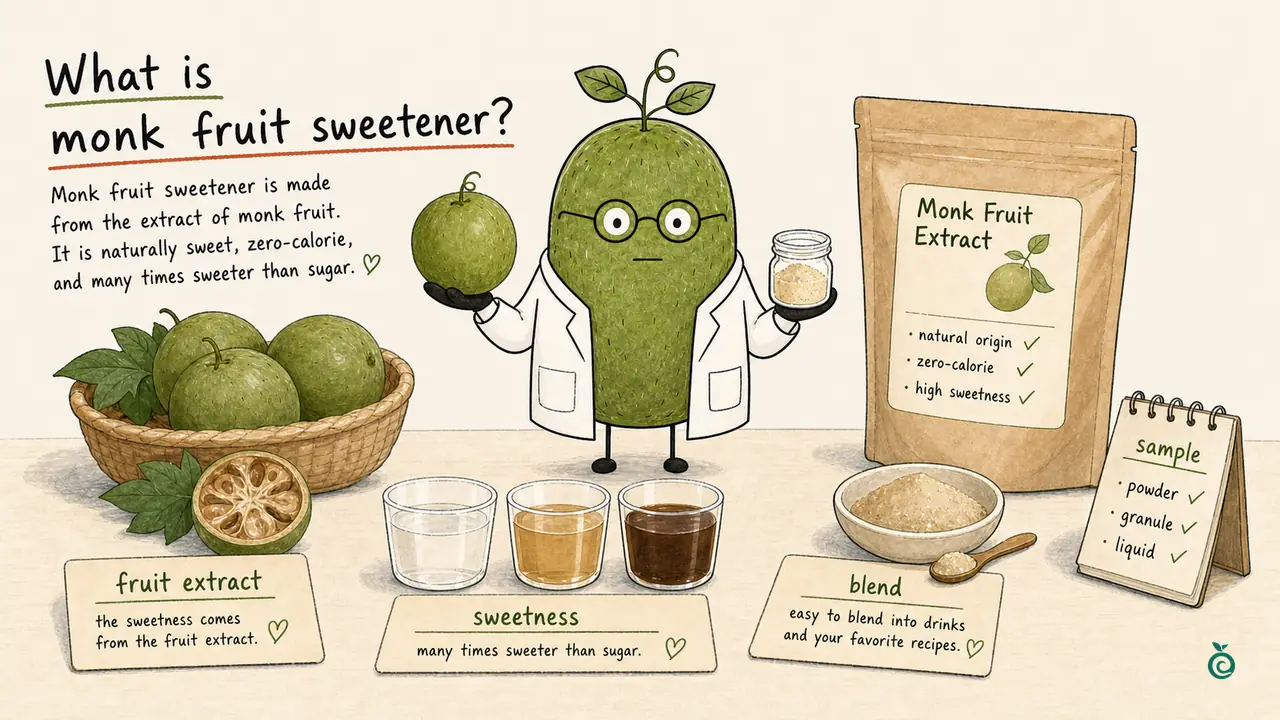
Where does the sweetness of monk fruit come from?
monk fruit contains a variety of mogrosides. According to the U.S. Food and Drug Administration, the sweetness of monk fruit extract mainly comes from these mogrosides. The specific sweetness will vary with the mogroside content, and the public range is about 100 to 250 times that of sucrose. The actual purchase still needs to check the assay basis, mogroside V content, other glycoside composition, carrier and complete ingredient list.
Five common product forms of monk fruit sweetener
Monk fruit sugar is often used as a broad name in marketing presentations. When requesting samples and quotations, the name should be reflected in the specific product form.
| Product form | What's inside the bag or container | Key points to confirm when purchasing | Common usage directions |
|---|---|---|---|
| Whole Monk Fruit Powder | The powder made from the whole monk fruit retains more of the fruit components. | Parts of the fruit used, processing methods, particle size, color, fruit flavor and dispersion | Powdered beverage mixes, prepared foods and products intended to retain the flavor of whole monk fruit |
| Monk Fruit Juice Concentrate | Clarified and concentrated monk fruit juice | Sugar content, solid content, sweetness index, sugar composition and storage conditions | Beverages, syrups and liquid foods |
| Monk fruit juice powder | Powder produced by drying monk fruit juice | Juice sources, carriers, complete ingredients, solubility and hygroscopicity | Powdered beverage mixes, premixes and powdered foods |
| Monk fruit extract or mogroside raw material | Concentrated raw material after extraction, purification and standardization of mogrosides | Mogroside V content, total mogroside assay basis, other ingredients, batch COA and recommended dosage | High-intensity sweetening in food and beverage formulations |
| Monk fruit blended sweetener | A blend of monk fruit sweetening ingredients with bulking agents or other sweeteners | Full ingredient list, relative sweetness, serving sizes, carriers, packaging and intended applications | Stick packs, tabletop sweeteners in containers, baking sweeteners and custom food formulations |
These five categories of products cannot be compared solely on the basis of price per kilogram. The dosage of high-intensity extract is low, and the compound sugar is also responsible for weighing, filling or taste adjustment. The purchaser should first determine the job to be done by the product and then compare the actual usage cost of a finished product or a production batch.
What data and conclusions are given in the public information?
| public information | key data | conclusions that can be drawn |
|---|---|---|
| US FDA Sweetener Instructions | The content of monk fruit extract varies, and the public sweetness is about 100 to 250 times that of sucrose. | monk fruit extract is a raw material with high sweetness, and the sweetness multiple will change with the specific specifications. When asking for samples, ask for specifications and batch COA, not just monk fruit sweetener. |
| US FDA GRAS Notice No. 627 Reply | The notice states that 65°Brix juice concentrate contains 3.5% mogroside V, 1.5% other glycosides, approximately 56% sugar and 35% water. | Juice concentrate and high-intensity extract are not the same raw material. Just because a product contains mogroside does not mean it is sugar-free |
| EFSA 2019 Assessment | Data records that mogroside accounts for about 0.55% to 0.65% in fresh fruits and about 2.5% in dried fruits; mogroside V is about 250 times that of sucrose. | Whole fruit, dried fruit and standardized extracts differ in mogroside concentration. That assessment found the available safety information insufficient for the proposed food-additive use, so an EU project must still verify the current regulatory status and the identity of the specific ingredient. |
The U.S. FDA public page uses specific monk fruit extract and GRAS notification conditions. A GRAS response does not equate to FDA's uniform approval of all monk fruit products, all uses, or all label names. Different countries and regions may also handle the identity of raw materials, scope of use, and label names differently, and export projects must be re-examined based on the target market.
Is it necessarily better if the content of mogroside V is high?
The mogroside V content is an important indicator to identify the specifications of the extract, but it cannot independently determine whether the product is suitable for a certain food. Customers also need to look at the total mogroside assay basis, other sweetening composition, carrier, color, solubility and actual aftertaste. Putting the same specification into different base formula will result in different results. Acidity, flavor, minerals, protein and processing conditions can all change the rate of sweetness and the aftertaste. Aqueous solutions can be used for preliminary screening of raw materials, and the final samples still need to be put into real food or beverages for testing.
How to choose product form according to application
| Project needs | Directions that can be prioritized for discussion | Questions that need to be answered by the sample |
|---|---|---|
| Add extra sweetness to existing food or beverages | Monk fruit extract or mogroside raw material | Which specification can achieve the target sweetness, aftertaste and dissolution performance? |
| Hope to keep juice or monk fruit flavor direction | Juice concentrate or juice powder | Does sugar, solids, color and fruity flavors match the complete recipe? |
| Requires one scoop, one packet or fixed grams for direct use | Monk fruit blended sweetener | Can the sweetness, weighing method, taste and packaging instructions of each serving be consistent? |
| For baking and requiring volume or structure | blended sweetener with main raw materials | In addition to sweetness, how does the batter or dough structure, coloring, moisturizing and taste of the finished product change? |
| For drink powders or powdered foods | Extract, juice powder or custom blend directions | Whether dispersion, dissolution, moisture absorption, aftertaste and batch mixing meet the requirements |
Baking, stick packs and beverage powders require different product roles. high-intensity monk fruit extract mainly provides sweetness and cannot replace the volume, solids and structure brought by white sugar by weight. When direct weighing or one serving per pack is required, blended products are usually more convenient to design dosage, but the complete ingredients and application results still need to be confirmed item by item.
How should Mogroside V, total mogrosides and Brix be checked in a purchase discussion?
Start by confirming the material identity: extract, juice concentrate, juice powder or a blend. Then ask which test method and reporting basis are used for Mogroside V and total mogrosides, whether Brix applies to the liquid material, and whether the figures belong to the same batch and product version. A public specification can explain the terms, but it cannot establish Hengliyuan's current grade or batch result. For a sample, compare the requested document fields with the actual beverage, bakery or other application rather than selecting on one percentage alone.
Which monk fruit raw material should be chosen for zero sugar or low-calorie projects?
When products plan to use zero sugar, zero-calorie or low-calorie claims, testing of standardized high-intensity monk fruit extract or mogroside allowed by the target market can be prioritized. This type of raw material has high sweetness, low dosage in the formula, and usually brings less sugar and energy to the finished product. It is easier to control nutritional indicators than juice concentrates, juice powders or blended sweeteners containing a large number of carriers. What we are talking about here is reducing the impact and cannot be understood as automatically reaching the standard. The purchaser still needs to check the mogroside V content, total mogroside content, residual sugar, carrier and recommended addition amount, and then put this data into the complete formula calculation. After the formula is determined, the nutritional data of the finished product must be used to confirm whether relevant claims can be used based on the requirements of the target market.
How do the main target markets judge zero sugar and zero-calories?
Each market is usually reviewed in two steps. The first step is to confirm whether the specific monk fruit raw materials and uses are approved. The second step is to determine whether the final product's formula, nutritional data and labeling unit meet the claim threshold.
| target market | Is it allowed to use high-intensity extract of monk fruit? | Zero sugar claim | zero-calorie or zero-calorie claim |
|---|---|---|---|
| China | Allowed. GB 2760-2024 includes "mogroside", CNS number 19.015; in addition to the food categories listed in Table A.2, it can be used in appropriate amounts in various foods according to production needs | Finished product sugar ≤0.5g/100g or 100ml, can be claimed as "sugar-free" or "sugar-free" | The energy of the finished product is ≤17 kJ/100g or 100ml, and it can be claimed as "no energy" |
| United States | Conditions permit. FDA does not dispute the conclusions in multiple GRAS notifications for monk fruit extract, but it should comply with the raw material specifications and intended uses stated in the corresponding notifications. | If sugar is less than 0.5g per reference serving size and per labeled serving, claims such as "sugar-free" can be used | If the calories per reference serving size and labeled portion are less than 5 kcal, you can use claims such as "Calorie free" |
| Canada | Restrictions allowed. Currently only tabletop sweeteners are allowed, up to 8,000 ppm, based on mogroside V | Sugar <0.5g per reference amount and per labeled serving; except chewing gum, must also meet low energy conditions | If the calories per reference amount and per labeled serving are less than 5 kcal or 21 kJ, you can use claims such as "Calorie-free" |
| Australia and New Zealand | Allowed. FSANZ has approved Monk Fruit Extract for use as a high-intensity sweetener | "Free" must meet local low sugar conditions, liquid ≤2.5g/100ml, solid ≤5g/100g | There is no "zero heat" condition that can be directly applied to the current Schedule 4; "Low energy" can be evaluated, liquid ≤ 80 kJ/100 ml, solid ≤ 170 kJ/100 g |
China and the United States can each assess zero sugar, zero energy or zero-calorie claims on a threshold basis. Canada also has both types of claims, but monk fruit extract is currently only allowed for tabletop sweetener use. Australia and New Zealand can evaluate sugar-free according to local standards. Energy claims should use the local low energy rules and cannot be written directly as zero-calorie. The China claim threshold in this article adopts the currently valid GB 28050-2011. GB 28050-2025 will be implemented on March 16, 2027. Products planned to be launched after this date should have their labels re-examined according to the new standards. This table only illustrates the judgment paths of several major target markets, and is not a global access list. The EU also needs to distinguish between traditional decoctions and selectively purified, highly sweet monk fruit extracts. The "not new food" conclusion in 2024 only applies to monk fruit water decoction that does not selectively extract sweeteners. It cannot be used to conclude that the high-intensity extract has been approved as a sweetener. Please also look at specific samples when purchasing. The dosage of high-intensity extract itself is very low, but the juice concentrate may contain natural sugars; erythritol, psicose, maltodextrin or other carriers in blended sweeteners will also change the nutritional calculation and labeling results. Suppliers can provide raw material identity, specifications and testing data, but brands still need to review the final formula and finished product labels according to the target market.
What information should I prepare before requesting samples?
- Target markets and product categories -Would you like to purchase extracts, juice raw materials or blended sweeteners? - Existing formula, sugar dosage or control sample - Amount of product per serving, preparation method or processing conditions - Target sweetness and aftertaste issues that need to be solved - Packaging specifications, estimated quantities and required documents When customers are temporarily unsure of the product form, they can first provide real applications and usage methods. Suppliers can use this to determine whether to start with extract specifications, juice directions or blending plans, and then arrange sample testing with clear questions. - Learn about Hengliyuan raw material of monk fruit extract and mogrosides - Compare monk fruit extract and blended sweeteners - View Mogroside V Specifications and Sample Requirements Guide - Submit monk fruit sweetener sample and quotation requirements
Source
- US FDA instructions on monk fruit extract and other sweeteners - US FDA GRAS Notice No. 627 Reply - U.S. FDA compliance statement regarding sugar-free claims - List of approved sweeteners in Canada - Canadian Nutrition Facts Content Claim Conditions Table - Food Standards Australia and New Zealand Monk Fruit Extract Application and Approval Information - Australia and New Zealand Food Standards Schedule 4 Nutrition, Health and Related Claims - Announcement of the National Health Commission of China on the release of GB 2760-2024 - China GB 28050-2011 General principles for nutrition labeling of prepackaged foods - National Health Commission of China's explanation on the implementation date of GB 28050-2025 - EU Member States' conclusions on the new food status of monk fruit decoction - EFSA evaluation of monk fruit extract
- US FDA instructions on monk fruit extract and other sweeteners
- US FDA GRAS Notice No. 627 Reply
- U.S. FDA Compliance Statement Regarding sugar-free Claims
- List of Approved Sweeteners in Canada
- Canadian Nutrition Facts Content Claim Conditions Table
- Food Standards Australia and New Zealand Monk Fruit Extract Application and Approval Information
- Australia and New Zealand Food Standards Schedule 4 Nutrition, Health and Related Claims
- Announcement of the National Health Commission of China on the release of GB 2760-2024
- China GB 28050-2011 General principles for nutrition labeling of prepackaged foods
- Note from the National Health Commission of China on the implementation date of GB 28050-2025
- Conclusions of EU Member States on the new food status of monk fruit decoction
- EFSA evaluation of monk fruit extract
Review note
Reviewed October 2, 2026.
Common questions
What is monk fruit candy?
Monk fruit sugar is often used to refer to raw materials or products that use monk fruit to provide sweetness. It could be monk fruit extract, mogroside, juice concentrate, juice powder or compound sugar. Continue to confirm specific product identity and complete ingredients when purchasing.
Are monk fruit sweetener and monk fruit extract the same thing?
Some suppliers mix the two, but monk fruit sweeteners have a wider range. Monk fruit extract usually refers to concentrated raw materials that have been extracted and standardized, and the finished sugar compound also contains other main raw materials or sweeteners.
The higher the content of mogroside V, the lower the dosage?
The sweetness V content will affect the sweetness direction, but the actual addition amount is also affected by the total sweetness composition, target sweetness, carrier and food base. Candidate sizes should be compared in the same base formula and not converted by just a percentage.
Is it okay to only write monk fruit sweetener when applying for samples?
It can be used as the category name for the first consultation, but the application, target market, product form, packaging, quantity and main test issues need to be supplemented. Only after the information is complete can the samples and quotations be compared.
Does Brix tell me the Mogroside V content?
No. Brix is a soluble-solids reading used for a liquid material, while Mogroside V and total mogrosides are reported assay fields. Confirm the material identity, test basis and batch COA together before using the figures for supplier comparison.
