Read this guide in
Buyer questions
Monk Fruit Powder vs. Juice Powder vs. Extract
Monk fruit whole fruit powder vs juice powder vs extract: processing, composition and buying specifications compared side by side.
The fundamental difference is what processing retains: whole fruit powder is made by directly grinding whole monk fruit; juice powder is made by concentrating and drying monk fruit juice; extracts specified by mogroside content focus on extracting and preparing mogroside ingredients at a target content level.
Accordingly, whole fruit powder purchasing focuses on milling and powder specifications; juice powder on juice source, composition and carriers; and extract on mogroside V or total-mogrosides content and processing. All three can be powders, but they are not the same product.
Start with the differences between the three products
| Comparison | Whole fruit powder | Juice powder | Monk fruit extract |
|---|---|---|---|
| How it is made | Whole fruit is ground directly | Juice is concentrated and dried | Extraction, followed by concentration, separation or purification as appropriate to the product |
| Composition | Retains the whole fruit material that is ground, including its insoluble fraction | Retains constituents that enter the juice and remain after subsequent processing; includes the carrier if one is used | Focuses on mogroside composition and content; other constituents vary with processing and specification |
| Purchasing priorities | Raw material treatment, particle size or mesh, moisture, impurities and powder behavior | Full ingredients, carrier type and proportion, moisture, reconstitution behavior and mogroside parameters | Whether the specified measure is mogroside V or total mogrosides, its content, analytical method, carrier and process |
| What to check in liquids | Particles, dispersion, sediment and whether filtration is needed | Dissolution or dispersion, cloudiness, sediment and actual flavor | Solubility of the selected grade, sweetness and aftertaste, and compatibility with the formulation |
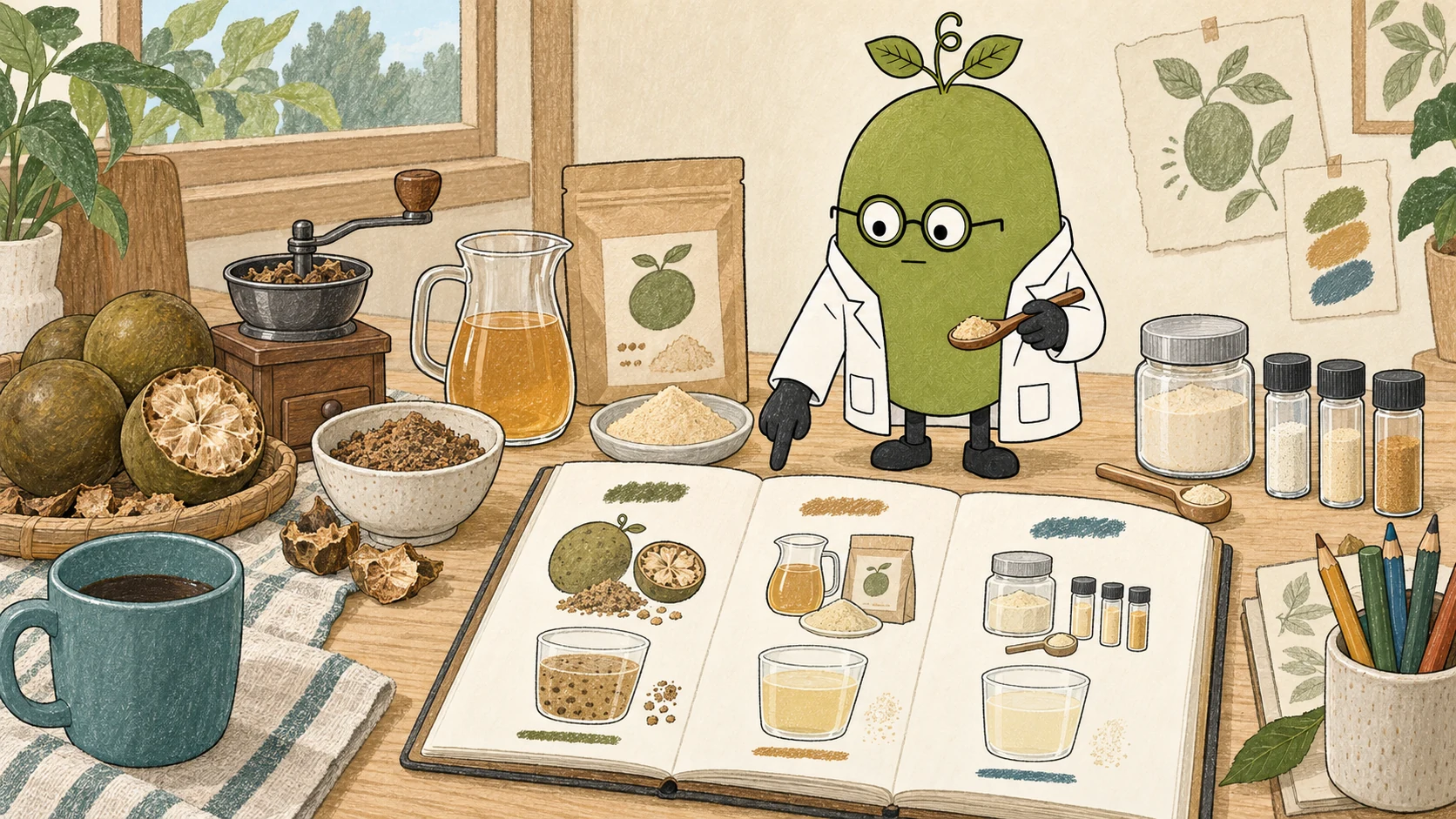
Whole fruit powder: what is ground, and how finely?
Hengliyuan’s whole fruit powder is made by directly grinding whole monk fruit. Grinding changes particle size; it does not isolate the mogrosides. Whole fruit powder therefore retains other ground fruit material as well as mogrosides. Being finely milled does not make it a fully water-soluble extract. Particle size or mesh is an important purchasing parameter: it describes how finely the powder is milled, not its mogroside content. Also confirm treatment of the original fruit, moisture, impurity controls, and particle feel, dispersion and sediment in actual use. If the application requires filtration, evaluate performance after filtration as well.
Juice powder: which juice, and is there a carrier?
Hengliyuan’s juice powder is made by concentrating and drying monk fruit juice. Unlike whole fruit powder, the material entering drying is juice, rather than directly ground whole fruit. Its composition depends on juice preparation and subsequent processing. If a carrier such as maltodextrin is used during drying, it forms part of the final powder. However, do not assume that all juice powders contain carriers. For purchasing, confirm the full ingredients, whether a carrier is used and its proportion, then compare mogroside content, moisture, color and reconstitution behavior. For two juice powders of equal weight, different carrier proportions or juice compositions mean that price per kilogram alone cannot identify the better fit. Brix is used to describe relevant specifications of liquid juice or concentrate; it cannot be treated directly as mogroside V content. When buying finished juice powder, distinguish liquid-stage parameters from those of the final powder.
Extract: what is extracted, and at what content level?
Monk fruit extracts specified by mogroside content focus on the composition and content of the mogroside ingredient. Individual products may involve extraction, concentration, separation or purification; “water-extracted” alone does not describe the complete process. First establish whether the label refers to mogroside V or total mogrosides. Mogroside V is only one of the total mogrosides, so “50% total mogrosides” and “50% mogroside V” are different specifications. Hengliyuan’s extract product page lists a 50% mogroside V sample reference and a 20%–60% range for content requests; customization can also be discussed. Changes in content affect taste as well as sweetness, so selection should consider the actual application. If a customer has explicit restrictions on resins, solvents or selective membrane separation, check the complete process from fruit to final ingredient. A high-content extract cannot simply replace the non-selective water-extracted juice ingredient the customer requires.
Why can the three powders not be exchanged at equal weights?
One kilogram each of whole fruit powder, juice powder and extract may contain different fruit materials, carriers and mogroside compositions. Equal powder weight does not mean equal mogroside content, sweetness or taste. Even when two products have the same mogroside V content, other constituents and physical behavior may differ. For example, an application that needs whole fruit material has different selection criteria from one that prioritizes reconstitution in liquids. When changing product categories, reconfirm dosage and actual performance rather than replacing the original ingredient at the same weight.
How does Hengliyuan help with selection?
Start with whole fruit powder if you need directly ground whole fruit; juice powder if you need concentrated, dried juice; or extract if you select a sweetening ingredient by mogroside V or total-mogrosides content. If you are unsure, you do not need to give us only the name “monk fruit powder.” Tell Hengliyuan what product you plan to make, how it will be processed, and your taste, particle or reconstitution requirements. We can help compare specifications and samples before confirming a supply proposal. For UAE and other cross-border projects, keep the buyer location, ship-to destination and final sales market separate. The name “monk fruit powder” alone cannot identify whole-fruit material, juice-derived powder, extract or a prepared blend. State the product form if known, or describe the application and ask the supplier to identify the offered material. A buyer’s location does not settle the final-market label or ingredient-review route. You can begin before every specification is settled. As the discussion develops, add the buyer location, ship-to destination, final sales market, intended form or undecided status, application and process, ingredient or carrier restrictions, estimated quantity, pack, document requirements and sample needs. Match the complete ingredient statement, selected specification and available batch COA or TDS to the material offered before confirming the purchasing basis.
Common questions
Can a Mogroside V percentage identify which powder I am buying?
A percentage alone does not establish whether a material is directly milled fruit, juice-derived powder or an extract. Confirm the actual process, full ingredients, named analyte and reporting basis with the offered specification and batch documents.
Discuss this requestDoes water extraction mean the full process is non-selective?
The words water-extracted do not describe all later steps. If your brief restricts resins, solvents or selective separation, ask for the complete process from fruit to final material. Match that process to the required ingredient rather than assuming equivalence from the extraction solvent.
Discuss this requestDoes Brix establish the Mogroside V content of a powder?
No. Brix is a liquid soluble-solids reading, while Mogroside V is an assay field. Keep liquid-stage information separate from the specification of the final powder and check the relevant methods and reporting bases.
Discuss this requestAre juice powders always made with a carrier?
Do not assume that they are. Confirm the full ingredients and whether a carrier is used, including its identity and proportion where relevant. Compare the actual supplied specification and reconstitution behavior.
Discuss this requestCan the three materials be compared by price per kilogram?
First match the product role, identity, composition and tested use level in the intended application. Equal powder weight does not establish equal sweetness, taste, solids or physical behavior. Keep the selected specification and quotation scope with the comparison.
Discuss this requestCan I discuss samples before selecting a form?
Yes. Start with the product, process, final sales market and the taste or reconstitution question. Buyer location and ship-to destination are useful separate details; the remaining specification, packaging, quantity and document requirements can be clarified as the project develops.
Discuss this request