Read this guide in
Liquid ingredients
Monk Fruit Juice Concentrate: Specifications, Batch Data, and Storage
Choose a liquid monk fruit concentrate by composition, Brix, mogroside V, flavor and batch COA. Compare real supplier formats, trial methods, storage and cost in use.
Monk fruit juice concentrate is a liquid ingredient that contributes sweetness and, depending on its grade, fruit flavor and color. Choose it by the complete composition, named mogroside V assay, Brix, appearance and performance in the intended beverage. It is different from a high-purity extract, a dried juice powder or a retail dropper blend, and the name alone does not establish a sugar-free ingredient.
One confirmed batch of Hengliyuan's LHX-N02 concentrate had a Brix reading of 56.84 °Bx and mogroside V content of 2.86%. Both figures can be correct: the first is a refractometric concentration reading, the second is mogroside V measured by HPLC. A reading of 56.84 °Bx does not mean 56.84% mogroside V or sweetness 56.84 times that of sucrose.
Colour and appearance are application observations, while instrument readings must retain their measurement conditions. The illustration contrasts dark and pale samples beside a refractometer and pH meter; it supplies no measured comparison or colour specification.

What are you buying: concentrate, extract, juice powder or drops?
The same search can return several different products. Identify the supplied material before comparing sweetness, price or dose. A liquid concentrate may retain substantial fruit sugars and other soluble components; a purified extract can have a very different composition. The manufacturing description and ingredient declaration resolve more than the words “pure monk fruit” on a sales page.
| Format | What the name establishes | What the comparison still needs |
|---|---|---|
| Liquid juice concentrate | A concentrated liquid derived from monk fruit | Full composition, Brix, named mogroside assay and basis, color, flavor, density if dosing by volume, and storage. |
| High-purity monk fruit extract | A more concentrated extract specification, often supplied as powder | Actual mogroside V and total-mogrosides results, process, carriers if any and intended-use documentation. Its dose is not interchangeable with juice concentrate. |
| Juice concentrate powder | A dried form of a juice ingredient | Juice solids, carrier declaration, moisture, assay basis, dispersibility and the amount of supplied powder used. “Concentrate” in the name does not make it liquid. |
| Retail liquid sweetener or syrup blend | A consumer dosing format | Every ingredient, supplied concentration and serving basis. Water, acids, other sweeteners or flavors may be present. A drop count is not an industrial dose unit. |
For a beverage with an existing liquid handling system, concentrate can be a candidate. For a dry sachet or instant mix, compare a suitable dry material and its reconstitution behavior. These are selection questions, not evidence that one physical form is always better.
Choose a flavour or decolorized concentrate first
Hengliyuan offers monk fruit flavour juice concentrate and decolorized monk fruit juice concentrate as two product options. If retaining monk fruit flavour matters, start by evaluating the flavour concentrate. If the finished drink has a colour target, ask about the decolorized concentrate and test its appearance in the actual formula. Share the beverage base, desired flavour, colour target and processing conditions when requesting samples. Decolorized does not mean colourless or flavourless; neither product name establishes sweetness or dosage. Confirm specifications, packaging and batch documents for the selected product. The LHX-N02 batch figures below explain how to read that model's report. They are not specifications for either product linked here.
Three commercial examples show why the format matters
These public supplier examples illustrate different buying tasks. They are not Hengliyuan customers, independent taste trials or equivalent products in a price comparison. Read the current specification and supplied lot before relying on a listing.
- Monk Fruit Corp original liquid-concentrate page
- Icon Foods item 1519 technical document and COA template
- Jedwards original organic-concentrate listing and document workflow
| Public example | What its own page or document says | What a buyer can learn |
|---|---|---|
| Monk Fruit Corp liquid juice concentrate | The manufacturer describes an approximate sweetness of 15–20 times sugar and separates concentrate from its extract and decoction products. | The supplier’s relative-sweetness description belongs to its material; it does not set the sweetness or dose of every concentrate. |
| Icon Foods Juice Concentrate Powder V3.5, item 1519 | Its May 4, 2026 technical document specifies fine powder, mogroside V 3.3–3.7% and loss on drying no more than 5.0%. | A similar mogroside number can refer to a different physical form and reporting context. The document includes a COA template with placeholder dates, not the results of a supplied lot. |
| Jedwards organic concentrate G1260 | The listing offers a 10 kg bag and separates certificates and SDS access from the lot-specific COA supplied with shipment notification. | Pack size, document access and COA timing are part of procurement. Agree when the selected-lot COA is needed; a certificate or SDS is not that COA. |
The observed pack sizes and document workflows belong to those sellers, not to Hengliyuan. We do not use their stock, prices, shelf-life claims or certifications as evidence for our supply. Ask for the selected Hengliyuan product option, packaging and actual batch documents.
A juice concentrate can contain both sugars and mogrosides
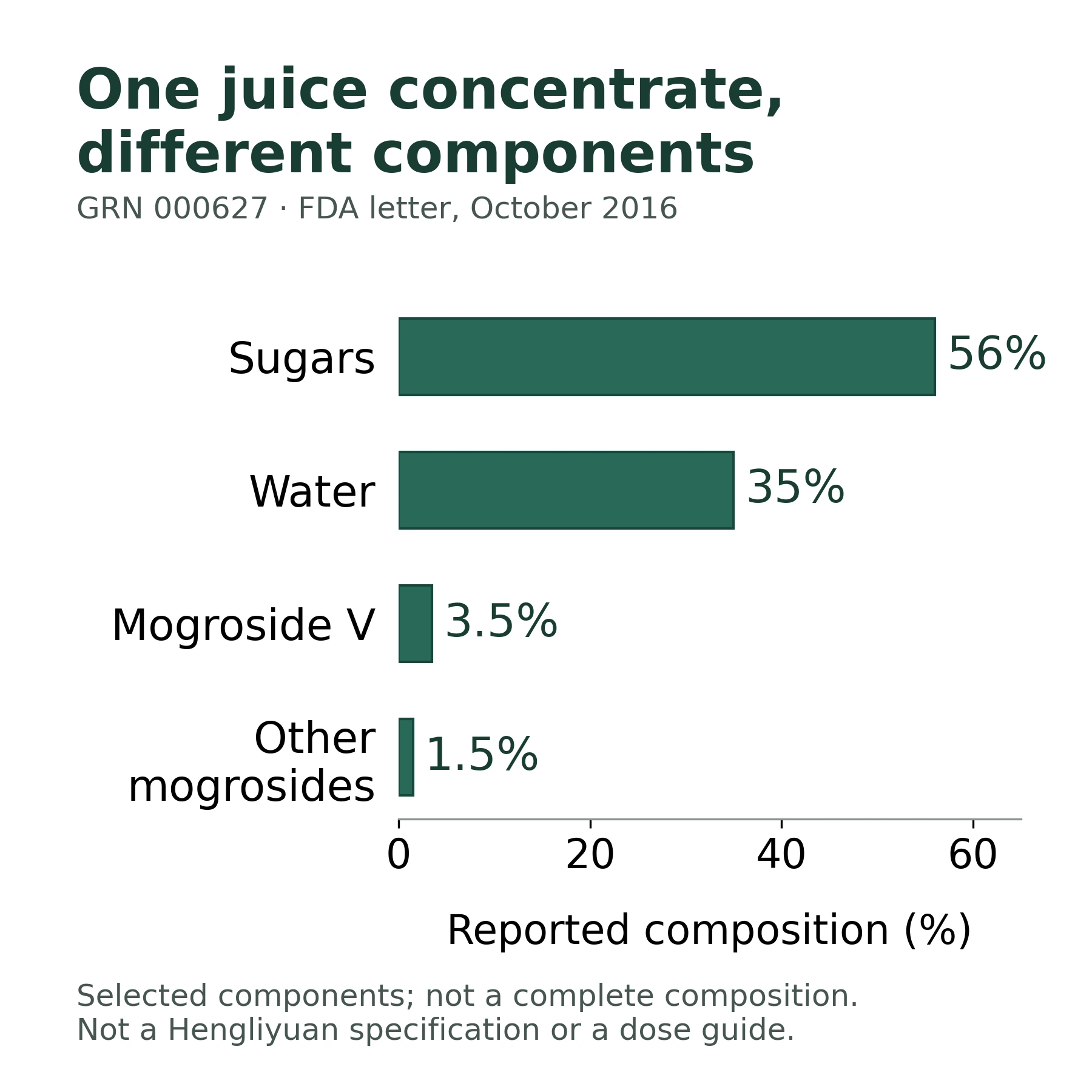
The FDA response to GRN 000627, dated October 11, 2016, describes one other company’s liquid juice concentrate at approximately 65 Brix. It records 56% sugars, 35% water, 3.5% mogroside V and 1.5% other mogrosides, along with smaller amounts of other constituents. This historical composition is useful evidence that a juice concentrate and a purified sweet extract are not interchangeable identities. It is not the composition of Hengliyuan’s LHX-N02 or a specification for our two product options. For this notice material, the manufacturer described water extraction, clarification and ion-exchange steps. The accompanying notice distinguishes this route from selectively retaining and eluting mogrosides to make a powdered extract. That distinction also shows why neither “made from juice” nor “uses resin” alone is a sufficient description of what remains in the ingredient. Obtain the selected manufacturer’s actual process and composition.
- FDA original response: GRN 000627 composition and process
- Original GRN 000627 notice, identity and composition tables
Reading a specification sheet through batch data
These data concern LHX-N02 concentrate, batch LHX-N02-26040601, reported on 11 April 2026. The specification column gives the requirements in that document; the result column gives this batch's test results. They do not mean every batch will have identical values.
| Test | Specification in the product document | Result for this batch | Interpretation |
|---|---|---|---|
| Mogroside V, HPLC | <3.0% | 2.86% | Content of the individual component mogroside V, not total mogrosides |
| Brix | 55.0–60.0 °Bx | 56.84 °Bx | Refractometric concentration reading; does not replace mogroside V testing or sweetness evaluation |
| pH | 4.5–5.5 | 5.16 | A test value for the ingredient, not the formulated beverage's pH |
| Turbidity, 0.5% solution | ≤20.0 NTU | 0.302 NTU | Measured in a 0.5% solution; must not be reported as undiluted concentrate turbidity |
| Total plate count | ≤100 CFU/mL | <10 CFU/mL | Keep the result as less than 10, not zero |
| Yeasts and moulds | ≤20 CFU/mL | <10 CFU/mL | Report the stated result; it does not mean sterile |
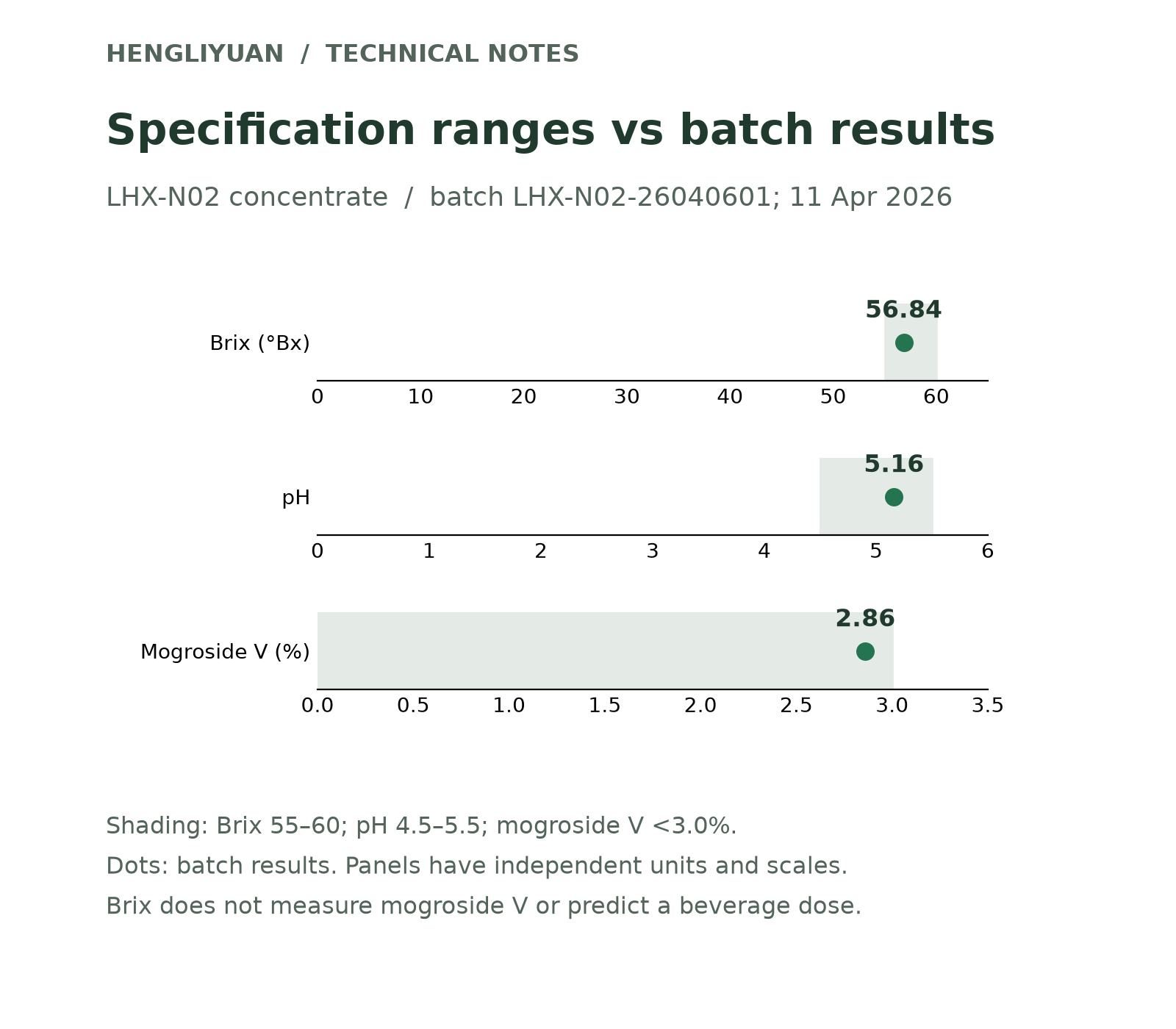
This also shows the difference between a specification range and a batch result. The Brix specification is 55.0–60.0 °Bx; this batch measured 56.84 °Bx. Check both the agreed range and the actual supplied batch's result.
Brix, mogroside V and total mogrosides are different measures
Brix is a liquid ingredient's concentration reading. Mogroside V content measures a specific component, while total mogrosides is the sum of the mogrosides included in the test. Here, 2.86% specifically refers to mogroside V, not 2.86% total mogrosides. Brix of 56.84 °Bx alone cannot establish total mogrosides or beverage dosage. List these measures separately when comparing concentrates. Ask the supplier for missing results rather than substituting another measure. For another supplier report, keep the product code, batch, method, unit and reporting basis with each result. Ask for the relevant temperature, sample preparation and dilution conditions before treating two readings as comparable. A similar Brix figure does not establish the same composition, flavour or accepted dose.
Calculate ingredient mass, assay delivery and beverage dose separately
Record the addition as grams of the supplied concentrate per kilogram of final beverage, or as a clearly defined mass percentage. Keep a prepared stock solution separate from the concentrate itself. If production meters the liquid by volume, obtain density at the relevant temperature rather than assuming one milliliter weighs one gram. As an arithmetic example only, suppose a 10 kg final trial contains 20 g of the LHX-N02 example batch at 2.86% mogroside V on a mass basis. The concentrate addition is 2 g/kg, or 0.20% by mass. The mogroside V delivered is 20 g × 0.0286 = 0.572 g, corresponding to 57.2 mg/kg of final beverage. These numbers describe mass accounting, not a recommended dose, a sweetness match or a regulatory limit. Keep the final trial mass at 10 kg by accounting for the ingredient and any stock-preparation water in the recipe. Replacing sugar also changes the mass and composition of the surrounding system. A nominal relative-sweetness factor can help choose an initial comparison, but it cannot establish the accepted use level across tea, acidic juice and dairy bases.
| Reported number | What it answers | What it cannot answer alone |
|---|---|---|
| Brix of the concentrate | How the sample reads under the refractometric method and conditions | Its individual sugar composition, mogroside V content or accepted sweetness dose. |
| Mogroside V mass delivered | How much of the measured component enters the final batch, using a confirmed basis | Total mogrosides, perceived sweetness, aroma, finished sugar content or legal claim. |
| Concentrate dose in g/kg final product | How much supplied ingredient the recipe uses | Whether a different grade or a powder will perform the same. |
| Delivered cost per accepted batch | What the trial-confirmed ingredient quantity costs on a consistent price basis | Whether the formula passes processing, sensory, safety or shelf-life requirements. |
Read turbidity and appearance together with test conditions
The turbidity here is 0.302 NTU, but the tested material was a 0.5% solution. Omitting that condition would misrepresent a diluted sample's behaviour as that of undiluted concentrate. An ingredient's result under specified test conditions does not guarantee the same behaviour in tea infusions, juice drinks or other formulations. Use the intended base and dosage, observing colour, cloudiness and visible sediment. For a new report, confirm what its dilution percentage means and how the test sample was prepared. Keep observations of the supplied concentrate separate from measurements on a diluted sample; record the actual preparation when checking appearance in the finished drink.
Match the trial to the beverage and its process
Use the current beverage as the reference, plus an unsweetened base where practical to distinguish base flavor from sweetener finish. Screen clearly identified concentrate candidates at recorded additions, then compare accepted sweetness in the same final batch mass. Equal ingredient dose and matched sweetness answer different questions; record which comparison you are making.
| Application | Observe in the actual base | Include in the comparison |
|---|---|---|
| Tea, coffee or botanical drink | Desired fruit note, bitterness, lingering sweetness and color | The same infusion strength, dilution water, serving temperature and process; decide whether the fruit character is helpful. |
| Clear acidic or carbonated beverage | Clarity, haze, sediment, acid balance and sweetness finish | Selected color grade, actual pH and acid system, carbonation where relevant, heat/package history and storage observations. |
| Dairy or plant-based drink | Sweetness timing, color and interaction with the complete base | The same protein, fat, stabilizers and homogenization/heat process; an ingredient assay does not prove physical stability. |
| Juice drink or syrup | Fruit balance, total recipe sugars, dilution and body | Final serving dilution and complete recipe; evaluate composition and finished claims separately. |
Use coded samples and the same serving conditions when comparing taste. Record immediate sweetness, finish, fruit aroma, color and visible change separately. A preferred fresh cup still needs the relevant pilot process, package and storage work; appearance after a short hold is not a microbial-safety or shelf-life validation.
An application demonstration shows the rest of the system
NutraEx publishes a chocolate-milk demonstration containing partly skimmed milk, cocoa powder, erythritol, its NFI-0118 monk fruit juice concentrate and carrageenan. It labels the nutrition information as calculated. The ingredient list is useful because it makes the surrounding dairy, bulk-sweetener and stabilizing system visible; it is not evidence that juice concentrate alone produced the claimed taste or texture. The public page does not provide a complete reproducible ratio, a controlled sensory comparison or shelf-life results. Treat it as a supplier application illustration, not an independent experiment or a Hengliyuan case. Its “No Sugar Added” wording does not approve the claim for another concentrate, recipe or market. In your own trial, retain the complete formula and compare what changes when the concentrate changes.
Check intended use and labeling for the actual material
For a US project, the response to GRN 000627 concerns the notifier’s identified concentrate and described intended uses. FDA stated that it had no questions at that time about the notifier’s GRAS conclusion, while making no independent GRAS determination. The letter also expressly says its use of the ingredient name is not an endorsement of that wording for a finished-food ingredient statement. The letter reports usual additions of 0.25–0.50% and about 1% maximum for that notice material, with use limited by sensory properties and current good manufacturing practice. Those reported intended-use figures are not a universal recommended recipe or a legal limit for every concentrate. They also differ from broad ranges on other supplier pages. Resolve identity, process, specification and intended use before transferring either set of figures. A concentrate’s natural sugars, a tiny retail serving rounded to zero and the composition of a purified extract are different matters. Obtain the selected ingredient’s composition and apply the relevant finished-product labeling rules to the complete recipe and serving. “Monk fruit,” “organic” and a GRAS reference do not by themselves establish sugar-free, no-added-sugar, zero-calorie or an approved ingredient name. Review other destination markets separately rather than carrying a US conclusion across borders.
Comparing concentrate and juice powder costs in use
Concentrate is liquid; juice powder is dried, and whether it contains a carrier must also be confirmed. Equal purchase weights do not imply equal monk fruit content or practical performance. First bring both options to the same beverage target, then record actual dosages: Ingredient cost per beverage batch = delivered unit price (CNY/kg) × actual quantity used (kg). Use quantities confirmed in trials, rather than calculations based only on Brix or mogroside V percentage. Compare fruit aroma, aftertaste, colour and production handling as well as sweetness. Keep the same final beverage quantity and accepted comparison target, and record concentrate or powder mass separately from any prepared stock liquid. For a quotation in another currency, use that currency consistently for both options; do not mix prices with different delivery-cost coverage. Include any carrier, added water and changed handling steps in the wider formulation comparison. For illustration only, if two accepted trials for the same 1,000 kg final beverage use 2 kg at USD 30/kg and 3 kg at USD 24/kg, their concentrate costs are USD 60 and USD 72 respectively, or USD 0.060 and USD 0.072 per kg of beverage. The lower purchase price is not the lower concentrate cost in use in that assumed example. These are invented arithmetic inputs, not supplier quotations, actual trial doses or evidence that either product tastes better. Add freight coverage, temperature-controlled handling where required, packaging loss, opened-pack waste and any changes to the rest of the recipe before comparing the total accepted-production cost. Convert cost per kilogram of beverage to cost per liter only with the relevant finished-beverage density; do not substitute an assumed density for a measurement or specification.
Use a failed sample to choose the next comparison
Keep the failing sample, lot and process record so the next change answers a specific question.
| Observation | Check first | Useful next comparison |
|---|---|---|
| Drink is too dark or too fruit-forward | Selected concentrate option and actual addition; color and aroma of the unsweetened base | Compare the flavor and decolorized options at an accepted sweetness target in the same base. |
| Sweetness is high but the finish is unacceptable | Dose, glycoside profile, base flavor and any other sweeteners | Reduce or redistribute the sweetness contribution while recording the whole formula; do not adjust several flavors simultaneously and attribute the result to the concentrate. |
| Haze or sediment develops | Water, pH, proteins, other solids, mixing and processing history | Repeat the same concentrate in a simpler base and retain a base-only control; do not diagnose all haze as undissolved mogrosides. |
| Production differs from the lab cup | Grade/lot identity, dosing units, stock concentration, mixing order and actual final mass | Repeat the approved lab procedure and compare the production procedure with a retained reference. |
| An incoming result does not fit the approved specification | Product code, sampling, dilution basis, units and method | Keep the lot segregated pending the agreed quality review and supplier clarification; do not average it into compliance. |
State storage duration together with conditions
The documentation for this model lists:
| Storage conditions | Documented storage duration |
|---|---|
| 0–4℃ | 24 months |
| Ambient temperature | 12 months |
These durations apply under different conditions. Do not retain only “24 months” and omit 0–4℃. The ambient-temperature entry has no stated upper temperature here, so it does not establish suitability for transport at any high temperature. These periods cannot be used directly as shelf life after opening. Confirm storage, transport and post-opening requirements against the selected product, packaging and actual supply documents.
How Hengliyuan helps beverage customers select samples
Customers can describe their planned beverage, desired monk fruit flavour and filtration, heat-treatment or other processing requirements. Hengliyuan uses this to help select concentrate specifications and samples. Test in the actual tea infusion, juice drink or other base. Record dosage; compare sweetness, aroma, aftertaste, colour and visible changes. Include heat treatment or storage in the evaluation when required for the finished product. After sample approval, confirm the specification, corresponding batch COA, packaging, quantity and delivery terms. This article's data explain specifications but do not replace the documents for a later order's actual supplied batch. Keep the sample code and lot with the trial result. State whether the request concerns the flavour concentrate, decolorized concentrate or a specification still to be selected, so the sample and documents refer to the same material. You can start with the beverage type, target market and main question while the full formula, quantity or pack plan is still undecided.
Common questions
Does higher Brix always mean more mogroside V?
No. Brix and the mogroside V assay measure different properties. Keep the named assay, method and reporting basis with its batch result; Brix alone does not establish mogroside V content or the beverage dose.
Discuss this requestDo all Hengliyuan concentrates contain 2.86% mogroside V?
No. That is the result for LHX-N02 batch LHX-N02-26040601 in this example. Other specifications and supplied batches need their own documents; do not copy this result into another product’s purchase specification.
Discuss this requestIs 0.302 NTU the turbidity of undiluted concentrate?
No. It is the reported result for a 0.5% solution. Preserve that condition, and confirm the preparation and dilution basis when comparing another report. It does not guarantee the same appearance in a finished tea or juice drink.
Discuss this requestCan this concentrate be stored for 24 months?
The model documentation lists 24 months at 0–4℃ and 12 months at ambient temperature. Keep each duration with its condition and follow the selected supply documents. Neither entry establishes an opened-pack period or suitability for any high-temperature transport route.
Discuss this requestDo the batch figures describe both flavour and decolorized concentrates?
No. The two product options must be evaluated against their own selected specifications and batch documents. The LHX-N02 example explains how to read one report; it does not supply specifications for both linked products.
Discuss this requestDoes a microbial result below 10 mean the concentrate is sterile?
No. Keep the reported result as below 10 CFU/mL for the stated test item. It is not zero and does not establish sterility or the shelf life of a finished beverage.
Discuss this requestWhat should the first concentrate inquiry include?
Start with the beverage type, target market, desired flavour or colour and main sample question. Add the intended process, current sample code, document needs, quantity and packaging when known. A complete proprietary formula is not required for the first discussion.
Discuss this requestIs monk fruit juice concentrate the same as a liquid extract or retail drops?
Not necessarily. Confirm the full composition, manufacturing route, assay and supplied concentration. A juice concentrate can retain natural fruit sugars, while a retail liquid can include water, acids or other sweeteners. Similar names do not establish equivalent doses.
Discuss this requestIs every monk fruit juice concentrate sugar-free?
No. The historical concentrate described in FDA’s response to GRN 000627 contained 56% sugars as well as mogrosides. That is one other company’s notice material, not a Hengliyuan specification. Check the actual ingredient composition and finished-product labeling requirements.
Discuss this requestCan I use a supplier’s 15–20-times-sweeter statement to set the final dose?
Use it only as material-specific starting information. Confirm the grade, measurement basis and actual beverage target, then compare taste and processing at recorded additions. Brix and mogroside V alone do not establish a universal sugar-replacement ratio.
Discuss this requestCan a sample COA template release the commercial batch?
No. Confirm the supplied lot identity, actual results, methods, dates and agreed specification. A blank or placeholder template shows the reporting format; it does not report the tested results of your order.
Discuss this requestDo I need flavor concentrate or decolorized concentrate for a clear drink?
Start with the drink’s color and aroma target, then compare the selected options in the actual base and process. Decolorized does not guarantee colorless, neutral taste or shelf stability. Retain the candidate code and lot with the observations.
Discuss this request