Read this guide in
Hengliyuan Applications and Selection
Monk Fruit Juice Concentrate vs. Juice Powder: Taste, Solubility, and Processing
Compare monk fruit juice concentrate and powder in your beverage base: taste, mixing, serving temperature, carrier declaration and cost at the accepted use level.
Our factory’s starting point is the finished drink: compare monk fruit juice concentrate and juice powder in the actual beverage base, at the required sweetness and through the intended process. Taste, mixing and performance at the drinking temperature decide the shortlist; liquid or powder form then needs to fit the production line.
Hengliyuan supplies both formats. Check each selected product’s current specification and complete ingredient declaration, including any carrier in the powder. Neither form wins on flavour, sweetness or cost simply because it is liquid or dry.
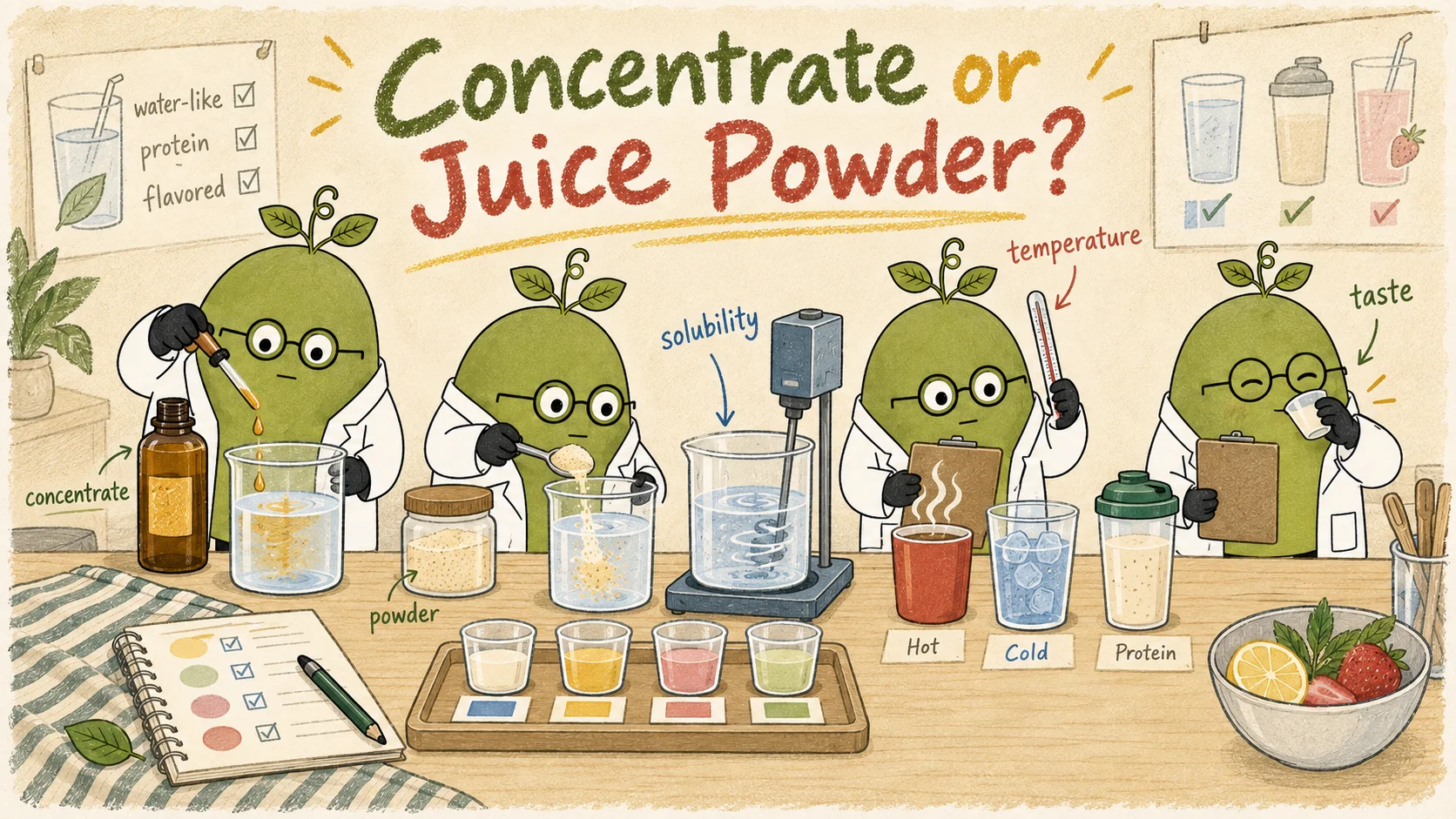
The illustration shows concentrate and powder being mixed, checked at different temperatures and tasted in several beverage bases. It summarises the comparison steps; the pictured drinks and tick marks are illustrative, not measured results or evidence that either format has passed a formulation trial.
Compare the specification and process, not just the format
Use this comparison to choose samples and agree what the trial must establish.
| Selection point | Monk fruit juice concentrate | Monk fruit juice powder |
|---|---|---|
| Physical form | Liquid concentrate. | Dry powder. |
| Dosing process | Assess liquid metering, dilution and mixing. | Assess dry blending or pre-dissolving before liquid dosing. |
| Composition | Confirm the complete composition of the selected concentrate. | Check the final powder’s complete ingredient declaration and any carrier details. |
| Specification | Check Brix and mogroside V separately, alongside agreed quality indicators. | Check the agreed content and quality indicators of the final powder. |
| Mixing | Confirm uniform dilution under the planned operating conditions. | Confirm dissolution or dispersion at the planned dose, water quantity, temperature and mixing conditions. |
| Serving conditions | Taste at the intended drinking temperature and after the relevant temperature change. | Use the same comparison; warm-water performance alone does not establish cold-drink performance. |
| Cost in use | Calculate from the amount that meets the finished-drink requirements. | Use the accepted amount and include any additional preparation or handling. |
These are two monk fruit juice formats. Keep them distinct from whole-fruit powder and high-purity monk fruit extract. Liquid or dry form alone does not establish sweetness, flavour or cost in use.
Define the beverage base and the flavour you want
Tell us what the ingredient needs to do in the drink: provide a light sweetness, work with protein or functional ingredients, or contribute a recognisable monk fruit flavour. A beverage category alone is not a sample brief.
Water-like drinks: keep the light taste and appearance in view
Set the target sweetness, whether a recognisable monk fruit flavour is acceptable, and whether the drink must be clear or nearly colourless. At each candidate’s trial dose, compare initial sweetness, lingering sweetness, flavour, colour and clarity. Reaching the sweetness target is only one part of passing this brief.
Protein drinks: test in the actual protein base
Identify the protein source and use level, plus any milk, cocoa, coffee or other flavour. Compare how the sweetness fits that base and whether the unwanted aftertaste remains. Emulsion stability, sedimentation and other physical stability issues need their own checks; choosing concentrate or powder does not guarantee a solution.
Functional drinks: identify the ingredient and the taste problem
Functional drinks cover many formulations. State which electrolytes, vitamins, amino acids or plant ingredients are present and what taste needs attention. Define the sweetness, flavour to retain and aftertaste to avoid, then test both forms in that base. Ingredient selection does not verify functional ingredient content or efficacy.
Flavoured drinks: decide whether monk fruit flavour belongs
For tea, fruit or coffee drinks, identify the main flavour. If that flavour should lead, judge whether the sample supports it or shifts it away from the target. If monk fruit flavour is part of the intended drink, make that a positive selection criterion.
These categories overlap: a protein drink may also have coffee flavour. State both the base and the flavour goal. We do not assign a whole beverage category to concentrate or powder without the selected specifications and application results.
Compare taste and mixing under recorded conditions
Taste: bring each candidate close to the target sweetness
Use the current drink or a target sample as the reference. Adjust each candidate towards the same sweetness target, then compare initial sweetness, lingering sweetness, monk fruit flavour and overall balance. Record the actual use level for each candidate; a fair taste comparison does not require the same ingredient weight. Results in water do not establish performance in a protein, electrolyte or flavoured base.
Mixing: separate speed, amount and clarity
Record the sample identity and lot, ingredient dose, base or water quantity, mixing temperature, addition order, mixing method and allowed preparation time. Use the process the factory can actually run. If the powder is pre-dissolved, record the ingredient and water used to prepare that solution as well as the quantity dosed into the drink.
Observe clumps, visible undissolved particles, uniformity and changes after the relevant standing period. How fast a sample dissolves, how much dissolves under stated conditions, and whether the drink is clear are separate questions. A clear-looking sample alone does not establish every mixing or stability requirement. Confirm that the concentrate also dilutes and mixes uniformly.
Separate serving temperature, ice dilution and heat processing
These comparisons answer different questions. Keep the formulation and ingredient dose consistent within each comparison, and record the actual temperatures, times and final drink quantities rather than using an unspecified “hot” or “cold” condition.
| Question | Comparison to make | What to keep separate |
|---|---|---|
| Does serving temperature change the taste? | Compare the same formulation at the relevant chilled, warmed, hot or cooled drinking states. | Keep concentration and preparation history consistent; record sweetness, finish and flavour at each state. |
| What happens when ice melts? | Record the ice addition and dilution in the intended serving method. | Melting changes concentration as well as temperature. Do not attribute every taste change to temperature. |
| What does the heat process change? | Run the actual factory heat process and bring before/after samples to the same tasting temperature. | Record the processing time and temperature separately from the tasting temperature; do not assume a universal heat condition. |
Use the resulting observations to choose the format for that specific drink and process. Neither a warm-water demonstration nor a different product’s trial establishes performance in your finished beverage.
Fit the chosen sample to liquid dosing or dry blending
For a line with liquid metering, concentrate is a sensible first sample to evaluate. Powder can also fit a liquid drink when the factory can pre-dissolve it and control the resulting solution. For dry-blended instant drinks or premixes, evaluate juice powder first, then check its distribution in the blend and the prepared drink’s sweetness, flavour, colour and visible residue. Confirm any carrier requirement against the selected powder’s current specification and complete ingredient declaration. If the formulation excludes a carrier, verify that condition in the current batch documents. If a carrier is listed, confirm its identity and proportion. Do not infer the final powder’s composition or content from the juice used before drying. A carrier requirement does not turn juice powder into high-purity extract.
Do not assume an equal-weight replacement
The concentrate’s concentration and the powder’s final composition, including any carrier proportion, need to be checked before substitution. Determine each candidate’s actual use level against the same finished-drink target, including flavour, colour and process performance as well as sweetness. Brix is not a sweetness multiplier or a direct conversion from concentrate weight to powder weight. Brix and mogroside V are different indicators; read them separately in the selected product’s documents. Keep the final drink quantity and base recipe consistent when comparing use levels. If one candidate needs extra water for pre-dissolving, account for that water in the finished formula so dilution is not an unintended difference between samples.
Calculate cost at the use level that passes the trial
First establish that both candidates meet the finished-drink requirements. Then compare the same finished batch quantity: Ingredient cost per batch = ingredient used in kg × quoted price per kg. Use consistent units, currency and delivery terms. For powder dosed as a prepared solution, calculate the cost from the powder ingredient it contains, not the entire solution weight at the powder’s price. Include any additional pre-dissolving, preparation, storage and transport costs on a comparable basis. A lower price per kilogram does not establish a lower cost per finished batch. To start sample selection, send the beverage base, sweetness and flavour goal, and dosing method. Add known carrier restrictions, drinking temperature and heat-processing requirements. After the trial confirms use level and application performance, confirm the purchase quantity, pack and delivery conditions for the selected product.
Common questions
Which should I sample first: concentrate or powder?
Start with the beverage and dosing process. Concentrate is a sensible first option for liquid metering; powder suits an initial evaluation for dry blending and can also be pre-dissolved for liquid dosing. Confirm the selected composition and judge the sample in the actual drink before choosing.
Discuss this requestCan I replace concentrate with the same weight of juice powder?
Do not assume an equal-weight replacement. Check the concentrate specification and the final powder’s composition, then establish each use level against the same finished-drink requirements. Brix is not a direct powder conversion or sweetness multiplier.
Discuss this requestDoes juice powder contain a carrier?
Check the selected powder’s complete ingredient declaration and current specification. Verify any exclusion against current batch documents; where a carrier is listed, confirm its identity and proportion. The product name and the composition before drying do not establish the final powder’s composition.
Discuss this requestDoes good dissolution in warm water prove suitability for a cold drink?
No. Check the planned dose, base, preparation process and drinking temperature. Record dissolution or dispersion, visible residue and flavour under those conditions. Mixing speed, the amount dissolved and clarity are different checks.
Discuss this requestHow do I avoid confusing heat stability with drinking temperature?
Record the heat process separately. Compare before/after samples at the same tasting temperature to assess the processing effect. To assess drinking temperature, keep concentration consistent and compare the intended serving states. Record ice-melt dilution separately.
Discuss this requestWhich format costs less in the finished drink?
Use the trial-accepted ingredient dose for the same finished batch quantity, multiplied by each quoted price on consistent units and terms. Include differences in preparation, storage and transport. For a pre-dissolved powder, distinguish powder ingredient weight from the total solution weight.
Discuss this request