Read this guide in
Buyer guide
Allulose–Monk Fruit vs. Allulose–Stevia Blends: How to Choose
Allulose with monk fruit or stevia? Compare ingredients, sweetness, taste and application trials to choose the right blend for your product.
Choose allulose–monk fruit when stevia is excluded from the ingredient brief. When both ingredients are acceptable, our recommendation is to compare specific blends at the same target sweetness in the actual product. Judge the first taste and the finish separately: a weak start and a long sweet tail need a different adjustment from insufficient sweetness throughout.
Hengliyuan can develop allulose–monk fruit and allulose–steviol glycoside blends for the customer’s application. Customers can provide their own formula, or describe the target product and the taste they want to improve, with Hengliyuan helping to select and adjust ingredients.
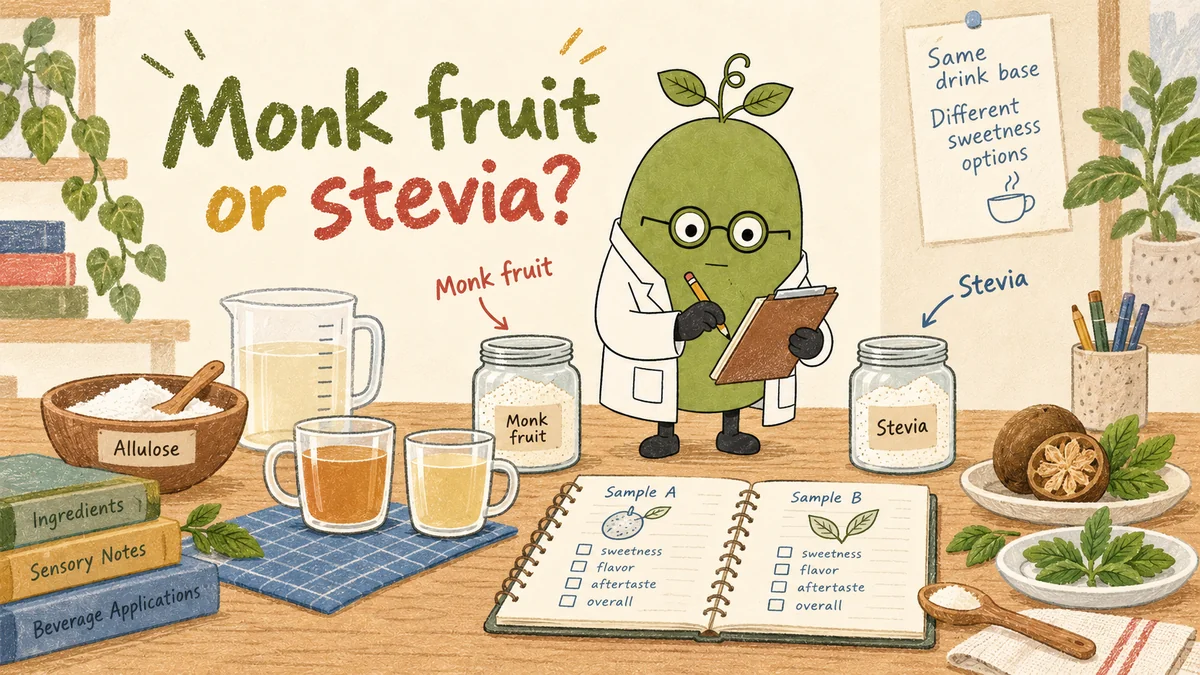
If allulose is already sweet, why blend it?
Allulose is about 70% as sweet as sucrose and contributes some bulk and texture to food. Used alone as an equal-weight replacement, it is often not sweet enough when the target is sugar-like sweetness. Monk fruit extract and steviol glycosides are high-intensity sweetening ingredients that can supply the additional sweetness. Allulose also contributes to browning during baking. When developing baked goods and similar products, check color and texture as well as sweetness; matching sweetness does not replace every function of sugar. Reference for allulose properties: Tate & Lyle. Blending must address two questions together: how much sweetness is needed, and how the ingredients taste when combined.
What are the main differences between the two options?
| Comparison | Allulose + monk fruit | Allulose + steviol glycosides |
|---|---|---|
| Ingredient supplying extra sweetness | Monk fruit extract | Steviol glycosides |
| What to check when selecting ingredients | Mogroside V content, other constituents and the specific taste profile | Steviol glycoside type, content, production process and specific taste profile |
| What to assess when tasting | Whether initial sweetness is sufficient and lingering sweetness is balanced | Whether initial sweetness is appropriate and whether bitterness or other aftertastes are present |
| For further adjustment | Compare different monk fruit extracts, their combinations and ratios | Compare different steviol glycoside ingredients and their ratios |
| Customer ingredient requirements | An option when stevia is explicitly excluded | An option when stevia ingredients are acceptable |
These differences guide sample selection; they do not mean one combination necessarily tastes better. Products with the same combination name can use different grades, ratios and sweetness levels.
Choosing monk fruit involves more than mogroside V content
In Hengliyuan’s ingredient-selection experience, changing the concentration grade of monk fruit extract changes taste as well as sweetness. Monk fruit is particularly known for its lingering sweetness, so assess both initial sweetness and how long sweetness lasts. If a sample tastes weak initially but lingers too long, compare the taste of different monk fruit extracts rather than simply adding more of the same extract. Hengliyuan already combines multiple monk fruit extracts to balance taste in erythritol–monk fruit formulations. Different extract combinations can also be included in sample selection for an allulose formulation, but their ratios and results must be confirmed again in the allulose system. Another formula cannot simply be copied.
For stevia blends, distinguish between specific ingredients too
Steviol glycosides do not all taste the same. Conventional extracted ingredients, enzymatically converted ingredients, and products with different compositions and grades should be compared separately. Hengliyuan uses stevia to supplement initial sweetness in blends; some conventional ingredients can leave a bitter aftertaste. In our ingredient-selection and tasting experience, the two enzymatically converted steviol glycoside products we have used have very mild bitterness. “Stevia has a bitter aftertaste” should therefore not be applied to every product. Customers who want stevia can specify their requirements for initial sweetness and bitterness together. Choose the particular product based on its performance in the allulose blend and the finished application.
Drinks, baked goods and tabletop sweeteners need different comparisons
| Application | Suggested focus |
|---|---|
| Coffee, tea drinks and fruit beverages | Compare initial sweetness, lingering sweetness, bitterness and compatibility with the original flavor in the actual beverage |
| Baked goods | Besides sweetness, assess color, taste and texture after baking, and record processing conditions |
| Tabletop sweeteners | Test the amount consumers would use per serving and confirm performance in coffee, tea and other applications |
When comparing two samples, first bring them close to the target sweetness, then assess taste. If one is clearly sweeter and the other much weaker, it is hard to tell whether the judgment reflects sweetness intensity or the ingredient combination itself. If the product must be used at the same weight as sugar, state that goal during development. Blend ratios affect final sweetness; do not assume every allulose blend replaces sugar 1:1.
Run two comparisons before choosing the blend
First compare the samples at the intended use rate. This answers whether each blend works at the dose you need, especially for a 1:1 tabletop product. Then, if sweetness differs, adjust the samples toward the same target sweetness and compare the taste again. Keep both results: equal-dose testing checks usability; matched-sweetness testing helps explain the taste difference. Use the same base recipe, preparation method and serving temperature. Give samples neutral codes, keep the tasting order in your notes and include the current product or a sugar reference. Where dose adjustment changes bulk or water, record that change; it remains part of the finished-product comparison.
| Record for each sample | Why it matters |
|---|---|
| Sample code, ingredient grades and lot | Makes the comparison traceable when a different extract or stevia ingredient is supplied. |
| Blend dose in g/kg of finished product; serving size | Separates concentration from the amount of sweetener weighed into a test cup. |
| Equal-dose result and matched-sweetness result | Shows whether the preference comes mainly from intensity or from the taste profile. |
| First taste, peak sweetness and finish | Record weak onset, bitterness and lingering sweetness separately; avoid a single “better” score. |
| Base recipe, process and serving temperature | Prevents a change in preparation from being mistaken for a change in blend performance. |
| Taste after processing and planned storage checks | Keeps a promising fresh sample separate from later product-validation results. |
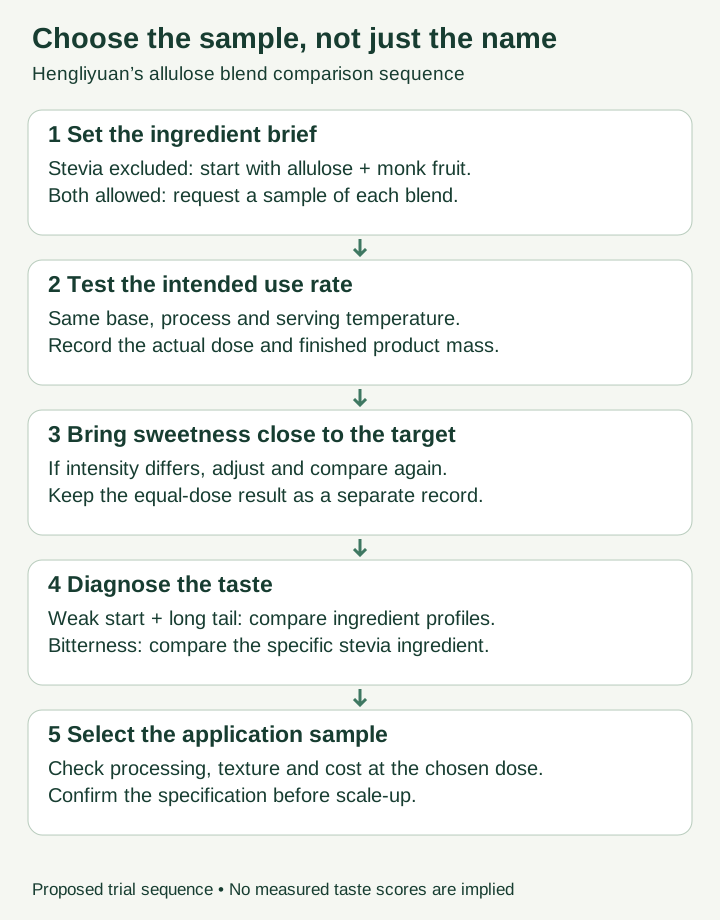
For a concentration record, 2 g of blend in 1,000 g of finished beverage is 2 g/kg, or 0.2% by weight. This is a unit-conversion example, not a recommended dose. Use the actual sample dose and final product mass. Do not calculate an exact monk fruit or stevia ratio from the approximate 70% sweetness of allulose; select the grade and confirm the blend by tasting.
How does Hengliyuan help customers choose?
Customers can start with the application, whether stevia is acceptable, the desired sweetness and what needs improving in the current sample. Hengliyuan uses this information to help select ingredients, adjust the blend and compare it in the actual product. Customers with a formulation team can discuss ingredient specifications and adjustment options. Those wanting a ready-made blend to add directly can develop it for the application. Customers planning consumer retail products can also discuss OEM packaging and directions for use. Compare quotations after taste and actual dosage are established. A different price per kilogram of ingredient does not necessarily mean a higher or lower cost for the same quantity of finished product. For a first discussion, send the product type, whether stevia is allowed, and the main taste problem. An existing sample code or a simple description such as “weak first sip, sweetness lasts too long” is useful. You do not need a finished formula to start.
How Hengliyuan makes the corresponding blend
Hengliyuan makes its allulose-based sweetener blends by high-speed powder mixing, which distributes the powdered ingredients in the selected formula. This is a common powder-mixing method. Confirm blend uniformity, particle size and application performance against the selected specification and sample.
Review note
Reviewed October 16, 2026. The trial sequence is Hengliyuan’s formulation recommendation; it is not a published head-to-head performance result. Check the selected ingredient documents and target-market requirements before purchase or label approval.
Common questions
Does allulose with monk fruit always taste better than allulose with stevia?
No. We choose by ingredient requirements and the taste of specific samples in the target product. If stevia is excluded, start with allulose–monk fruit. If both are allowed, compare them at the intended dose and then near the same target sweetness before deciding.
Discuss this requestCan an allulose–monk fruit blend be developed without stevia?
Yes. Hengliyuan can develop a stevia-free formula and compare different monk fruit extracts and combinations. State the exclusion in the sample brief, then confirm the selected formulation and ingredient declaration before ordering.
Discuss this requestCan allulose directly replace erythritol in an existing formula?
It can be a starting point for testing a new formulation, but an equal-weight substitution cannot be assumed to perform identically. Reassess sweetness, actual dosage, processing behavior and texture in the target product.
Discuss this requestAre these blends automatically a 1:1 sugar replacement?
No. A 1:1 replacement by weight is a development target, not a property of every allulose blend. Tell us the intended use amount and application. Confirm sweetness at that dose and check bulk, texture and processing performance separately.
Discuss this requestWhat should we change if a sample starts weak but stays sweet too long?
In our formulation work, that is a reason to compare ingredient profiles rather than simply increase the same blend. For a stevia-free brief, compare monk fruit grades or extract combinations. Where stevia is acceptable, assess the specific steviol glycoside ingredient for initial sweetness and bitterness. Confirm the result in the finished product.
Discuss this requestWhich option costs less in the finished product?
Compare the quoted price at the dose that meets your taste and process targets. Ingredient cost per kilogram of finished product equals blend price per kilogram multiplied by blend dose in g/kg, divided by 1,000. A lower price per kilogram of blend does not establish the lower cost in use.
Discuss this request