Read this guide in
Hengliyuan Applications and Selection
Allulose–Stevia Blends for Baking: Cookie and Cake Trial Checklist
Testing allulose-stevia blends in baking? Keep a sugar control; check cookie spread and crispness, cake volume, crumb and softness.
Our recommendation for an allulose–stevia baking trial is to keep the original sugar recipe as the control and judge the finished product after cooling. For cookies, compare spread and the intended crispness or softness. For cakes, compare volume, cut crumb and softness. Matching sweetness alone is not enough to adopt the blend.
Before starting, identify which characteristics of the original product should be retained and which changes are acceptable. The aim may be to match the original as closely as possible or to develop a new texture; these require different evaluation criteria.
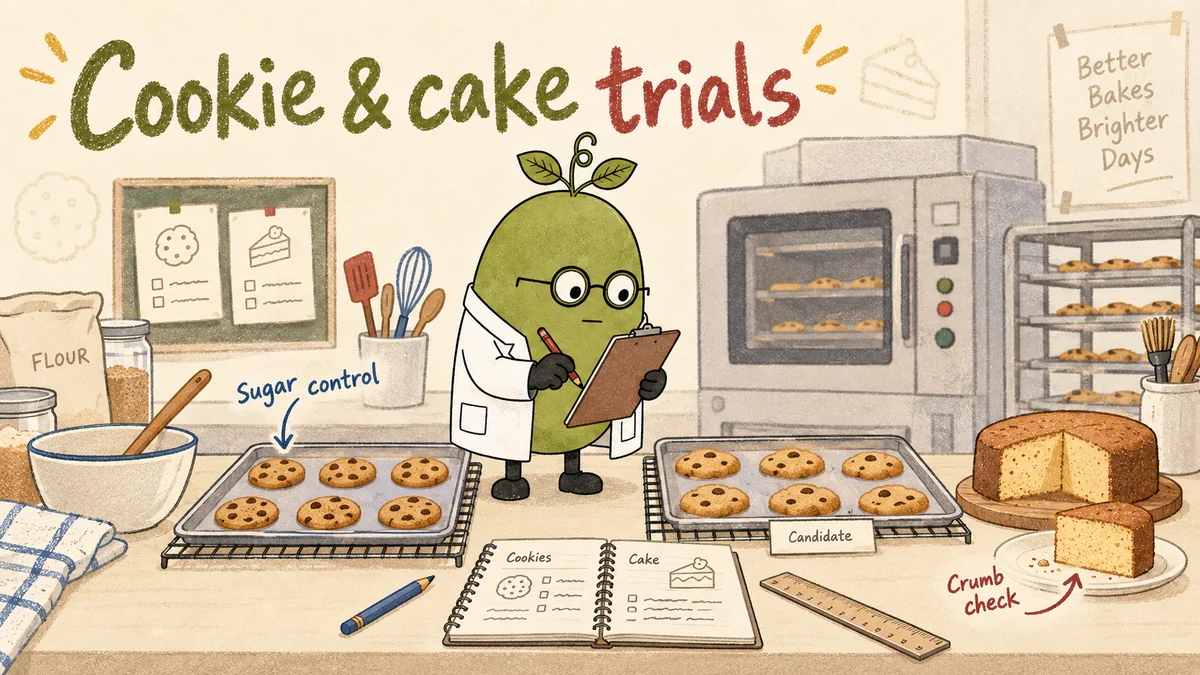
Make the control useful before changing the recipe
Write down the target before baking: which properties must stay close to the original, and which can change? Use the same ingredient lots where practical, the same preparation sequence and comparable oven positions. Record any unavoidable difference instead of treating the two batches as identical. Keep the control recipe unchanged. For the candidate, record the blend identity, dose and every compensating change to flour, water, fat or other ingredients. If several things change together, the result describes the revised recipe as a whole; it does not isolate the effect of the sweetener. Choose one main question for the next round. Repeat the reference alongside the revised candidate when the production conditions change. Do not select the best-looking piece from one batch and compare it with an unrepresentative piece from another.
Cookies: compare shape and texture after cooling
Keep unit weight, thickness, trays and shaping methods as consistent as possible between the original recipe and sugar-replacement samples, and record actual baking conditions. After cooling, inspect them side by side, then taste. Check whether cookies spread more or become thicker and whether edge and center colors meet expectations. Then assess breakage during handling and whether bite crispness approaches the target. Judge against the intended product. A noticeably softer result needs adjustment if a crisp cookie is intended. For a soft cookie, assess the intended softness instead; lack of crispness does not automatically mean failure.
Cakes: compare volume and the cut crumb
Use identical pans and batter fill weights, and record mixing, baking and cooling conditions. Compare both the exterior and a cut section. Record height, any collapse and surface color. After cutting, check pore uniformity and any notably dense or wet, sticky areas, then compare softness and moistness in the mouth. Similar surface color describes only part of the appearance and cannot replace crumb and texture assessment. These observations describe differences; no single observation establishes the cause. When a problem appears, use the full recipe and processing record to plan the next comparison.
Record measurements at the same cooling endpoint
Agree on a cooling endpoint and measurement method before comparing batches. Use the same delay after baking, sample temperature and measurement positions. Keep individual readings as well as a summary so variation within the batch remains visible.
| Measurement | How to keep the comparison useful |
|---|---|
| Cookie diameter and thickness | Use the same axes and thickness position for each piece; record individual readings and the number of pieces checked. |
| Cake height and cut section | Measure height at the same positions. Photograph equivalent slices with a scale; height alone is not a measurement of total volume. |
| Product mass before baking and after cooling | Exclude trays, tins and liners. Keep the weighing basis and cooling endpoint consistent; note lost crumbs or handling losses. |
| Color and texture observations | Use the same lighting, background and serving temperature. State the intended crisp or soft texture before judging the sample. |
| Packaged follow-up | Record packaging, storage conditions and the actual observation date. Check the same target qualities again; a fresh result is not a shelf-life result. |
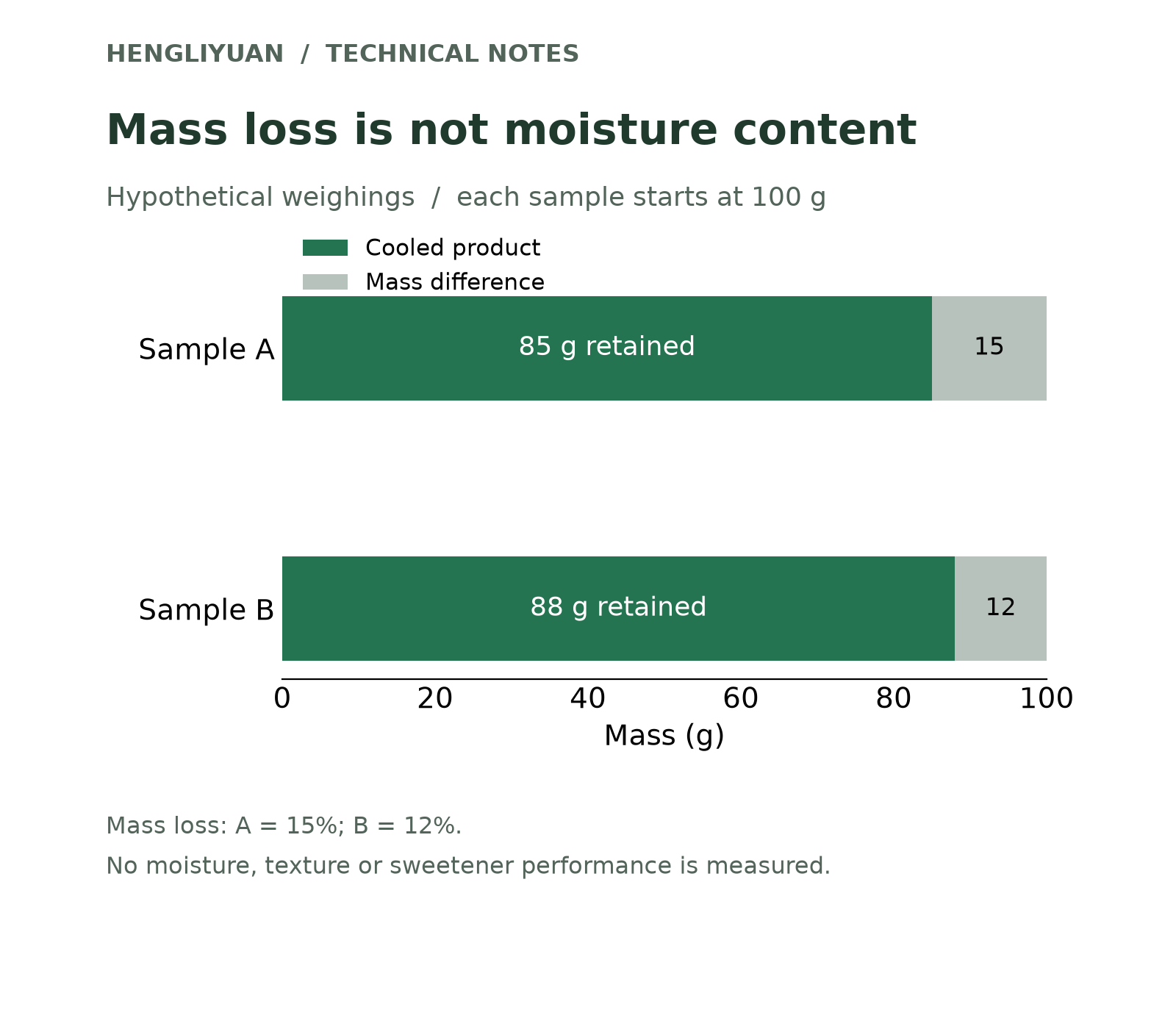
For an internal mass record, calculate observed mass loss as (mass before baking − mass after cooling) ÷ mass before baking × 100. The example below only demonstrates the arithmetic. It does not report Hengliyuan trials or show that either sweetener retains more moisture. A 15% mass loss does not mean the finished product contains 15% moisture. It records the difference between two weighings. Water content, water activity, texture and shelf life need their own appropriate measurements; do not infer them from this number.
Use a simple table to choose the next priority
Cool both sample groups under the same conditions and compare at similar temperatures. The table below is a recording template: its prompts are observations to make, not Hengliyuan test results.
- Review the allulose and stevia blend
- Discuss a baking sweetener blend with Hengliyuan
- Discuss the next baking sample
| Item | Cookie observations | Cake observations |
|---|---|---|
| Shape | Size, thickness and spread | Height, volume and collapse |
| Color | Edges, center and base | Surface and interior |
| Texture and structure | Target crispness or softness; tendency to crumble | Pores, softness and moistness |
| Sweetness | Too sweet, too weak or on target | Too sweet, too weak or on target |
| Top improvement priority | Enter observed differences | Enter observed differences |
In each round, first adjust the issue that most affects product acceptance. For example, if sweetness is right but cooled cookies are not crisp enough, focus the next round on that difference; there is no need to redo every satisfactory aspect. For filled, coated or packaged products, continue comparing in the final format. A freshly made sample meeting requirements does not establish identical performance after packaged storage or determine shelf life. When providing feedback to Hengliyuan, combine the sample ID, actual dose, changes to other ingredients, processing conditions, cooled-sample photos and texture descriptions. Photograph the exterior and cut section, and describe the clearest differences from the original. This helps both parties decide whether to adjust the sweetener blend next or first investigate the overall recipe and process.
How Hengliyuan makes the corresponding blend
Hengliyuan makes its allulose-based sweetener blends by high-speed powder mixing, which distributes the powdered ingredients in the selected formula. This is a common powder-mixing method. Confirm blend uniformity, particle size and application performance against the selected specification and sample.
Review note
Reviewed October 16, 2026. These are Hengliyuan’s trial-planning recommendations and recording prompts. The mass-loss figures are hypothetical arithmetic, not measured product performance. Actual formulation, process and market requirements follow the selected project.
Common questions
Why keep the original sugar product as a baking control?
It provides the reference for the texture and appearance your team intends to preserve. Prepare the control and candidate under the same conditions so differences can be compared.
Discuss your baking trialWhat should I check in cookie trials?
Compare spread and shape, then crispness and texture after cooling. Record the formula, actual dosage and bake conditions for each sample.
Discuss your baking trialWhat should I check in cake trials?
Compare volume, the cut crumb structure and softness after cooling. Taste alone cannot establish whether the cake structure meets the product target.
Discuss your baking trialDoes matching sweetness mean the baking blend is ready to use?
No. Confirm cookie or cake performance separately. Allulose and stevia contribute different functions, so sweetness matching does not replace checking browning, structure and texture.
Discuss your baking trialHow should I choose the next trial adjustment?
Record the control and candidate observations in the same comparison table. Identify the main remaining difference, then agree on the next formula or process adjustment before repeating the trial.
Discuss your baking trialDoes lower baking mass loss prove a softer or more stable product?
No. It only shows a smaller difference between the recorded before-baking and after-cooling masses on the chosen basis. Compare actual texture separately and use appropriate moisture, water-activity and packaged-storage checks for those questions.
Discuss your baking trialWhat should I send with trial feedback?
Send the blend sample code, actual dose, changes to the base recipe, baking and cooling conditions, and the clearest difference from the sugar control. Photos of the outside and cut section help. Start with the observations you have; a complete commercial formula is not required for the first discussion.
Discuss your baking trial