Read this guide in
Hengliyuan applications and selection
Allulose–Stevia Blends: Sweetness, Taste, and Cost in Use
Allulose-stevia blends: how a higher sweetness level can lower cost in use, plus checks for bitter aftertaste and baking performance.
An allulose–stevia blend combines a bulk sweetener with a concentrated source of sweetness. It can help balance taste and ingredient cost, but the two names do not define a sugar-replacement ratio. Check the actual stevia material, any additional sweeteners, and whether the replacement claim refers to volume, weight or perceived sweetness.
For allulose–steviol glycoside blends, increasing sweetness and reducing the amount needed to reach the same sweetness is one way Hengliyuan explores lower cost in use. Bitter aftertaste and lingering sweetness must remain acceptable to the customer, and final costs should use the dosage confirmed in trials.
Customers can choose a blend close to sugar in sweetness or discuss a higher-sweetness option. First clarify whether equal-weight sugar replacement is needed and what other functions allulose must perform in the target food.
What does an allulose–stevia blend actually contain?
Start with the full ingredient declaration. A two-component blend, a blend that also contains monk fruit, and a brown-sugar-style product with molasses are different offers. The word stevia may identify a specific glycoside such as Reb M, a mixture of glycosides or a differently processed ingredient. Do not transfer the taste or dose of one to another. Allulose supplies material to the formula as well as sweetness; the selected steviol glycoside material supplies much more concentrated sweetness. Increasing blend potency can reduce the mass added, which changes the amount of allulose delivered. That matters when the existing recipe relies on it for solids, browning or texture.
| Offer | What the name does not settle |
|---|---|
| Pure allulose | No added stevia is implied. Its amount cannot be converted using a ready-blend replacement claim. |
| Allulose plus a specified stevia ingredient | Identify the grade, composition and sweetness specification for that exact sample. |
| Allulose, stevia and monk fruit | A three-sweetener system; its result does not isolate the stevia contribution. |
| Brown-sugar-style blend | Check molasses, glycerin and other ingredients as well as the sweeteners. Colour and flavour can come from these components. |
What current retail products tell us about replacement ratios
Two manufacturer pages illustrate why the complete product identity matters. These are public examples, not Hengliyuan customer cases or independent performance tests. The comparison below describes the named products as read on October 23, 2026.
- Truvia: ingredients and cup-for-cup directions
- Whole Earth: brown blend ingredients and conversion table
| Named product | Declared ingredients | What the instruction means |
|---|---|---|
| Truvia Allulose Plus Stevia Sweetener and Monk Fruit Sweetener | Allulose, stevia glycosides (Reb M), monk fruit extract. | The manufacturer specifies cup-for-cup use and a 2-teaspoon (8 g) serving. This is a volume instruction for that product, not a recipe for making a blend. |
| Whole Earth Brown Stevia Leaf, Monk Fruit & Allulose | Allulose, molasses, vegetable glycerin, stevia leaf extract, monk fruit extract. | Its conversion table uses equal teaspoons, tablespoons and cups of brown sugar and blend. Additional ingredients contribute to its brown-sugar-style character. |
Neither page supplies the internal proportions needed to reproduce its product. A cup-for-cup claim also does not establish equal mass per cup or unchanged baking behaviour. For a factory formula, weigh the amount actually used and test the resulting food. Retail serving-size calorie statements should not be copied into a bulk specification or a different finished product.
Separate blend ratio, addition rate and sweetness contribution
A percentage is useful only with its denominator. Blend composition describes what is inside the supplied powder; addition rate describes how much enters the final batch; sweetness contribution estimates a sensory role. These are not interchangeable. An 80:20 split of estimated sweetness would not mean 80:20 ingredient mass. For an arithmetic example, adding 500 g of an identified ready blend to a final 100 kg batch is 0.5% by mass. It does not tell you the stevia dose until that blend composition is known. Likewise, the 1× and 5× cost example below concerns assumed sweetness multiples, not glycoside purity or a recommended formulation.
| Term | Basis | Still needed |
|---|---|---|
| Cup-for-cup replacement | Volume of a named consumer product relative to sugar | Mass per serving and performance in the actual food. |
| Blend addition, % w/w | Blend mass divided by final batch mass × 100 | Full blend composition and the final mass, including added water. |
| Glycoside assay | The specified analyte and basis in the stevia material | Not the same number as the material percentage in a finished blend. |
| Matched sweetness | Observed sweetness at the accepted dose and serving condition | Not an assumed constant across concentrations, acids, proteins or temperatures. |
Bitter aftertaste? First compare the stevia ingredients
In Hengliyuan’s actual ingredient selection and tasting, some conventional stevia ingredients have a bitter aftertaste, while two enzyme-converted steviol glycoside ingredients used had only mild bitterness. Customers seeking to improve bitter aftertaste can therefore compare different stevia ingredients to see whether a replacement better meets the taste target. This experience applies to the ingredients actually tasted; it does not mean all enzyme-converted stevia is free of bitterness. Each ingredient must still be tested in the customer’s food as part of the allulose blend. Hengliyuan recommends giving separate feedback on sufficient sweetness and acceptable aftertaste. Insufficient sweetness calls for discussing how to supplement it; adequate sweetness with a pronounced bitter aftertaste calls for comparing stevia ingredients and proportions, rather than repeatedly changing only the overall dosage.
How do you assess whether an ingredient change works?
Keep the original sample as a control, use the same target food and adjust the new option to similar sweetness before tasting. For tea drinks, keep the tea base and other ingredients constant; for coffee, keep the coffee and milk formula constant. Focus on three points: whether initial sweetness meets the target, whether bitterness after swallowing is reduced, and whether the original tea, coffee or other flavors remain balanced. If the drink itself is bitter, also compare it with the original drink rather than attributing all bitterness to stevia. Record the replacement ingredient, changes in proportions and actual dosage in each round to guide the next adjustment.
What a 100-person yogurt study can and cannot tell us
A 2022 Foods study by Mora and colleagues compared separate sucrose-, allulose-, Reb A- and sucralose-sweetened vanilla Greek yogurts. It did not test an allulose–stevia blend. The base was non-fat plain Greek yogurt with 1.3% vanilla extract. Reported additions were 6% sucrose, 11% allulose, 0.01% Reb A and 0.02% sucralose by weight, selected through benchtop sweetness matching. These are study conditions, not recommended use levels. One hundred yogurt consumers evaluated coded samples in a counterbalanced repeated-measures design. The researchers recorded liking, just-about-right attributes and aftertaste comments. Overall liking did not differ significantly between sucrose and allulose in this study, while the Reb A sample was less liked. The authors reported that 7 participants used the descriptor bitter for the allulose sample and 15 for the Reb A sample.
| Separate sample | Reported ingredient addition | Used the descriptor “bitter” |
|---|---|---|
| Allulose yogurt | 11% wt/wt | 7 of 100 participants |
| Reb A yogurt | 0.01% wt/wt | 15 of 100 participants |
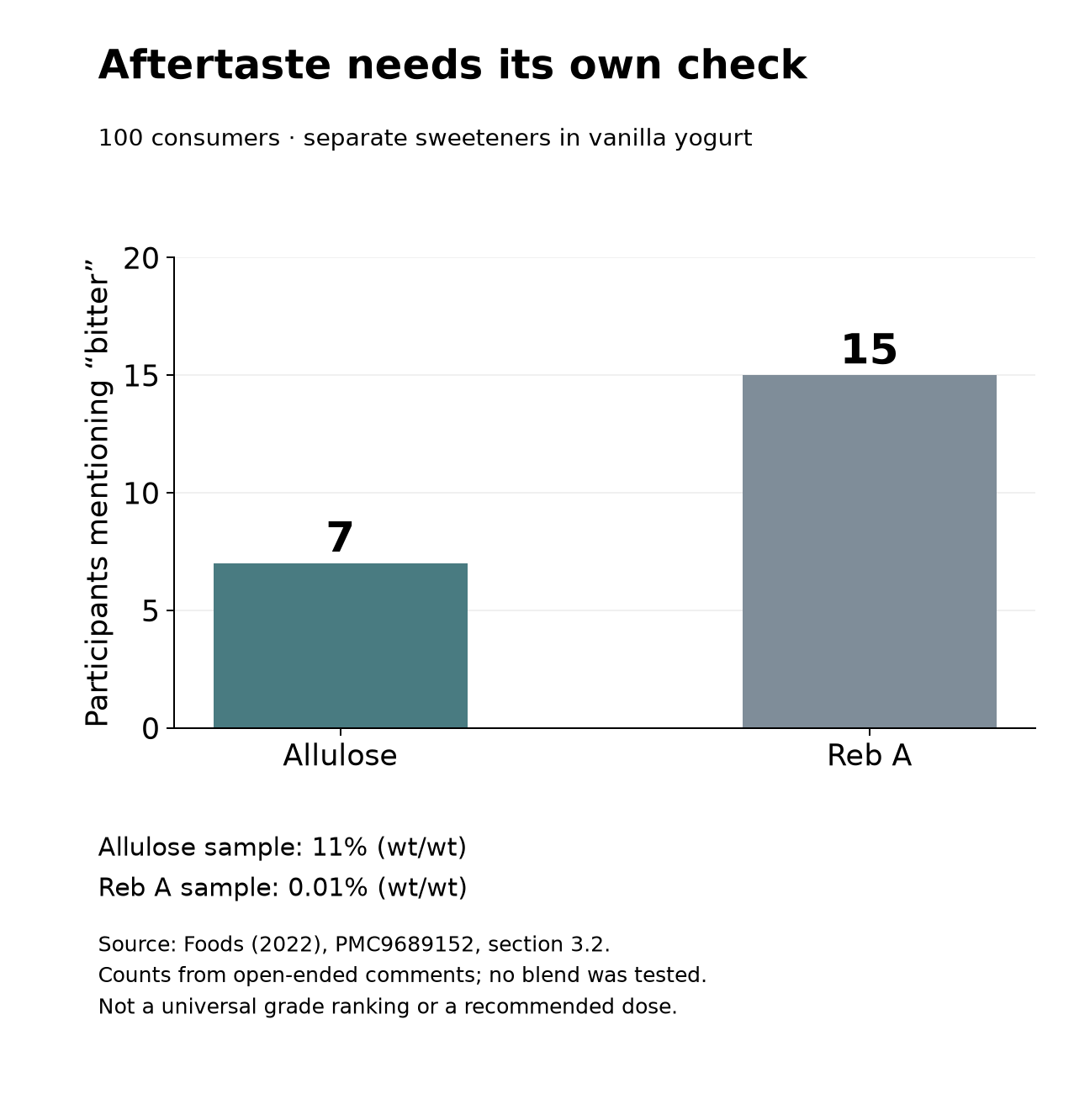
The study gives a useful testing lesson: record aftertaste separately from sweetness and liking. It does not establish that adding allulose removes Reb A bitterness, that Reb M or an enzyme-converted material will give the same result, or that a blend is cheaper. The authors also observed sweetness differences despite initial matching. Recheck the accepted sweetness in the finished base before interpreting preference.
A published chocolate prototype and the first-bite problem
HOWTIAN’s January 2021 formulation article describes a dark-chocolate prototype combining allulose, Reb A 99 and its DGS Flavor TN, shown at SupplySide West 2019. The article also identifies PQQ, inositol and vitamin E among the prototype ingredients. This is evidence of a supplier-developed multi-ingredient example, not a controlled comparison or a Hengliyuan recipe. HOWTIAN reports that initial sweetness in its allulose–stevia combinations could decrease with repeated consumption. That supplier observation is worth checking in a serving-length tasting; the article does not publish the panel data needed to predict the size of the change in another food. Its historical cost discussion is not a current allulose quotation. For your trial, use coded samples and the same serving temperature, portion and tasting sequence. Record the first sip or bite, later sips or bites, and the finish after swallowing. Compare candidates in a balanced order with consistent palate clearing. Keep sweetness intensity, bitterness, lingering sweetness and liking as separate observations. A good first sip should not be the sole acceptance decision.
Use four comparisons to locate the source of a taste problem
Choose a small set of comparisons that answers the current problem. Establish an agreed sweetness target in the actual food first, then keep the recipe and process recorded. A different sample code is needed whenever the stevia material or blend composition changes.
| Comparison | Record | Purpose |
|---|---|---|
| Current accepted formula | Keep it as the reference for sweetness, flavour and texture. | Provides the target and a way to detect day-to-day changes. |
| Current base without the proposed sweetener system | Prepare only if it is suitable for the intended sensory screening. | Shows which bitter, sour or astringent notes are already in the base. |
| Current stevia material plus allulose | Record exact additions and every compensating ingredient change. | Tests the present system at the agreed sweetness. |
| Alternative stevia material plus allulose | Retune to similar perceived sweetness; retain all actual masses. | Tests whether a material change improves the finish without losing flavour or body. |
Do not remove necessary process controls to create a sensory comparison. For a heat-treated or stored food, repeat the relevant observations after that process and at planned storage checkpoints. A fresh water screen is useful for screening ingredients, but cannot release a shelf-stable beverage or bakery formula.
How can a higher-sweetness formula reduce cost in use?
When adjusting these blends, Hengliyuan can increase sweetness to reduce the quantity needed for the customer’s target sweetness, potentially lowering cost in use. Compare the price per kilogram alongside sweetness relative to sugar, then verify the required dose in the application. For an initial arithmetic screen, ingredient cost to provide the sweetness of 1 kg of sugar = blend price per kilogram ÷ the assumed sweetness multiple relative to sugar. This assumes that multiple applies at the intended use level; it does not establish a trial dose. The following hypothetical prices compare two options, each providing the sweetness of 10 kg of sugar.
| Comparison | 1× sweetness formula | 5× sweetness formula |
|---|---|---|
| Price per kilogram (hypothetical) | CNY 20 | CNY 50 |
| Quantity for equal sweetness (theoretical) | 10 kg | 2 kg |
| Sweetener cost | 10 × 20 = CNY 200 | 2 × 50 = CNY 100 |
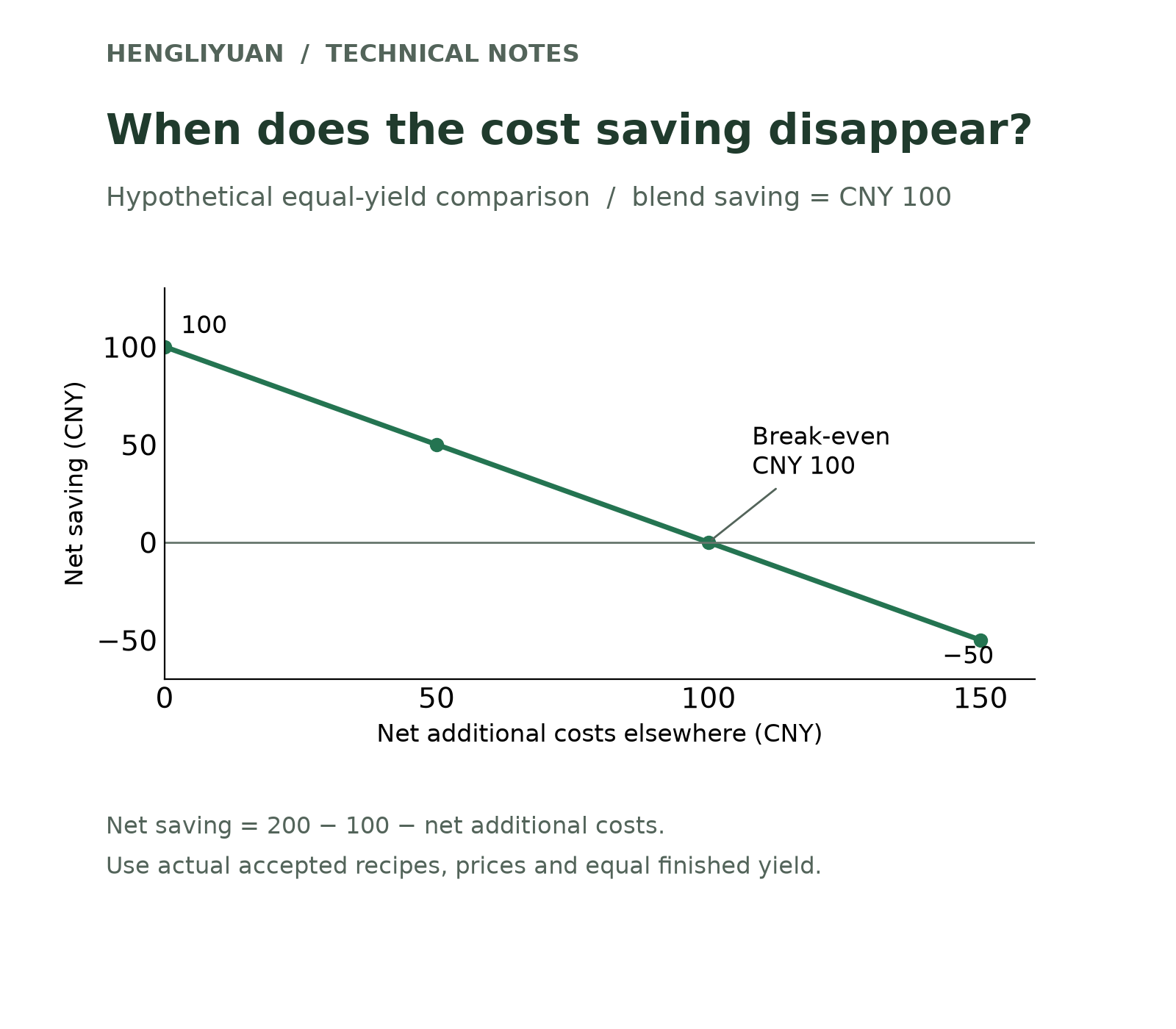
In this example, the 5× formula costs more per kilogram but requires less product. Equal sweetness costs CNY 100, saving CNY 100 versus the 1× formula. This is a calculation example, not a Hengliyuan quotation or recommended dosage. Calculate actual costs from the confirmed quotation and trial dosage. Higher-sweetness formulas are not cheaper at every price: the reduction in dosage must sufficiently offset the unit-price difference. Reassess initial sweetness and aftertaste when increasing sweetness. If a lower dosage brings unacceptable bitterness, continue adjusting the stevia ingredient and proportion. Once taste meets requirements, calculate the final cost per kilogram or serving of finished product. Sweetener cost per kilogram of finished product = sweetener quantity per batch (kg) × purchase price (CNY/kg) ÷ finished batch weight (kg). Use the same currency and delivery terms when comparing. Include corresponding costs if the change also requires adjustments to other ingredients.
Check whether the saving survives the complete formula
In the example above, the blend cost falls from CNY 200 to CNY 100, leaving CNY 100 of potential saving for the comparison. If the higher-sweetness route adds CNY 100 in net costs elsewhere, that saving disappears. Compare the same quantity of acceptable finished product before deciding that the new route costs less. The blend quantity also falls from 10 kg to 2 kg: 8 kg less blend enters the recipe. That does not automatically mean adding 8 kg of a bulking agent. Decide which functions and finished yield must be retained, adjust the recipe where needed and test the result.
| Cost or trial input | Keep the comparison on the same basis |
|---|---|
| Accepted sweetness and aftertaste | Use the dose that passes the same product target; record the specific stevia ingredient and blend revision. |
| Blend price and dose | Use the same currency, delivery scope and units. The 1×/5× example is not a quotation. |
| Changes elsewhere in the recipe | Include the net change in all other ingredients, including any water, bulk or texture adjustments. |
| Processing and usable yield | Include relevant changes in handling, processing or losses; use the same quantity of acceptable finished product. |
| Final comparison | Report blend-only cost and complete-formula cost separately so a material saving is not mistaken for a total saving. |
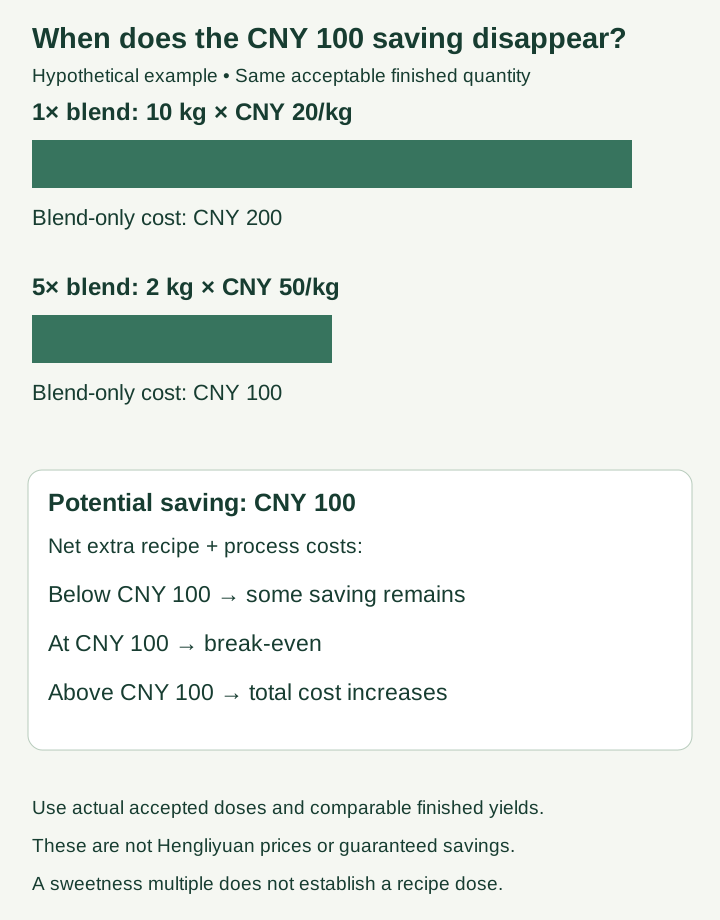
For equal finished batch size, net saving = original blend cost − candidate blend cost − net additional costs elsewhere. In this illustration, that is CNY 100 minus the net additional costs. If finished yields differ, first convert each complete cost to the same finished-product basis. This arithmetic does not establish which formula tastes better or whether extra ingredients are needed. Use the accepted trial, actual quotation and production requirements to fill in the numbers.
For baking, retain the functions required of the base
Besides sweetness, allulose participates in the Maillard reaction and influences browning and texture in baking. If blend sweetness is increased to reduce dosage, also check whether the actual allulose quantity changes. After sweetness and aftertaste are acceptable, baking trials must still assess browning, crumb structure and texture after cooling before calculating the complete formula cost. Beverage trial results cannot replace baking validation. Hengliyuan can help select stevia ingredients and adjust allulose blend proportions for the application, while providing full ingredient names, ingredient proportions, target sweetness and finished-product specifications. Customers with existing samples can describe the specific aftertaste issue and cost target to determine the next trial direction together.
A commercial sauce example: allulose with stevia
Samlip’s October 12, 2026 announcement describes two Pig in the Garden low-sugar dipping sauces, chipotle and garlic, made with allulose and stevia extract. The company says the products contain no added sucralose, acesulfame K or aspartame. This is a public example of the combination being used in sauces, alongside the beverage and bakery applications discussed here. It is not a Hengliyuan customer case. The announcement does not disclose the blend ratio, stevia grade, allulose assay or comparative sensory results. It therefore cannot supply a recipe or a cost calculation for another sauce. For a similar project, compare candidate blends in the actual tomato, garlic or emulsion base at the agreed sweetness. Record acidity, solids, viscosity, processing and aftertaste before comparing cost at the accepted dose. Reducing the sweetener dose can also change the solids supplied by allulose.
When the blend misses the target, change the right variable
A stronger blend is not the answer to every defect. Use the observed failure to choose the next comparison rather than changing grade, dose, acid and flavour together.
| Observed issue | Next useful check |
|---|---|
| Sweet enough, bitter finish | Compare stevia material and proportion at similar sweetness; compare the base control. |
| Good first sip, weak or lingering later | Check a serving-length sequence, sample order and temperature before raising the dose. |
| Good sweetness, thin body | Review the solids lost when reducing blend mass; evaluate a texture adjustment separately. |
| Uneven sweetness between servings | Check weighing, premix preparation, particle differences, mixing and representative sampling. |
| Bakery colour or texture changes | Review actual allulose mass, bake conditions and cooled texture; a tabletop conversion does not validate the bake. |
| Lowest blend cost, higher finished cost | Recalculate with net ingredient changes, processing and accepted yield. |
How Hengliyuan makes the corresponding blend
Hengliyuan makes its allulose-based sweetener blends by high-speed powder mixing, which distributes the powdered ingredients in the selected formula. This is a common powder-mixing method. Confirm blend uniformity, particle size and application performance against the selected specification and sample.
Confirm the sample specification before turning a trial into an order
A useful offer identifies the full blend and the exact material used in the accepted trial. Compare quotes on the same delivery and finished-product basis. A supplier’s standard packing or certificate list is not confirmation that your selected blend, lot and destination are covered.
| Item | What to align |
|---|---|
| Blend identity | Full ingredient names, selected stevia material, proportions or agreed composition specification, sample and revision code. |
| Sweetness and physical specification | Reference method and conditions, powder form, relevant particle size, moisture and mixing requirements. |
| Commercial basis | Current price, currency, delivery terms, pack, order quantity and the accepted trial dose. |
| Evidence and change control | Applicable specification, matching batch COA, required certificate scope and re-evaluation when materials or composition change. |
Keep calorie and label calculations separate from taste
For U.S. nutrition labeling, FDA guidance describes enforcement discretion for excluding allulose from Total Sugars and Added Sugars and using 0.4 kcal/g for its caloric contribution. That is not a declaration that every allulose blend or finished product contains zero calories. Other ingredients, serving size and the applicable claim rules still matter. Keep the complete formulation, intended use, sales market and proposed package statements with the review. A supplier application table is not a universal legal maximum, and changing a food into a supplement is not an automatic route around ingredient-use requirements. A sensory result also cannot establish digestive tolerance or a health benefit.
Review note
Reviewed October 23, 2026. Factory taste observations apply to the ingredients actually evaluated. Retail examples and the HOWTIAN prototype are attributed to their manufacturers; the yogurt study tested separate sweeteners, not this blend. Cost figures and the addition-rate example are hypothetical arithmetic, not quotations, recommended doses or measured savings.
Common questions
Can a blend with a higher price per kilogram cost less in use?
Yes, if a lower confirmed dosage offsets the higher unit price at the same finished-product sweetness target. Use the actual quotation and trial dosage; a higher-sweetness blend is not automatically cheaper.
Discuss taste and cost targetsHow do I calculate sweetener cost per kilogram of finished product?
Multiply the sweetener quantity used per batch by its purchase price per kilogram, then divide by the finished batch weight. Use the same currency and delivery terms when comparing candidates.
Discuss taste and cost targetsWhat should I do when sweetness is sufficient but the aftertaste is bitter?
Compare the specific stevia ingredients and their proportions in the same product base. Keep the original sample as a control and taste at similar sweetness instead of changing only the overall dosage.
Discuss taste and cost targetsAre all enzyme-converted stevia ingredients free of bitterness?
No. The ingredient observations in this article apply to the materials actually tasted. Confirm aftertaste for each selected ingredient and blend in the intended food or beverage.
Discuss taste and cost targetsCan beverage cost and taste trials establish bakery performance?
No. A lower blend dosage can also change the amount of allulose in a bakery formula. Check browning, crumb structure and cooled texture before comparing the complete formula cost.
Discuss taste and cost targetsDoes the 5× example mean I should use one-fifth as much in my recipe?
No. That quantity follows from the assumed sweetness multiple in the arithmetic example. Confirm the actual dose and taste in your product, then check the functions and finished yield affected by using less blend.
Discuss taste and cost targetsHow much extra cost would cancel the saving in this example?
CNY 100 in net additional costs would cancel the CNY 100 blend-only saving, provided both routes make the same quantity of acceptable finished product. Include recipe and relevant process changes; if yields differ, compare cost per kilogram of acceptable finished product instead.
Discuss taste and cost targetsIs an allulose–stevia blend always a 1:1 sugar substitute?
No. Check the exact product and whether 1:1 means cups, mass or sweetness. A cup-for-cup retail blend does not establish the composition, dose or baking behaviour of another blend.
Discuss taste and cost targetsDoes the yogurt study prove that allulose removes stevia bitterness?
No. It compared separate allulose and Reb A samples, not their combination. It supports measuring aftertaste in the actual base; it does not establish an additional benefit from combining them or a ranking of every stevia grade.
Discuss taste and cost targetsDoes a blend ratio describe the same thing as its addition percentage?
No. Composition is measured within the blend; addition rate is measured against the finished batch. A share of estimated sweetness is a third basis. Keep all three separate when discussing samples.
Discuss taste and cost targetsWhy taste more than the first sip?
Initial sweetness can differ from the experience over a serving. Record later sips or bites and the finish under consistent conditions; HOWTIAN reports adaptation in its own allulose–stevia tests, but that does not predict every product.
Discuss taste and cost targets