Read this guide in
Hengliyuan applications and selection
Erythritol–Stevia Blend Samples: Particle Size, Specifications, and COA Review
Compare erythritol–stevia blend ratios, sugar replacement, particle size and batch documents. Use real product examples and research to plan application trials.
An erythritol–stevia blend combines a bulk sweetener with a high-intensity sweetener. Erythritol supplies most of the mass in many blends; stevia raises sweetness at a lower inclusion rate. The product name does not tell you its sugar-replacement ratio, extract grade, particle distribution or performance in your food.
A good-tasting sample is a starting point. Confirm the full composition and replacement basis, compare the sample in your real process, then match its formula version, particle specification and batch documents. Hengliyuan provides customers purchasing finished blends with complete ingredient names, exact proportions, target sweetness and finished-product specifications. State equipment and document requirements before sampling so the final agreement can become an order specification.
Why combine erythritol with stevia?
Erythritol contributes bulk and some sweetness, but it is less sweet than sucrose. Adding a high-intensity stevia ingredient can raise the sweetness without requiring the same increase in erythritol mass. That can be useful when the current erythritol-only trial is not sweet enough. It does not make the blend physically identical to sugar. The stevia ingredient also matters: total steviol glycosides, individual glycosides such as Reb A or Reb M, and a formulated tabletop stevia product describe different materials. A product labelled “stevia” may already contain a carrier. Confirm what you are buying before discussing a percentage. Treat bitterness, lingering sweetness, cooling and grittiness as separate observations. Changing the stevia dose may change sweetness and residual taste; it does not automatically remove erythritol crystallization or restore every function of sucrose.
Real products show why the name does not establish a ratio
The following are the brands’ own public statements. They illustrate different products, not an independent ranking or Hengliyuan specifications. Confirm current directions for the exact SKU and ask whether a sweetness comparison uses mass, volume or another defined method.
- Steviva Blend: product description and stated 2:1 sweetness
- Z Natural Foods: product directions and 1:5 cup comparison
- Panda Pantry: declared stevia extract inclusion
| Published product | What its page states | What still needs checking |
|---|---|---|
| Steviva Blend | Granulated erythritol with Reb A; stated 2:1 sweetness ratio to sugar | Exact composition, measurement basis and the dose needed in your base |
| Z Natural Foods Stevia–Erythritol Blend | Two named organic ingredients; states five times sugar sweetness and one cup for five cups sugar | Actual ingredient masses and the solids removed by a lower-volume substitution |
| Panda Pantry Sweetener Blend | Erythritol and stevia extract at 0.6% | Extract identity/assay, target sweetness and application performance |
A disclosed extract percentage is useful identity information; it is not a complete performance specification. Retail zero-calorie, no-aftertaste or medical claims also do not establish those results in your finished product. Brand organic claims do not establish certification for a Hengliyuan order.
Separate sweetness equivalence from equal mass and equal volume
First identify what the supplier means by “1×”, “2×” or “1:1”. A volume instruction needs the stated product and measuring method. Weigh the actual quantities before converting a cup-based instruction into a factory batch sheet. Equal volumes can have different masses. If a candidate has a verified mass-based sweetness factor S under the chosen test conditions, an initial arithmetic screen is sugar-reference mass divided by S. For an assumed 100 g reference, factors 1, 2 and 5 give 100 g, 50 g and 20 g candidate. These are hypothetical calculations, not the measured doses of the brands above or recommended use levels.
| Comparison | What it answers | What it leaves open |
|---|---|---|
| Equal mass | What happens at the same weighed addition | Whether the sweetness matches |
| Matched sweetness | How candidates compare at similar perceived sweetness | Whether their different masses reproduce solids, texture and cost |
| Equal volume | What the specified scoop/cup instruction delivers | Actual mass, density and suitability for production |
A lower dose can leave a substantial solids gap. In a cake, filling or frozen dessert, approve the complete formulation after the sweetness screen; do not silently replace the missing mass with water or assume it is unnecessary.
Check the formula, particle specification and sample condition
Products called erythritol–stevia blends may differ in formula, sweetness and particle specification. Check each item on arrival:
| Item | What to confirm |
|---|---|
| Ingredients and proportions | Match to the selected formula; no unacceptable ingredients |
| Target sweetness | Development target and how to establish dosage |
| Powder form | Fine powder, granules or mixed form |
| Mesh or particle-size range | Sieve standard and requirements for percentage passing or particle-size distribution |
| Sample condition | Label and sample identification, visible particle condition and any caking |
| Packaging and storage | Clear packaging specification, storage conditions and shelf life |
A mesh number alone is insufficient: define what it requires. Must a specified proportion pass a particular sieve, or must particles fall within an agreed size range? A shared standard supports later acceptance checks. Inspect coarseness and caking first. To confirm the agreed size, use the sieving or particle-size test method accepted by both parties. Record the sample identifier as received, including the batch or lot where supplied. Ask which formula and specification revision it represents. Do not assign a missing batch number yourself or assume two similarly named samples are identical.
Test the particle specification in your process
Choose particle size for the application. In dry mixing, check ease of uniform blending; in stick packs or jars, assess feeding and dosing; in beverages, observe dissolution at actual water temperature, dosage and stirring conditions. Use production ingredients and equipment conditions as closely as possible, noting what works and what needs adjustment. Mesh specification is one selection and acceptance criterion; process results establish practical suitability. If particle specifications change later, reconfirm mixing, feeding or dissolution even if ingredient ratios remain unchanged, and update samples and specification documents. Record the material dose, equipment, operating conditions and observed result together. A passing particle-size result does not demonstrate blend uniformity or filling accuracy by itself. If the small trial cannot reproduce your line, note that limitation before approving production use.
Granulation, particle size and uniformity are different checks
An ingredient blend may be supplied as fine powder, granules or a combination. Granulation can change how particles handle, but the name of the process does not prove uniform sweetness throughout a bag. Confirm the particle distribution, composition and performance of the selected material. For a dry line, follow the sample through weighing, mixing, discharge, transfer and filling. A blend that looks uniform in a small jar may segregate during handling. Use representative samples and an agreed analytical or other suitable method; do not use a single spoon’s taste to certify an entire lot. For a sieve requirement, specify the standard, aperture or mesh system, percentage passing or retained, method and acceptance limit. Where flow, bulk density or filling accuracy matters, agree those checks separately. A smaller mesh number or a finer-looking powder is not automatically the better product.
| Property | Useful check | Avoid assuming |
|---|---|---|
| Particle distribution | Agreed sieve or instrumental method with a defined limit | One mesh number fully describes a distribution |
| Composition distribution | Representative sampling through the relevant handling stages | A particle-size pass proves uniform extract distribution |
| Feeding and filling | Actual equipment, settings and measured fill distribution | A uniform laboratory scoop guarantees line dosing |
| Dissolution | Dose, base, temperature, addition and agitation | Fine powder always dissolves faster in every recipe |
Measure wetting, dissolution and later crystals separately
A powder disappearing below the surface is a wetting observation; it is not proof that every component has dissolved. Prepare the same base, dose and stirring method for each comparison. Record the time to wet, visible residue and what remains after the intended hold or cooling step. If crystals appear after refrigeration, identify the residue and compare the concentration, water balance and storage conditions. More mixing during preparation does not prove that the dissolved material will remain in solution later. For milk coffee, cocoa or a protein base, particles from the base itself can also confuse the observation.
| Observation | Record | Next question |
|---|---|---|
| Powder floats | Addition method, base, temperature and wetting time | Does premixing or the agreed physical form improve wetting? |
| Residue remains | Dose, time, agitation and residue identity | Is this sweetener, base sediment or another insoluble component? |
| Crystals appear later | Concentration and cooling/storage history | Is the final system stable under the intended conditions? |
A published coffee experiment separates measurements from specifications
Tasso and colleagues (2020) studied three coded blends containing erythritol, steviol glycosides and silicon dioxide. Their coffee preference test involved 60 tasters, with no significant preference difference reported. Table 3 gives moisture results from triplicate measurements; all three share the same statistical group. The paper’s B/C sweetness descriptions conflict with its formulation table, so the figure retains codes without assigning sweeter/less-sweet labels. These research measurements are not acceptance limits, a universal blend ratio or Hengliyuan results.
| Research sample | Moisture, mean ± SD (%) | Reported group |
|---|---|---|
| A | 2.1 ± 0.2 | a |
| B | 2.2 ± 0.2 | a |
| C | 2.3 ± 0.1 | a |
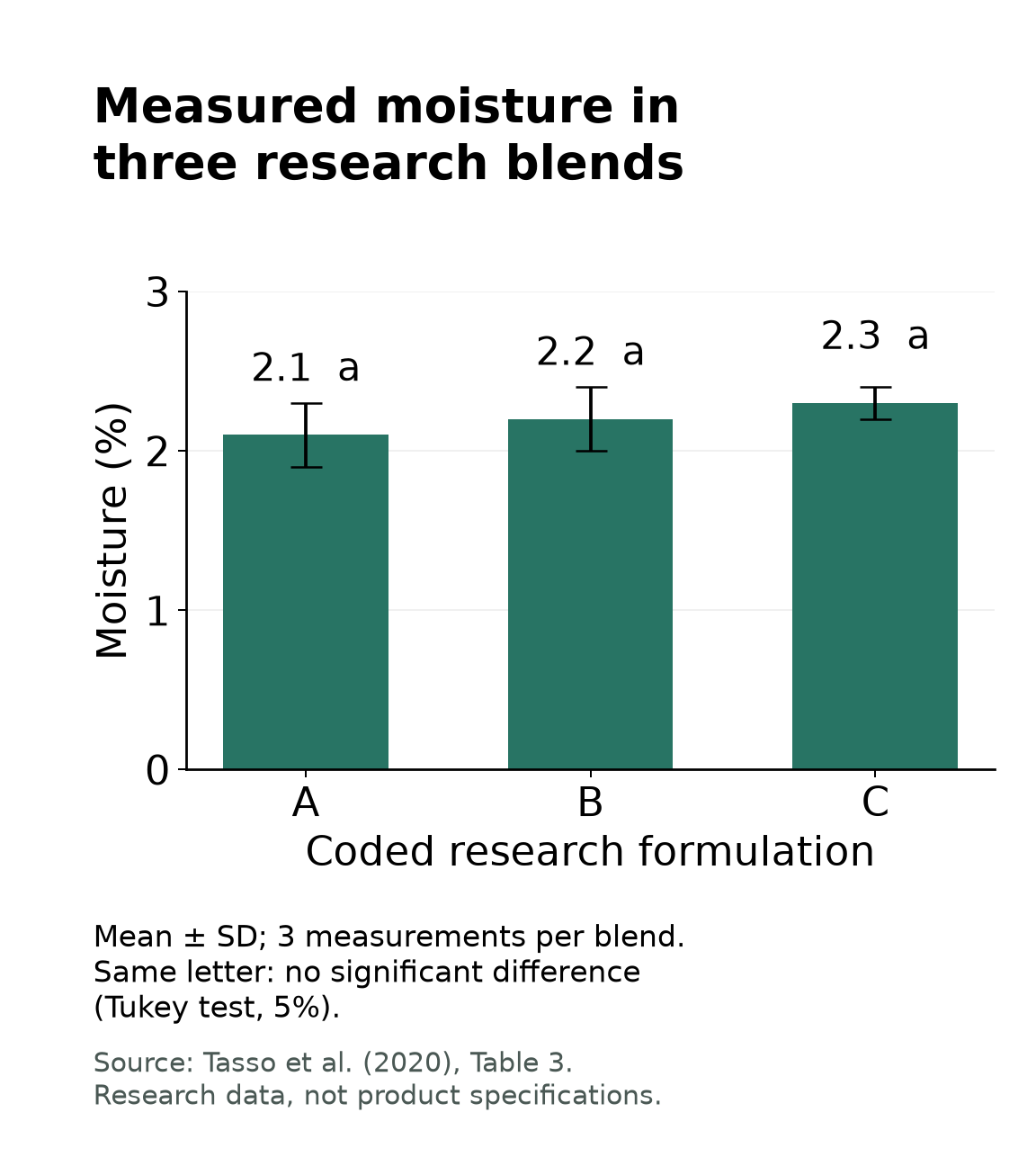
The practical distinction is simple: a measured mean, its variability and an agreed product limit answer different questions. A small numerical difference is not automatically evidence of a better ingredient.
Set the application test before judging a sample
Use the current formulation as the control and record all ingredient changes. Where practical, use coded samples and compare a sugar reference, the current sweetener and the candidate. Match the serving condition, not merely the room-temperature beaker. In taste work, distinguish sweetness onset, peak, lingering sweetness, bitterness, cooling and original flavor. An equal-dose comparison and a matched-sweetness comparison can reveal different problems. Keep their results labelled so a change in dose is not hidden.
| Application | Beyond sweetness | Record after processing |
|---|---|---|
| Coffee, tea or RTD drink | Original flavor, cooling, dissolution and storage appearance | Base, dose, serving temperature, heat/hold and visible changes |
| Dry beverage or protein premix | Distribution, flow, filling and reconstitution | Mix/transfer sequence, sample locations, fill results and dilution |
| Bakery | Spread, set, moisture, color and texture | Complete formula, baking profile and checks after cooling/storage |
| Sauce or filling | Body, acidity, dissolved solids and storage stability | pH, water activity where relevant, process and appropriate preservation review |
| Frozen dessert | Freezing behavior, hardness, melt and crystal development | Complete sweetener/solids system, storage and serving conditions |
Passing sweetness does not establish water activity, a safe preservation process or shelf life. If the pilot does not reproduce your equipment or storage, record that gap before approving production.
A sauce-development case shows what supplier experience can support
NCC Food Ingredients described work with producers on low-sugar and no-sugar ketchups and brown sauces in a 2019 application article. It attributed the work to an erythritol–stevia approach and reported launched products. This is a supplier’s own account; it does not identify the customers or provide a controlled performance dataset. It is useful as an example of working on a full sauce system rather than sweetness alone. It is not a Hengliyuan customer case, an independently verified sales outcome or a universal recipe. The article’s approximate blend proposal depends on its described stevia material; do not transfer it to a different extract. Revalidate viscosity, acidity, water activity and preservation under your own formulation and process.
Distinguish ingredient documents, finished specifications and batch reports
Documents describe different objects. Separate them into three categories:
| Document | Purpose | Key checks |
|---|---|---|
| Erythritol or stevia ingredient documents | Understand the ingredients used | Ingredient name, grade and relevant parameters |
| Finished blend specification | Define agreed requirements for the whole product | Ingredient proportions, target sweetness, particle specification and other quality requirements |
| Batch certificate of analysis (COA) or test report | Read results for the batch or submitted sample | Product name, batch, test object, test items and results |
If a blend sample comes with only an erythritol report, that report describes the ingredient, not the whole finished blend. The stevia ingredient’s assay value is not its inclusion percentage in the blend. Read results together with units, methods and scope. An unlisted test item does not mean a zero result; “not detected” must be interpreted against the stated detection limit. Raise specific test requirements early and confirm document coverage. State local regulatory and certification requirements before sample selection. Check the certificate’s covered entity, products or activities and validity period to establish relevance to this purchase. A specification states the agreed limits; the batch report records the reported results for its identified material. Read them side by side. A result marked “conforms” is useful only when you know which requirement it was assessed against. Where a report gives a numerical result, check the unit and method before comparing it with the limit.
Read extract assay, blend inclusion and batch result on the right basis
Ask what each number describes. An ingredient assay describes the stevia material. A formula percentage describes its addition to the finished blend. A batch result describes the identified tested object using its stated method. The numbers should not be substituted for one another. For arithmetic only, suppose 1,000 g of blend contains 0.50% of an extract with a 95% as-is assay for the stated measured constituent or constituent group. There are 5 g extract and a calculated 4.75 g of that assayed material, or 0.475% of the blend, assuming no other source or loss. This invented example is not a Hengliyuan formula, a sensory potency or a measured finished-blend result. Check whether an assay uses an as-is or dry basis, total steviol glycosides or an individual glycoside. A method reporting total glycosides does not necessarily provide the amount of Reb A or Reb M. Do not compare a numerical limit and a result until the test object, basis, units and method correspond.
| Number or statement | Object to identify |
|---|---|
| Extract assay | Specific glycoside or group, method and moisture basis |
| Extract inclusion | Mass of that extract per defined finished-blend mass |
| Target sweetness | Reference, measurement basis, base and sensory conditions |
| COA result | Tested sample or lot, item, unit, method and corresponding limit |
Resolve document mismatches before approving the sample
If the product name, sample code, batch or formula version does not line up, ask the supplier to explain the connection and provide the corresponding document or correction. Keep the unresolved item with the sample record; do not mark the finished blend approved using an ingredient-only report. For a missing test, distinguish “not reported” from a result that meets the requirement. Agree whether the item needs testing, which method and limit apply, and what evidence will be provided. Do not fill the blank with zero or copy a result from another batch. Trial and production batches can have different lot numbers. What must stay clear is the link from the accepted sample to the agreed finished specification, and from the delivered lot to its own batch documents. If the formula or particle specification changes, identify the new version and reconfirm the affected process performance.
Keep market access, labeling and exposure separate from taste approval
For US food use, FDA distinguishes high-purity steviol glycosides covered by particular GRAS conclusions from whole-leaf stevia and crude extracts. FDA says use of the latter as sweeteners is not permitted. A commercial ingredient still needs the identity, specification, intended-use and destination review relevant to your product; “stevia” on a label is not enough. For erythritol, EFSA’s 2023 re-evaluation established an ADI of 0.5 g/kg body weight per day to protect against laxative effects and related consequences. That is an assessment for erythritol exposure, not a recommended blend dose, a threshold guaranteeing everyone has no symptoms or a US labeling instruction. Calculate erythritol from the full formula and cumulative servings separately from the stevia component. FDA and EFSA also describe limitations in interpreting observational cardiovascular associations; do not present an association as proof that dietary erythritol caused disease, or turn that uncertainty into a guarantee of no risk. Review the current destination rules and proposed claims before packaging. Zero-calorie, sugar-free, organic and suitability for a particular medical condition are different matters.
Compare cost at the accepted dose and required physical result
A cheaper kilogram is not necessarily cheaper in the finished food. Compare the dose that reaches the accepted taste and physical target, then include any changes elsewhere in the formulation. A more concentrated blend can reduce sweetener mass and cost while leaving a solids gap. For an invented example, blend A at USD 5/kg and 10 g/kg finished food costs USD 0.05/kg food. Blend B at USD 8/kg and 5 g/kg costs USD 0.04/kg. Those are assumed prices and doses, not quotations or application recommendations; the lower-cost example also adds 5 g/kg less material. Do not call the systems equivalent until that difference is addressed.
| Cost item | Basis to align |
|---|---|
| Ingredient use | Accepted kg blend/kg finished product × comparable delivered price/kg blend |
| Formula changes | Any replaced solids, water, texturizer or other ingredient changes |
| Processing | Weighing, yield, losses, handling and required extra steps |
| Commercial terms | Quantity, pack, currency, delivery basis, freight/tax scope and validity |
Give each failed trial a specific next check
Keep the control and sample identity fixed while investigating a failed result. Change one main factor where practical and record the revision. This makes feedback useful for the next sample instead of restarting the comparison.
| Observation | First distinction | Next check |
|---|---|---|
| Too sweet or not sweet enough | Wrong identity or conversion basis versus a taste mismatch | Confirm dose and reference before adjusting the selected formula |
| Lingering or bitter | Stevia effect versus the original coffee/protein base | Coded matched-sweetness comparison in the same base |
| Cooling or gritty | A taste sensation versus crystals or insoluble base particles | Identify residue, concentration and cooling/storage history |
| Uneven stick packs | Filling error versus composition distribution | Measure fill mass and representative composition checks separately |
| COA does not match | Missing identity link versus missing test scope | Resolve with the supplier; do not fill a blank with zero |
Turn the accepted sample into a clear order
Keep the selected sample code, final formula version, target sweetness, particle specification, packaging and agreed test requirements together in the order confirmation. Identify the agreed specification revision so a later document cannot silently replace it. Taste acceptance and document acceptance answer different questions. Compare sweetness, aftertaste and original flavor in the actual application, while checking that the material and paperwork describe the same selected blend. When requesting Hengliyuan samples, send the application, destination country, target sweetness, excluded ingredients and any known equipment, particle-size or document requirements. If you have not selected a mesh requirement, describe the mixing, packing or reconstitution step first. We can use that brief to discuss the sample direction.
How Hengliyuan makes the corresponding blend
Hengliyuan makes its erythritol-based sweetener blends by fluid-bed granulation. In this common food-powder process, airflow fluidizes the powders as particles agglomerate. Confirm the particle specification, dissolution and application performance against the selected formula and sample.
Review note
Reviewed October 23, 2026. Brand directions and the sauce account are attributed to their publishers. Research data, assumed calculations and Hengliyuan’s confirmed supply information are kept separate. Final orders follow the selected sample, full composition, agreed specification and current destination-market requirements.
Common questions
Can an erythritol COA establish the quality of the finished blend?
No. It describes the erythritol identified in that report. Ask for documents that correspond to the finished blend and its batch or submitted sample, and compare their scope with the agreed finished-product requirements.
Discuss blend samples and documentsIs the stevia assay the same as its percentage in the blend?
No. An assay describes a property of the stevia ingredient; the inclusion percentage describes how much of that ingredient goes into the blend. Check the formula proportions and ingredient specification separately.
Discuss blend samples and documentsWhat if the supplier gives only a mesh number?
Ask for the sieve or measurement standard, the required passing proportion or size range, and the test method. Keep that agreement with the sample and order. Visual inspection alone cannot confirm a particle-size distribution.
Discuss blend samples and documentsDoes a missing test result mean zero or not detected?
No. It means the result is not reported in that document. Confirm whether the test was performed and whether it is required for your purchase. Interpret “not detected” against the stated detection limit and method.
Discuss blend samples and documentsMust the production lot have the same number as the trial sample?
Not necessarily. Trial and production lots can differ, but each needs traceable identification and corresponding documents. The delivered product must match the agreed specification; changes to the formula or particle requirements need explicit review.
Discuss blend samples and documentsDoes Hengliyuan provide the blend formula and specification?
For customers purchasing finished blends, Hengliyuan provides complete ingredient names, exact proportions, target sweetness and finished-product specifications. State equipment, particle-size and document requirements before sampling, then include the final agreement in the order.
Discuss blend samples and documentsCan every erythritol–stevia blend replace sugar 1:1?
No. Different products have different sweetness targets. Confirm whether the instruction uses mass or volume, then compare sweetness and the required physical functions in the actual food. A lower dose can leave missing solids.
Discuss blend samples and documentsDoes a stated extract percentage tell me the finished sweetness?
No. Extract identity, glycoside profile, dose, base and serving conditions matter. The assay percentage, amount of extract added and finished-product sweetness are separate information.
Discuss blend samples and documentsDoes a powder sinking into a drink prove it has fully dissolved?
No. Wetting, dissolution and later crystallization are different observations. Record the dose, liquid, temperature, mixing and storage, and identify any remaining or later-formed particles.
Discuss blend samples and documentsDoes a published research result set my purchase limit?
No. A research mean and its variability are observations for the tested samples. Your order needs an agreed specification with the appropriate method, basis, unit and acceptance limits.
Discuss blend samples and documents