Read this guide in
Hengliyuan application and selection
Erythritol Powder vs. Granules: Particle Size, Handling, and Applications
Compare powdered and granulated erythritol for frosting, baking, beverages and bulk filling. See real ingredient labels, spoon-to-gram examples and particle-size checks.
Powdered erythritol is finely divided crystalline erythritol, often sold as confectioner's erythritol. Compare it first for smooth frostings, dusting and low-water formulations; compare granules for pouring, dosing and applications where a crystalline texture is useful. Grinding changes the particle size, not the identity of the sweetener.
Start with the ingredient list. Pure erythritol powder and a powdered monk fruit–erythritol blend can have different sweetness and serving instructions. Hengliyuan supplies powder and granular erythritol, with granular mesh requirements available for discussion. Confirm the actual specification and sample before purchasing.
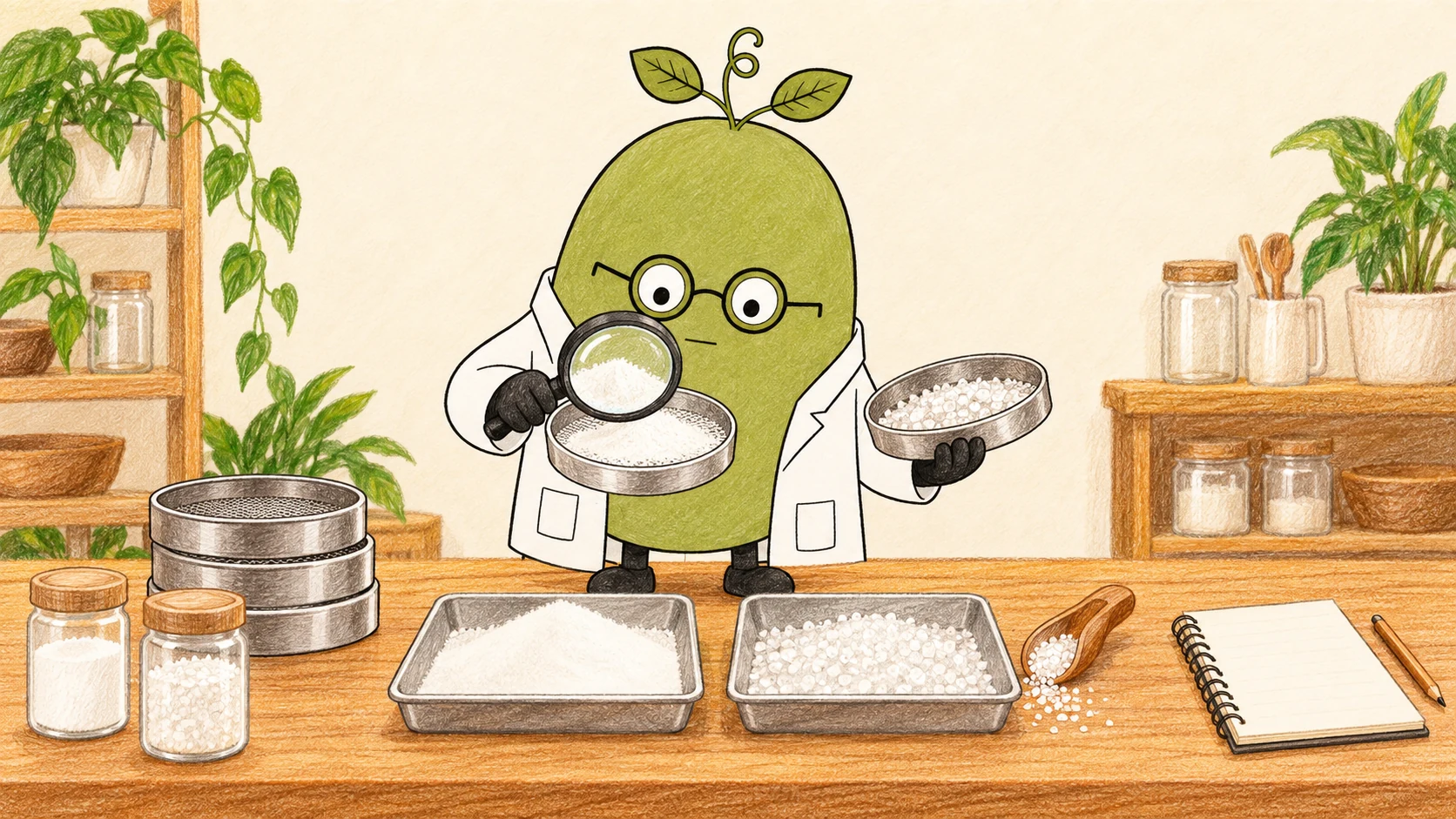
What is powdered erythritol, and is it the same as confectioner’s sugar?
Pure powdered erythritol and granulated erythritol contain the same sweetening substance; the physical form differs. Conventional confectioner's sugar is a sucrose-based product, so the words “confectioner's” and “powdered” do not make the two interchangeable. Check the full ingredient declaration for starch, high-intensity sweeteners or other ingredients. Actual manufacturer pages show why that check matters. These are examples of product declarations, not laboratory comparisons or endorsements. They do not establish the composition of a Hengliyuan product.
- Anthony’s confectioner’s erythritol: product details
- NOW organic confectioner’s erythritol: ingredients
- Lakanto powdered monk fruit–erythritol: ingredients and usage
| Public product example | What the manufacturer declares | What this tells you |
|---|---|---|
| Anthony’s Confectioner’s Erythritol | Erythritol without other added ingredients; about 70% as sweet as table sugar | “Confectioner’s” can describe pure erythritol without added starch. |
| NOW Organic Confectioner’s Erythritol | Organic erythritol powder as the sole ingredient | A powdered product does not necessarily contain a carrier or anti-caking ingredient. |
| Lakanto Powdered Monkfruit and Erythritol Sweetener | Erythritol plus monk fruit extract; marketed as a cup-for-cup powdered sugar replacement | A blend’s 1:1 instruction cannot be transferred to pure erythritol. |
When to consider erythritol powder
For frosting, icing, dessert dusting and other applications with little water or little heating, compare a fine powder first. The immediate question is whether the finished product feels smooth, not whether every particle has dissolved. In chocolate and other fat-rich systems, judge particle dispersion and the refining process rather than assuming the powder disappears into the fat. Powder is a useful starting point when erythritol must mix with other powdered ingredients or enter a further formulation step. Compare the actual sample in that process rather than choosing only by how fine it looks. Check dust during charging, adhesion during transfer, agglomerates after mixing, and dosing on the intended packaging equipment. In the finished food or drink, check dispersion, dissolution and mouthfeel as applicable. A finer material is useful only if it improves the task without creating another handling problem.
When to consider erythritol granules
Granules can be useful where a visible crystal, deliberate crunch or sugar-like pouring behavior is wanted. For creamed doughs, compare the actual dough and baked texture: changing the sweetener form can also change how it mixes with fat. Compare granules for direct dosing, filling, retail containers and applications where flow matters. Observe discharge through the actual hopper, consistency of each fill, emptying from the pack and how the consumer pours or measures the product. Then test the material in its intended food or drink. Granular form does not guarantee flow in every machine or complete dissolution under every preparation method. Particle size, shape, surface condition and equipment all matter.
A public application example: two forms in the same cookie
NOW Foods publishes a Keto Snowball Cookies recipe credited to Meal Prep on Fleek. Its dough uses ¼ cup granulated erythritol, while ½ cup confectioner's erythritol is reserved for rolling the cooled cookies. The dough also contains a liquid monk fruit sweetener. The example assigns granules to the mixing step and powder to the exterior coating. It is not a controlled powder-versus-granule trial, and the two listed volumes serve different jobs. It does not prove that swapping either form gives the same texture, nutrition or shelf life. For a production project, test the coating after packing and storage as well as just after rolling.
Why the same spoonful can deliver a different weight
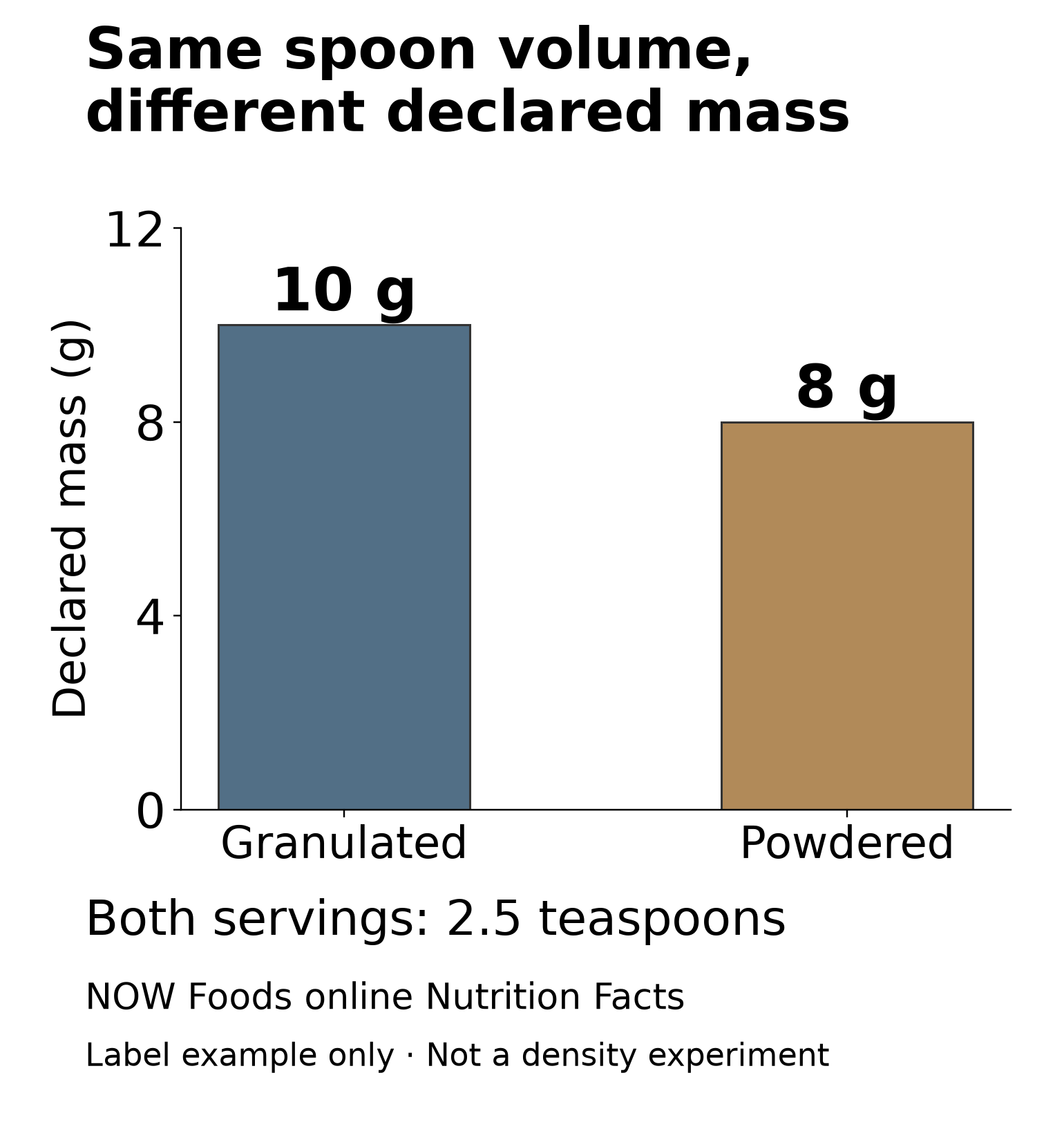
Weigh ingredients when changing form. NOW's online Nutrition Facts list 2.5 teaspoons as 10 g for its organic granulated erythritol and 8 g for its organic confectioner's erythritol. Both list organic erythritol as the only ingredient. At the declared serving volume, that is a 2 g difference. This is a comparison of two manufacturer declarations, not a measurement of bulk density. Rounded serving values and filling methods limit the inference; it does not establish a conversion factor for another brand, a different pack or Hengliyuan material.
- NOW organic granulated erythritol: Nutrition Facts
- NOW organic confectioner’s erythritol: Nutrition Facts
| NOW online Nutrition Facts | Declared household serving | Declared mass |
|---|---|---|
| Organic Erythritol, granulated | 2.5 tsp | 10 g |
| Organic Confectioner’s Erythritol, powder | 2.5 tsp | 8 g |
Can you replace sugar or a powdered blend by weight?
Pure erythritol is less sweet than sucrose. Cargill's Zerose guide reports relative sweetness of 70 against sucrose at 100 in 10% aqueous solution, pH 6, 25°C. This is a useful reference condition, not a fixed sweetness ratio for every finished food. Milling alone does not turn pure erythritol into a 1:1 sugar replacement. For a calculation only, assume sweetness scales linearly with mass and the relative sweetness is 0.70. Then 100 g ÷ 0.70 = about 143 g erythritol to represent the sweetness of 100 g sucrose. Using 130 g would represent 91 g sucrose under that assumption. This arithmetic is not a recipe, a sensory result or a suggested serving.
| Comparison basis | What it means | What still needs testing |
|---|---|---|
| Same erythritol mass, powder vs. granules | Controls the amount of incoming erythritol | Mixing, texture, dissolution and fill behavior |
| Same cup or spoon volume | May deliver different masses | Weigh the actual material and record the filling method |
| Same calculated sweetness | May require different sweetener masses | Sweetness in the food, bulk, moisture and texture |
| A blend labeled 1:1 | Applies to that product’s stated use and measurement basis | Its ingredient list and the actual finished application |
Removing sucrose also changes functions beyond sweetness. Cargill describes different baking behavior and less color formation with erythritol. A finer grind cannot supply missing browning, moisture management or structure. Retest the full formula when replacing sugar or a blend.
Turn a mesh request into an agreed specification
Send the intended application and equipment with the size request. If you have a particle-size requirement, include its measurement method and acceptance limits; a mesh label on its own is an incomplete purchasing instruction. Do not treat a size result as proof of filling or dissolution performance. Hengliyuan can discuss the offered mesh specification and corresponding sample. Keep the sample code, agreed particle specification, method, packaging and quantity together in the quotation and order. Confirm performance in your own process before approving that specification. If you do not yet know the mesh you need, describe the task instead: batch feeding, retail pouring, sachet filling or further processing. That is a useful starting point for selecting samples; there is no need to invent a mesh number. A supplier example makes the distinction concrete: Icon Foods lists ErySweet crystalline at 20–60 mesh, fine at 80–120, Ultra at 130–170 and Supreme at 180–220. Its stated applications range from tabletop and dry blends to chocolate. These are that supplier's grade descriptions, not a universal definition of “powder” or Hengliyuan stock specifications. Ask for the sieve standard, percentage passing or retained, and test method; for laser diffraction, specify the distribution basis and D10/D50/D90 instead of treating a mesh label as the full distribution.
Choose the pack around how material is used
Current Hengliyuan erythritol formats include 1 kg bags, 25 kg bags and 25 kg drums. Choose around the quantity used at one time, how material is withdrawn, transport and storage—not net weight alone.
| Available format | Use to discuss | Check before ordering |
|---|---|---|
| 1 kg bag | Samples, smaller quantities or staged use | Actual quantity needed, opening frequency and storage instructions |
| 25 kg bag | Bulk production with bag handling | Transfer method, material withdrawal and storage conditions |
| 25 kg drum | Bulk projects using a drum format | Handling, withdrawal and the agreed inner/outer packaging specification |
Other pack sizes or materials can be discussed. Confirm custom-pack specifications, quantity, artwork or labeling, lead time and quotation before treating them as available. Keep material form and pack format on the same confirmation document.
How should powders and granules be compared?
| Comparison | Powder sample focus | Granule sample focus |
|---|---|---|
| Formulation | Mixing and dispersion with the other powders | Dosing and entry into the next process step |
| Production handling | Dust, adhesion, agglomerates and transfer | Flow, discharge, filling and pack emptying |
| Beverage preparation | Dispersion and dissolution at the intended temperature, concentration and mixing conditions | Dissolution time and residue under the same conditions |
| Tabletop use | Suitability for the planned serving and pack | Pouring, portion mass and fit with the serving instruction |
| Purchasing documents | Particle-size information and sample/batch documents for the offered powder | Agreed size specification and sample/batch documents for the offered granules |
Use the same addition rate, equipment, operating method and observation time for the initial comparison. Powder mixed warm at high speed cannot fairly be compared with granules mixed cold by hand. If you deliberately change the process for one form, record the change and compare the complete operating routes.
Separate dissolution speed from chilled stability
For a beverage trial, record the erythritol mass, total beverage amount, temperature, addition order and mixing method. Observe particles or residue immediately after preparation, then repeat the checks under the planned serving and storage conditions. Powder that dissolves quickly is not automatically protected against later crystallization. Granules that dissolve more slowly may still work with the specified preparation method. Evaluate the actual formulation rather than using the form name as a solubility guarantee. The Max Planck Institute for Polymer Research describes erythritol's strong tendency to crystallize and investigates how additives affect that process. Treat “smooth just after mixing” and “smooth after storage” as separate acceptance criteria. Record when grit appears, the storage temperature, package and water loss; do not declare stability from a fast dissolution result.
Which form should be used in a blended sweetener?
Select the erythritol form together with the other ingredients, target sweetness, mixing route, packaging and consumer use. For a small addition of a high-intensity sweetener, compare how the chosen materials and process achieve the required blend uniformity. If the final blend must pour, scoop or fill into portions, test the finished blend—not only the incoming erythritol. Confirm its handling and application performance after the ingredients and ratios are selected. Hengliyuan can discuss the material form and blending direction from that complete brief. A published dark compound chocolate study by Wong and colleagues (Food Chemistry, 2024) compared sweetener–polymer systems, including erythritol with polydextrose. The university's public abstract reports that particle properties and moisture affected flow and texture. It concerns complete blends, not a controlled test of pure erythritol powder against granules. Use it as a reason to check the final chocolate system; it does not validate a universal mesh target or substitution ratio.
Can granules be ground into powder, and is it cheaper?
Granules can be milled into finer particles, but a kitchen-ground powder does not establish the particle distribution of a commercial grade. For production, qualify the mill, temperature control, sieve or particle test, contamination controls and resulting lot consistency. Keep the original ingredient identity and the new lot/process record together. Compare cost per accepted finished batch. Add milling labor, energy, transfer losses, dust control, cleaning and rejected fills to the material cost. Obtain current quotes for the same quantity, pack and delivery terms; retail bag prices do not establish a bulk powder premium. Neither home milling nor a supplier's “ultra-fine” label replaces a sample test.
Calories and safety: particle size is not the deciding factor
For U.S. nutrition-label calculations, 21 CFR 101.9(c)(1)(i)(F) specifies 0 calories per gram for erythritol. That factor is distinct from rounding a small serving to zero. It does not mean that a frosting, cookie or blend containing other ingredients has zero calories or no carbohydrates. Assess the finished product's label and claims in its destination market. A finer powder is not evidence of better digestive tolerance or lower cardiovascular risk. FDA states that the observational studies it reviewed in 2023 did not establish a causal link between consuming erythritol and the reported cardiovascular effects, and that it continues to monitor new information. That statement does not establish the absence of risk or justify claiming that erythritol prevents disease. Assess ingredient exposure and current market requirements separately from particle-size selection.
Request samples that match the purchasing decision
Start with the application, the operation that matters most and whether you want to compare powder, granules or both. Share a known size requirement and measurement method, or describe the issue you need to solve. Add the pack, estimated quantity, sales market and document needs when available. For the formal order, confirm the accepted sample code, material form, particle specification, pack type and net weight together. Ask whether the offered batch and documents match that agreement. Custom packs, quotation terms and available batches remain subject to project confirmation.
Review note
Reviewed October 22, 2026. Manufacturer examples describe the named public products at the time checked; they are not endorsements, Hengliyuan specifications or comparative laboratory tests. The spoon chart uses online label declarations, and the 0.70 sweetness calculation is illustrative. The chocolate paper was reviewed through its university abstract, not its full methods. Approve material form using the actual sample and intended process.
Common questions
Is finer erythritol powder always better?
No. Test the actual mixing, transfer, dosing and packing task. Finer material may suit one step while creating dust, adhesion or agglomeration in another. Approve the sample against the whole intended process.
Discuss erythritol sample optionsWhat if I do not know which mesh to request?
Describe the application, equipment and current handling or dissolution problem. If you have a size requirement, include the method and acceptance limits. Otherwise, start with sample selection and agree the specification after comparison.
Discuss erythritol sample optionsDoes the same mesh description guarantee the same performance?
No. The particle specification and measurement method need to be clear, and process performance still needs testing. Keep the accepted sample identification with the purchasing specification rather than ordering from a form name alone.
Discuss erythritol sample optionsWhich pack sizes can I discuss with Hengliyuan?
Current formats include 1 kg bags, 25 kg bags and 25 kg drums. Choose according to usage, handling and storage needs. Other formats require confirmation of specifications, quantity, labeling, lead time and quotation.
Discuss erythritol sample optionsShould a cold beverage use powder or granules?
Compare both at the intended dose, temperature and mixing conditions. Check immediate dissolution and later chilled storage separately. Faster initial dissolution does not establish freedom from later crystallization.
Discuss erythritol sample optionsCan I approve a sweetener blend from the erythritol sample alone?
No. The other ingredients, ratios and mixing route affect the final blend. Check the finished blend for uniformity, flow, dosing and performance in the intended application and pack.
Discuss erythritol sample optionsIs powdered erythritol always a 1:1 powdered sugar substitute?
No. Pure erythritol is less sweet than sucrose, while some blends add monk fruit or another sweetener and carry their own 1:1 instruction. Check both the ingredient list and whether the instruction is by volume or weight. Texture and other sugar functions still need testing.
Discuss erythritol sample optionsCan I swap powdered and granulated erythritol cup for cup?
Do not assume the masses match. The two NOW organic products discussed here declare 2.5 teaspoons as 10 g for granules and 8 g for confectioner’s powder. Those are product-specific online label values, not a general conversion. Weigh your actual material and test the application.
Discuss erythritol sample options