Read this guide in
Hengliyuan application and selection
Bulk Erythritol Buying Guide: Specifications, Packaging, and Storage
Compare bulk erythritol offers by composition, particle size, batch COA, pack size, landed cost and remaining shelf life, with documented supplier examples.
To buy bulk erythritol, first decide whether you need pure erythritol or a sweetener blend. Then compare the quoted grade, particle-size specification, batch documents, packaging, delivered cost and remaining shelf life on the same basis. A 20 kg monk fruit blend, a 10 kg bag of granules and a 25 kg food ingredient are different offers, even when all appear in a search for bulk erythritol.
Hengliyuan supplies erythritol in powder and granular forms, with granular mesh requirements available for discussion. Current packs include 1 kg bags, 25 kg bags and 25 kg drums; other custom packaging can be discussed against project needs.
This guide is for food and beverage procurement, R&D and quality teams. It shows how to read an actual published specification and turn sample approval into a traceable purchase. For a live quotation, use the erythritol product page or send the application, form, quantity and destination; price, MOQ, stock, delivery and current batch documents require confirmation.
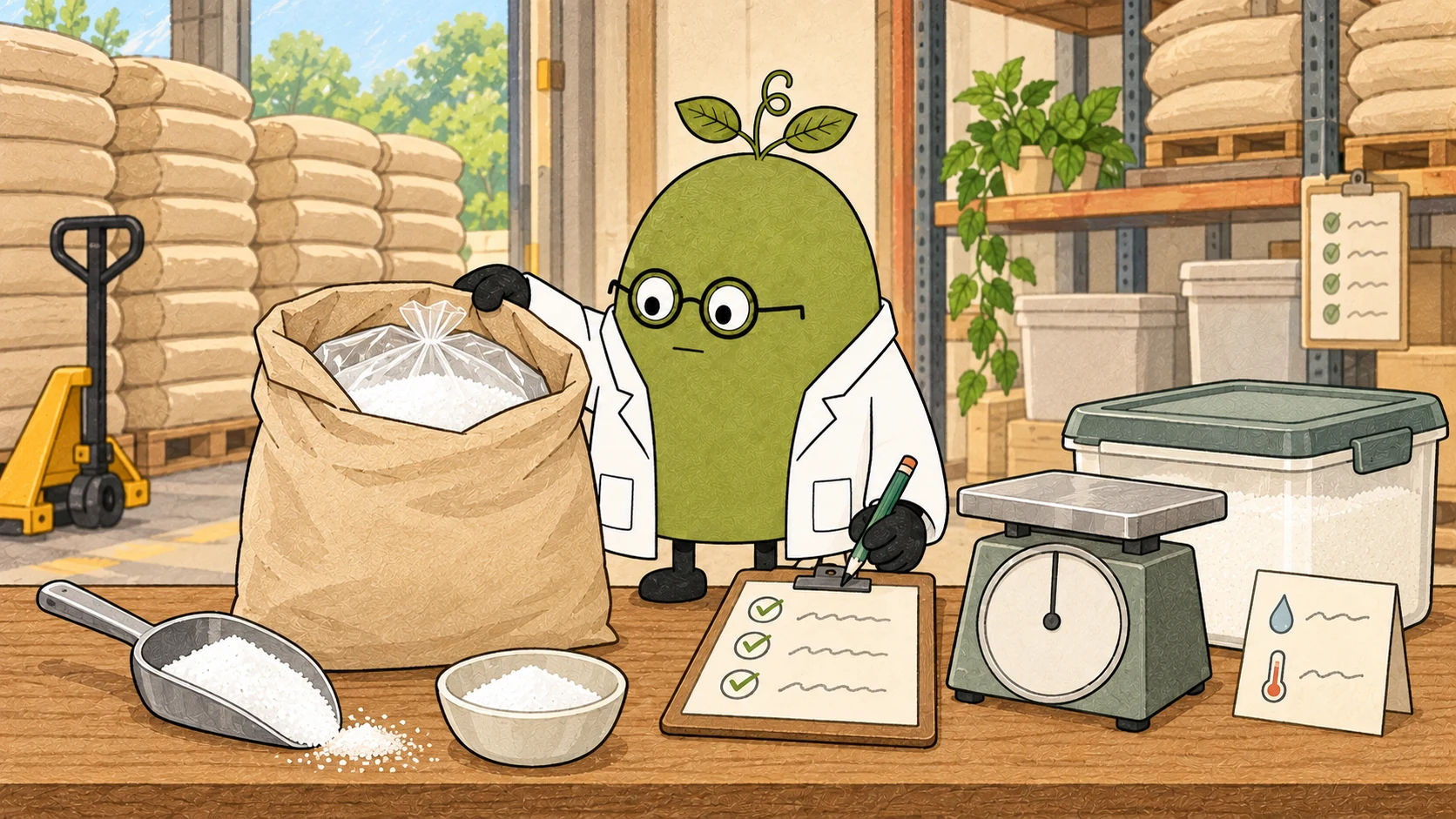
What does a bulk erythritol offer actually contain?
Start with the ingredient list and exact product name, not the bag photograph or the word bulk. These public examples were checked on October 22, 2026. They illustrate differences between offers; they are not recommendations, current Hengliyuan terms or evidence that the products perform equally.
- Jedwards: non-GMO erythritol granules, 10 kg
- Lakanto: bulk erythritol blend collection
- BulkFoods: erythritol sizes and volume tiers
- Icon Foods: ErySweet grades and specifications
| Public offer | What is specified | What a buyer should compare |
|---|---|---|
| Jedwards non-GMO granules | 10 kg (22 lb) product; powder and organic granules are separate listings. | Compare the same form and certification scope. The listing alone is not the delivered lot’s analysis. |
| Lakanto erythritol blend collection | Classic and golden 20 kg offers; an organic classic 25 kg offer. These are monk fruit sweetener blends. | Read the full composition and sweetness basis before comparing price per kilogram with pure erythritol. |
| BulkFoods erythritol | Ingredient: erythritol; 1 lb, 5 lb and 30 lb pack choices, with quantity tiers for the case. | A retail or case pack is not the same unit as a factory pallet; calculate net delivered kilograms. |
| Icon Foods ErySweet | 20 kg bag or box; four stated mesh grades; separate conventional, organic and blend offerings. | Choose the named grade and obtain its current specification. Do not combine figures from different grades. |
Public prices, stock indicators and delivery promises can change. Ask for a written offer for the exact quantity, product, destination and document package. Do not treat a collection’s certification badges as proof for every variant.
Define the product required for this purchase
"Food-grade erythritol" alone is not a complete purchasing requirement. Within the same project, powder, granules and specified mesh grades can differ in dissolution, mixing, dosing, conveying and packing performance. A supplier enquiry should state at least: - Whether the product is for beverages, baked goods, tabletop sweeteners, tablets or another application; - Whether powder or granules are required, or a mesh specification is to be discussed; - Whether samples and bulk material must use the same form and mesh specification; - Target market, expected purchase volume and intended use after receipt. If powder or granules have not yet been selected, first define the application, equipment and current issue, then select the relevant sample for testing.
Check the supplier, manufacturer and document chain
The company issuing a quotation may be a manufacturer, distributor or repacker. Ask who makes the quoted material, who packs it, whose specification applies and who issues the batch COA. A directory entry or a list of “best manufacturers” is a starting point for verification, not proof that every company makes every grade. Record the manufacturer or approved source, product code, production site when needed for qualification, country of origin and lot traceability. If supply can move between plants or origins, agree on change notification and requalification before the next order. A warehouse location is not the country of manufacture. For organic, non-GMO, kosher or halal requirements, check the named product, operator/site, certification scope and validity against the actual supply. A certificate for stevia or monk fruit does not establish certification of erythritol. Food-grade qualification also does not establish suitability for pharmaceutical use.
Read a real specification: assay, water and sieve limits
Ingredion’s North American ERYSTA C40 document, effective October 9, 2024, provides a useful reading example. Its columns distinguish typical properties, microbiological maxima and a screen test. These are the named manufacturer’s published entries, not Hengliyuan acceptance limits or measured results for a batch.
| Published entry | Value and basis in the document | How to use it in a purchase |
|---|---|---|
| Assay / water, under typical properties | Erythritol >99.5% dry basis; water <0.2%. | Keep the dry-basis qualifier. Ask for the agreed release limits, methods and lot results. |
| Screen test: on U.S.S. #18 | Maximum 15%; stated opening 1000 µm. | This is a retained fraction, not a promise that every particle is below 1000 µm. |
| Screen test: #18–#60 | Minimum 80%; #60 opening stated as 250 µm. | A distribution band cannot be replaced by an average diameter or the word fine. |
| Screen test: through #60 | Maximum 5%. | Record passing/retained direction, sieve system and method for comparison. |
| Microbiological standards | Plate count ≤200/g; yeast ≤20/g; mold ≤20/g; E. coli negative/10 g. | Preserve test portions and units. “Negative” without a sample amount is incomplete. |
The same sheet calls the form a white crystalline powder. That wording alone does not establish equivalence with an ultra-fine chocolate grade. Also, a general product sheet may include typical values rather than contractual batch limits. Put the accepted specification revision and any additional safety or contaminant requirements into the order; do not turn all typical values into guarantees. For a deeper comparison of form and particle size, use the existing powder-versus-granules guide.
What product specifications and a batch COA each establish
A product specification defines the acceptance items and ranges agreed between supplier and customer. A batch certificate of analysis (COA) records test results for one batch. They serve different purposes; neither a general product introduction nor a historical report replaces them. Before ordering, check that the product form, mesh requirement and other agreed quotation items match the current specification. On receipt, match the batch number on the packaging and delivery documents to the batch COA. If specific tests, third-party reports, compliance statements or target-market documents are required, raise them before order confirmation so availability for this supply can be verified. Hengliyuan’s 2020 erythritol report is historical sample information. It does not represent a current quotation grade or supply batch. Available documents are confirmed against the current product, batch and project requirements; historical reports are not used as evidence for a current batch. Ask whether assay is reported on a dry basis or as received, and whether the sheet shows a typical value, an acceptance limit or a measured lot result. Those are not interchangeable. Agree the unit, test method and sample amount for each acceptance item; “food grade” does not resolve missing data.
Agree when each document will be available
Document timing can affect whether an order can be released. Jedwards’ public listing, for example, says lot-specific COAs are attached to the shipment notification sent the morning after an order ships; some other documents require an account. That is the seller’s stated workflow, not a universal requirement. If your QA team needs approval before dispatch, resolve that timing before paying or authorizing shipment.
- Jedwards listing: product documents and COA timing
- Faisfor erythritol product page: published shelf-life statement
- Faisfor public COA: dated historical lot
| Stage | Document or record | What it must establish |
|---|---|---|
| Supplier qualification | Current specification/TDS, SDS and applicable certification statements | Exact product/form, revision, handling information and relevant certification scope. An SDS is not a batch purity report. |
| Sample evaluation | Sample lot ID, associated COA and test record | What was tested, where the sample came from, and under which process conditions it passed. |
| Order confirmation | Accepted specification, pack/label details, document list and change-control agreement | The requirements that the bulk delivery must meet, including any pre-shipment approval. |
| Dispatch and receipt | Delivered lot COA, packing list, lot labels and required origin/market documents | Traceability to the actual quantity and lot received, with approved exceptions documented. |
Agree what happens when a requested test is not performed on every lot, a result is outsourced, or a document will arrive later. “Available on request” does not establish a test result or a guaranteed delivery time. Obtain clarification instead of filling a blank COA field with zero. A dated public COA gives another useful example. Faisfor’s downloadable erythritol COA lists production on April 12, 2023 and expiry on April 11, 2025, while its product page states a 36-month shelf life. This historical lot is not evidence of the life or condition of current stock. Ask which current grade, document revision and packaging the quoted period covers, and reconcile the actual lot dates before accepting the delivery.
Make the application trial decide the grade
Supplier pages often give an application list. A more useful bulk decision is to specify what must pass in your own product and process. Cargill’s Zerose page discusses beverage, confectionery, baking and frozen applications; its examples are a development starting point, not results for an arbitrary customer recipe.
- Cargill Zerose: applications and technical details
- Powder versus granules: particle size and handling
- Cold-drink dissolution and crystal checks
| Use | Trial conditions to record | Acceptance evidence |
|---|---|---|
| Cold drink or dry beverage mix | Dose, water temperature, mixing time, other solids and storage temperature. | Dissolution during preparation and crystal/sediment checks after the intended hold. Faster initial dissolution does not prove storage stability. |
| Chocolate or fat-based filling | Particle distribution, refining/conching process, erythritol fraction and tasting temperature. | Grittiness, cooling sensation and texture in the finished product; do not assume powder removes cooling. |
| Tabletop blend or sachet | Blend composition, particle/bulk-density differences, mixing and filling equipment. | Sweetness uniformity, segregation and fill-weight consistency at the start, middle and end of the run. |
| Bakery or frozen dessert | Sugar replacement level, water balance, process and storage cycle. | Color, texture and storage performance. A sweetness match alone does not replace sugar’s other functions. |
Use a retained control and the same process when comparing grades. Record sample and bulk lot identifiers separately. These are suggested checks, not a validated formula, fixed replacement ratio or a claim that Hengliyuan has run these trials.
Packaging is more than net weight
Hengliyuan’s current erythritol packs are 1 kg bags, 25 kg bags and 25 kg drums. They suit different uses: 1 kg packs can support sample evaluation, small runs or staged material withdrawal; 25 kg bags and drums should be selected for the customer’s unloading, stacking, feed and post-opening handling. For custom packaging, state together: - Net weight per bag or drum; - Bag, drum or another format; - Inner-pack, sealing, outer-pack or pallet requirements; - Label language, label content and target-market requirements; - Expected quantity, delivery method and required delivery date. Feasibility and effects on quantity, lead time and quotation must be confirmed for the project. Do not add packaging requirements only when production or shipment is due.
Confirm storage conditions for the quoted product
Storage instructions belong to a named grade, document revision and packaging. These examples show why a shelf-life number must stay attached to its source and conditions. They are reference cases, not Hengliyuan batch guarantees.
- Ingredion ERYSTA® C40 Technical Specifications
- Icon Foods ErySweet: packaging and storage specifications
| Published source | Stated storage conditions | Stated period and scope |
|---|---|---|
| Ingredion ERYSTA C40, North American technical specification, October 2024 | Below 38 °C and below 60% relative humidity. | 36 months from manufacture under the recommended conditions. |
| Icon Foods ErySweet public specifications, checked October 22, 2026 | Below 85 °F (about 29.4 °C). Its table does not state a relative-humidity limit. | 36 months; 20 kg bag or box listed. Confirm the current written handling instructions for the selected grade. |
For the actual quotation, confirm the written storage temperature, humidity, unopened shelf life and packaging covered by those instructions. Do not transfer another manufacturer’s limits to the supplied material. Also agree on resealing and handling after opening. Give us your warehouse conditions, opening frequency and expected usage cycle. If the selected pack does not fit that routine, discuss smaller units or a different delivery schedule before ordering.
Pack size and remaining life: two planning examples
A larger unopened pack can be inconvenient when consumption is slow. In a hypothetical plant using 5 kg per week, a 25 kg bag spans five weeks after first opening, while five sealed 5 kg units would be opened one at a time. This is handling arithmetic, not a recommended five-week open life, and the 5 kg unit is not a promise of a Hengliyuan standard pack. Compare the cost and feasibility of an agreed smaller format with the need to reseal, identify and protect an opened bag. Also specify minimum remaining unopened life at arrival. For illustration, material with a documented 36-month unopened life that is 8 months old at dispatch and spends 2 months in transit has about 26 months remaining on arrival, provided the documented storage and transport conditions have been met. A manufacturing-date shelf life is not the same as a fresh 36 months at receipt. Use actual manufacture/best-before dates, transit conditions and QA requirements in the purchase; calendar-month arithmetic is not a stability study.
Carry the approved sample requirements into the bulk order
An approved sample establishes a result for that sample under the recorded test conditions. Put the agreed product form, mesh, acceptance specification, packaging and document requirements into the purchase record. On receipt, check: 1. Product identity, form and agreed particle-size requirement; 2. Pack type, unit weight, quantity and seal condition; 3. Batch numbers against the delivery documents and batch COA; 4. The incoming inspection agreed before purchase; 5. Any application or equipment check required for release. When the sample and delivery come from different batches, use their respective batch records. State additional release requirements before confirming the order.
If the bulk lot differs from the approved sample
Keep questionable material identified and separate from released stock while QA assesses it. Record the purchase/specification revision, sample and delivered lot numbers, photographs of seals/labels and the observed difference. Ask the supplier to reconcile the lot records and agreed test method before making a disposition. For example, if a powder seems gritty, compare the agreed sieve or particle-size method and repeat the relevant application check against a retained control. If bags arrive damp or damaged, document the affected units and transport condition; an unopened shelf-life statement does not establish the acceptability of compromised packs. If a COA is missing or lists a different lot, obtain the correct traceable document. Do not silently relabel, blend away or release a discrepancy merely because the product name is the same. Any retest, replacement, concession or rejection should follow the agreed quality procedure. This is a proposed receiving workflow, not a report of a Hengliyuan customer incident.
Compare landed cost, not only price per kilogram
Bring each quote to the same currency, net mass, composition, specification, destination, delivery term and date. Separate product cost, packaging, transport, insurance where relevant, import charges, clearance, inland delivery and testing. Ask which party pays each item and whether a local warehouse offer already includes import costs. For U.S. purchases, the March 27, 2026 notice issued AD/CVD orders for erythritol from China. Its scope covers all physical forms and grades, including organic; it specifically excludes certain finished tabletop substitutes packaged and labeled for retail sale or individual consumption. A bulk blend is not automatically exempt. The importer or customs broker must verify the written scope, producer/exporter combination and current entry requirements; no single duty percentage is applied here. A useful internal calculation is total comparable delivered cost divided by accepted usable kilograms. Track rejected material and process losses separately. Do not divide a blend’s price by an assumed erythritol percentage when its composition has not been disclosed.
What to include in a bulk erythritol inquiry
| Inquiry item | Useful details |
|---|---|
| Application | Product type, production step and the issue to solve. |
| Material form | Powder or granules; required mesh and measurement method, if specified. |
| Quantity | Sample needs, initial order and expected ongoing use. |
| Packaging | 1 kg bag, 25 kg bag, 25 kg drum or proposed custom format. |
| Documents | Specification, batch COA and target-market document requirements. |
| Storage | Warehouse conditions, opening routine and expected usage cycle. |
| Delivery | Destination, required arrival date and handling or pallet requirements. |
Start with the details you know. Clear requirements make quotations easier to compare; the remaining sample, document and delivery questions can be worked through together. You can copy this brief: “We need erythritol for [application] in [target market]. Please quote [quantity] of [powder/granules and agreed particle-size requirement], packed as [format and net weight], delivered to [destination] by [date]. Please identify the manufacturer/origin, specification revision, document availability before dispatch, minimum remaining life at arrival and all included/excluded delivery costs. We need a traceable sample for [test conditions]. Please flag any difference between sample and bulk supply.”
Discuss bulk erythritol purchasing with Hengliyuan
If form, mesh and packaging are already set, send those requirements with the quantity and destination. If they are undecided, start with the application, equipment and handling problem so we can agree on the sample to evaluate. Available specifications, batch documents, storage requirements and delivery arrangements must match the product quoted. Custom packaging remains subject to project confirmation.
What is the difference between a TDS and a batch COA?
A technical data sheet describes the named material's properties, handling and technical specifications. A batch COA reports results for an identified lot. Check the TDS revision and selected form or mesh, then match the sample and delivery lot to the agreed specification and their respective COAs. A general TDS is useful for selecting a sample, but it does not establish the test results of the delivered batch.
What does current evidence say about erythritol health risks?
Erythritol can cause diarrhoea at high intake. EFSA’s 2023 assessment set an acceptable daily intake of 0.5 grams per kilogram of body weight per day, based on protection against laxative effects and their consequences. This is an exposure benchmark, not a recipe dose or a guarantee of individual tolerance. Cardiovascular evidence needs a separate reading. EFSA’s 2023 review did not establish dietary erythritol as a cause of cardiovascular disease and noted uncertainty about what blood levels represented. A later 2024 intervention in 20 healthy volunteers, 10 per group, found increased platelet responsiveness 30 minutes after a 30-gram erythritol drink compared with glucose. It raises concern, but did not measure long-term heart-attack or stroke incidence. Do not dismiss that finding or present it as proof that every serving causes an event. For product development, document intake per serving, likely repeat consumption and the target population; keep personal health advice with a clinician and review current market requirements.
Review note
Reviewed October 22, 2026. Commercial examples are the named sellers’ public offers, checked on that date. The Ingredion specifications retain their document dates, value types and units; the Icon Foods entries are the seller’s published specifications, checked on the review date. Application checks and planning arithmetic are clearly identified suggestions, not measured customer results. Health findings retain their study/assessment dates and do not provide individual medical advice. U.S. import scope must be rechecked for the actual entry.
Common questions
How should I choose powder or granular erythritol?
Choose from the application, equipment and handling problem. Confirm the required form and mesh specification, then test the matching sample for dissolution, mixing, dosing or packing before placing a bulk order.
Discuss erythritol requirementsIs a batch COA the same as a product specification?
No. The specification defines agreed acceptance items and ranges; the batch COA records results for one batch. Match the quoted product to the specification and the received batch number to its documents.
Discuss erythritol requirementsDoes an approved sample prove the bulk delivery will match?
No. Record the agreed form, mesh, acceptance specification, packaging and document requirements in the purchase. Check the incoming batch against those items; sample results do not establish another batch’s results.
Discuss erythritol requirementsCan I use another manufacturer’s shelf life for Hengliyuan erythritol?
No. Confirm storage conditions and unopened shelf life from the current written information for the quoted product and packaging. Another manufacturer’s values are reference questions, not a guarantee for this supply.
Discuss erythritol requirementsWhat packaging details should I confirm before ordering?
Confirm bag or drum format, net weight, inner pack, seal, labeling and any pallet requirements. Discuss warehouse conditions and handling after opening so pack size fits the actual usage cycle.
Discuss erythritol requirementsDo erythritol studies establish that every serving causes cardiovascular harm?
No. Cardiovascular associations and an acute platelet intervention raise questions that need continued evaluation, but they do not quantify long-term event risk for every serving. Gastrointestinal tolerance and current exposure guidance also matter.
Discuss erythritol requirementsIs a 20 kg monk fruit sweetener the same as pure bulk erythritol?
No. A monk fruit–erythritol blend has a different composition and sweetness basis. Read the ingredient list and product specification; compare the same material and quantity before comparing price per kilogram.
Discuss erythritol requirementsWhat does a mesh number establish?
A mesh number needs a sieve system, opening size and a passing or retained fraction. A distribution requirement is different from an average particle diameter. Put the agreed method and limits into the sample approval and bulk purchase.
Discuss erythritol requirementsDoes an unopened shelf life restart when a shipment arrives?
No. It normally runs from the date defined by the supplier document, such as manufacture. Agree minimum remaining life at arrival, verify the actual dates and transport conditions, and handle opened packs under separate written instructions.
Discuss erythritol requirements