
Read this guide in
Hengliyuan application and selection
How to Choose a Monk Fruit Sweetener Supplier: Ingredient, Blending, and OEM Capabilities
Monk fruit extract supplier guide: how to choose a manufacturer in China. Compare raw material, blending and OEM capabilities, COA verification and capacity.
When choosing a monk fruit extract supplier, the first step is to confirm which part of the work the other party will undertake. monk fruit raw material manufacturers, blended sweetener manufacturers and OEM packaging manufacturers have different core capabilities, and purchasers cannot use the same price list to judge.
Raw material manufacturers must be able to control their products, explain how to monitor each key link, and make batches traceable. blended sweetener manufacturers must turn raw materials into sweetening solutions suitable for specific foods. Experience, formula design and sensory adjustment directly affect the results. OEM packaging manufacturers must also stably turn the confirmed formula into a pack, a can or a box of finished products, and control the version and quality during the packaging process.
The purchaser can first use the same demand statement to ask for samples from similar manufacturers, and then check whether the specifications, samples, batch COA and quotation correspond to each other. Only when the product identity, manufacturer's responsibilities and transaction conditions are consistent will the price be meaningful.
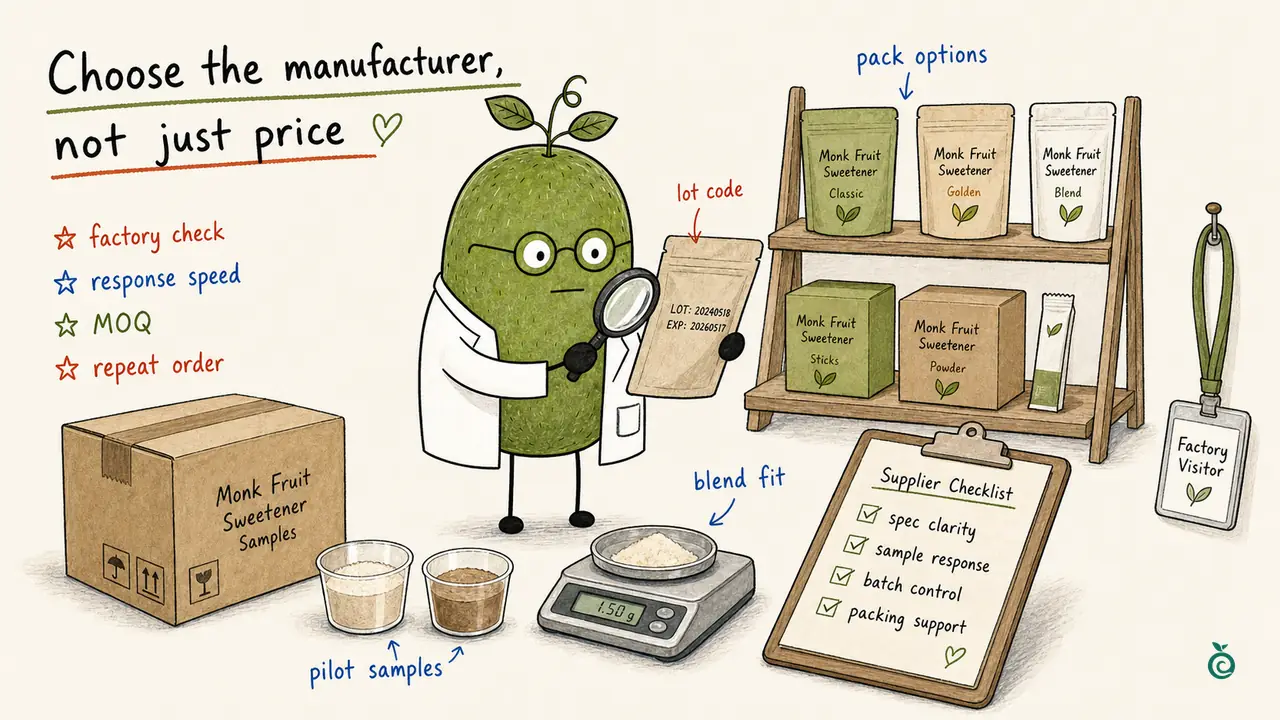
First confirm which product you want to purchase
Just write "Monk Fruit Sugar" or "Monk Fruit Sweetener", and the manufacturer may quote a completely different product. The first inquiry should start with explaining what the product needs to do.
| Manufacturer type | core competencies | The purchaser's key points to check | Focus on order volume |
|---|---|---|---|
| monk fruit raw material manufacturer | Control of raw materials, production processes, standardization and batch release | Whether raw material batches, key production nodes, inspection records, specifications and COA can be matched, and how to trace abnormalities | Raw material supply, production scheduling, and batch-to-batch metric stability |
| blended sweetener manufacturer | Design the formula based on application experience and adjust the sweetness curve, aftertaste, taste and dosage. | Do you understand the actual product base and processing conditions? Can you explain the reasons for sample selection and make adjustments based on test results? | Uniformity and batch capabilities from lab sample scale-up to batch blending |
| OEM packaging manufacturer | Stably convert the confirmed formula, packaging materials and layout into retail finished products | How to manage formula locking, packaging material acceptance, filling, net content, batch number, packing and finished product release | Production line speed, scheduling, line changeover and on-time delivery capabilities for specified package types and weights |
How do specifications correspond to batch COA?
The specification describes the requirements that the product should meet, and the batch COA records the test results of a certain batch of products. When purchasing, make sure that the two documents and samples received use the same product name, specification code and version.
| Check items | What to see | FAQ |
|---|---|---|
| product identity | Extract, juice powder, blended sweetener or OEM finished product? | The names all say monk fruit sweetener, but the actual ingredients are different. |
| Assay basis | Mogroside V, total mogrosides or other agreed indicators | Only comparing a percentage without confirming the detection object |
| Complete ingredients | Does the monk fruit sweetening ingredient contain carriers, fillers or other sweeteners? | The sweetness of the sample is appropriate, but the ingredients do not meet the project requirements |
| Product form | Powder, liquid, granular or finished small packaged product | The form of the quotation is inconsistent with the use of the production line |
| Batch information | Batch number, production date, test items and results | Replace this sample information with COA from other batches |
| Version relationship | Whether specifications, sample labels, COA and quotations use the same code | The sample passed the test, but the batch quotation was changed to another specification. |
The U.S. FDA's public explanation of monk fruit raw materials also emphasized that the sweetness of monk fruit extract will change with the mogroside content. The purchaser cannot regard "Monk Fruit Extract" as a single product with fixed sweetness and fixed ingredients. Target markets, food categories and label names also need to be checked against local regulations, and a single document cannot mean that it has been applied to all formulations and markets.
The sample should answer a clear question
Sample testing should use the actual base formula planned for mass production. The acidity, aroma, protein, minerals and processing conditions of beverages, coffee, baked goods and powdered beverage mixes are different, and the results in the aqueous solution cannot directly replace the performance of the finished product. The same round of comparisons can keep sugary controls and adjust candidate samples to the same target sweetness. Records should at least include sweetness onset rate, sweetness intensity, aftertaste, solubility, mouthfeel, color and aroma changes. Products that require heating or storage should also be retested at planned process nodes and storage nodes. The passing of the sample only shows that it is worthy of continued verification under this base formula and these conditions. Before mass production, it is still necessary to confirm the mixing uniformity, processing adaptability and predetermined shelf life after scale-up. All application results cannot be deduced from one sample.
Raw material manufacturers must be able to clearly explain product control
The value of raw material manufacturers is first reflected in their control of products. The whole process that the purchaser wants to see does not mean that the manufacturer must own all links in planting, transportation and export, but that every node that affects the identity and quality of the product has a responsible person, records and judgment standards. Taking monk fruit extract as an example, you can start from the raw material acceptance batch and continue to check extraction, purification, concentration or drying, standardization, sampling testing and batch release. The specific process will change with the product. The manufacturer should be able to explain which indicators are checked at which links, and how to trace the raw materials, production records and test results after deviations occur. The purchaser can focus on three sets of correspondences. The raw material batch number must correspond to the production batch number, the production batch number must correspond to the inspection and release records, and the shipping batch number must correspond to the label and COA received by the buyer. The meaning of process traceability is very specific here. When there are differences in color, glycoside content, solubility or other indicators, both parties will know which batch and link to start checking. ISO 22005 gives the general principles and basic requirements for food chain traceability systems and uses traceability systems to determine the history and location of products or related components. Procurement audits can borrow this idea and require manufacturers to use batch numbers and records to connect various links, instead of just using the phrase "full traceability" to replace evidence. The supply capacity of raw material manufacturers must also be implemented according to specific specifications. The same factory's ability to supply conventional grades does not mean that the buyer's specified content, particle size or other requirements will also have the same spot and monthly output. The purchaser should hand over the estimated single batch quantity, annual usage and replenishment rhythm to the manufacturer, and ask the other party to explain raw material preparation, production schedule, safety stock and peak season changes.
blended sweetener manufacturers need to turn raw materials into usable solutions
The blending manufacturer is responsible for the application work. When the same monk fruit extract is put into coffee, acidic beverages, powdered beverage mixes or baked goods, the sweetness appears at a different speed, aftertaste and taste may be different. Manufacturers need to understand the buyer's actual base ingredients, processing methods, serving temperatures, serving sizes, and label restrictions before deciding to start with an existing formula or create a customized formula. Experience cannot just be reflected in providing a recipe. A qualified blending proposal should explain why this direction was chosen in the first place, what samples are to be tested for verification, how the buyer will make comparisons, and how to adjust the next round if the test results show sweetness, long aftertaste, insufficient body or dissolution problems. Manufacturers should also help customers convert sensory descriptions into testable questions and reduce repeated sending of samples without a clear purpose. After the customized sample can be produced, it must be confirmed whether it can be scaled up consistently. The addition amount of high-intensity sweetening raw materials is small. When batch mixing, attention should be paid to feeding, mixing uniformity, sampling and batch release. The purchaser can ask the manufacturer to describe the single-batch production capacity, scale-up validation method and continuous order scheduling according to the planned batch to avoid changes in taste or uniformity after the laboratory sample is qualified and the order quantity increases. Taking Hengliyuan current product direction as an example, the natural series is a blend of erythritol, monk fruit sweetening ingredients and stevia glycosides, and the artificial sweetener series is a blend of erythritol and sucralose. When customers need to change the sweetness multiple, single serving amount, ingredient direction, or application texture, they should move to a custom formula discussion. Which route the buyer ultimately chooses should be supported by sample results in actual product base.
OEM packaging manufacturers must control the process from finalization to finished products
The work of the OEM packaging manufacturer begins after the formula and packaging specifications are confirmed. It needs to first lock the formula version, single-portion weight, packaging material and layout used in this order, and then arrange packaging material acceptance, production preparation, filling or sub-packaging, process inspection, batch number identification, packing and finished product release. Records corresponding to orders and batches should be kept at each step. Manufacturers also need to make suggestions based on customer usage scenarios. For coffee stick-packs, it is necessary to consider how many packages are used in one cup, and whether the sweetness and weight of a single sachet are easy to understand; for table sweeteners, the measurement method must be considered; for retail boxed products, the number of inner packages, outer box information, and transportation packaging must also be checked. Packaging recommendations should be in the service of accurate use and not determined solely by what existing equipment can do. In OEM inquiries, formula confirmation and packaging confirmation should be separated. After the formula sample passes, the printed text, barcode, batch number position and packing information are locked. This avoids the need to produce packaging materials while the taste is still being modified, and also prevents the confirmed formula from being replaced by another version during the quotation or mass production stages. The capacity of the packaging end should be calculated according to the specific package type. Packaging, bagging, canning and boxing use different equipment, packaging materials and line change times. It is difficult to answer the buyer's delivery date with a total production capacity figure. Manufacturers should provide an executable first order and replenishment plan based on the weight of a single sachet, the quantity per box, the total order quantity, the arrival time of packaging materials and the current schedule. When the order is significantly enlarged, it is also necessary to confirm whether increasing shifts, adding production lines, or batch delivery will change the inspection and release arrangements.
How to judge whether the manufacturer can accept planned orders
The purchaser can provide the first order quantity, estimated monthly usage and demand range in the next twelve months, and let the manufacturer respond based on specific products and packaging. It is recommended to check the following.
| Check items | What needs to be explained by the manufacturer |
|---|---|
| Sample to mass production | How to scale up the sample formula and what confirmation is needed before mass production? |
| Single batch capacity | How much can be produced in each batch of a specified specification or package type? How to calculate the standard batch size? |
| Monthly availability | How many can be accepted under the current schedule? Will it change during the peak season? |
| Raw materials and packaging materials | The preparation cycle of key raw materials and customized packaging materials, and whether there is a safety stock |
| Quality control | How to sample, inspect and release when order scale-up or continuous production |
| Replenishment arrangements | How long does routine replenishment take, and what arrangements can be made when demand suddenly increases? |
| Delay in processing | When there are changes in raw materials, packaging materials or production lines, when will we notify you and how will we adjust the delivery date? |
It is best to let the manufacturer use recent available schedules and production records of similar specifications to explain, rather than just looking at the design capacity in promotional materials. Design capacity, current available capacity and actual capacity obtained from customer orders are three different numbers.
How do factories and trading companies judge
The purchaser does not have to make a decision based solely on the other party's claim to be a "source manufacturer" or "trading company." You should first confirm which part of the other party is responsible for raw material control, compound application or OEM packaging, who is the actual producer, who makes the samples, who provides the documents, who answers technical questions, and who is responsible for the packaging, inspection and export links. You can ask the supplier to explain the product production path, and check the subject, address, product scope and validity period listed in the company and production materials. When it comes to quality system, audit or market-specific documents, it also depends on whether the company, site and products covered by the document are consistent with the order. Similar names, complete documentation, or prompt responses do not alone prove that a sample is suitable for the buyer's formula.
How to compare OEM quotations in the same table
After receiving the quotation, it is recommended to compare the following items item by item. Blank items should be filled in by the supplier, and it is not advisable to infer that they are included.
| quote field | What needs to be confirmed |
|---|---|
| Product version | Is it an existing formula or a customized formula, and is it consistent with the tested samples? |
| Raw material specifications | Extract content, complete ingredients and product form of blended products |
| Usage specifications | Sweetness multiple, added amount per serving, net content of single sachet or single can |
| Packaging range | Who provides the inner packaging, outer boxes, cartons, labels, barcodes and printing plates? |
| Minimum order conditions | Minimum order quantity is calculated based on raw material weight, finished product quantity or single packaging version |
| Quantity acceptance | Single batch capacity, current monthly availability, batch delivery and replenishment schedule |
| tests and documentation | What tests are included in the quotation, what documents are available, and how are additional items calculated? |
| Delivery time | From which node does the calculation start after recipe, layout and order confirmation? |
| terms of trade | Are the quoted currency, validity period, Incoterms and freight included? |
A quote with a lower unit price may not include the same content specifications, packaging materials, testing range or shipping conditions. Complete these fields first, and then calculate the actual cost of each product and the entire order.
The first reply can also help screen suppliers
A valid response should differentiate between information that has been confirmed and information that still needs to be tested. Raw material manufacturers must be able to explain product control and traceability paths, blending manufacturers must be able to propose justified sample selection and adjustment directions, and OEM packaging manufacturers must be able to explain how versions, processes, and delivery are managed. The supplier should also explain what existing documentation can answer, what samples need to be verified, and what conditions are missing from the quote. If the response only gives the lowest price without confirming the application, product identity and packaging requirements, the purchaser cannot make a decision based on this. Replies that clearly state boundaries often make it easier to track samples, documents, and order versions later.
This information can be provided directly during the first inquiry
- Target sales countries or regions - Specific applications for food, beverage or tabletop sweeteners - Do you need high-intensity extracts, existing blended products, customized formulas, or OEM finished products? - Existing recipe, sugar dosage, target sweetness or control sample - Unwanted ingredients and labeling directions - Single pack, single can or bulk format - Estimated purchase quantity and desired delivery time - First order quantity, estimated monthly usage and subsequent replenishment rhythm - Certificates, testing or export documents that need to be verified - The most important problems that need to be solved in this round of samples When customers are temporarily unable to determine specific specifications, they can first provide real applications, target markets and usage methods. The supplier then narrows down the product range and proceeds with testing using clearly numbered samples and corresponding documentation.
What jobs can Hengliyuan undertake?
Hengliyuan was established in 2013 and can continuously undertake projects from monk fruit sweet raw materials and blend formulas to OEM packaging finished products. Our raw material control, formula research and development, packaging customization and order acceptance capabilities are all supported by corresponding production conditions.
- View Hengliyuan monk fruit Extract product directions
- Learn about custom blended sweeteners
- Read the OEM Guide to Private-Label Monk Fruit Sweetener Stick Packs
- Submit natural sweetener OEM and private label requirements
| There are conditions | Ability description |
|---|---|
| Guilin origin supply chain and 600 acres of its own monk fruit planting base | Provide the basis for monk fruit raw material supply, batch management and source traceability |
| 5000 tons/year | We have the ability to undertake batch orders and can arrange production according to the first order, monthly demand and replenishment rhythm. |
| 1,200 m² standardized factory and 380 m² Class 100,000 clean workshop | Support blended sweetener production, clean packaging and OEM packaging projects |
| 11 patents and sensory laboratory | Support formula development, sensory adjustment and application testing, and can promote customized solutions based on customers' actual product base |
| OEM and ODM capabilities | We can undertake formula, packaging and brand customization, and make the confirmed plan into the product form that customers need. |
| SGS factory audit | The factory has accepted third-party audits, and customers can continue to check the audit scope and related materials based on project needs. |
In terms of blended sweeteners, Hengliyuan's existing natural series uses erythritol, monk fruit sweetening ingredients and steviol glycosides, and its artificial sweetener series uses erythritol and sucralose. Customers can directly test existing formulas or develop custom formulas based on food bases, sweetness targets, serving sizes, mouthfeel issues and ingredient requirements. After entering the OEM or ODM stage, we can continue to undertake packaging materials, layout, sub-packaging, process inspection, batch number, packing and finished product release. If customers only purchase raw materials, only make blending solutions, or need complete branded finished products, they can start from the corresponding link. After the buyer sends the target market, product application, estimated usage and packaging ideas, we will first determine what kind of raw materials the project requires, whether it is suitable for the existing formula, which parts need to be customized, and how production and packaging should be arranged for the planned order. Samples, documents, quotations, and production versions are progressed as part of the same project, and customers can check at each confirmation point. Specific product specifications, packaging forms, document scope, order quantity and delivery time are subject to project confirmation results. - View Hengliyuan monk fruit Extract product directions - Learn about custom blended sweeteners - Read OEM Guide to Private-Label Monk Fruit Sweetener Stick Packs - Submit natural sweetener OEM and private label requirements
Source
- US FDA instructions on monk fruit extract and other sweeteners - ISO 22005 general principles and basic requirements for food chain traceability systems
Review note
Reviewed October 2, 2026.
Common questions
What should you look for first when choosing a monk fruit sweetener manufacturer?
First determine whether you need raw material control, blending solutions or OEM packaging, and then see if the supplier can clearly explain the work it undertakes. After the product identity and manufacturer responsibilities are consistent, compare sample performance, documentation, delivery conditions and costs.
What is the difference between specifications and COA?
The specification lists the items and scope that the product should comply with, and the COA records the test results of a certain production batch. The purchaser must confirm that the sample, specification, batch COA and quotation refer to the same product version.
Should you choose a factory or a trading company?
Check whether the actual production path and responsibilities are clear. It is necessary to confirm who produces, who provides documentation, who handles samples and technical issues, and who is responsible for packaging, inspection and export. The company name alone cannot determine whether a product is suitable for a project.
Why can't the prices of monk fruit sweeteners from two manufacturers be compared directly by kilogram?
The two products may use different sweetener content, carrier, sweetness multiple and packaging conditions. First unify product versions, usage specifications, test coverage and trade terms, and then compare actual costs per portion or batch.
Do I need to submit the complete formula to the manufacturer when applying for samples?
Not necessarily. The purchaser can first provide application categories, main base formula, sugar dosage, target sweetness, processing conditions and problems that need to be solved. When it comes to confidential formulas, the necessary information can be provided in stages, and more complete technical information can be processed after the cooperation method is determined.
