Read this guide in
CHINA SUPPLIER GUIDE
How to compare a monk fruit extract supplier in China
Compare bulk monk fruit extract suppliers with real product and specification examples, sample-evaluation evidence, cost-in-use calculations and a purchasing checklist.
For food and beverage manufacturers, comparing bulk monk fruit suppliers starts with the purchasing item: a concentrated extract, a juice ingredient or a finished sweetener blend. Then match the named assay, specification and sample before comparing taste and cost at the dose your product needs. “Pure monk fruit” and a low price per kilogram do not settle those decisions.
This guide focuses on buying monk fruit extract from China. It uses public supplier examples, a specification-sheet walkthrough and an existing Hengliyuan prototype case to show what to check. The case involves finished sweetener blends, not a controlled comparison of extract grades; use it to understand the evaluation process, not to infer a universal extract performance or dose.
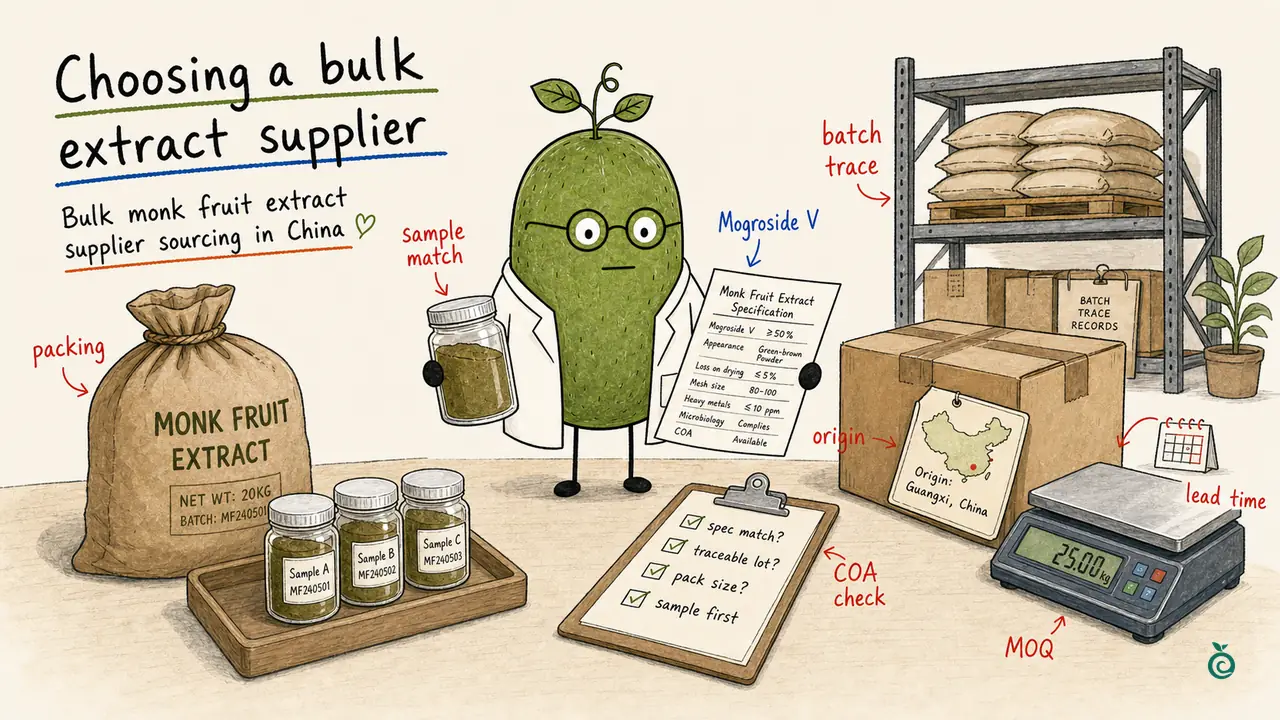
First confirm that you are buying monk fruit extract
'Monk fruit,' 'Luo Han Guo' and Siraitia grosvenorii identify the fruit, but they do not identify one fixed commercial ingredient. Suppliers may be quoting an extract, juice concentrate, juice powder, fruit powder or a finished sweetener blend. If your project needs a finished blend or private-label pack, use a blending or OEM brief instead of asking suppliers to quote it as pure extract.
| Product form | What it is | What the buyer should confirm |
|---|---|---|
| Monk fruit extract | A concentrated ingredient described by one or more mogroside measures | Analyte, assay method and basis, acceptance range, product form, carrier and batch COA |
| Monk fruit juice concentrate | A liquid juice-derived ingredient | Brix or solids basis, sugar profile, storage, packaging and intended application |
| Monk fruit juice powder | A dried juice ingredient that may include a carrier | Full composition, carrier, solubility, hygroscopicity and handling |
| Whole monk fruit powder | Dried or milled fruit material | Fruit part, processing route, particle size, flavor, color and dispersibility |
| Finished sweetener blend | Extract combined with bulking ingredients or other sweeteners | Full ingredient list, relative sweetness, serving or dosage, application and label route |
What the front-page bulk listings actually sell
Bulk describes quantity, not composition. Public results include high-intensity extracts and finished blends in large bags. The following examples help separate the purchasing routes; they are not a supplier ranking or a check of today’s inventory.
- Lakanto: powdered bulk product and ingredient list
- Jedwards: G1251 extract description
- Dolce: 25% extract and linked specification
- Monk Fruit Corp: extract portfolio
| Public example | What the page identifies | What to compare next |
|---|---|---|
| Lakanto Classic Monkfruit Powdered bulk product | Its ingredient list names erythritol and monk fruit extract. | Treat it as a finished blend. Confirm the exact SKU’s current replacement instructions rather than applying them to pure extract. |
| Jedwards Monk Fruit Extract Powder, G1251 | The description identifies a 30% Mogroside V extract and a 1 kg purchasing unit. | Request the matching analytical specification and lot COA; the product description is not a measured result for your sample. |
| Dolce Monk Fruit 25% Extract, DSRM0489 | Its linked specification states 23%–27% Mogroside V by HPLC. | Read the accepted range and basis, not just the 25% product name. |
| Monk Fruit Corp extract portfolio | The supplier lists distinct Mogroside V extract grades, separate from its juice products. | Choose an exact product code and request its specification; the portfolio is not one interchangeable ingredient. |
Do not compare percentages until the assay terms match
Mogroside V is one constituent within the broader group of mogrosides. “50% total mogrosides” and “50% Mogroside V” are different measurements. Before comparing offers, confirm the analyte, test method, reporting basis, acceptance range and any carrier. Ask which sample and batch COA correspond to those terms. EFSA’s 2019 review describes multiple mogrosides in monk fruit extracts. The FDA letter for GRN 629 names several proposed Mogroside V levels, but records that the notifier withdrew that notice and FDA ceased its evaluation. This notice cannot be used as a favorable FDA response letter. Neither document verifies a Hengliyuan batch or establishes approval for a buyer’s finished product. Use the actual specification and relevant market documents for the material being offered.
Read a real extract specification before accepting a COA
Dolce’s publicly linked specification for DSRM0489, Version 1 revised August 8, 2026, calls the product Monk Fruit 25% Extract. Its analytical requirement is a range: 23%–27% Mogroside V by HPLC. It also specifies 95% passing an 80-mesh sieve and a maximum 5% loss on drying. These are specification requirements, not three reported results from one batch.
| Field in this public specification | What it establishes | What remains to confirm for your sample |
|---|---|---|
| Mogroside V: 23%–27%; HPLC | The named analyte, accepted range and method type. | Actual lot result, detailed method/reference and reporting basis. The table does not explicitly state a dry-basis assay. |
| 95% pass 80 mesh | A stated passing fraction, rather than the word “powder” alone. | The sieve standard, method and actual lot result if particle size matters to your process. |
| Loss on drying: maximum 5% | An acceptance limit. | The measured value and method for the sample; do not substitute the limit into an as-is/dry-basis conversion. |
| Revision and supply record | The document version and named product code. | The approved current specification and its connection to the sample, seller and delivery batch. |
The four-page document also distinguishes the product’s ingredient information, facility information and revision history. Check those fields separately. A statement that an ingredient contains no listed allergen is not the same as a statement that the site handles none. Do not transfer this supplier’s limits, serving suggestion or certification wording to Hengliyuan’s products.
Check the US evidence for the exact preparation and use
FDA’s sweetener guidance says it has evaluated GRAS notices for Siraitia grosvenorii fruit extracts and has not questioned the notifiers’ GRAS conclusions under the intended conditions of use identified in those notices. This is more specific than saying every product called monk fruit is “FDA approved.” Connect the offered preparation, composition, production route and intended food use to the supporting documentation. A withdrawn notice, a facility registration, an organic certificate and a batch COA answer different questions; none alone supplies a finished-product label or launch decision. For another sales market, review its requirements separately.
Confirm who makes the quoted grade and who handles the documents
A supplier may manufacture the selected extract, source it from another factory, or handle blending and packing. Ask about the specific material being quoted. A factory address or a company certificate does not establish the source of every grade in a supplier’s range. For a Hengliyuan inquiry, confirm the manufacturing source and matching documents for the selected specification. If an alternative source is proposed, review its specification and sample before accepting the substitution. Keep the agreed source, product version and sample reference in the purchasing record.
| Checkpoint | What should match | What to resolve before ordering |
|---|---|---|
| Manufacturer and supply role | The manufacturing entity/site for the quoted grade, and the seller responsible for delivery. | Which party supplies batch documents and handles quality questions? |
| Specification and sample | Product code, grade, composition, specification version and sample reference. | Is the quotation for the material you evaluated? |
| Batch COA | Batch identity, reported results, methods or references and applicable limits. | An earlier sample COA does not report results for a future shipment. |
| Certificates and changes | Entity/site, scope, validity and the source/product version agreed for the order. | Confirm how a source or specification change will be communicated and reviewed. |
A certificate or audit report supports its stated scope. Check the connection to the selected material rather than treating a document folder as proof that every grade, site, blend or destination is covered. Hengliyuan’s existing product-document page separates the named extraction-factory documents from the Hengliyuan business and finished-blend records. Review the holder and scope shown there, then confirm which source and document set apply to the exact extract in your offer. A related factory’s certificate is not automatically a certificate for every finished blend, order or destination.
Resolve document mismatches before comparing prices
Open the actual files, even when a supplier page looks complete. Check the botanical name, ingredient, product code, analyte, version and issuing entity against the offer. A specification for a different sweetener is not evidence for the monk fruit extract you requested. Ask for the correct file before treating the document pack as complete.
| Mismatch or unresolved claim | Useful next step |
|---|---|
| “100% pure” but no Mogroside V assay | Request the full composition and the named analyte, method, reporting basis and accepted range. One ingredient does not mean 100% Mogroside V. |
| Title, dosage instructions and technical sheet disagree | Identify the exact SKU/version and ask the supplier to resolve the difference in writing. Do not select whichever number makes the price look best. |
| An old sample COA is used for a new delivery | Request the delivery lot’s own results and verify the agreed specification. |
| “Organic,” “no allergens” or “FDA approved” without matching scope | Review the relevant document and its limits. Keep market-use, certification, site handling and analytical checks separate. |
| A higher assay is said to guarantee half the dose | Treat it as an application question. Equal Mogroside V input is not proof of equal perceived sweetness, flavor or solubility. |
Use each sample round to answer a clear question
Start with the application and the issue the sample should resolve: a lingering finish, color, clarity, dissolution or a target dose. A buyer does not need to order unrelated grades and build every comparison alone. We can discuss the useful sample directions first. Then test the selected candidates in the real product under the intended process and serving conditions. Match the target sweetness before deciding which taste profile you prefer. Record the actual dose, sweetness timing, lingering notes, aroma interaction and mouthfeel; add clarity, sediment or dispersion where relevant. Retain the sample code and test conditions so the accepted direction can be connected to the specification and quotation. That comparison selects an application direction. Finished-product stability, shelf life, nutrition and market requirements still need their own checks.
A Hengliyuan case: compare onset separately from sweetness
In the existing anonymized preliminary evaluation dated October 10, 2026, seven tasters compared whole 2 g and 3 g sweetener-blend sachet prototypes with 10 g sucrose per 200 mL. The drinks were coffee, tea and water, tested at ambient temperature, 3 °C and 40 °C. This was a blend-development project; its formulations are not disclosed and it does not compare named monk fruit extract grades. The two prototypes had identical rounded scores for six of seven attributes. Sweetness onset was scored 3/5 for the 2 g prototype and 4/5 for the 3 g prototype. Those are five-point performance scores, not seconds. The useful lesson for an extract buyer is to separate sweetness intensity, onset, lingering taste and dissolution observations rather than reducing the sample decision to “sweeter” or “higher purity.”
- Read the existing coffee and tea prototype case
- Read the anonymized preliminary sensory summary (English PDF)
- Discuss a finished-blend application trial
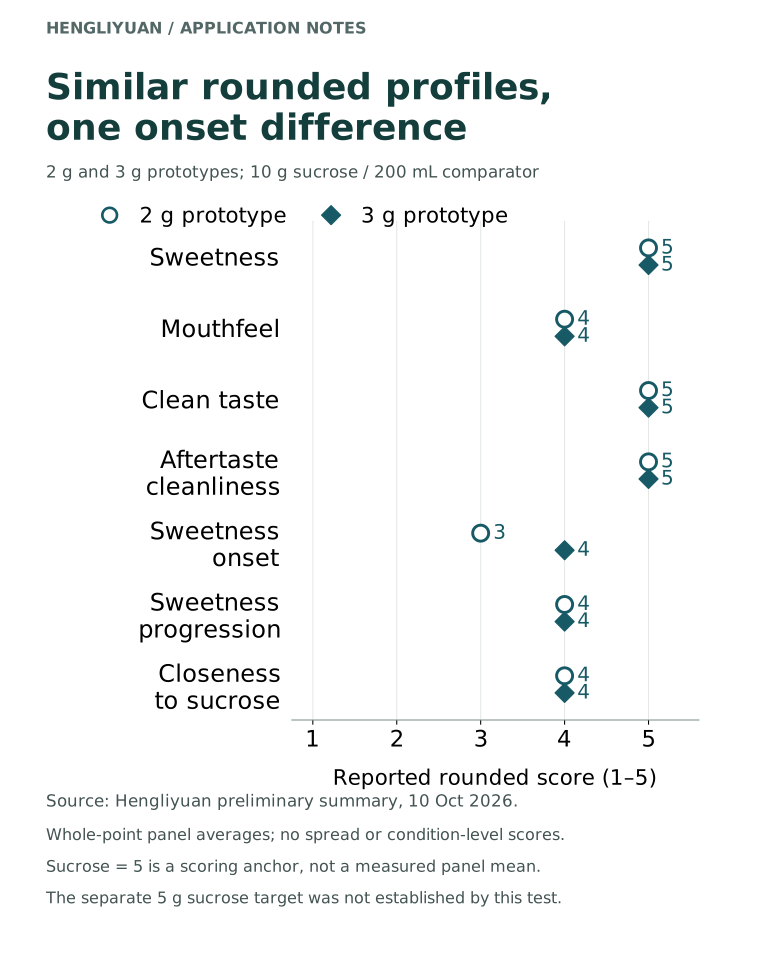
The summary reports rounded aggregate scores without individual sheets or variability. Repeated cups are not independent tasters, and sucrose at 5 is the scoring anchor rather than a measured panel average. The record does not prove statistical equivalence, select a universal serving weight, or establish the separately discussed 5 g sucrose target. Use the linked case and English summary to inspect the conditions before applying the comparison method.
Compare application fit, not only laboratory content
A higher assay is not automatically the better purchase. The appropriate direction depends on target dosage, taste profile, process, cost in use and the finished product. For beverages, compare sweetness timing, aftertaste, solubility, clarity, aroma interaction and sediment in the real base. For bakery products, sugar also affects bulk, moisture, browning and structure, so concentrated sweetness alone does not complete the replacement. For dry mixes, check dispersion, blend uniformity, flow, moisture pickup and serving accuracy. Keep a current formula or sugar-containing control where practical, change one main variable at a time and record results under the same preparation and serving conditions.
| Application | Question to resolve in the trial | Keep with the result |
|---|---|---|
| Clear or acidified beverage | Does the selected addition give the required sweetness and finish without unacceptable color, haze or sediment? | Actual base, pH, dose, dissolution method, process and observation time. A clear water sample does not supply an acidic beverage shelf-life result. |
| Coffee, tea or protein drink | How do onset, lingering taste and aroma interaction change within this particular drink? | Drink composition, preparation, serving temperature, coded sample and comparator. Separate preference from intensity. |
| Bakery or dry blend | What replaces sugar’s bulk and other functions, and can the small extract dose be distributed consistently? | Full sweetener system, mixing sequence, scale resolution, blend uniformity and actual baked or prepared product. A 1:1 retail blend is not a 1:1 extract. |
Put all suppliers into the same quotation table
Before deciding that one supplier is cheaper, normalize the offer. MOQ, available pack formats, stock, lead time and document availability must be confirmed for the selected specification and order; they should not be inferred from a generic supplier page. For a bulk import, distinguish manufacturing lead time, dispatch date, transit and customs clearance. Confirm the importer, consignee, final market and the team responsible for reviewing food-use and import documents. A domestic seller’s small-pack offer and an export drum quotation may include different services and costs. Do not treat a missing freight, test or handling charge as zero.
| Quotation field | What to compare |
|---|---|
| Product identity | Extract rather than a juice ingredient or finished blend |
| Analytical specification | The same analyte, method, basis and acceptance range |
| Composition | Carrier and all other declared ingredients |
| Sample link | Accepted sample code and corresponding product version |
| Packaging and quantity | Inner material, net weight, outer pack, trial quantity, MOQ and planned order quantity |
| Documents | Specification, batch COA and project-relevant quality or export files |
| Commercial basis | Currency, Incoterms, named place, freight inclusion, validity and timing assumptions |
Keep an acceptance record from sample to bulk shipment
Before a trial becomes an order, keep the accepted material identity, specification version, sample code and supply role together. Record what was accepted, what remains unresolved and who will review a changed source or specification. A taste result should not silently approve a different manufacturing source or a later batch.
- Download the existing supplier comparison sheet (.xlsx)
- Read the supplier-brief and workbook instructions
| Stage | Record to retain | Decision supported |
|---|---|---|
| Shortlist | Exact extract or blend identity, intended application/market and requested documents. | Which suppliers are quoting comparable purchasing items? |
| Sample acceptance | Sample/lot ID, specification, corresponding COA, actual dose and application observations. | Which material met the agreed trial target under the recorded conditions? |
| Order confirmation | Matching product/version, agreed pack and quantity, quotation basis, delivery plan and unresolved conditions. | What exactly is being ordered, and which details still need confirmation? |
| Delivery review | Delivered identity and lot, applicable batch results, pack condition and any notified source/specification changes. | Does the shipment match the agreed item and documentation? Resolve discrepancies before accepting it as equivalent. |
The free comparison workbook below can hold the brief and two actual offers. It has blank fields rather than a supplier score or recommended grade. Use additional project records for the exact assay, batch result and acceptance decision; completing the worksheet is optional before contacting Hengliyuan.
Compare cost at the tested dose, not just price per kilogram
For each candidate, calculate sweetener ingredient cost per 1,000 servings = price per kg × dose in grams per serving. This works because 1,000 servings at d grams each use d kilograms. Use the same currency, delivery basis and accepted sweetness target. The example below uses indices, not supplier prices. Suppose Candidate B costs 30% more per kilogram but meets the same application target at 30% less dose. Its ingredient cost per serving is 1.30 × 0.70 = 0.91 of Candidate A’s, or 9% lower. The lower dose is an assumption for this calculation, not a result inferred from Mogroside V percentage.
| Illustrative comparison | Candidate A | Candidate B |
|---|---|---|
| Price per kg index | 100 | 130 |
| Dose index at the same accepted target | 100 | 70 |
| Ingredient cost per serving index | 100 | 91 |
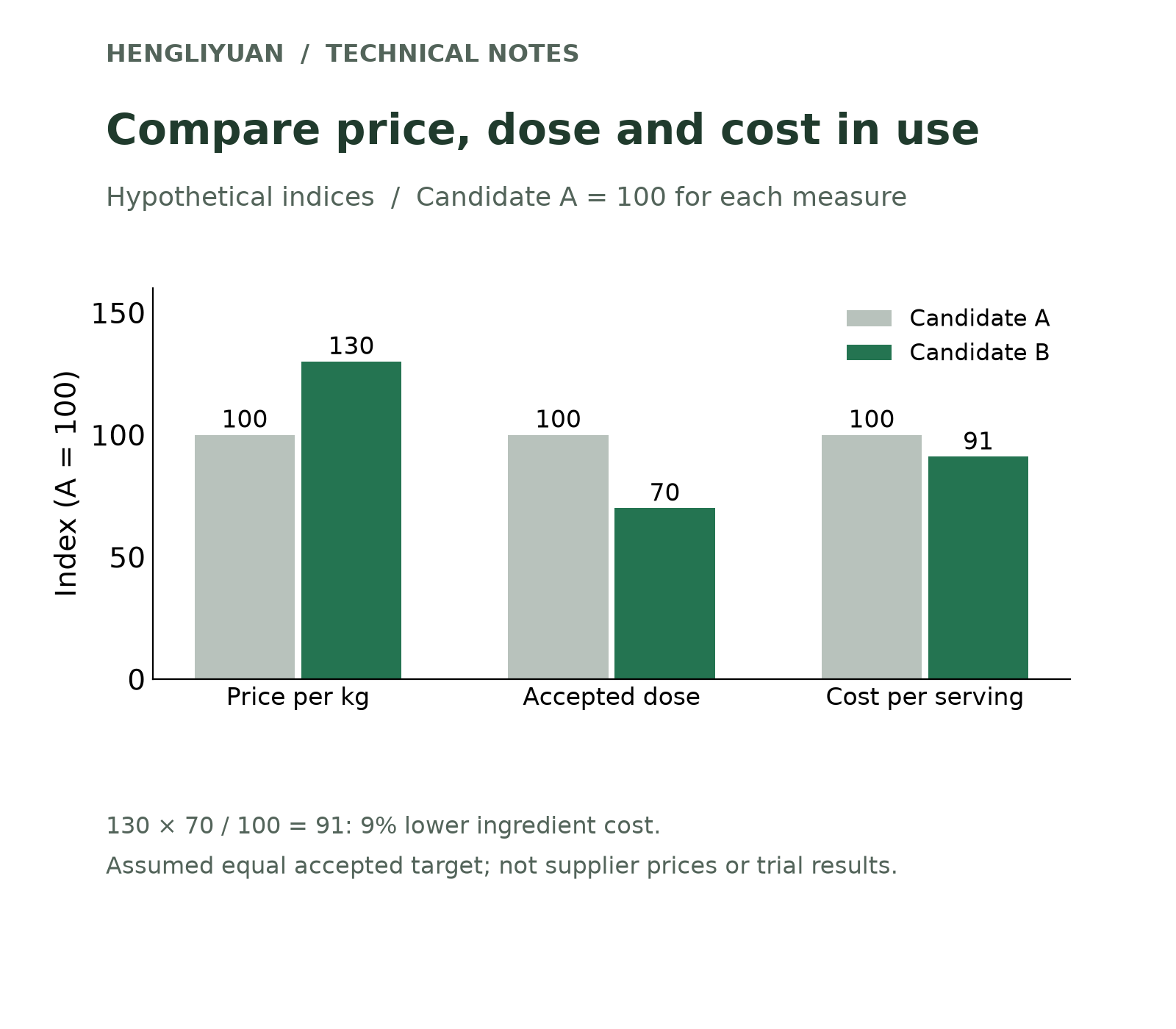
Use doses established by your own sample comparison. If B needs the same dose as A, its ingredient cost would be 30% higher instead. Include freight, duties where applicable, handling and any formula changes separately when comparing total delivered or finished-product cost. An assay percentage alone cannot provide the dose or the cost saving.
What Hengliyuan needs for a useful first reply
Send the product you are making, the destination market and the decision you need help with. If you have a target grade, current sample, dosage or trial quantity, include it. Those details let us discuss a relevant sample or quotation without requiring a finished technical brief first. Before an order is confirmed, use the quotation table above to close the remaining specification, source, packaging and delivery details. Record the accepted sample and any unresolved conditions; do not assume that an initial indicative offer fixes stock, lead time or the manufacturing source.
Review note
Reviewed October 22, 2026. Public listing and specification examples describe their named suppliers and documents; they do not verify a current Hengliyuan batch, stock position or certification. The existing prototype case concerns finished blends, not isolated extract grades. The cost comparison is a calculated example, not a quotation, customer saving or reported trial result.
Common questions
How do I compare two monk fruit extract suppliers?
Confirm the same product form and assay basis, identify the manufacturing source for the quoted grade, and connect each sample to its specification and COA. Compare candidates at the required sweetness in your real product, then calculate cost using the tested dose and comparable delivery terms.
Discuss this requestIs Mogroside V the same as total mogrosides?
No. Mogroside V is one constituent within the mogroside group. A percentage must name the analyte and its test and reporting basis before it can be compared with another offer.
Discuss this requestShould I request a sample before asking for a quotation?
You can discuss both together. Keep the quotation tied to the same product version as the sample, and test application-sensitive projects before locking the specification. An initial quote can help screen options; it does not replace confirming the accepted material and order terms.
Discuss this requestIs a higher Mogroside V percentage always more economical?
No. Compare actual ingredient cost at the dose needed to meet your taste and application target. A higher assay does not by itself establish a proportionally lower dose, a better finish or lower total formulation cost.
Discuss this requestDoes a batch COA prove that the extract will work in my product?
No. It reports defined results for the identified batch. Application fit needs testing in your product. A COA from a sampled batch also does not report results for a different future shipment; confirm the batch documents for the order.
Discuss this requestShould I ask whether the supplier manufactures every grade?
Ask who manufactures the specific grade being quoted and which party is responsible for documents, delivery and quality questions. When the source or specification changes, review the new material against the agreed requirements rather than assuming the earlier sample still represents it.
Discuss this requestWhat should be included in the first inquiry?
Start with your product, destination market and main question. Share a target grade, reference sample, dose or trial quantity if available. A complete specification is not required to begin the discussion; the remaining details can be confirmed before ordering.
Discuss this requestDoes “100% pure monk fruit extract” mean 100% Mogroside V?
No. A single-ingredient extract contains multiple constituents. Confirm the specific Mogroside V assay, method and reporting basis; “pure extract” and a named-compound percentage describe different things.
Discuss this requestIf I change from 25% to 50% Mogroside V, can I simply halve the dose?
Halving the extract amount may equalize the nominal Mogroside V input when both assays use the same basis. It does not prove matched sweetness or the same flavor and handling in your product. Establish the actual dose with comparable samples and recorded application trials.
Discuss this request