
Read this guide in
SYRUP AND BEVERAGE GUIDE
Allulose Syrup for Beverages: Sugar Reduction Guide
Develop allulose beverage syrups: distinguish ingredient syrup from drink concentrate, calculate dilution by weight, and compare coffee and soda trials.
Judge an allulose beverage syrup in the drink people will actually serve. Our view: a concentrate that tastes good on its own has not yet passed the beverage trial. Compare it with your sucrose control at the intended dilution, serving temperature and sweetness target.
First distinguish allulose ingredient syrup from a finished coffee syrup or soda concentrate. The ingredient specification describes the supplied material; the beverage formula also includes its water, flavors, acids and any other sweeteners. Buying the ingredient does not establish the finished drink's performance or shelf life.
Keep the concentration basis and serving dose explicit. The calculation below connects the syrup specification to the final drink, followed by separate coffee and soda trial records.
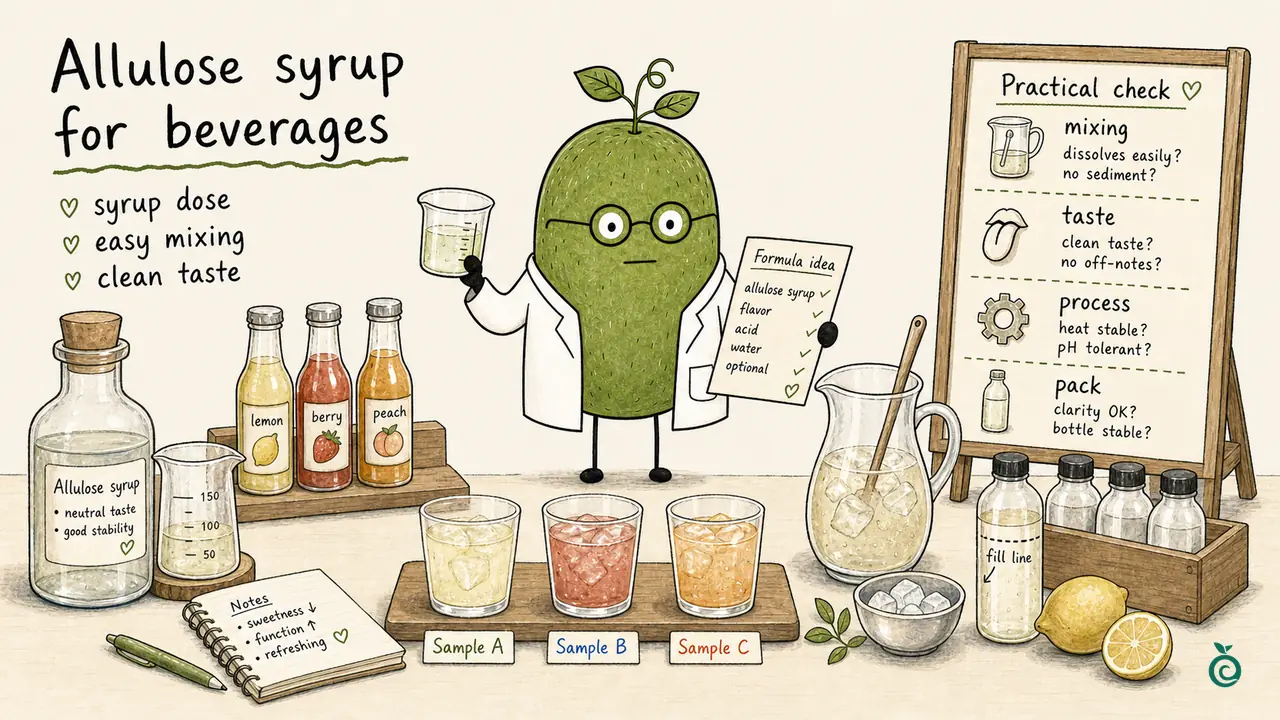
Sugar has more than one job in syrups
In coffee syrups, soda bases and beverage concentrates, sugar contributes more than sweetness. Changing it can affect body, viscosity, flavor balance and how much syrup a consumer dispenses. Review the complete formula and preservation process; matching sweetness alone does not establish equivalent shelf life.
Where allulose may help
Allulose can support body, mild sweetness and sugar-like behavior in some beverage systems. Monk fruit or stevia may then be used at low levels to lift sweetness without adding too much bulk.
Test acid, flavor and process together
Citric acid, phosphoric acid, coffee notes, tea solids, fruit flavors, carbonation and heat processing can change sweetness perception. Buyers should test pH, flavor release, aftertaste, clarity and storage taste.
Watch crystallization, viscosity and dilution
Check crystals, haze, sediment, pouring, pump delivery and filling behavior in the concentrate. Then dilute it using recorded masses and taste the finished drink. State whether a ratio means syrup:water or syrup:final drink, and whether it is by weight or volume. These are not interchangeable instructions.
| Hypothetical serving | Syrup mass | Water mass | Final drink mass | Allulose in final drink |
|---|---|---|---|---|
| 1:4 syrup:water by mass | 20 g | 80 g | 100 g | 12 g / 100 g = 12% by mass |
| 1:9 syrup:water by mass | 20 g | 180 g | 200 g | 12 g / 200 g = 6% by mass |
Calculation only: assume the finished beverage syrup contains 60% allulose by mass, and the added water contributes none. Each 20 g dose supplies 20 × 0.60 = 12 g allulose. Final allulose mass fraction = syrup mass × allulose mass fraction in that syrup ÷ final drink mass. The 60% is an invented arithmetic input, not a Hengliyuan specification, recommended formula or sensory result. Both drinks contain the same allulose mass but different concentrations. This does not predict equivalent sweetness, safety or label claims. For a volume-based pump dose, measure delivered mass or use a measured density before applying this calculation.
Confirm label and market direction first
Allulose rules, no added sugar claims, calorie treatment and ingredient wording depend on the market. Buyers should review local requirements before finalizing formula and artwork.
Start with the drink, then choose the sample
Tell us the destination market and whether you are developing a coffee syrup, soda concentrate or ready-to-drink beverage. Share the serving dilution, flavor base, process and taste problem if known. Add quantity, packaging and document requirements when available; an incomplete brief can still start a sample discussion. Confirm whether you want an ingredient or a sweetener blend rather than assuming either is a finished beverage syrup.
Coffee syrup: concentration, dilution and storage records
Start with the coffee product that the syrup will actually serve. Record whether concentration means total solids, the supplier’s allulose content, a mass fraction or a refractometer reading. These values answer different questions. Brix can be used as a process observation, but a reading from a multi-ingredient syrup does not identify allulose content or confirm the finished product’s sugar claim. Request the syrup specification and record the method next to the value. For a café test, weigh syrup and coffee rather than relying on a pump count alone. Check the pump delivery separately if that is how consumers will use the product. Record coffee roast, extraction, serving size, milk type, ice weight and dilution. Taste the black-coffee and milk-coffee versions independently. A clean sweetness result in black coffee can change when dairy solids or a plant base is added. Keep the original sucrose syrup as a coded control so coffee aroma, bitterness and body are compared at an agreed sweetness target. Use a planned storage calendar rather than promising stability from the first tasting. For example, an R&D team may choose week 4 and week 12 as screening checkpoints, alongside its actual commercial shelf-life study. These are example observation dates, not validated storage limits. At each point, inspect crystals, haze, color, aroma, pouring and package closure, then prepare the same serving dilution. Photograph the sample before remixing. Record any deposit that disappears with warming separately from a deposit that remains. Do not change the formula and storage condition simultaneously if the purpose is to identify the cause.
| Sample | Syrup concentration basis | Syrup / coffee masses | Storage checkpoint | Crystal / taste observation |
|---|---|---|---|---|
| Sucrose control | Record method and value | Record both masses | Baseline and planned dates | Complete after tasting |
| Allulose syrup trial | Record specification and solids method | Same serving conditions | Same dates as control | Complete after tasting |
| Blend alternative | Record each ingredient and total solids | Record actual dose | Same dates as control | Complete after tasting |
Soda syrup: compare acid balance before and after carbonation
Make the soda trial in the actual flavor base. Keep the acid type and dose, water source and flavor addition fixed for the first sweetener comparison. Record pH and titratable acidity with their methods; pH alone does not describe every difference in sourness. If the existing formula uses citric or phosphoric acid, name that ingredient in the record instead of treating all acid systems as interchangeable. Prepare a still sample and a carbonated sample from the same formula. Record the final dilution, carbonation setting, serving temperature and interval between opening and tasting. Compare sweetness onset, sourness, flavor strength and finish in both. Carbonation and serving temperature may change the balance that seemed acceptable in still water. Choose a new acid or sweetener level only after the first comparison, and give that change a new sample code. Before scale-up, separate an acceptable sensory sample from a production-ready syrup. Ask whether the concentrate can be dosed consistently, whether its container and closure suit the filling line, and whether the finished beverage’s process and storage plan have been validated. Microbiological control and shelf life require the complete product’s assessment; this record is a formulation comparison, not a preservation specification.
Review note
Reviewed October 16, 2026. Use the actual material specification and destination-market requirements. Dilution arithmetic and screening records do not establish a commercial formulation or shelf life.
Common questions
Is allulose syrup a ready-made coffee or soda syrup?
Not necessarily. Allulose ingredient syrup and a finished beverage concentrate are different products. Check the ingredient list and specification, and confirm whether the quote covers the ingredient, a sweetener blend or a finished syrup.
Discuss a beverage sweetener blendHow do I calculate allulose after dilution?
Multiply syrup mass by its allulose mass fraction, then divide by final drink mass. Use the allulose fraction in the actual syrup, not Brix or total solids as a substitute. State the ratio and whether it is by weight or volume.
Discuss a beverage sweetener blendCan Brix confirm allulose content or a sugar-free claim?
No. A refractometer reading in a multi-ingredient syrup does not identify its allulose content or establish the finished drink's sugar claim. Use the relevant specification and analytical basis, and review the destination-market labeling requirements.
Discuss a beverage sweetener blendShould the concentrate or the diluted drink pass the taste test?
Both need checks, but choose the sweetener direction from the intended serving. Assess the concentrate for handling and dosing, then compare the finished drink at a recorded dilution and temperature. Test milk coffee and black coffee separately, and compare soda before and after carbonation.
Discuss a beverage sweetener blendDoes a clear syrup with good taste prove shelf life?
No. Visual clarity and an acceptable first tasting do not validate microbiological control or storage life. Assess the complete formula, process and packaging under the intended storage conditions.
Discuss a beverage sweetener blendWhy add monk fruit or stevia, and what should I send for samples?
Monk fruit or stevia can help lift sweetness while allulose contributes bulk. Start with the destination market, beverage type and taste target. Share the dilution, flavor base and process if known, then discuss suitable ingredient or blend samples.
Discuss a beverage sweetener blend