
Read this guide in
FORMULATION COMPARISON
Allulose–Monk Fruit Sweetener Blend: Low-Calorie Project Buyer Brief
Evaluate allulose–monk fruit sweetener blends: application fit, taste and dosage, label rules by market, format and a buyer sample brief.
Buyers often meet allulose and monk fruit together when a product needs a lower-calorie or reduced-sugar direction. The two ingredients do different jobs in a blend, and the finished food still has to be evaluated as a complete formula.
This brief keeps the practical question narrow: what should a buyer specify before requesting a sample or discussing a low-calorie label direction? It does not make the finished product low calorie or establish a one-to-one replacement.
Why brands discuss monk fruit with allulose
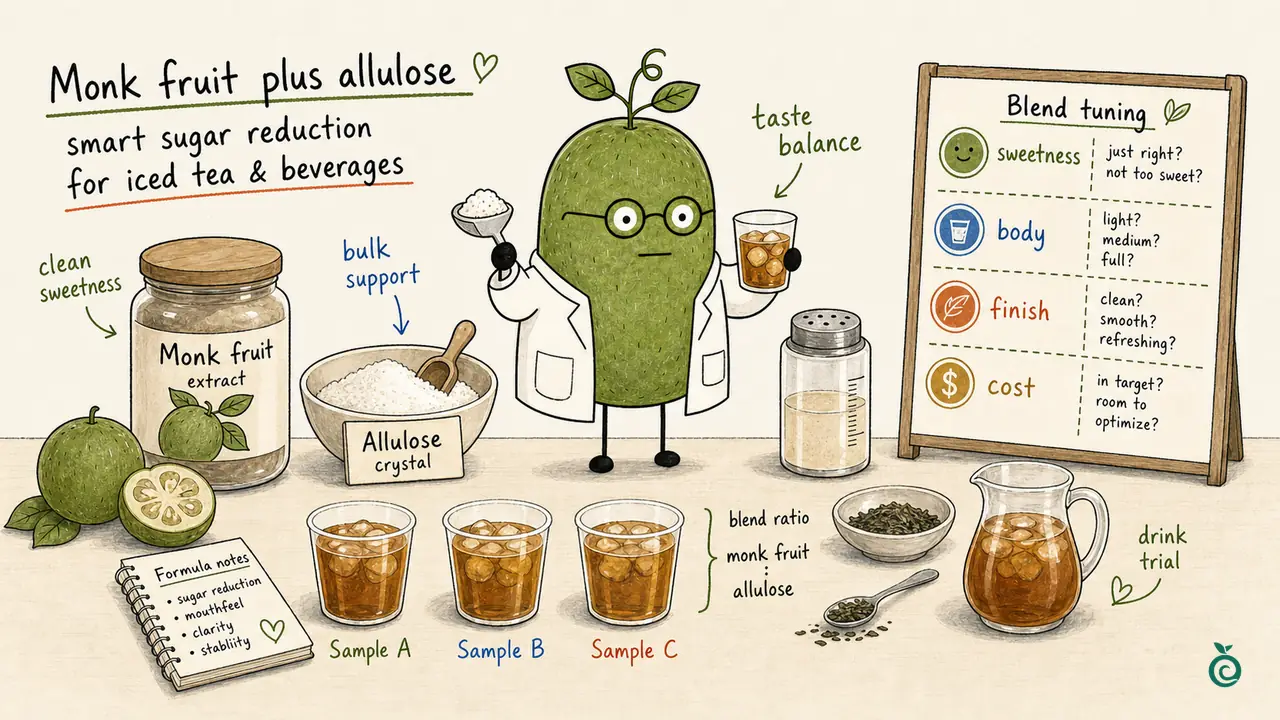
Monk fruit can provide high-intensity sweetness at low dosage, while allulose can help with bulk, mouthfeel and sugar-like behavior in some applications. The blend goal is usually balance rather than using either ingredient alone.
Application matters more than the ingredient name
A drink powder, RTD beverage, bakery product, chocolate-style product, syrup and tabletop sweetener may need different sweetener systems. The same monk fruit and allulose idea may work in one format and fail in another.
Check taste and dosage carefully
Buyers should test sweetness onset, aftertaste, mouthfeel, flavor release and how much material is needed. If allulose is used at a high level, cost, process behavior and market acceptance should be reviewed.
Define the low-calorie project before choosing a blend
Low-calorie can refer to a sweetener product, a serving or a finished food. Record which one, the serving basis, the current sugar source, the target market and whether allulose is handled under local nutrition rules. U.S. FDA allulose guidance is a U.S.-specific reference; it does not set treatment in other markets. Ingredient names alone cannot establish a finished-product claim.
Confirm market and label rules
Allulose rules are not identical in every country. Before finalizing a blend, buyers should confirm whether allulose is allowed in the target market and how the ingredient must be declared on the label.
Specify format, carrier and pack
A powder or granule, syrup, stick packet, jar or bulk blend carries different questions. State whether allulose supplies bulk, monk fruit supplies sweetness lift or a carrier is required; record pack format, fill weight, moisture handling and target application. Public market examples show allulose-plus-monk-fruit packets and blends exist, but they do not reveal ratios or prove fit.
Turn the phrase into a sample brief
For a sample discussion, share any available details on target market, product type, current formula or sugar role, serving size, desired sweetness and mouthfeel, ingredient restrictions, packaging specification, estimated quantity, required certificates or documents and whether samples are needed. Ask the sample to answer one question, such as taste, bulk, dissolving, baking behavior or label treatment. If some details are undecided, we can clarify them together before confirming the sample or quotation.
Compare with other blend directions
Depending on the product, buyers may also compare erythritol-free carriers, fibers, stevia combinations, pure monk fruit extract or other sweetener systems. The best option should be selected by testing, not by trend alone.
How Hengliyuan can discuss blend options
Hengliyuan can review monk fruit extract and sweetener blend directions based on the buyer's product type, target market, packaging plan, sample testing goal and document needs.
Technical references and boundary
Use FDA allulose nutrition-label guidance (https://www.fda.gov/regulatory-information/search-fda-guidance-documents/guidance-industry-declaration-allulose-and-calories-allulose-nutrition-and-supplement-facts-labels), FDA high-intensity sweetener information (https://www.fda.gov/food/food-additives-petitions/high-intensity-sweeteners) and public product-label examples such as NOW Foods and Truvia only as market or format signals. These sources do not establish global permission, finished-product calories, a formula ratio, safety, shelf life, performance or a Hengliyuan guarantee.
Review note
Reviewed October 2, 2026.
How Hengliyuan makes the corresponding blend
Hengliyuan makes its allulose-based sweetener blends by high-speed powder mixing, which distributes the powdered ingredients in the selected formula. This is a common powder-mixing method. Confirm blend uniformity, particle size and application performance against the selected specification and sample.
Common questions
Why is my allulose and monk fruit blend not as sweet as expected?
Start by checking the exact blend and the amount used. Ask whether the stated sugar replacement is by weight or by volume, and compare samples in the same food or drink at the same serving size. For a sample review, send the product name or specification, grams used, the sugar reference and what you noticed about sweetness and aftertaste. Hengliyuan can use that brief to discuss a suitable sample direction; the ingredient names alone do not specify a replacement ratio.
Why combine monk fruit and allulose?
The combination may help balance high-intensity sweetness with bulk, mouthfeel or sugar-like behavior, depending on the application.
Does this blend automatically make a finished product low calorie?
No. The finished product's energy and any low-calorie claim depend on the complete formula, serving basis, nutrition calculation and target-market rules. A zero- or low-calorie sweetener direction does not make every finished food low calorie.
Is allulose allowed in every market?
No. Buyers should confirm local regulations and label rules before choosing an allulose-containing formula.
What should buyers specify before asking for a sample?
Send target market, product type, current sugar role, serving size, sweetness and mouthfeel target, packaging specification, estimated quantity, required certificates or documents and whether samples are needed.
Can this blend replace sugar 1:1?
Some concepts may move toward a 1:1 replacement direction, but the final formula must be tested because sugar also affects texture, browning, moisture and bulk.
What should buyers test first?
Test the blend in the real product for sweetness, aftertaste, mouthfeel, solubility, processing behavior, cost and label fit.
