
Read this guide in
BEVERAGE FORMULATION
Stevia Reb A Beverage Sugar Reduction Guide
Separate sugar removed from the Reb A dose. Compare named stevia grades in the real drink, record dose units and evaluate body, acidity and aftertaste.
Reb A stevia is often discussed as a quick way to reduce sugar in beverages, but it should not be treated as a direct sugar replacement. It can replace part of the sweetness at a very low usage level, while sugar's body, solids and rounded finish still need to be rebuilt.
This guide is for beverage brands, R&D teams and ingredient buyers preparing a stevia sample discussion for tea drinks, flavored waters, functional beverages, drink powders, syrups or RTD concepts.
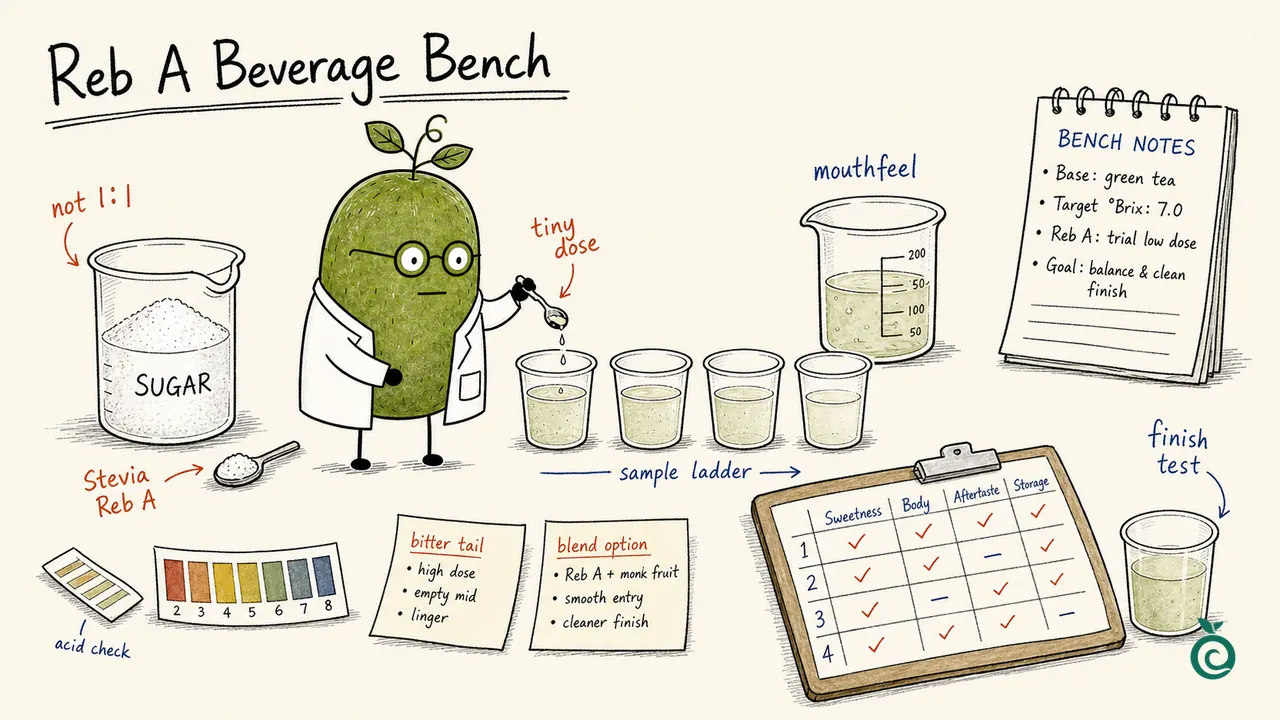
Do not treat Reb A as a 1:1 sugar replacement
Reb A is a high-intensity sweetener, so a small amount can create strong sweetness. That does not replace the grams of sugar that previously provided body, Brix, viscosity, flavor release and a softer finish. A supplier brief should separate sweetness replacement from mouthfeel replacement.
Start with a sugar-reduction target
Before asking for dosage, decide whether the project aims for partial sugar reduction or full sweetness replacement. Targets such as 30% or 50% are formulation examples here, not automatic label qualifications. We would screen a partial-reduction direction alongside the current drink before deciding how much body, acid balance and finish need to change; the preferred route depends on the product and its market.
Check the beverage matrix
Reb A behaves differently in plain water, tea, coffee, citrus drinks, botanical drinks, protein beverages and mineral beverages. Acidity, bitterness, aroma, carbonation, heat process and storage time can all change how the sweetness and aftertaste are perceived.
Use blends to solve different problems
A practical blend may combine stevia with monk fruit, allulose where the target market allows it, or other body and mouthfeel tools. The point is not to add more ingredients blindly, but to use each ingredient for a clear role: sweetness lift, front sweetness, body, finish or cost control.
Identify the material before comparing doses
Record the commercial product code, named glycoside and total-glycoside specification, reporting basis, form and any carrier. A supplier description of stevia powder does not establish that the whole powder is Reb A, and a higher assay does not by itself select a finished-drink dose. Match the sample to its documents and compare the actual material in the intended base.
Does stevia powder always mean Reb A?
No. A powder may contain a different glycoside profile or a carrier, so confirm the full composition before applying a Reb A trial plan. For the selected powder, record actual dose, addition order, water temperature and mixing method. Check complete dissolution before judging taste, then repeat in the finished drink after its intended processing and storage. A named powder form does not establish a universal mixing time, concentration or sugar-replacement ratio.
How do you calculate sugar reduction without guessing a Reb A dose?
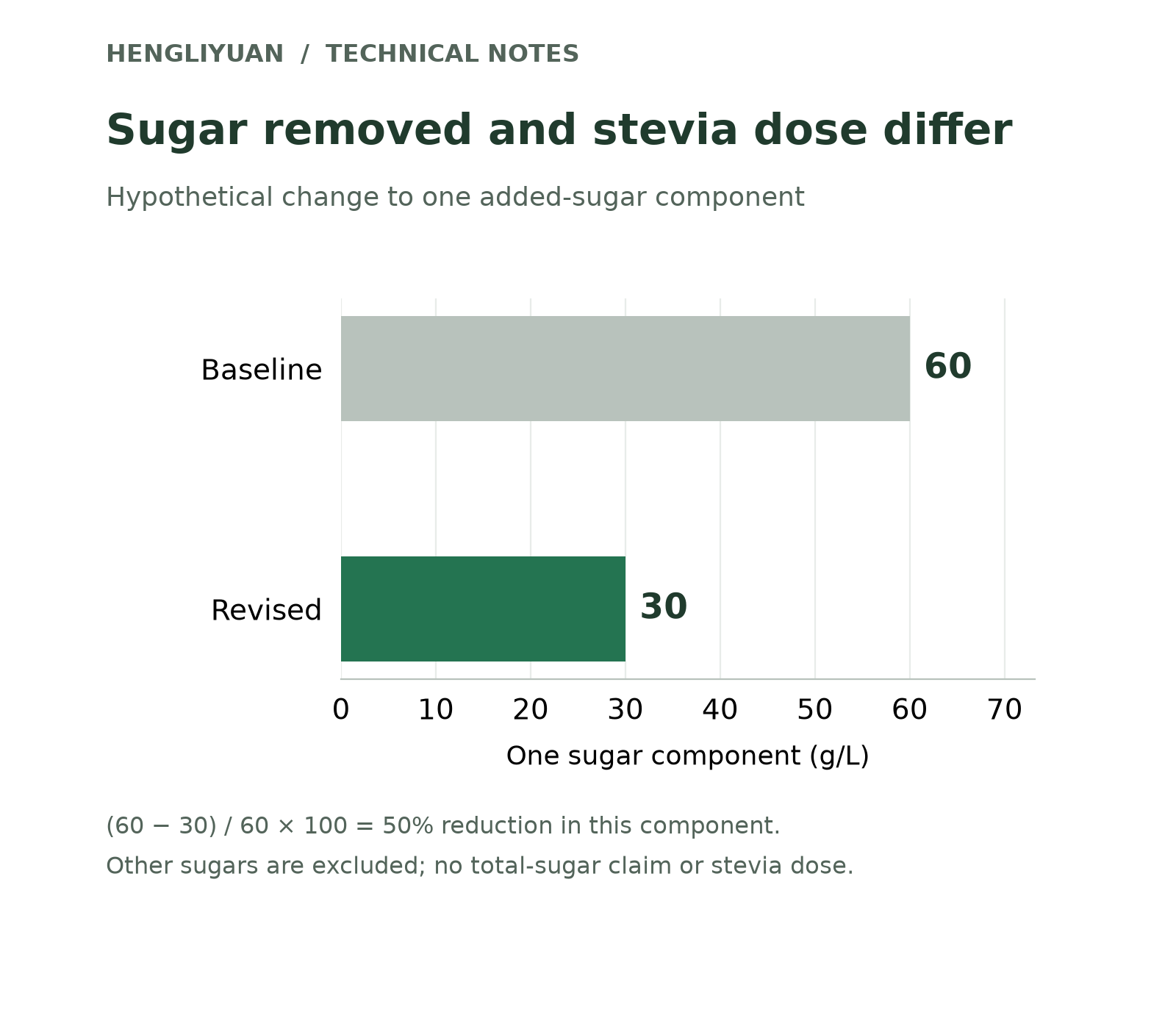
Separate the amount of sugar removed from the stevia dose needed to restore sweetness. On the same finished-drink basis, formulation sugar reduction is (baseline sugar minus revised sugar) divided by baseline sugar, multiplied by 100%. For example, changing one added-sugar component from 60 to 30 grams per litre halves that component. It does not prove a 50% reduction in total sugars when juice, milk or other ingredients also supply sugars. A finished-product label claim needs its own compositional and market review. Neither a Reb A assay nor a supplier's generic sweetness multiple determines the final dose.
To find that dose, compare a small dose series of the named grade with the original sweetened control in the real drink. Keep the base, processing and serving conditions comparable, then choose the sample that meets the sweetness and aftertaste target. Record how reduced sugar affects body and acidity as well. An aqueous screening result or a recommendation for another beverage is a starting point for a trial, not an approved recipe.
Which dose units should be written in a trial record?
State whether the dose is the whole commercial ingredient, a named glycoside or a prepared stock solution, and use the same final-volume basis throughout. One gram of commercial powder per 1,000 litres equals one milligram per litre. If a stock contains c milligrams of that powder per millilitre and the trial target is d milligrams per litre, the required stock volume is d/c millilitres per litre of finished drink. Record stock concentration, actual weighing, dilution and the ingredient batch. Carrier content, incomplete dissolution and handling losses need separate checks; this arithmetic is not a sweetness or uniformity guarantee.
Keep a dose trial that another person can repeat
Compare a small coded dose series with the current sweetened control in the complete drink. If the aim is to compare finish at matched sweetness, record how each dose was adjusted; a fixed-addition comparison answers a different question. Keep observations of sweetness strength, target fit and liking separate.
| Trial record | Write down | Read the result as |
|---|---|---|
| Material and actual addition | Product/grade/batch, whole commercial material or named glycoside, actual mass and final-volume basis; stock concentration and amount if used | A recorded addition for that material, not a universal sweetness multiple or a ratio inferred from assay. |
| Complete drink and preparation | Control and candidate recipes, sugar from other ingredients, water/dilution, actual mixing, dissolution, process and serving condition | An application comparison; a complete beverage powder prepared as specified in water is its real base. |
| Taste and physical observations | Sweetness, bitterness/linger, acidity perception and body; method, units and actual checkpoint for physical readings | Keep Brix, viscosity and sensory observations distinct; Brix in a mixed formulation is not automatically a total-sugars measurement. |
| Next sample decision | The specific gap to fix, actual results including missing observations, preparation/storage history and the next one-variable question | A basis for the next trial, not a shelf-life, label, safety or commercial approval. |
What the published beverage studies support
Acevedo and colleagues (2018) used a trained panel and mixture modeling for tagatose, sucrose and stevia in a carbonated soft-drink matrix. It supports evaluating sweetness and bitterness together in the selected mixture; it does not supply a dose for every commercial Reb A grade. Mintarsih and colleagues (2025) studied an RTD tea system containing steviol glycoside, maltodextrin and xanthan gum, with sensory evaluation around UHT processing. The full formula matters: reducing sugar does not by itself determine the change in energy, mouthfeel or cost. These specific study systems are not Hengliyuan trials or ready-made recipes for your drink.
Start with the drink and one question for the next sample
Tell us the drink type, intended market and the sugar or taste change you want. Share the current sugar level, target, named ingredient, flavor and known preparation or process details; pH, quantities and a completed trial sheet can follow if you do not have them yet. Clarify whether you are asking about a sweetener ingredient, a blend or a separate finished-product/packing project before a quotation is prepared. Powder or liquid form and packaging support must be confirmed for the actual selected scope.
Common questions
Can Reb A replace sugar gram for gram?
No. Separate the sweetness task from the mass, body, solids and flavor functions that sugar supplied. A named grade still needs a dose comparison in the complete beverage.
Request a stevia ingredient sampleDoes cutting one sugar component in half halve total sugars?
Only that recorded component has been halved on the same basis. Other ingredients may contribute sugars, and a total-sugars or label claim needs its corresponding composition and market review. The retained 60-to-30 g/L chart is hypothetical component arithmetic, not a test result.
Request a stevia ingredient sampleCan a Brix reading tell me the final total-sugars reduction?
Not by itself in a mixed formulation. State the measurement method and composition, and keep Brix, total sugars and the mass of an individual added ingredient as different records.
Request a stevia ingredient sampleDoes a Reb A percentage determine the beverage dose?
No. Confirm the assay item and basis, full supplied composition and form. The dose is the actual amount of the selected material that meets the intended drink target after preparation and processing, not a number inferred from a generic sweetness factor.
Request a stevia ingredient sampleHow should a stock-solution dose be recorded?
State what material the stock contains, its concentration, actual stock volume and final-drink volume. Use consistent units and account for dilution; complete dissolution and handling losses still need their own checks.
Request a stevia ingredient sampleCan monk fruit or another ingredient be blended with Reb A?
Yes, as a direction to test for a defined role such as sweetness timing, finish or body. Confirm ingredient identity and market fit, then compare actual amounts in the drink; the blend name alone does not establish an improved taste or lower cost.
Request a stevia ingredient sampleIs a dose series in water enough?
It is an early screen if it contains only the sweetener. Compare the complete intended beverage and its processing and serving conditions; a complete RTM drink powder reconstituted as directed in water is its application base.
Request a stevia ingredient sampleMust I finish all measurements before contacting you?
No. Start with the drink, intended market and one problem or target. Share the details you know; the exact sample, specification, documents, quantity, form and quotation scope can be clarified next.
Request a stevia ingredient sample