
Read this guide in
FRUIT BEVERAGE FORMULATION GUIDE
How to Test Sweeteners in Low-Sugar Fruit Beverages
Compare fruit drink sweeteners fairly: distinguish Brix, pH and titratable acidity, standardize reconstitution, and match before/after heat tasting conditions.
A low-sugar fruit drink can reach the intended sweetness and still lose its fruit character after processing. Our approach is to separate the measurements from the sensory decisions: Brix, pH and acidity describe different parts of the drink, while sweetness, sourness, aroma and the finish still need their own comparison.
Start with the real fruit base and a matched control. Keep dilution, process and serving conditions consistent before deciding whether the next change should be sweetener, acid balance, aroma or process. Use the existing fruit-beverage scorecard linked below to record the trial rather than creating another set of disconnected notes.
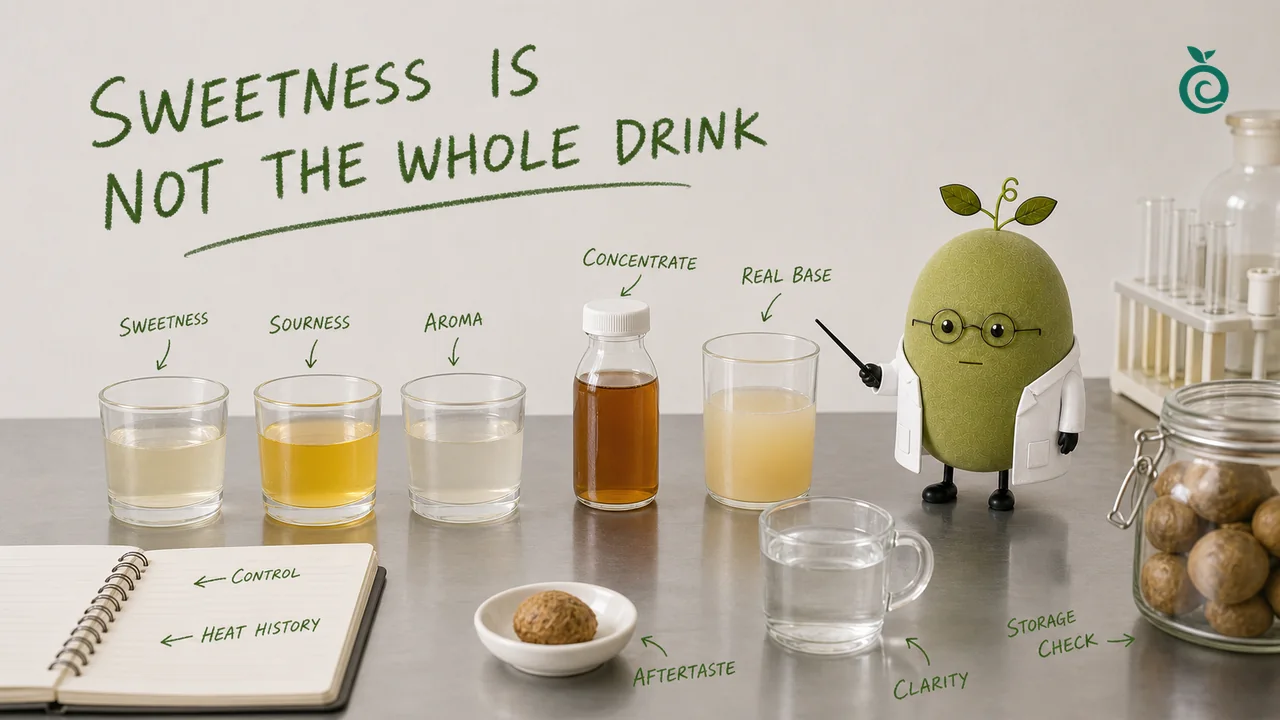
Which variables should a fruit beverage sample separate?
Record sweetness and sourness separately, even though they interact. Smell the drink before sipping, then describe the fruit character during the sip and the finish afterward. Use the same cups, fill volume, serving temperature and time after opening. A weaker fruit impression is an observation; it is not, by itself, proof that a measured percentage of aroma compounds was lost.
Keep Brix, pH and titratable acidity in separate fields
Name the product first: NFC juice, reconstituted juice, flavored fruit drink, fruit tea or sparkling beverage. Record the fruit lot, recipe and measurement methods. Do not write “pH or acidity” as though one could replace the other, and do not use a refractometer as a direct sugar assay in a mixed sweetener system.
- METTLER TOLEDO: refractometer Brix and dissolved-substance effects
- Hanna Instruments: fruit-juice pH and titratable-acidity methods
| Measurement | What to record | What it does not replace |
|---|---|---|
| Refractometer Brix | Reading, instrument/method, sample preparation and temperature correction. In a mixed drink, other dissolved materials affect the reading. | Measured sugar composition, perceived sweetness or aroma intensity. |
| pH | Calibrated method, sample temperature and whether the sample is concentrate or ready to drink. | Titratable acidity, perceived sourness or a full process-safety assessment. |
| Titratable acidity | Method and endpoint, units and acid equivalent used for reporting. | pH or the sensory balance of a different fruit base. |
| Sensory observations | Coded control/candidate, serving temperature, volume, order and timing. | Instrumental aroma-retention data, microbiological validation or shelf-life proof. |
Why keep concentration and reconstitution visible?
Specify whether the sample is a concentrate or a finished beverage. For reconstitution, state the concentrate-to-water ratio and whether it is by mass or volume; record water source, mixing order and final batch amount. Test at the intended drinking strength. Keep the aroma addition point and any pulp, cloud or other solids in the record. A concentrated tasting cannot approve the diluted product.
Compare the heat step without changing serving temperature
Where heating is part of the intended process, prepare a defined before/after comparison and document the actual treatment, filling and cooling history. Bring both samples to the same sensory serving temperature before comparing them; otherwise heat exposure and tasting temperature are confounded. Note opening aroma, fruit character, cooked or stale notes, color, cloud and sediment. Any unprocessed sample intended for tasting must be suitable under the project’s food-safety procedures. This sensory comparison does not validate a thermal process.
How should a control and sample be compared?
Keep the current or sugar-containing control. Change one main direction where practical, and list all linked changes if a blend also changes solids or acidity. Use coded samples and vary their order. If sweetness is acceptable but the finish is too sour, test the taste balance before assuming that adding aroma will solve it. If the unprocessed drink is acceptable and the processed drink is not, investigate the process comparison before blaming the sweetener alone.
What the research supports
The 2019 orange soft-drink study examined sugar reduction, flavor release and sensory perception in a defined orange model. Mao and colleagues’ 2025 sucrose–citric-acid study found time-dependent sweet–sour interactions in model solutions. Those studies support separating aroma and taste observations and checking the finish; they do not establish the same response for every fruit, high-intensity sweetener or commercial process. No universal Brix, acid ratio or heat setting is taken from them here.
Turn the result into the next sample request
Send the fruit base, finished-drink or concentrate format and the defect you want to resolve. Add the control/candidate changes, reconstitution instructions, measurements with methods and the point at which the defect appears. Share target market, process, packaging, estimated quantity and document needs where available. The first discussion can then focus on a specific next comparison.
Record these fields before comparing fruit beverage samples
- Beverage lane and real fruit base
- Current or sugar-containing control
- Brix, pH and titratable acidity recorded separately with methods
- Sweetener and aroma or essence direction
- Heat process and fill condition
- Opening aroma, in-mouth fruit character and aftertaste
- Clarity, cloud, sediment or separation
- Cooling and storage checkpoints
Common questions
Does a Brix reading tell me how sweet a low-sugar fruit drink is?
Not by itself. A refractometer responds to the sample’s refractive properties, including dissolved substances other than sucrose. Record the result separately from sweetness and any measured sugar composition.
Discuss this requestCan pH replace titratable acidity in the sample record?
No. They describe different properties. Record the pH method and temperature, and state the titratable-acidity method, endpoint, units and acid equivalent where measured.
Discuss this requestHow should I compare a concentrate with a finished drink?
Reconstitute according to a defined ratio, stating mass or volume basis and water conditions. Evaluate the intended drinking strength rather than using concentrate taste as a finished-drink approval.
Discuss this requestShould the before-heat and after-heat samples be tasted at different temperatures?
For a comparison of processing effects, bring them to the same defined serving temperature and record the processing and cooling history. Only taste samples suitable under the project’s food-safety procedures.
Discuss this requestDoes weaker perceived aroma prove a particular aroma-loss percentage?
No. Sensory observations and analytical volatile measurements are different evidence. Describe what changed and how it was assessed; do not assign an aroma-retention percentage without the corresponding measurements.
Discuss this requestDo I need a separate new spreadsheet for this guide?
No. The linked fruit-beverage scorecard provides access to the existing trial record. Use a separate record for each base and checkpoint, and mark any fields that do not apply rather than inventing values.
Discuss this request