
Read this guide in
STEVIA ALLULOSE GUIDE
Stevia and Allulose Blend Formulation Guide
Compare a stevia and allulose blend by exact material, dose basis, sweetness timing and application. Use a free sensory record for the next sample.
Stevia can deliver strong sweetness at low use levels, while allulose can help with body, mouthfeel and a more sugar-like base in selected markets. That makes stevia allulose blends a common discussion for sugar-reduction projects.
The blend still needs careful testing because stevia grade, dosage, flavor system, application and local regulations can change the final result.
Why combine stevia and allulose
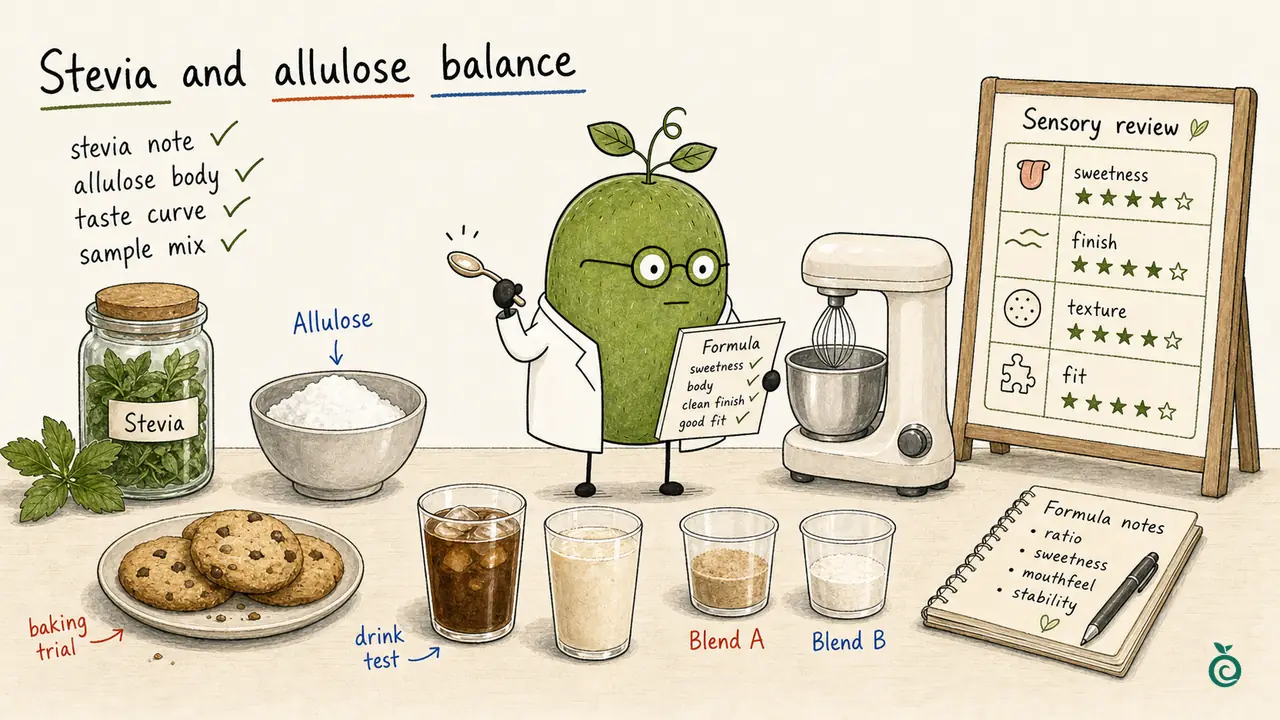
Allulose is less sweet than sucrose but can support bulk and mouthfeel. Stevia can lift sweetness without adding much weight. Together, they may help buyers reduce sugar while avoiding a thin or overly sharp sweetness profile.
Stevia grade changes the taste
Different stevia extracts can vary in bitterness, lingering notes and sweetness timing. Buyers should avoid judging only by the word stevia and should test the exact sample grade in the final product base.
Compare a ready blend with ingredients purchased separately
Decide whether your team wants to dose an agreed allulose and steviol glycoside blend or prepare the mixture from separate ingredients. For a ready blend, identify the full composition, sweetness specification and sample reference in the quotation. For separate ingredients, identify the allulose specification and the selected steviol glycoside material before choosing trial levels. Compare candidates in the same product base at the intended sweetness, keeping preparation and serving temperature consistent. Record the amount of each ingredient, sweetness onset, finish and mouthfeel. If the selected steviol glycoside material or blend composition changes, treat it as a new sample comparison rather than assuming the earlier result still applies.
Choose the comparison question before choosing the ratio
Our starting point is the intended product and the exact commercial materials. A fixed addition comparison and a matched-sweetness comparison answer different questions. Record which one you are running before interpreting the result; a different total addition can change the bulk, dilution and formula as well as sweetness.
| Comparison | Keep in the record | What it does not isolate |
|---|---|---|
| Fixed addition | The same stated addition basis, actual blend mass and finished product base | Equal perceived sweetness or equal functionality across different compositions. |
| Matched sweetness | The actual amount needed for each candidate, the agreed sweetness target and every compensating formula change | The effect of one sweetener when dose, bulk or dilution also changed. |
| Ready blend versus separate ingredients | The complete supplied composition, component identities, actual preparation and amount reaching the same base | An equivalent result simply because both offers say allulose and stevia. |
| A different stevia grade or blend revision | The new sample code, material identity, composition and a fresh comparison in the intended base | An inherited taste result from a differently identified sample. |
Make the amount and material basis explicit
Keep the commercial ingredient or supplied blend mass distinct from its declared steviol glycoside content and from the amount present in the finished food. A blend composition percentage and an addition percentage into a beverage use different denominators. Preserve the unit and reference mass whenever a trial or quotation changes.
| Record | Keep explicit | Before interpreting the next sample |
|---|---|---|
| Commercial material | Grade, lot, carrier or other components, material form and applicable specification | Do not treat the material name alone as full identity or dose equivalence. |
| Addition basis | Actual ingredient or blend mass, the corresponding batch mass and units; blend composition separately | Do not read a percentage inside a premix as the same percentage in the finished product. |
| Small additions or a prepared stock | Weighing capability, actual stock composition, total stock added and the carrier or liquid it introduces | A displayed zero or an unrecorded dilution is not a known delivered dose. |
| Mixing and sampling | Actual preparation, addition order, mixing and sampling method, sample location or stage when relevant | A powder-mixing method or one scoop does not establish every serving's composition or application performance. |
If a small addition cannot be weighed reliably with the available equipment, agree a suitable preparation and weighing method before comparing doses. For a stock, retain both the commercial ingredient amount and the total stock amount; include its carrier or liquid in the final formula. This guide supplies no universal stock concentration, stevia dose, blending time or uniformity limit.
How Hengliyuan makes the corresponding blend
Hengliyuan makes its allulose-based sweetener blends by high-speed powder mixing, which distributes the powdered ingredients in the selected formula. This is a common powder-mixing method. Confirm blend uniformity, particle size and application performance against the selected specification and sample.
Applications that often ask for this blend
Stevia allulose blends are often discussed for flavored water, tea drinks, coffee drinks, beverage powders, tabletop sweeteners, dairy-style products, sauces, syrups and selected bakery or snack formulas.
Use a separate comparison for baking
A drink trial does not answer whether the selected allulose and steviol glycoside blend suits your baked product. Keep the current recipe as a control and document the proposed blend quantity and any other recipe changes. Compare dough handling, portion weight and spread using a recorded baking programme. After a consistent cooling period, assess colour, bite and crumb or interior texture separately. For a filled or packaged product, evaluate that finished format as well. If the taste is acceptable but the structure misses the target, review the recipe and process rather than simply adding more sweetness. Keep the blend identity with the trial record; changing the selected steviol glycoside material or blend composition calls for another comparison.
Separate taste, preparation and the finished application
In the actual beverage or tabletop direction, keep the control, base revision, addition basis, preparation and serving conditions with each sample. Describe sweetness onset, peak, lingering notes and mouthfeel separately. A stronger sweet taste does not by itself resolve a thin body, poor dispersion, powder flow or another process defect. Check the relevant actual heat or acid process, preparation, package and storage observations for the intended product. Do not carry a water-screening or immediate tasting result into a finished beverage, powder, baked product or later storage checkpoint without that comparison. If multiple ingredients or process steps changed, report the observed difference without assigning it to one material.
Use the existing free sensory record
The sweetener scorecard records one coded sample, one person and one checkpoint at a time. Its 57 blank input cells cover the comparison context, six dimensions, three separate review gates and the next action. Use the same agreed targets and comparison basis across the candidate records, retaining each actual addition and preparation with its sample. The optional 1–5 target-fit entries do not calculate a total, average or ranking. Keep target fit, intensity and preference distinguishable, leave missing observations blank, and review unresolved ingredient/market, safety and document requirements separately. The file downloads without an email address or account; it is not an automatic formula or label approval.
Keep market and label review with the real product
Record the intended sales market, full ingredient composition, finished-food use, proposed product name and packaging claims before selecting the final material. A taste result or a description such as natural, sugar-free or erythritol-free does not settle every ingredient-use and label question. For a U.S. allulose project, include the main sales states and proposed packaging claim for review. This guide does not provide a current country-by-country approval list. Confirm the actual product and market review alongside the sample and specification rather than transferring another market's answer.
Start with the product, market and main taste or texture problem
Send what you are making, the intended sales market and the one issue the next sample should address. Add the base, current sweetener system, desired sweetness, exact stevia grade or restrictions and available observations. A finished scorecard, fixed blend ratio and complete purchasing brief are optional at first contact. Once the ingredient or blend direction is clearer, confirm the supplied composition, selected specification and sample reference, then discuss packaging, estimated quantity, required documents and sample arrangements. A quotation should identify the actual material and scope, rather than treating a material name or a good tasting result as the whole offer.
Common questions
Why combine allulose with stevia?
Allulose can contribute bulk, body and mild sweetness while the selected stevia material lifts sweetness at low addition levels. The balance still needs comparison in the actual product and intended market.
Discuss this requestDoes allulose guarantee removal of stevia aftertaste?
No. Keep the exact stevia grade, dose, base, flavor, acidity, process and timing of the observation with the result. A rounded taste in one system does not establish the same finish in another.
Discuss this requestIs there one correct allulose-to-stevia ratio?
No universal ratio follows from the two ingredient names. Identify the commercial materials, supplied composition, target product, comparison basis and market before selecting and evaluating a trial.
Discuss this requestIs a fixed-addition trial the same as matching sweetness?
No. Matching perceived sweetness may require a different actual addition and a change in bulk or dilution. Record those changes so the comparison question remains clear.
Discuss this requestWhat if the small stevia addition cannot be weighed reliably?
Agree a suitable weighing and preparation method for the actual material. If using a stock, retain its composition, the total stock added and the carrier or liquid reaching the final product. This guide supplies no universal stock concentration or dose.
Discuss this requestDoes high-speed powder mixing prove blend uniformity?
The process description identifies how the corresponding Hengliyuan allulose-based blends are mixed. Confirm uniformity, particle size and application performance against the selected specification and sample; the process name or a single scoop does not establish those results.
Discuss this requestCan a beverage result establish performance in baking?
No. Retain the baked-product control, actual recipe changes, portion and bake/cooling conditions, then assess handling, spread, color and texture in that finished format. A good drink result does not supply the baking result.
Discuss this requestMust the sensory file or complete purchasing details be finished before contact?
No. Start with the product, market and main taste or texture problem. Share the base and sample observations you have; the worksheet and further specification, pack, quantity, document and sample details can follow.
Discuss this request