Stevia selection for food and beverage teams
Reb A vs Reb M: Taste Differences, Applications and Cost in Use
Compare Reb A and Reb M for beverages, dairy and food formulation: bitterness, lingering sweetness, application choices, grade documents and cost in use.
If the problem in your recipe is stevia bitterness, especially the bitter taste that stays after swallowing, try Reb M first. If your current Reb A formula already tastes right, or you are reducing only part of the sugar, keep Reb A as a candidate or control.
Reb A and Reb M are different steviol glycosides. Taste them in the same food at similar perceived sweetness. Record bitter aftertaste separately from sweetness that lingers. If you remove sugar, work on its bulk and texture functions separately.
Reb A vs Reb M at a glance
Use this comparison to choose the first sample direction. The application suggestions are starting points for formulation, rather than results from Hengliyuan tests of every listed food. Actual performance depends on the commercial grade, dose and food base.
| Decision | Reb A | Reb M |
|---|---|---|
| Main reason to include it | Keep a working Reb A formula as the control. It is also a starting candidate for partial sugar reduction or an established blend. | Try it first when stevia bitterness, especially bitter aftertaste, is the problem to solve. |
| Taste question | Watch bitter notes as the addition increases; compare the actual glycoside composition. | Check bitterness after swallowing and record lingering sweetness separately. |
| Useful first screening routes | Part-sugar tea or fruit drinks; sauces and dressings; sweetener blends. | Light-flavoured drinks; higher-reduction beverages; dairy and frozen-dessert sweetener systems. |
| Sugar replacement | Supplies high-intensity sweetness; bulk and texture need their own solution. | Supplies high-intensity sweetness; bulk and texture need their own solution. |
| Buying identity | Match the named Reb A content, total glycosides, reporting basis and grade. | Match the named Reb M content, total glycosides, production route and grade. |
| Cost decision | Compare the tested amount per finished batch, rather than price per kilogram alone. | Calculate whether the tested dose and any reformulation costs justify the quoted grade. |
A beverage with a delicate flavour and a sauce with salt, acid and spices should not inherit the same sweetener decision. Choose against the product that will be sold, including its normal serving temperature.
What do the taste studies show?
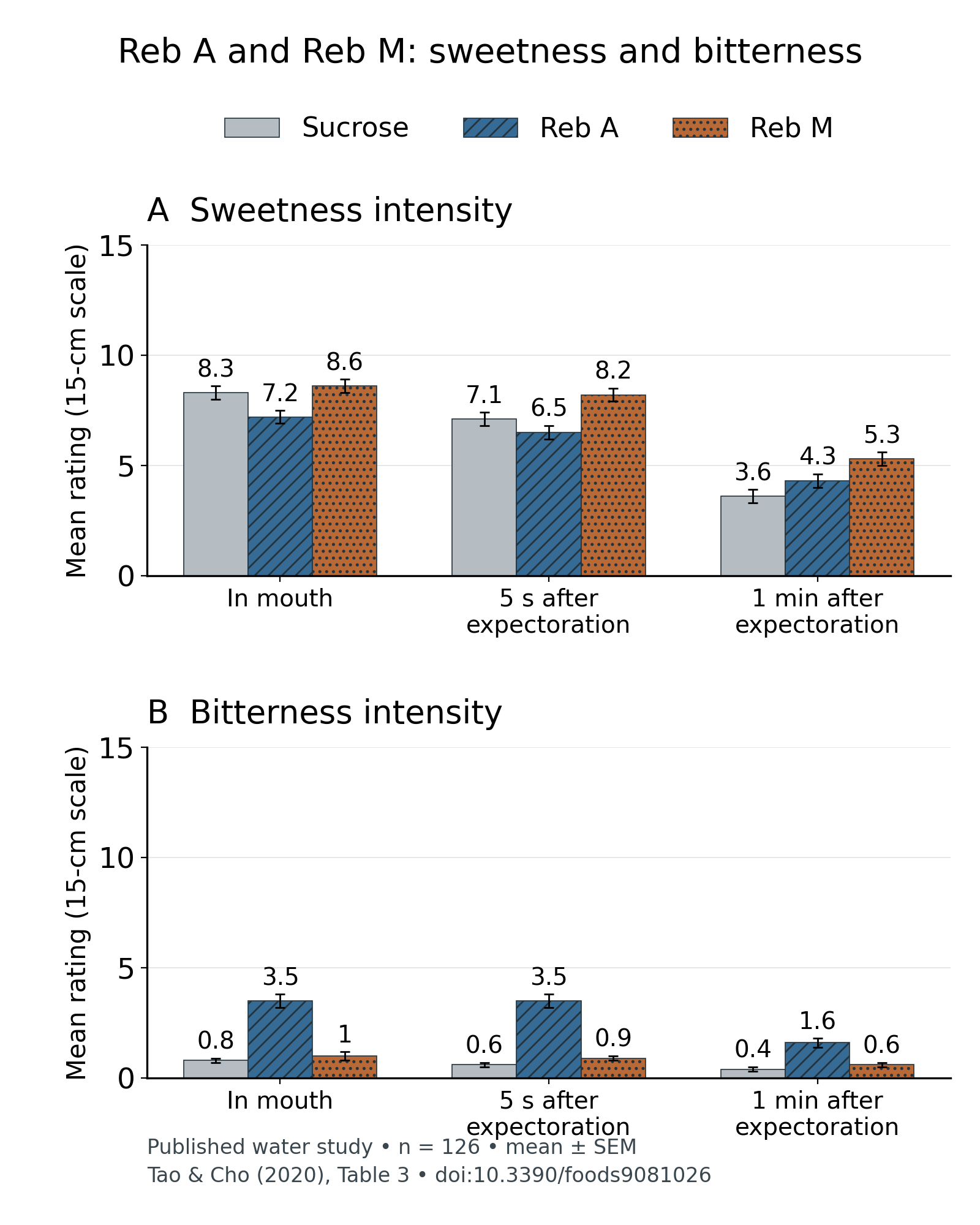
Tao and Cho tested 95%-purity Reb A and Reb M at 0.10% w/v in water, with 14% w/v sucrose as the reference. Their 126 consumers rated sweetness and bitterness on 15-cm scales. One minute after expectoration, the Reb M sample had a lower mean bitterness rating and a higher mean sweetness rating than Reb A. Reb M had also tasted sweeter initially at the same concentration. Tao and Cho discuss a separate study by Prakash and colleagues, in which Reb A and Reb M at a similar sweetness level, about 8% sucrose equivalence in water, did not differ in lingering sweetness. The equal-concentration test shows how the two materials tasted at the same addition. For a formulation choice, match the perceived sweetness in your own food, then compare the bitter finish and remaining sweetness.
- Tao and Cho, Foods 2020: consumer sensory study
- Prakash et al., Foods 2014: Reb A and Reb M sensory profiles, Figure 5
When should you start with Reb A?
Start by keeping Reb A in the comparison when the product retains some sugar, or when it is one part of an established sweetener system. A partial replacement asks the high-intensity sweetener to supply less of the total sweetness than a complete sugar removal. This can leave more room to manage taste through the complete formulation. It is a screening rationale, not evidence that every Reb A dose will be acceptable. For tea and fruit drinks, compare the sweetness with the tea bitterness, acidity and aroma still present. For a sauce or dressing, evaluate the whole acid-salt-sweet balance. These stronger bases are worth screening; they must not be assumed to hide an unacceptable bitter finish. If the product already meets its target with Reb A, changing only to obtain a Reb M name may add work without solving a defined problem. Reb A is also a candidate in blends. Change its contribution systematically rather than adding another sweetener to an unidentified base. A useful reason to move on to Reb M is a repeatable bitter note that remains after the Reb A dose has been adjusted to the required sweetness.
When should you start with Reb M?
Start with Reb M when the problem is the bitter taste of stevia, especially bitterness that remains after swallowing. It is worth trying early in light-flavoured drinks or when a larger sugar reduction has made the bitter finish more noticeable. Compare with your current sweetener at the intended sweetness. Record the bitter finish and lingering sweetness separately. In dairy drinks and yogurt, evaluate the milk or protein base as well as the acid and flavour. A cleaner sweetener does not correct a protein off-note, an overly acidic fruit preparation or a processing defect. For yogurt with fruit, taste the base and fruit preparation separately before judging the assembled product. In an electrolyte or other dry drink mix, choose the sweetener in the reconstituted drink, not by tasting the dry powder. Mineral bitterness, concentration per bottle, mixing and serving temperature all affect the decision. Reb M is a candidate for the sweetness system; its name does not establish instant dissolution or cold-storage clarity.
Ice cream shows why taste and sugar function need separate decisions
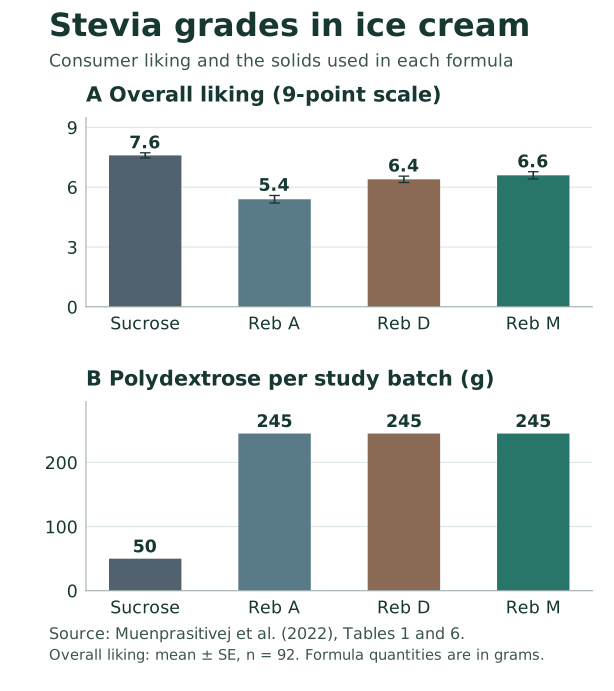
A 2022 ice-cream study used 95%-purity Reb A, D and M materials at 0.09% w/v and a 14% w/v sucrose control, with 92 consumers. Reb M ice cream received higher overall liking than Reb A, but the sucrose control remained higher than both. Each steviol glycoside formula used 245 g of polydextrose per study batch, compared with 50 g in the sucrose formula. This supports testing Reb M as a lower-bitterness frozen-dessert direction. It does not show that replacing sugar with a small dose of Reb M leaves ice cream otherwise unchanged. Sugar contributes solids and freezing behaviour; bulking ingredients and the rest of the system affect texture and serving hardness. The same separation matters in baking. Reb A and Reb M can contribute sweetness, while the lost sugar mass, moisture management, browning and structure need their own formulation choices. A change from Reb A to Reb M alone is not a solution to a small cake, dry crumb or hard frozen product.
- Muenprasitivej et al., Foods 2022: ice-cream study
- Sweetener blends for ice cream and frozen desserts
- Sweetener testing in beverages and bakery products
Choose an application before choosing a grade
The table gives a practical order for the first comparison. It describes what the formulation needs to resolve, not a promise that one glycoside wins an entire food category.
| Application and brief | First comparison worth making | What decides the next step |
|---|---|---|
| Tea or fruit drink with some sugar retained | Current formula versus a Reb A direction; add Reb M if bitterness remains a limitation. | Sweetness-acid balance, tea bitterness, fruit character and the finish at serving temperature. |
| Light-flavoured or higher-reduction drink | Reb A and Reb M at the same intended sweetness, with the rest of the base held comparable. | Bitter notes, sweetness persistence, flavour release and dose needed to reach the target. |
| Milk, protein drink or yogurt | Compare Reb M with the existing system; include a Reb A direction where it fits the brief. | Protein/base flavour, acidity, sweetness timing, processing and the finished product after storage. |
| Ice cream or frozen dessert | Compare sweetener systems with the sugar-replacement solids plan recorded separately. | Flavour and aftertaste together with scoopability, hardness and melting behaviour. |
| Sauce or dressing | A Reb A or blend direction as a screen; include Reb M when a bitter finish remains. | Salt-acid-sweet balance, spice profile, viscosity and use temperature. |
| Dry drink powder or tabletop blend | Compare the commercial blend and its prepared drink or intended serving. | Dose uniformity, carriers, mixing, taste and the distinction between ingredient mass and sugar-equivalent sweetness. |
| Bakery product | Choose the glycoside after defining the replacement for sugar solids. | Browning, moisture, volume and texture as well as sweetness. |
For large sugar reductions, a blend may let each ingredient do a specific job. Keep the glycoside, any other sweeteners and bulking ingredients identifiable. A blend percentage is not a statement of how much of the finished product’s sweetness each ingredient contributes.
How products use Reb A and Reb M
A product label or supplier statement can tell you which glycoside is used and what it is paired with. Check the exact product before carrying that example into your own trial.
- Orgain Chocolate Organic Protein & Oatmilk powder ingredient statement
- Orgain Creamy Chocolate Plant Protein Shake ingredient statement
- Icon Foods RA99M supplier announcement
| Published example | How it is used | What you can take from it |
|---|---|---|
| Orgain Chocolate Organic Protein & Oatmilk powder | The brand’s product catalogue lists Reb A and monk fruit extract in this mix-at-home protein powder. | If you are comparing powder directions, taste the prepared drink at its intended dilution. |
| Orgain Creamy Chocolate Plant Protein Shake | The brand’s catalogue lists Reb M and monk fruit extract in this ready-to-drink shake. | The two Orgain examples use different bases and formats. They establish the pairings, while the grades’ relative taste still needs a controlled trial. |
| Icon Foods RA99M | Icon Foods announced a supplier premix combining Reb A and Reb M and listed powdered beverages as one application. | This is a supplier blend example. The announcement did not disclose the component proportions. |
Is Reb M sweeter, and can you use less?
Sweetening potency is not one fixed number that applies to every concentration and food. A material may be compared at equal powder addition, equal named-glycoside addition or equal perceived sweetness; these answer different questions. For a formulation choice, establish the intended sweetness in the actual food and measure the commercial material needed. If Reb M reaches that target with a different amount than Reb A, use those measured doses in the cost comparison. Do not obtain a production dose by multiplying the grade percentages, or by assuming that two powders with the same purity have the same taste. A pilot comparison should distinguish sweetness intensity from liking. Two samples can be equally sweet while differing in bitterness, lingering sweetness or flavour balance. Higher sweetness is not automatically a better sample.
Cost in use: compare the amount that achieves your target
For a material quoted per kilogram and a tested dose in grams per litre: Sweetener cost per litre = price per kilogram × dose in grams per litre ÷ 1,000. For solid foods, use the same calculation with grams of material per kilogram of finished product. Keep currency, order quantity, freight basis and quote validity consistent. Add the cost of any other changed sweeteners, carriers or bulking ingredients. A price break-even calculation can help before requesting final quotes: Reb M breaks even on sweetener ingredient cost when its price ratio to Reb A equals the Reb A dose divided by the Reb M dose. For illustration only, if recorded trial doses were 0.20 g/L for A and 0.16 g/L for M, the ratio would be 1.25. At those assumed doses, a 25% higher price per kilogram would give the same glycoside cost per litre. Those numbers are arithmetic inputs, not suggested doses, current prices or a Hengliyuan test. A lower powder price can be a sensible choice when the full product already meets its taste target. A more expensive grade can also be justified when its measured application benefit matters. Neither conclusion follows from the ingredient name alone.
What do Reb A and Reb M names tell you?
Both belong to the steviol glycoside family, but their molecular structures differ. FDA notice records identify Reb A as one glycoside and describe Reb M as another. A specification may report total steviol glycosides, a named glycoside percentage or both; those figures answer different questions. Ask for the analysis method and the composition of the actual grade. Do not read a total steviol glycoside figure as a Reb A or Reb M percentage. The Reb A response cited here concerns Hunan Huacheng's notified preparation and intended uses. FDA said it had no questions at that time about the notifier's conclusion and had not made its own GRAS determination; this is not approval of Hengliyuan or every stevia product.

Why does the production route matter?
Some steviol glycoside preparations come from leaf extraction and purification; other notified preparations use enzymatic conversion. The linked PureCircle GRN 745 notice describes a Reb M-rich preparation made by enzymatically converting Reb A from stevia leaf extract. It is a notifier's submission, not an FDA response letter, and does not establish the route used by every product sold as Reb M or by the RM95 batch examples below. Request the production route, ingredient declaration, selected grade's specification and batch documents. Check the destination market's rules for the actual preparation and use, rather than transferring a conclusion from another route or country.
How do RA60SG95, RA98 and RM95 differ?
Read the named glycoside and total-glycoside rows separately. RA60SG95 is not a claim of only 60% total steviol glycosides. The table gives three supplier-issued Haigen batch examples, with percentages on a dried basis. Specification minima and measured batch results are different. These reports do not establish a complete profile of the remaining glycosides, current stock or a fixed specification for future deliveries.
- View the published RA98 batch example
- Request the current grade and batch documents
- View Reb A 60% / SG95
- View Reb A 98%
- View Reb M 95%
| Grade and batch | Named glycoside: minimum / result | Total steviol glycosides: minimum / result |
|---|---|---|
| RA60SG95 · 20260912 | Reb A: 60.0% / 65.43% | 95.0% / 95.51% |
| RA98 · 20260923 | Reb A: 98.0% / 98.29% | 98.0% / 99.41% |
| RM95 · 20260920 | Reb M: 95.0% / 96.31% | 95.0% / 98.82% |
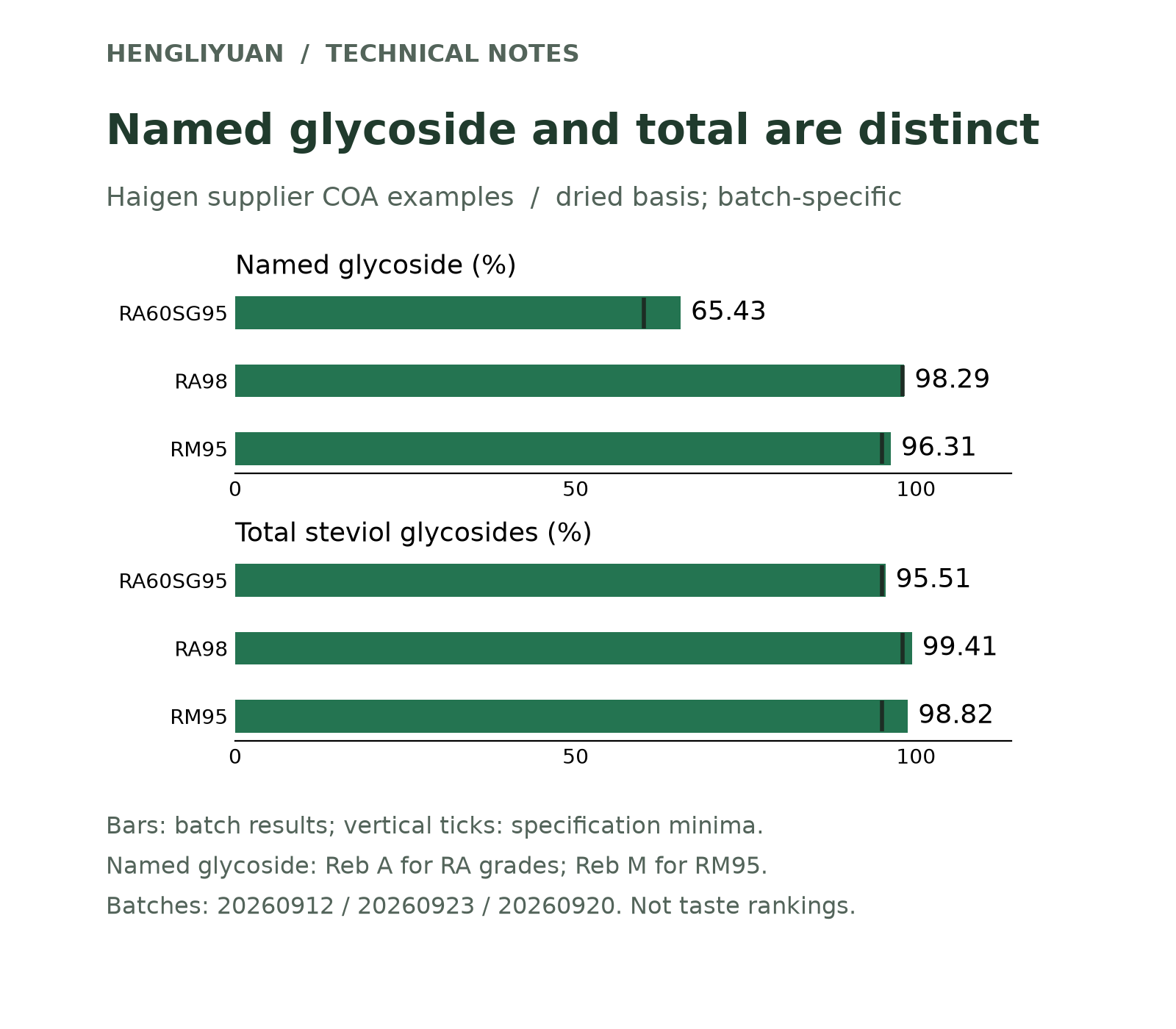
Compare these as different purchasing items, then test them at the intended sweetness in the same food or drink. Higher named-glycoside content does not by itself prove better taste, faster dissolution or lower finished-product cost. Ask for the offered grade's full composition, preparation instructions and matching COA before choosing the sample.
Solubility, processing and market documents are grade-specific
Ask how the offered material should be dissolved or premixed at the concentration you need. Use its actual instructions to plan the preparation temperature, stock concentration and mixing sequence. Then check the finished food after the intended hold and storage. A clear fresh stock is a different observation from a clear cold-stored drink. The names Reb A and Reb M identify glycosides; they do not establish the production route of the offered grade. Leaf extraction and purification, enzymatic conversion and fermentation are different supply routes. Glucosyl steviol glycosides are also a different purchasing identity from a named Reb M grade. Review the exact preparation and intended use in the destination market. A supplier’s notice, an FDA response for another preparation, or a public COA is not approval of every grade or a finished-product label. Confirm the ingredient statement, route documents and applicable market requirements for the product you are developing.
Run a focused sample comparison
For a reduced-sugar tea, pour three coded samples: the current recipe, a Reb A candidate and a Reb M candidate. Keep the tea base, serving volume and temperature consistent. Record each commercial grade, the material mass, batch size and any stock dilution. Adjust the two candidates to similar perceived sweetness against the reference. If the current recipe uses Reb A, keep that recipe as the control and use the second cup for the adjusted Reb A direction. Record the first sip, peak sweetness, bitterness after swallowing and how much sweetness remains. Record the actual dose that reaches the target and use it in the cost calculation above. Keep any fixed-dose comparison separate. Taste the shortlist again after the real process and during the intended storage period. A bitter finish can justify trying a different glycoside or blend. If the main problem is lingering sweetness, adjust the sweetness system and retest. Changes in texture or stability need their own formulation work.
How Hengliyuan can help you choose the next sample
Tell us the product, target market and the taste or sugar-reduction problem you want to solve. If available, share the current sweetener grade, the comparison you have already made and whether the problem is a bitter finish or sweetness that lingers. A complete proprietary formula or annual purchase quantity is not needed to begin. We can discuss suitable stevia ingredient or custom-blend directions and confirm the offered grade, current documents and sample arrangements. Keep the approved sample, specification and quotation linked by product code. Final pricing, quantity, packing, availability and delivery terms are confirmed for the actual request.
Sources and how to read the evidence
Published sensory results in this guide concern the materials, concentrations, panels and bases described in the original papers. The application table is our editorial screening advice. Haigen COA examples shown concern identified supplier batches and must not be read as the sensory samples used in those papers. The cost example is arithmetic, not a quotation or experimental result.
Common questions
What is the main difference between Reb A and Reb M?
They are different steviol glycosides. Published comparisons found lower bitterness for Reb M under the studied conditions. Its sweetness can still linger, so compare the actual grade, dose and food rather than treating Reb M as having no aftertaste.
When is Reb A worth choosing?
Keep it in the comparison for partial sugar reduction, a prepared blend or an existing product that already meets its flavour target. Decide from the measured dose, taste and full cost in that product; there is no reason to change a working system solely for a different glycoside name.
Where is Reb M especially worth screening?
Consider it when lower bitterness is important, including light-flavoured or higher-reduction drinks and dairy or frozen-dessert systems. The base, dose and remaining sweetness aftertaste still decide the result.
Does Reb M remove all sweetener aftertaste?
No. Bitter aftertaste and lingering sweetness are different attributes. A reduction in bitterness can coexist with persistent sweetness. Evaluate both in the intended food.
Can Reb A or Reb M replace the bulk of sugar in ice cream or bakery?
They supply high-intensity sweetness at low addition. Removed sugar solids, texture, browning or freezing behaviour need their own formulation solution; changing the glycoside does not replace those functions.
Does RA60SG95 mean only 60% total glycosides?
No. The supplier example has separate Reb A and total-glycoside specification rows. Read the named constituent, total content, dried basis and batch results separately.
Is RM95 the same as RA98 at a slightly different purity?
No. RM95 names a Reb M purchasing grade and RA98 a Reb A grade. Different glycosides, full compositions and sample preparation must be compared alongside the percentages.
Is Reb M always more economical if less material is used?
No. Compare the current price multiplied by the actual dose at the intended sweetness, then include other formula changes. A smaller addition can offset only a corresponding part of a higher price per kilogram.
Does a Reb M name prove that the material is leaf-extracted?
No. Ask for the selected grade’s production statement. Leaf extraction, enzymatic conversion and fermentation are different routes, and the name or grade code alone does not identify one.
Can I ask for samples before finishing the formula?
Yes. Start with the food, target market and taste or sugar-reduction objective. Share what is known; the matching material, documents, sample quantity and commercial terms can be confirmed next.