
Read this guide in
KOMBUCHA PROCESS VALIDATION
Low-Sugar Kombucha Sweetener Guide: Fermentation and Post-Sweetening Validation
Separate fermentation sugar, endpoint acidity and post-fermentation sweetening when testing low-sugar kombucha, monk fruit or stevia.
Kombucha sugar reduction has three separate questions: what supports the fermentation stage, how the finished tea reaches its acidity endpoint, and when sweetness is adjusted for the final drink. A post-fermentation sweetener can change the taste of a finished sample, but it cannot by itself prove that the fermentation process, acidity target or label plan has been validated.
This page is for kombucha brands, fermented-tea makers, beverage developers and ingredient buyers preparing a real-base sample.
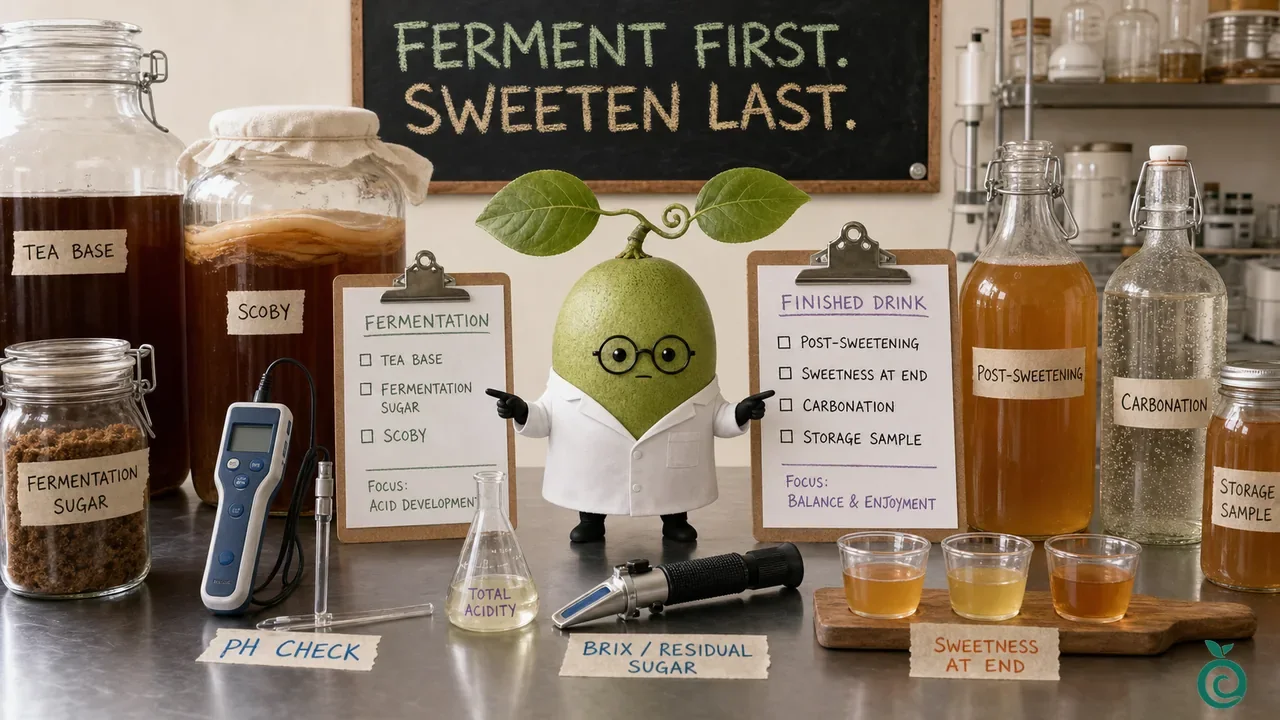
Separate fermentation sugar, endpoint acidity and finished sweetness
Keep these decisions in different rows. The fermentation stage has its own tea base, culture, substrate, time and temperature. The endpoint has its own pH, titratable acidity, residual sugar or Brix and sensory record. The finished drink may then receive dilution, carbonation, flavor and a post-fermentation sweetness adjustment. One sweet cup cannot answer all three questions.
Start with the tea and process brief
Name the tea base, tea strength, starter or culture process, vessel, fermentation time and temperature. Add the current pH, titratable acidity, residual sugar or Brix, carbonation plan and intended storage condition when known. These details keep a monk fruit, stevia, allulose-supported or broader natural sweetener direction tied to the actual beverage instead of to a water test.
Build a control and sample matrix
Keep the current or sucrose control when possible. Then separate a partial sugar-reduction fermentation, a post-fermentation sweetening direction and any blend route that fits the target market. The purpose is to see whether the next problem is fermentation progress, acid balance, body, aroma, carbonation or lingering sweetness. Do not change the tea, culture, process and sweetener timing in every row at once.
Record the process and finished drink at their own checkpoints
During fermentation, record pH, titratable acidity, residual sugar or Brix and sensory notes at the project-defined timepoints. After the endpoint, record sweetness, sourness, tea astringency, aroma, carbonation, sediment or separation and aftertaste again after the agreed blend or storage step. A Brix reading, a single sweetness check or a public label cannot replace the complete test.
Treat research numbers as model conditions, not a recipe
In the 2023 Foods study by Cohen, Sela and Nolden, fermentation temperature and sucrose concentration were tested in a controlled black-tea kombucha model while pH, Brix, titratable acidity and sensory response were tracked. Temperature had a strong effect on acidity and astringency in that model. A 2025 black-tea study on monk fruit substitution and a 2026 stevia study add useful application signals, but neither proves a universal sweetener ratio, live-culture outcome, alcohol result, safety result or market claim.
Prepare the next sample from the failed row
If acidity or fermentation progress is the concern, hold the finished sweetener step steady while reviewing the process row. If the finished cup is too sharp or too long, hold the fermentation record and compare the post-fermentation sweetness direction in the real base. If carbonation, sediment or storage changes, keep those observations beside the taste notes rather than blaming the sweetener before the variables are compared.
Technical references and boundaries
Sources: Cohen et al., Sucrose Concentration and Fermentation Temperature Impact the Sensory Characteristics and Liking of Kombucha, Foods, 2023, https://www.mdpi.com/2304-8158/12/16/3116; Physicochemical and Sensory Analysis of Monk Fruit (Siraitia grosvenorii) Sweetener as Sucrose Substitute in Black Tea Kombucha, Journal of Functional Food and Nutraceutical, 2025, https://doi.org/10.33555/jffn.v7i1.8; Mukoid et al., PRODUCTION OF KOMBUCHA USING UNCONVENTIONAL RAW MATERIALS, 2026, https://doi.org/10.31548/humanhealth.1.2026.124. These sources support variables and test design in their own models. They do not set a universal pH, Brix, acidity, fermentation time, sweetener ratio, alcohol limit, shelf-life result, safety conclusion or Hengliyuan performance guarantee.
Review note
Reviewed October 2, 2026.
Common questions
Can a post-fermentation sweetener replace fermentation sugar?
Not as a blanket assumption. A conventional kombucha process and a finished-drink sweetness adjustment are different decisions. Keep the current control and test timing, process, acidity and finished sweetness separately.
Why can a kombucha taste sweet and still be acidic?
Sweetness and acidity are different sensory signals. Fermentation products, tea compounds, residual sugar, dilution and post-fermentation sweetening can all shape the final cup, so record sweet and sour separately.
Can monk fruit or stevia be added before fermentation?
They can be considered only inside a defined application trial. The tea base, culture, process, acidity, Brix, aftertaste and target-market label plan still need review in the real product.
What should buyers send before requesting a kombucha sample?
Start with your target market and product idea. Share any known packaging specification, estimated quantity, required certificates/documents and whether samples are needed; we can clarify the remaining details together. Add the tea base, fermentation stage, sweetening timing and main test question.
