Read this guide in
BEVERAGE SAMPLE SCORECARD
Zero-Sugar Beverage Sweetener Trial Scorecard
Use a comparable control/A/B/blend sample plan and record the taste, process, physical and storage checks that matter in a real zero-sugar beverage.
The fastest first-round beverage test is usually the one that keeps the comparison fair. This scorecard is designed for a zero-sugar or sugar-reduction project using monk fruit, stevia, allulose-supported, erythritol-free or other natural sweetener directions.
It helps a team decide what to test and what to record. It does not provide a universal ratio or replace commercial validation.
Start with one real decision
Write the decision at the top of the sheet: "Can this system deliver the target sweetness without an unacceptable finish in our real beverage?" Add the drink type, serving size, target market, flavor, pH or acidity, soluble solids, viscosity, carbonation and process. If the question is not clear, the sample set will be difficult to interpret.
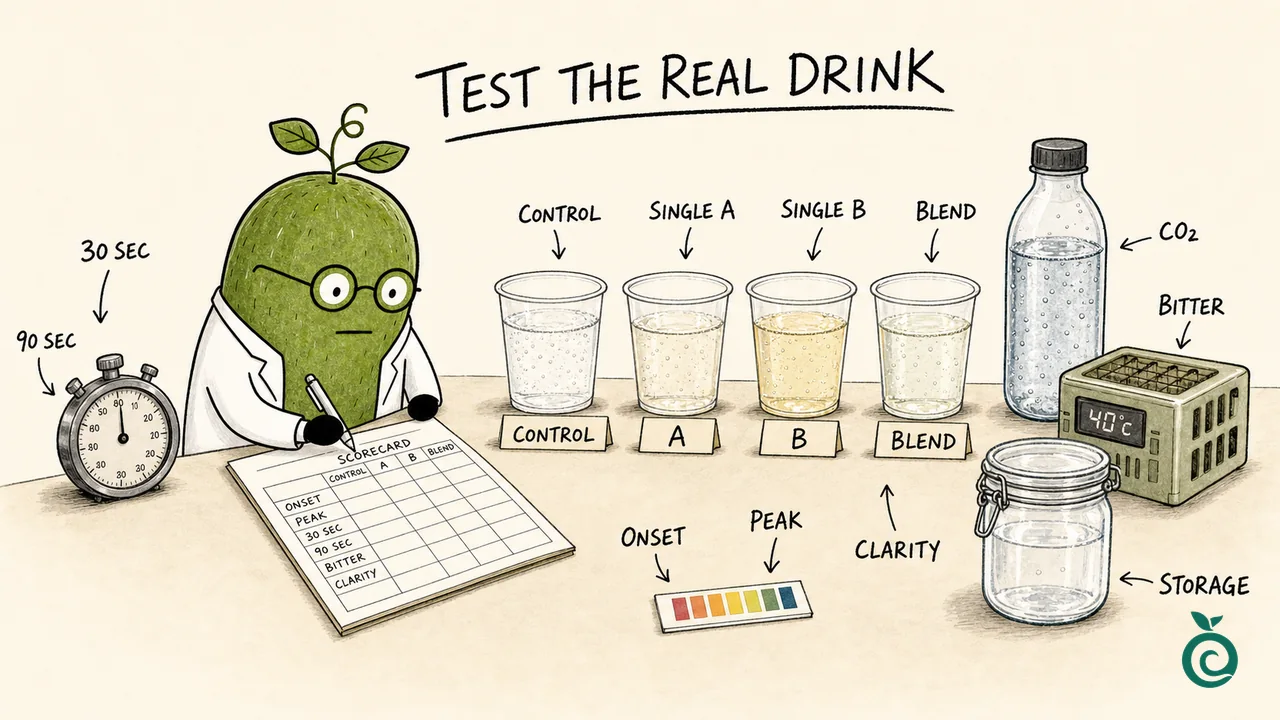
Keep four samples comparable
A useful first matrix is the current formula or sucrose control, one candidate sweetener direction A, a second candidate direction B and one blend designed to test a specific trade-off. Keep the target sweetness and serving conditions clear. If a sample also changes body, acid or flavor, record that change instead of treating it as a pure sweetness comparison.
| Sample | Question | Keep with the record |
|---|---|---|
| Current or sucrose control | What is the reference for this drink? | Identified control version, actual recipe and safe preparation/serving conditions. |
| Candidate A | How does the first actual material behave? | Commercial grade, carrier, sample/batch version, measured dose and stock dilution. |
| Candidate B | What changes with the second material? | Use the agreed base and comparison conditions; record its actual dose. |
| One blend direction | Does this combination address the selected trade-off? | Full blend identity, proportions, measured amount and any other recipe changes. |
State whether the comparison fixes inclusion or adjusts each candidate toward a matched sweetness target. Keep the actual amounts and total beverage basis either way. Mass ratio and sweetness contribution are different; adding a bulking ingredient changes the complete formula. Use coded samples and an agreed presentation order, and keep individual notes before discussing the group result.
Lock the real beverage conditions
Record water and mineral profile, pH, titratable acidity and acid type, fruit, tea, coffee, botanical, protein or electrolyte base, flavor, soluble solids, viscosity, carbonation, mixing order, heat treatment, filling, cooling, serving temperature, package and storage checkpoint. Water can be a screening step, but it should not be the final decision for a flavored, acidic, carbonated or protein-containing drink. Keep pH, titratable acidity and perceived sourness as separate observations. Record the measurement method, units and temperature where relevant. Brix is not a direct total-sugars assay in a mixed drink.
Use a time-sensory record
Record each sample at the same agreed temperature and serving format. Follow sweetness onset, peak and finish, then note bitterness, metallic or licorice-like sensations, astringency, acid balance, aroma, body and mouth-coating where relevant. Choose and record the time origin and tasting checkpoints; the original 30- and 90-second observations are examples, not a universal method. Mao et al. (2025) studied sucrose–citric-acid water models, not a zero-sugar finished drink or a commercial blend. Visalli and Galmarini (2024) reviewed temporal sensory methods. These references explain why method and time matter; they do not supply a blend ratio, a panel-size requirement or the protocol for your beverage.
Add physical and process checks
Record clarity, haze, sediment, separation, foam and color before disturbing the relevant sample. Keep any dissolution-time or pH-drift result with its preparation method, units, temperature and checkpoint. Repeat the relevant checks after heat treatment, carbonation, filling and the planned storage checkpoints. A sample that tastes good in a glass but separates in the package has not answered the production question. Use samples prepared for the intended sensory check, with the required safety review. An appearance check, an immediate taste result and a packaged storage test answer different questions; a fresh sample does not establish shelf life.
Make the decision traceable
Write which sample best answered the stated question, which attribute improved, which trade-off remained, what must be retested and which documents or market checks are missing. This turns "sample B tasted better" into a buyer-ready development note. It still does not prove a fixed formula, shelf-life result, cost advantage or approval in another market. Keep ingredient/market fit, safety review and required documents separate from sensory scores. A high taste score does not close an unresolved requirement. Identify the next change and retain the actual version to be retested.
Use the record that fits the question
The free Excel below is our existing sample-feedback record. Save a separate copy for each coded sample, reviewer and checkpoint; use it alongside the four-sample plan above. It has blank fields for agreed targets, six review dimensions, observations, next actions and three independent decision gates. No email or account is needed. Its 1–5 example anchors describe how well a sample meets the agreed target. They are not raw sweetness intensity, consumer liking, a laboratory measurement or an automatic pass. Put detailed timing and physical measurements in the notes or your own method record; do not force different quantities onto the same scale. Missing scores stay blank.
- Download the existing blank sample-feedback Excel (.xlsx)
- Read the scoring definitions and decision-gate guide
| Observation | Record clearly | Keep separate |
|---|---|---|
| Sweetness timing | Sample code, time origin, checkpoint, serving conditions and actual observations. | Target match, raw intensity and liking. |
| Aftertaste and body | The sensation, when it appears and the agreed target. | An unwanted note from an assumed cause. |
| Acid-related checks | pH; titratable acidity with method and units; perceived sourness. | Three different readouts. |
| Solids and flow | Brix or the chosen flow/viscosity method, with conditions and units. | Total-sugars content and mouthfeel. |
| Appearance and preparation | Undisturbed appearance, mixing history and any measured dissolution endpoint. | Visible dispersion, dissolution and stability. |
| Process and storage | Actual process, package, storage condition, date and checkpoint. | Fresh observations, storage results and shelf-life approval. |
Start the discussion with the drink and the question
Tell us the beverage, final sales market and the problem the next sample should answer. Share existing observations when available; a completed scorecard or full formula is not required for the first message. Known process, packaging, quantity and document requirements can be clarified as the sample direction develops.
Research and related guidance
The studies cover model-system perception and temporal sensory methods. The US claim rule is a separate labeling reference. None of them establishes a commercial beverage formula, sample acceptance or permission in every market.
Common questions
Should I include a control?
An identified current formula or sucrose control gives the comparison a reference for sweetness, finish, acid balance and body. Keep its actual recipe and preparation conditions with the record.
Discuss this requestAre four samples enough to approve a formula?
They can answer a first comparison question. Production, packaging, storage, safety, documents and target-market requirements need the checks agreed for that project.
Discuss this requestMust I taste at 30 and 90 seconds?
No. Those are example checkpoints. Define the time origin, serving conditions, attributes and checkpoints for the beverage, then apply the same method to the compared samples.
Discuss this requestShould I use the same dose for every sample?
Decide whether the question concerns fixed inclusion or a matched sweetness target. Record the actual dose, material identity, any stock dilution and the complete beverage basis. Equal mass does not establish equal sweetness.
Discuss this requestHow do I use the downloadable Excel with four samples?
Save one record for each sample code, reviewer and checkpoint. Use the same agreed targets across the comparison, keep individual observations and retain any detailed timing or measurement records alongside it.
Discuss this requestDoes a score of 5 mean the sweetest sample or an approved product?
The reused record defines 5 as meeting the agreed target. It is not a raw intensity or liking score, and it does not clear unresolved safety, market or document requirements.
Discuss this requestCan I contact you before the record is complete?
Yes. Start with the drink, final sales market and the taste, body or processing question. Existing observations help the discussion; unfinished fields do not prevent the first contact.
Discuss this request