
Ingredient basics
What Is Allulose? Forms, Formulation and Label Checks
What is allulose? A food-manufacturer guide to allulose powder, syrup and blends, first trial design, and target-market label checks.
Allulose, also called D-psicose, is a low-calorie sugar used in food and beverage formulations. Our first recommendation is to choose its job in the product before choosing the form: are you adjusting sweetness, replacing part of the sugar mass, or using it as part of a blend?
Powder, syrup and blends are different purchasing and formulation choices. Compare the actual allulose content, water contribution and performance in your process. Then assess the finished-product label for the destination market. A promising sample does not settle all three decisions.
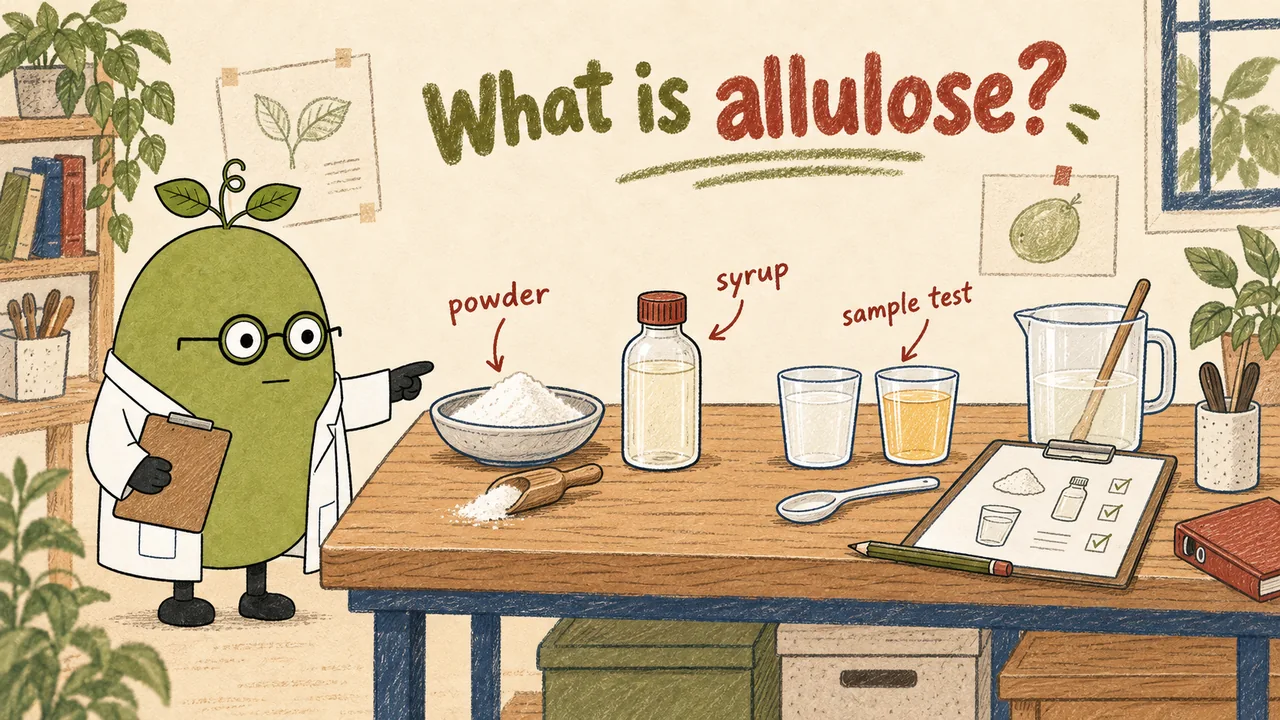
What is allulose, and how is it different from monk fruit extract?
Allulose is a sugar molecule. The U.S. Food and Drug Administration calls it D-allulose or D-psicose and describes it as a low-calorie sweetener. Monk fruit extract is a different ingredient whose sweetness comes from mogrosides. They cannot be compared by ingredient weight alone: a formulator must assess sweetness, ingredient mass and the finished product separately. The ingredient name also does not tell you the composition of a commercial syrup or blend. Ask for the complete ingredient list and the selected product specification.
What is allulose made from, and is it a sugar alcohol?
Allulose is a sugar, not a sugar alcohol such as erythritol. Commercial manufacturing examples convert fructose into allulose with an enzyme, then separate and purify the material into syrup or crystalline powder. One FDA-notified process starts from corn-derived sugars; the feedstock and enzyme system are specific to that manufacturer's material. Ask for the origin and production documents of the ingredient offered to you. These examples do not establish Hengliyuan's manufacturing process, a universal corn origin or a finished-product label claim.
Powder, syrup or a blend: which form should you test?
Choose the form that fits how you weigh, mix and process the ingredient. Powder contributes a dry ingredient; syrup also brings water; a blend introduces the other ingredients listed in its composition. Compare each against the same finished-product target, recording the actual dose rather than copying a dose from a different form.
| Form | When we would consider it | Check before comparing samples |
|---|---|---|
| Powder | Dry premixes, or a process where a dry ingredient is easier to meter. | Allulose assay and reporting basis, moisture, handling and dissolution in the intended process. |
| Syrup | A process set up for liquid addition and water-balance adjustment. | Solids, allulose content and its basis, other constituents, storage and dosing conditions. |
| Formulated blend | A project that needs allulose alongside other sweeteners or bulking ingredients. | Complete composition, intended sweetness, application dose and the contribution of every ingredient. |
Syrup solids and allulose content are different numbers
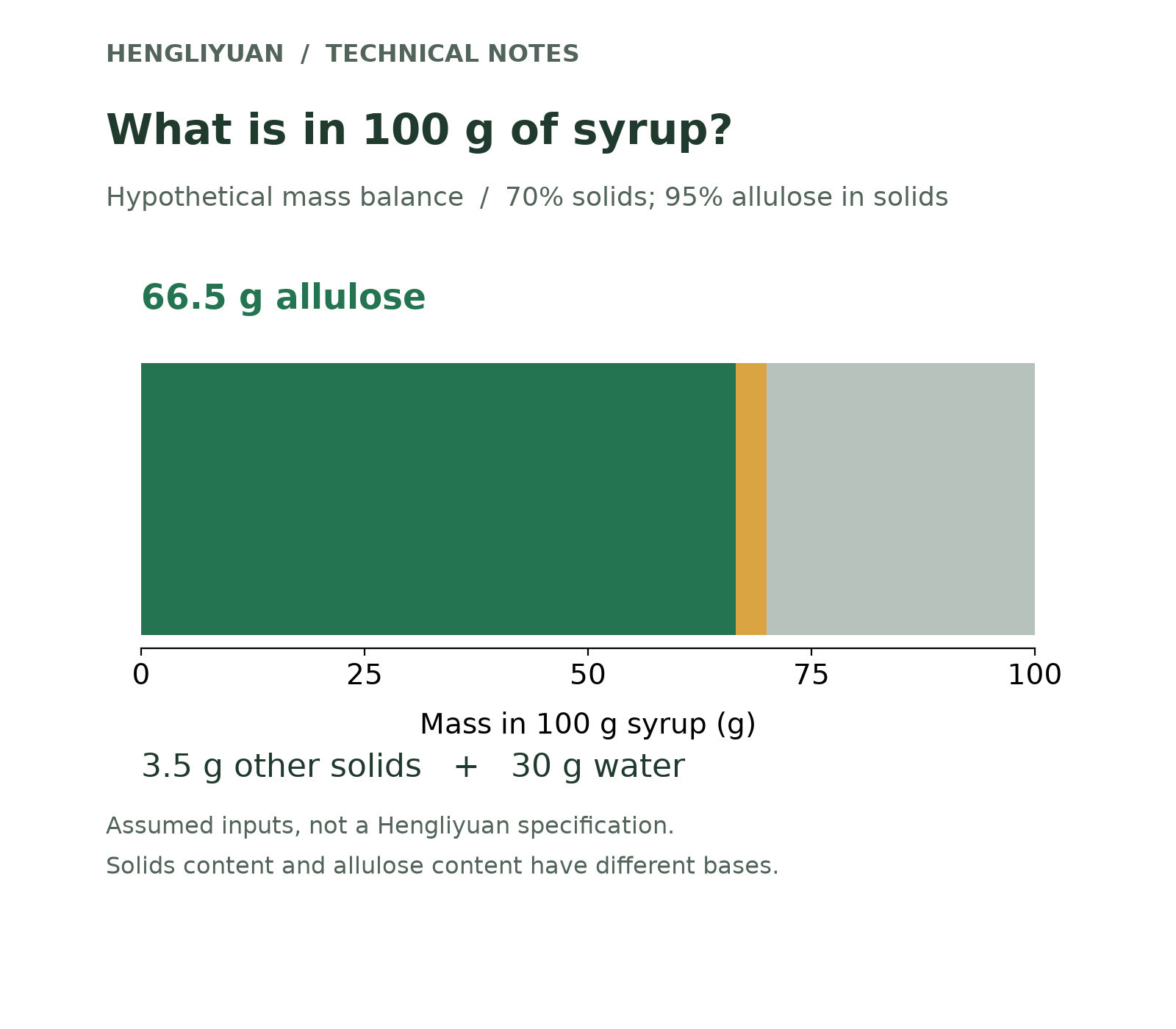
A solids figure describes the material left after water is excluded; it does not identify how much of those solids is allulose. Read the specification for both values and their reporting basis. Do not treat a refractometer reading alone as a direct allulose assay. Here is a hypothetical mass-balance example: 100 g of syrup at 70% solids contains 70 g of solids and 30 g of water. If allulose makes up 95% of those solids, the syrup contains 66.5 g allulose and 3.5 g other solids. Allulose mass = syrup mass × solids fraction × allulose fraction of solids. These are calculation inputs, not a Hengliyuan specification. For a real sample, use its confirmed assay and solids basis. Count syrup water in the formula, identify the remaining solids, and do not substitute the same weight of powder without recalculating the balance. Matching allulose mass is only a starting point for the application trial.
What should a first food or beverage trial measure?
Keep your current product or sugar formula as a control. Decide what the first trial must answer, and hold the base formula and preparation conditions constant where possible. When switching between powder and syrup, record the water adjustment explicitly. We would compare the attributes below before selecting a commercial direction. These are trial-record fields, not results from a Hengliyuan experiment.
| Application | Record during the first trial | What to decide next |
|---|---|---|
| Beverage | Actual dose, water balance, sweetness, flavor, clarity or sediment, and results after the intended process. | Whether the sample works in the complete drink, rather than only in water. |
| Bakery | Dough or batter behavior, bake settings, color, texture after cooling and changes during storage. | Whether sugar replacement meets the product’s physical requirements as well as its taste target. |
| Dry premix | Ingredient distribution, flow, moisture pickup, serving accuracy and dispersion after preparation. | Whether the selected form suits mixing, filling and consumer use. |
Do not assume that an equal-weight sugar swap will reproduce sweetness, body and processing behavior. Choose the direction against the result you need, then confirm its specification and continue the relevant stability and shelf-life work.
Does an allulose ingredient settle the finished-product label?
The U.S. label treatment is specific. FDA guidance describes enforcement discretion for excluding allulose from Total Sugars and Added Sugars, and for using 0.4 kcal/g when calculating its energy contribution. Allulose remains included in Total Carbohydrate. For example, 10 g of allulose contributes 4 kcal using that factor. This is the contribution of the allulose, not the total calories of a serving or a sugar-free claim.
| U.S. label item | Treatment described by FDA |
|---|---|
| Total Carbohydrate | Include allulose. |
| Total Sugars and Added Sugars | The guidance describes enforcement discretion for excluding allulose. |
| Energy from allulose | Use the guidance’s 0.4 kcal/g factor in this U.S. labeling context. |
Apply the destination market’s current requirements to the complete formulation and final serving. Check other sugars and ingredients separately. The FDA guidance is not global permission to use allulose or a guarantee that a finished product qualifies for a claim. Keep the label decision with the product and regulatory team.
Move from an ingredient question to a sample decision
Start with the product you are developing, the destination market and the question you want the sample to resolve. If you already know whether you need powder, syrup or a blend, include that; if not, we can discuss the options. A current control, target dose or ingredient restrictions help narrow the comparison, but you do not need a complete formulation to begin. Hengliyuan can discuss the relevant material, sample and matching documents. Confirm the exact specification, packing and commercial terms for the selected order.
Review note
Reviewed October 16, 2026. The syrup diagram is a calculated example. U.S. labeling figures are attributed to FDA guidance and must not be applied as a global claim.
Common questions
Is allulose a sugar alcohol?
No. Allulose is a sugar molecule, also called D-psicose. It is a different ingredient class from sugar alcohols such as erythritol and from high-intensity sweeteners such as monk fruit extract.
Discuss an allulose sampleIs allulose powder interchangeable with allulose syrup?
Not by the same ingredient weight. Check the powder assay and moisture, and the syrup’s solids and allulose reporting basis. Recalculate allulose mass and water contribution, then test the adjusted formula.
Discuss an allulose sampleDoes 70% syrup solids mean 70% allulose?
No. Solids may include constituents other than allulose. In the calculated example above, 70% solids with allulose at 95% of those solids gives 66.5% allulose by syrup weight. Use the actual specification rather than this hypothetical example for dosing.
Discuss an allulose sampleCan I replace sugar with allulose one for one?
Do not assume an equal-weight substitution gives the same sweetness, texture or processing result. Test the selected material in the real product, retain a control and evaluate the functions that matter for that application.
Discuss an allulose sampleHow is allulose treated on a U.S. nutrition label?
FDA guidance describes excluding it from Total Sugars and Added Sugars under enforcement discretion and using 0.4 kcal/g for its energy contribution. It remains part of Total Carbohydrate. This does not by itself establish a finished-product claim or requirements in another market.
Discuss an allulose sampleIs allulose always made from corn?
Do not infer feedstock from the ingredient name. The cited FDA-filed manufacturing example uses corn-derived sugars and enzymatic conversion of fructose. Confirm the origin and production documents for the actual material offered; that example does not describe every supplier’s process.
Discuss an allulose sampleWhat should I send for an allulose sample discussion?
Tell us the food or beverage, destination market and main question. Include the preferred form, current control, dose or ingredient restrictions if known. We can discuss the first sample direction and identify which specifications and documents need confirmation.
Discuss an allulose sample