
Frozen dessert trials
Allulose vs Erythritol in Ice Cream: A Controlled Trial
Compare allulose and erythritol in ice cream at matched serving conditions: record overrun, hardness, melt, crystals and storage before choosing samples.
Choose the sweetener direction from the hardened ice cream at its intended serving condition. Our view: equal sweetness in the liquid mix is not enough to select allulose, erythritol or a blend. Record the base, actual dose, air incorporation and temperature history before attributing a texture difference to the ingredient.
This is a controlled trial plan, not a claim that one sweetener always makes softer ice cream. Keep the existing product as a control, compare separate candidates, and repeat promising samples under the intended storage and handling conditions.
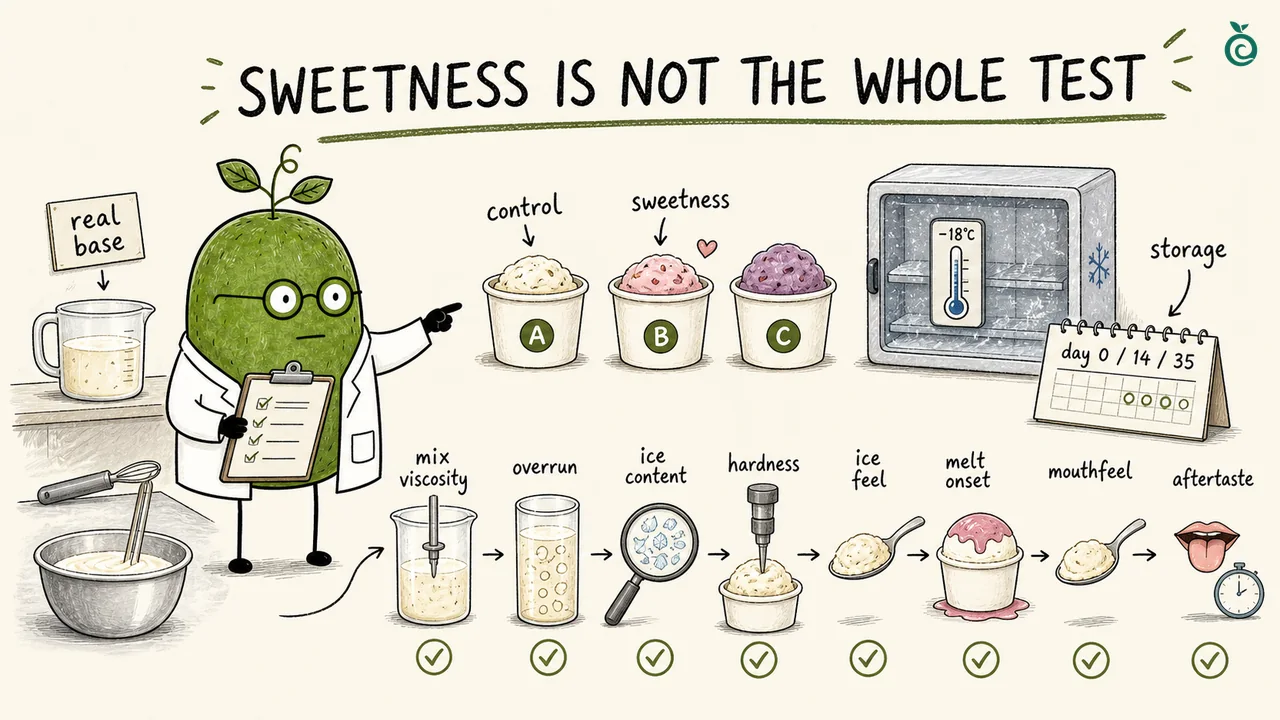
Keep one ice cream base and process
Use one control formula and separate allulose and erythritol trials with the same dairy or plant base, fat, protein, stabilizer system, mix process and package. Record the actual amount of every ingredient and any solids or water adjustment. Match the intended sweetness, but do not hide formulation differences behind a nominal one-to-one swap. Jungbunzlauer's published light-protein ice-cream trials used several sweetener systems, including combinations with stevia and inulin. Its results support testing complete formulations; they are not a clean universal ranking of two ingredients or Hengliyuan performance data.
Measure the frozen product, not just the mix
After hardening, compare scoop or cut resistance at the intended serving temperature. Record iciness, body, melt behaviour and any erythritol cooling sensation. Repeat after the planned storage interval and normal temperature handling. A fresh draw sample may hide the hardness or crystal changes that appear later. If the samples differ in sweetness or solids, write down that difference before judging which ingredient is responsible for texture.
Record overrun before comparing texture
Overrun is the percentage increase in volume as air is incorporated. For a plain product without pieces or inclusions, use the same fixed-volume cup for mix and ice cream, subtract the empty cup mass and fill consistently. Calculate overrun = (mix mass − ice-cream mass) ÷ ice-cream mass × 100%. Measure each candidate’s own mix; do not assume all mixes have the same density.
| Hypothetical sample | Mix mass in fixed cup | Ice-cream mass in same cup | Calculated overrun |
|---|---|---|---|
| A | 120 g | 80 g | (120 − 80) / 80 × 100 = 50% |
| B | 120 g | 60 g | (120 − 60) / 60 × 100 = 100% |
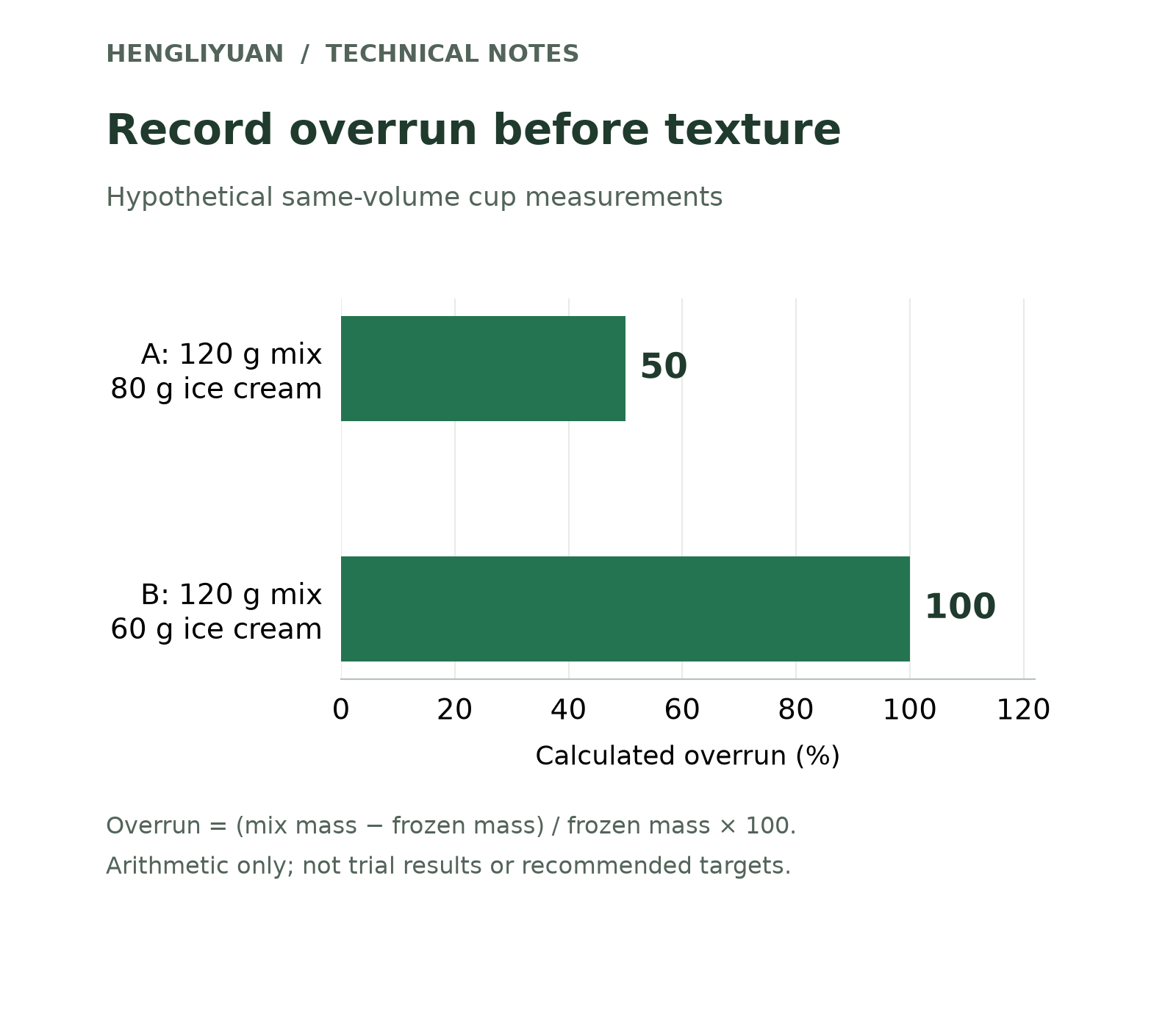
These are arithmetic examples, not our trial results or recommended targets. A and B have different air incorporation, so do not call their texture difference a sweetener-only effect. Record measured overrun alongside hardness and melt. For products with nuts, cookie pieces or other inclusions, this simple cup comparison needs adjustment; use a method that accounts for the particles.
Decide whether a blend deserves a third trial
If one sample meets sweetness but misses scoopability, change one part of the formula at a time. A blend of bulk ingredients or a separate high-intensity sweetener may be worth testing, but an ingredient pairing is not automatically a solution. Keep each formulation, dose and storage result traceable. Review the target market before using allulose or making a reduced-sugar claim. The U.S. label treatment for allulose does not settle other markets.
Brief the supplier on the failed attribute
Start with the base type, destination market and the failure you need to solve: too hard, icy, fast-melting or poor taste. Share the current sweetener system, process, serving temperature and storage plan when available. You do not need a complete proprietary formula to start the discussion. Ask which ingredient forms and documents fit the proposed trial; confirm the sample specification before comparing a commercial quotation.
Compare hardened samples at the serving condition
Record the actual sweetener mass, total solids, base composition, mix process and hardening history for each ice-cream sample. Use the intended serving temperature and the same time outside the freezer for every comparison. A spoon test on a fresh draw sample and a spoon test after hardening describe different stages. Define hardness by one agreed method, then record body, visible crystals and melt behavior separately. Give temperature handling its own row. If samples pass through transport, retail storage or repeated opening, reproduce the relevant handling in a separate trial rather than mixing it into the initial ingredient screen. Photograph the sample and note the measurement condition at each planned checkpoint. A later icy or hard sample needs review of the complete formulation and storage history; it cannot be attributed to the sweetener name alone.
| Record | Control | Allulose sample | Erythritol sample |
|---|---|---|---|
| Sweetener dose and solids | Enter actual values | Enter actual values | Enter actual values |
| Hardening and serving condition | Record temperature / time | Same method | Same method |
| Hardness and melt | Record agreed observation | Compare with control | Compare with control |
| Storage and handling | Record checkpoints | Same checkpoints | Same checkpoints |
Are gritty crystals ice or crystallized erythritol?
Grittiness alone does not identify the crystal. Ice growth and erythritol crystallization are different possible causes and may need different corrections. Compare the control, record when the defect appears and review the complete solids balance and temperature history. Ask the laboratory to identify the particles with an appropriate method before assigning the cause. For an erythritol direction, assess how much remains dissolved in the actual unfrozen phase; a pure-water value cannot serve as an addition limit for the whole frozen dessert.
Review note
Reviewed October 16, 2026. The overrun figures are calculation examples. Confirm current material documents, destination requirements and the complete product’s processing and storage performance before a purchase decision.
Common questions
What should stay the same in an allulose versus erythritol ice-cream trial?
Keep the dairy or plant base, fat, protein, stabilizers, mix process and package consistent. Use one control formula and record the actual amount of each ingredient.
Discuss an ice-cream sweetener trialWhen should ice-cream hardness be compared?
Compare scoop or cut resistance after hardening at the intended serving temperature. Repeat after the planned storage interval and temperature handling; a fresh draw sample may not show later changes.
Discuss an ice-cream sweetener trialWhy record overrun in a sweetener trial?
Air incorporation is another difference between samples. Use each candidate’s own mix and the same-volume method for a plain product, then record the result alongside hardness and melt. Do not attribute a difference to sweetener alone when overrun or measurement conditions also changed.
Discuss an ice-cream sweetener trialWhat should I record besides sweetness and hardness?
Record iciness, body, melt behavior and any cooling sensation. Note differences in solids or sweetness before attributing a texture difference to one ingredient.
Discuss an ice-cream sweetener trialDoes matching sweetness mean two ice-cream samples will have the same texture?
No. Equal sweetness does not establish equal dissolved solids or frozen-water behavior. Compare the hardened product and its storage changes in your actual base.
Discuss an ice-cream sweetener trialDoes combining allulose and erythritol guarantee better scoopability?
No. Treat a blend as a separate trial. Change one part of the formula at a time and keep the formulation, dose and storage result traceable.
Discuss an ice-cream sweetener trialDoes grittiness prove that erythritol crystallized?
No. Grittiness does not identify the particles. Compare the control and storage history, and use an appropriate laboratory method to distinguish ice growth from ingredient crystallization before changing the formula.
Discuss an ice-cream sweetener trial