Read this guide in
ALLULOSE IN BAKERY
Allulose for Baking: Browning, Moisture & Sample Testing Guide
Bake with allulose by separating sweetness, mass and texture. Compare published cake and cookie results, powder versus syrup, cooling, storage and trial adjustments.
Allulose can be used in baking to contribute sweetness, ingredient mass and browning, particularly when developing a soft or chewy product. It is about 70% as sweet as sucrose, and it changes more than sweetness: color, spread, cake height and moisture behavior may also change. It is a candidate ingredient to test, rather than a universal gram-for-gram substitute.
Our view: define the texture you want before adjusting the sweetener. A soft cookie, a crisp biscuit and an aerated cake need different outcomes. Keep the sugar control, weigh the exact material, and judge the cooled, packaged product; a darker surface or a good first warm bite does not establish doneness, structure or shelf life.
Sugar does more than sweeten
Cookies, bars, cakes, fillings and baked snacks depend on sugar for color, structure and moisture control. Replacing sweetness without replacing function can change spread, bite, browning and eating quality. In a cake, the sugar system interacts with aeration and setting; in a cookie, it affects flow before the structure sets. In filled products, water can also migrate between components. Replacing a sweetness number alone does not preserve those functions. Name the product and the reference outcome before choosing a replacement percentage.
How much allulose replaces sugar? Use a defined basis
Cargill lists allulose at 70% of sugar’s sweetness. For a nominal weight-based screen, 100 g sucrose replaced with 100 g pure allulose keeps the sweetener mass but gives about 70% of the reference sweetness. Matching the reference with allulose alone gives 100 ÷ 0.70 ≈ 142.9 g, adding about 42.9 g of material. This is arithmetic for understanding the change, not a validated recipe. A cup is a volume, not a fixed ingredient mass. Crystal size, powder packing and syrup solids change the comparison. Record weighed quantities rather than converting 70% sweetness into a universal “1⅓ cups” instruction. A branded product’s 1:1 direction applies to the product and measuring basis it specifies; it does not prove identical sweetness and physical performance for every allulose grade.
- Cargill allulose: nominal sweetness and functions
- Allulose and monk fruit: mass, sweetness and blend identity
| Trial question | What to hold or record | What still needs testing |
|---|---|---|
| Same ingredient mass | Exact grams of sucrose removed and allulose added. | Sweetness and baking performance may differ. |
| Nominal equal sweetness | The stated sweetness factor, actual added mass and complete formula. | The extra mass may alter handling and texture. |
| Partial replacement | Both remaining sucrose and allulose, with percentages defined by mass. | The outcome is not automatically a sugar-free product. |
| Supplied blend or retail 1:1 product | Full composition, product version and stated measuring basis. | A different blend or pure ingredient may behave differently. |
Powder, granules and syrup are different trial materials
For powder or granules, identify the grade, particle-size specification and composition. Finer material may be useful for dispersion or a smooth filling, but particle size alone does not establish a finished texture. Assess creaming, mixing and dissolution under the actual process. For syrup, separate allulose purity on a dry basis from the syrup’s dry-matter or solids fraction. In a stated hypothetical example, 100 g of syrup at 70% dry matter contains 70 g total solids and 30 g water. Those solids are not necessarily 70 g allulose: their allulose fraction must also be known. Replacing 100 g dry material with 100 g syrup changes both water and solids, even before sweetness is assessed. Keep a water-and-solids balance with the full formula. Do not subtract an arbitrary spoonful of liquid or treat refractometer Brix as a stand-alone allulose purity assay. For a first dry-formula comparison, powder helps avoid adding syrup water as an extra variable. Where liquid handling or binding is part of the product target, a syrup can be a separate direction to evaluate. Neither choice removes the need to balance the complete formula.
Browning is useful, but it is not a doneness test
Allulose is a reducing sugar and can participate in Maillard browning with amino compounds in the food. Caramelization is a separate sugar-degradation pathway; the two terms should not be used as interchangeable oven-temperature rules. The complete matrix, water conditions, pH, protein system and heating history affect color. If the surface or base darkens before the required interior is achieved, record where and when that happens. Compare pan material and color, tray position, portion size and the actual heating profile alongside the formula. A lower oven setting with a different dwell time can be a candidate test, but “reduce every recipe by 25°F” or “always remove it five minutes early” is not a validated process. Keep the product’s required cooking and safety endpoints in the assessment. Do not reduce a validated heat treatment solely to match surface color. Evaluate any process change separately, then check cooled structure and storage again. Ertuğrul and colleagues (2021) investigated caramel-like browning in a sugar model, using freeze-dried preparations incubated at 50°C and 55% relative humidity for three hours. Alkaline-buffer preparations browned more strongly than the water and pH 7 preparations. These laboratory conditions differ from a saucepan, sauce or cake; they are evidence that the reaction conditions matter, not a recommended alkaline food process or a universal caramelization temperature.
Choose the texture target before calling the bake successful
Softness is useful in one product and a defect in another. Set an acceptance target for the actual format rather than treating a moist or dark sample as universally better.
| Bakery format | What to compare after cooling | Additional check |
|---|---|---|
| Soft cookies or brownies | Bite, cohesion, portion shape and handling. | Whether the packaged product becomes sticky, fragile or too soft. |
| Crisp biscuits or cut-out cookies | Snap, spread, edge definition and moisture behavior. | Whether crispness survives the intended package and storage. |
| Cakes and muffins | Center height, crumb, springiness and any collapse or gumminess. | Keep mixing, aeration, pan fill and setting conditions comparable. |
| Fillings, frostings and assembled bakes | Smoothness, piping or cutting behavior and component contact. | Check water migration and the assembled product, not just each component. |
| Yeast-leavened products | Proofing, dough handling, loaf attributes and crust. | Test the actual fermentation system; a cookie or microwave-cake result does not validate bread. |
Published cake experiment: height and volume told different stories
Özgür and Uçar (2023) compared wheat-flour cakes with 0%, 50% and 100% of the sucrose replaced by allulose by mass. Table 1 specifies an 80 g total sugar system per 100 g flour: 80:0, 40:40 and 0:80 sucrose:allulose. The preparation used a scaled recipe and the same reported bake of 175°C for 30 minutes, followed by one hour of cooling. These were mass replacements, not matched-sweetness treatments. Table 3 reports center heights of 2.60, 1.75 and 1.50 cm, with standard deviations of 0.14, 0.10 and 0.00 cm respectively. The two allulose treatments share the same comparison letter, so the table does not establish a significant height difference between 50% and 100% replacement. The reported overall height p-value is 0.003. The same table reports specific volumes of 1.13, 1.13 and 1.12 mL/g, without a significant difference (p = 0.99). Its total-volume comparison also has p = 0.67. A lower center height therefore cannot be rewritten as proof that every measure of volume or every cake will fail.
| Published cake treatment | Center height: mean ± SD (cm) | Specific volume: mean ± SD (mL/g) |
|---|---|---|
| Sucrose control | 2.60 ± 0.14 | 1.13 ± 0.10 |
| 50% sucrose replaced by allulose | 1.75 ± 0.10 | 1.13 ± 0.20 |
| 100% sucrose replaced by allulose | 1.50 ± 0.00 | 1.12 ± 0.00 |
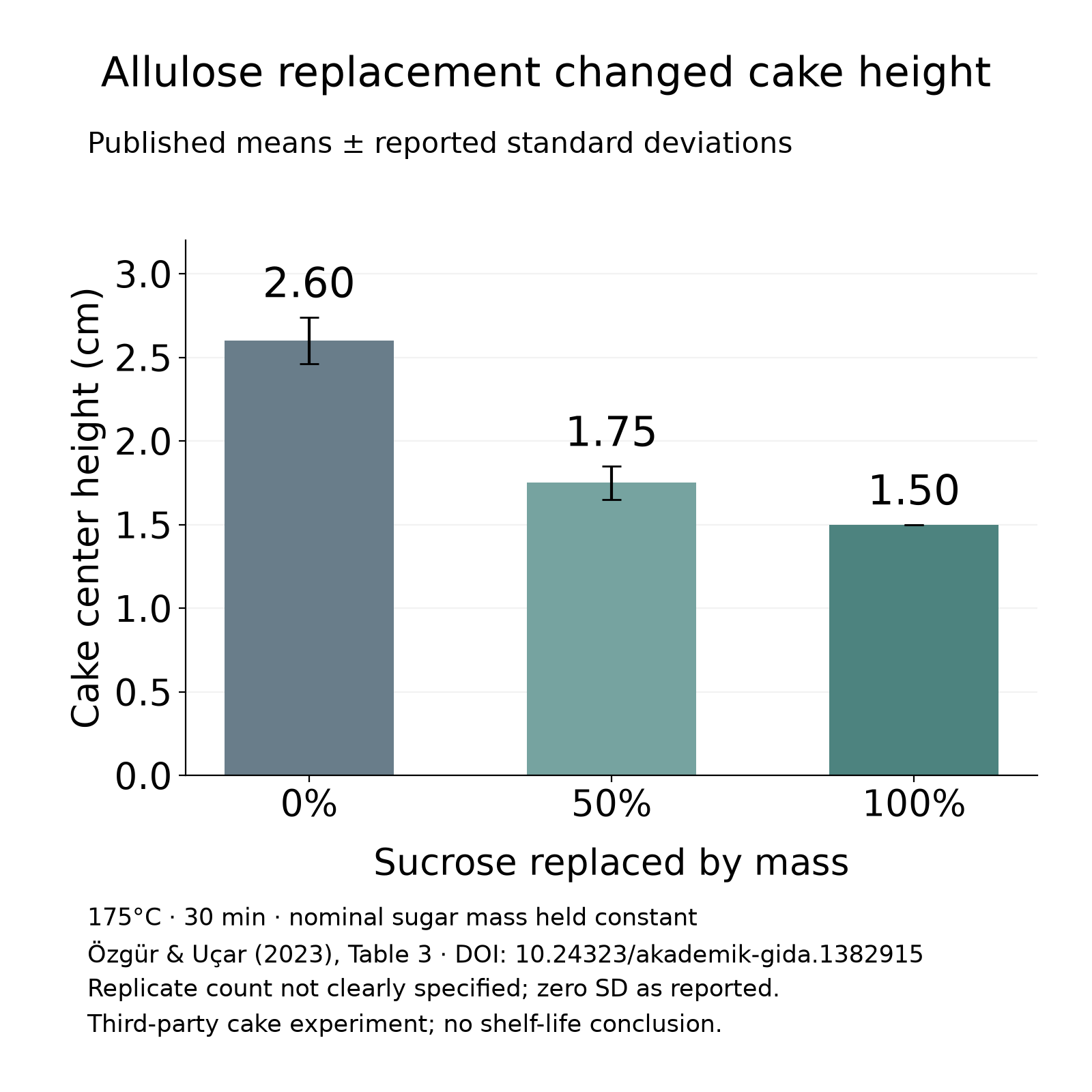
The article reports SD for these measurements but does not clearly specify the independent replicate count for cake height. A rounded zero SD is reproduced as reported, not interpreted as perfect repeatability. This is one published formula and method, not a Hengliyuan trial, a recommended replacement ratio or a shelf-life demonstration.
Published cookie research: do not assume allulose always increases spread
Woodbury and Mauer (2024) compared allulose and several oligosaccharides in wire-cut cookies, selecting concentrations to match their effect on starch gelatinization temperature relative to sucrose. Their original abstract reports that the allulose cookies were darker, had reduced spread and a softer, cake-like texture. The abstract is available; the complete article was not accessible in this review, so no unverified recipe dose or full-table number is inferred. Gomez-Betancur and colleagues (2025) used a different wire-cut system with equal 94.5 g sugar additions, 205°C for 11 minutes and assessment after 24 hours. Their allulose biscuits were narrower and had higher moisture than the sucrose control, while fracture strength was not significantly different. The recipe also contained HFCS. These results give useful counterexamples to a blanket claim that allulose always produces more spread, the same snap or a sugar-free biscuit. For a crisp product, record the cooled geometry, fracture or snap, moisture and water activity separately, then repeat the relevant checks in the intended package. Those observations cannot be reduced to the first warm bite.
Combine sweetness and function separately
A practical bakery system may use allulose for part of the sugar-like function and monk fruit or stevia for sweetness lift. The best direction depends on target sweetness, label rules, cost, process temperature and desired texture. A sweetness booster can close a flavor gap without adding much mass, but it cannot reverse an unsuitable bulk system by itself. If you reduce allulose to alter color or serving exposure, record what replaces its mass. If the selected blend also contains erythritol, fiber or another bulk ingredient, assess those contributions explicitly. Do not copy a supplier’s proprietary ratio or infer the composition from its product name.
Industrial example: IFPC separates four sweetener roles
In its February 2023 Q&A, IFPC food technologist Charlie Hall describes Legacy SWEET SP #9712-50 as a bakery sweetener system using erythritol and allulose for the bulk and browning direction, with monk fruit extract and Reb M to lift sweetness. He reports several trials and sensory adjustments during development. This is a named supplier account of a specific system, not a disclosed controlled study or a general formula. Its value for a bakery buyer is the separation of roles: changing sweetness, color and bulk together requires more than a 1:1 ingredient swap. The account does not establish a Hengliyuan recipe, product relationship, commercial grade or guaranteed result.
Brand examples: instructions belong to a defined recipe
Splenda’s own allulose baking page recommends starting from recipes developed for its product and discusses early browning, moisture, cake texture and cooling. Its 1:1 directions and suggested temperature adjustments are product guidance, not evidence that every allulose ingredient behaves identically. Truvia’s vanilla mug-cake page describes an 85 g serving and a short microwave process, with optional variants that change the nutrition information. It reports 160 calories per serving and compares this with a 290-calorie full-sugar reference serving. Those are the brand’s published recipe values; the comparison does not disclose enough to establish an equal-mass controlled nutrition experiment or a result for another formula. An oven cookie, an aerated pan cake and a microwave mug cake have different processes. Use these examples to specify the product, ingredient version, equipment, portion and endpoint. Do not transfer one recipe’s cook time, shelf-life advice or nutrition result to an industrial line.
Creator examples: separate caramel, filling and a personal ranking
A creator’s finished dessert can show how an ingredient is used, while leaving the effect of that ingredient unmeasured. The examples below belong to their authors; they are not Hengliyuan tests, customer results or a ranking validated across the same recipe.
- Yaidy Makes: original flan recipe and ingredient roles
- Diana Kraules: original vegan-cajeta video and spoken quantities
- Sean Sabin: original baking-product ranking
| Original creator example | What the public post shows | How to use the example in a bakery trial |
|---|---|---|
| Yaidy Makes: cheese flan | The written recipe uses allulose for a separate caramel layer. Its cream-cheese filling uses allulose together with liquid monk fruit and stevia products named by the creator. | Treat the caramel and filling as separate components with different jobs. The example shows a multi-sweetener system, not proof that a pure high-intensity extract can replace the caramel layer. |
| Diana Kraules: vegan cajeta | Her spoken vegan-cajeta demonstration starts with 100 g allulose and approximately 60 mL water, then adds baking soda and about 500 mL plant milk. It is a sauce process, not an aerated cake or crisp-cookie formula. | Track the caramel stage, liquid addition and cooled texture separately. The video does not report final yield, water activity, pH or a validated storage study, so its ingredient quantities cannot set a commercial shelf life. |
| Sean Sabin: baking sugar-replacer ranking | The video ranks named retail products and places allulose first. The second-place package is XyloSweet; it should not be counted as a second erythritol product. | Keep the ranking attributed to its creator and identify the actual products. The images do not supply a same-recipe experiment, and a retail product is not automatically a pure ingredient. |
The flan example gives a useful starting question: do you need a browned coating, sweetness within a filling, or both? A different sweetener may answer one task without replacing the other. Keep the complete material identities and formula with each component, then test the assembled product after cooling. Neither the creator’s “sugar-free” wording nor a “zero calories” caption establishes the nutrition, blood-glucose effect or label of another recipe. This guide uses the posts for application context. The published cake and cookie results and the browning study provide separate technical evidence; a personal preference does not overturn their conditions or counterexamples. Diana’s spoken ingredient quantities provide more detail than the caption, but they do not determine the final sauce concentration after evaporation. Her stated refrigerated storage period is a creator’s claim, not a validated shelf life for another formulation. Record final mass, the selected plant-milk composition and the actual product controls before considering a commercial sauce. Yaidy’s spoken explanation favors adding a little stevia to complete allulose sweetness, while the named products in her written filling recipe include liquid monk fruit and stevia. Keep those product identities with the specific recipe rather than turning either description into a universal extract ratio.
Separate the observations in a controlled bake
Compare the current sugar formula with an allulose direction under a documented process. Record ingredient form, actual dose, added water, dough preparation, portion mass and dimensions, tray position, oven settings and cooling conditions. First identify the difference; then give a process or formula adjustment its own sample code. Changing the sweetener, water and bake program together makes the cause harder to identify.
- Water activity and moisture content: USDA explanation
- Controlled allulose–stevia bake trials and mass-loss calculation
| Observation | Keep the comparison consistent | What it does not establish |
|---|---|---|
| Surface color | Same lighting and defined bake checkpoints | Internal doneness or cooled texture |
| Spread and dimensions | Same initial portion mass and shape; measure after cooling | An acceptable texture by themselves |
| Bite or snap | Same cooling time, sample temperature and evaluation method | Measured moisture or shelf life |
| Moisture content | Same sampling and analytical method | Water activity |
| Water activity (aw) | Record measurement method and temperature | Complete shelf-life validation on its own |
| Packaged storage | Intended packaging, recorded conditions and checkpoints | A universal allulose storage limit |
Moisture content and water activity are different measurements. A softer bite is not a moisture assay, and measured moisture cannot be substituted for water activity. Keep these records separate and use the complete product’s process, packaging and storage assessment for shelf-life decisions.
Troubleshoot the failed attribute, not the ingredient name
Code the control and candidate, then change one defined variable or a planned set of variables. Keep the initial trial record; a successful adjustment should remain traceable to what changed.
| Observed problem | What to check before adjusting | A useful next comparison |
|---|---|---|
| Dark surface with an unset center | Actual heat exposure, pan, portion size, formula and endpoint. | A separately coded time/temperature or geometry trial; retain required cooking endpoints. |
| Too soft, sticky or fragile after cooling | Actual allulose and water addition, complete solids balance, cooling and packing time. | Compare the intended texture after the same cooling and packaged storage. |
| Too little or too much spread | Dough preparation, initial shape, fat/flour system and setting behavior. | Measure cooled dimensions at a fixed process; do not assume the direction from the sweetener name. |
| Cake is short, dense or gummy | Aeration, pan fill, mixing sequence and thermal setting. | Record height, specific volume and crumb separately rather than judging color alone. |
| Fresh sample passes; packed sample fails | Package, seal, humidity, component moisture migration and handling. | Evaluate the assembled, packed product at relevant checkpoints. |
Cooling, packing and storage are part of the formulation decision
Compare a control and the proposed allulose formulation using a documented dough preparation, portion size and baking programme. Record the baking conditions and appearance at the chosen checkpoints; do not infer internal texture from surface colour. After a consistent cooling procedure, compare bite or snap using the same evaluation method. For storage, pack the samples in the intended packaging and record the time and environment of each repeated check. If the product has a filling, include the assembled cookie in the storage comparison. Keep colour, bite and measured moisture results as separate observations. If one result misses the product target, review the formula or process variable that the trial was designed to test, then compare the revised sample with the control again. These observations help select a formulation; they do not establish a universal allulose dosage, bake time or shelf life. Define when the sample is cool enough to handle and pack; record that interval rather than sealing a warm product by habit. Test the intended package and seal under the relevant storage and transit conditions. For a filled biscuit or frosted cake, include the assembled product because component-to-component moisture movement may change texture. USDA ARS hosts a CSIRO fact sheet explaining that moisture content and water activity are not the same measurement. Its illustrative food values are not specifications for your bake. Neither a low water-activity reading nor a supplier’s “stays moist” statement alone establishes the complete shelf life or microbiological safety of a new product.
Check market and label status
Allulose rules are market-specific. FDA’s final guidance is dated October 2020. It describes enforcement discretion for excluding allulose from Total Sugars and Added Sugars and using 0.4 kcal/g in U.S. nutrition labeling pending rulemaking. Allulose remains part of Total Carbohydrate. This does not establish the label, claims or market access of every finished bakery product; review the complete formula for its destination. Calculate the full recipe and the actual finished serving, including other sugars, starches, fibers, polyols and toppings. A reduction in sugar is not proof of a proportional energy reduction or a blood-glucose outcome. Record the grams of allulose in a serving and in likely multiple-serving consumption; a published tolerance-study dose is not a universal safe ceiling. Heating and mass loss also mean the input ingredient amount is not automatically a finished-product analytical result.
Compare cost at the accepted baked output
Confirm the selected powder, syrup or blend, specification, sample identity and actual accepted dose before comparing quotations. Include any other bulk or sweetness ingredient and the agreed net process, packaging and delivery costs. Avoid counting included packaging or freight twice. For a bakery comparison, use the same acceptance target and finished output basis. More batter mass, different bake loss, more rejects, a slower process or a different pack can change cost per acceptable piece or kilogram. A cheaper raw-material kilogram does not establish a cheaper finished bake. Use measured yield and accepted portions, not a retail price per cup copied from another seller.
Supplier brief for bakery projects
Start with your target market and product idea. Share any known packaging specification, estimated quantity, required certificates/documents and whether samples are needed; we can clarify the remaining details together. Add process temperature, target sugar reduction, current formula benchmark and texture goal. A practical first request is: “We are developing [bakery format] for [sales market]. Our sugar control gives [target texture/color/shape], and the current trial changes [specific problem]. We use [known ingredient form, dose and process]. Please identify the proposed allulose or blend, specification and sample documents so we can compare it in our own formula.” The full proprietary recipe or a completed testing sheet is not required to begin.
Review note
Reviewed October 22, 2026. Published cake, cookie and caramelisation studies, creator recipe examples, personal rankings, and supplier or brand accounts are distinguished. Confirm the exact commercial material, product process, required documents and destination rules; no universal bake setting, replacement ratio, medical outcome or shelf life is established.
Common questions
Can allulose help bakery browning?
It can support browning in some bakery systems, but buyers should test color development carefully because process, dose and product type change the result.
Discuss a bakery sweetener trialShould I shorten baking time if an allulose cookie turns dark sooner?
Do not use color alone as the endpoint. Record the original process and check the product’s required internal and cooled attributes. Test any time or temperature adjustment as a separately identified change, then reassess texture and packaged storage.
Discuss a bakery sweetener trialCan monk fruit or stevia replace all sugar in bakery?
They can replace sweetness, but not all of sugar's bulk, browning and moisture functions. A blend or formula adjustment is usually needed.
Discuss a bakery sweetener trialAre moisture content and water activity interchangeable?
No. Measure and record them separately using suitable methods. Surface color, soft texture and baking mass loss do not replace either measurement or the complete product’s shelf-life assessment.
Discuss a bakery sweetener trialIs allulose accepted in every market?
No. Buyers should confirm the target market's current ingredient, label and nutrition rules before using allulose commercially.
Discuss a bakery sweetener trialWhat should bakery buyers send before sample discussion?
Start with your target market and product idea. Share any known packaging specification, estimated quantity, required certificates/documents and whether samples are needed; we can clarify the remaining details together.
Discuss a bakery sweetener trialCan I replace sugar with allulose 1:1 by weight?
That keeps the nominal ingredient mass, not equal sweetness or function. At the approximate 0.70 sweetness factor, 100 g allulose corresponds to about 70 g sucrose sweetness. Adding more changes solids and serving exposure; validate the selected ingredient or blend in the actual bake.
Discuss a bakery sweetener trialDoes allulose always make cookies spread more?
No. Published wire-cut cookie studies reported reduced spread under their conditions. Dough, ingredient concentration and the setting process matter. Measure your cooled control and candidate rather than assuming a universal direction.
Discuss a bakery sweetener trialWill allulose make every cake taller or fluffier?
No. In the cited mass-replacement cake experiment, center height decreased, while specific volume was not significantly different. Keep the recipe, mixing, pan and heating conditions with the result; it does not define an outcome for every cake.
Discuss a bakery sweetener trialCan I substitute syrup for powder without changing the water?
Not by assuming equal weights are equivalent. Record the syrup’s dry-matter fraction and allulose content on the correct basis, then account for its water and other solids in the full recipe.
Discuss a bakery sweetener trialDo brand recipe storage instructions prove my commercial shelf life?
No. A recipe’s household advice or one water-activity reading does not validate a different product, process or package. Assess the complete finished product under its intended storage and handling conditions.
Discuss a bakery sweetener trialCan liquid monk fruit or stevia replace an allulose caramel layer?
Do not infer that from their sweetness. In the cited flan recipe, the creator uses allulose for caramel and combines sweeteners in a separate filling. Identify the commercial liquids and test any replacement’s mass, browning and texture in that component; then evaluate the assembled dessert.
Discuss a bakery sweetener trialDoes a creator’s top-ranked sweetener establish the best choice for my bake?
No. Treat it as an attributed application preference and identify the exact retail products. Compare the candidate with your reference recipe under recorded conditions. A preferred flan topping, soft cookie and crisp biscuit are different targets.
Discuss a bakery sweetener trialCan a creator’s refrigerated storage claim set my commercial sauce shelf life?
No. A home-video statement does not establish the finished sauce’s final solids, pH, water activity, packaging, microbiological controls or validated storage conditions. Use the example to define a trial, then assess the actual product.
Discuss a bakery sweetener trial