
Read this guide in
TABLETOP FORMAT GUIDE
Tabletop Sweetener Pack Formats for Private-Label Brands
Compare stick packets, sachets, jars, pouches, refill bags and tablets for private-label tabletop sweetener brands. Format-by-format buying checklist.
Choose a tabletop sweetener pack by how the customer measures and uses it: an individual stick or sachet for a defined serving, a jar for repeated spooning, or a pouch for a larger pack or refill. Compare those uses with your selected blend and sales channel before requesting packaging costs.
The comparison below is a planning aid for private-label buyers. It does not establish available pack sizes, a minimum order or a manufacturing offer for every format. Hengliyuan reviews the requested pack together with the product, market and order quantity.
Stick packets and sachets
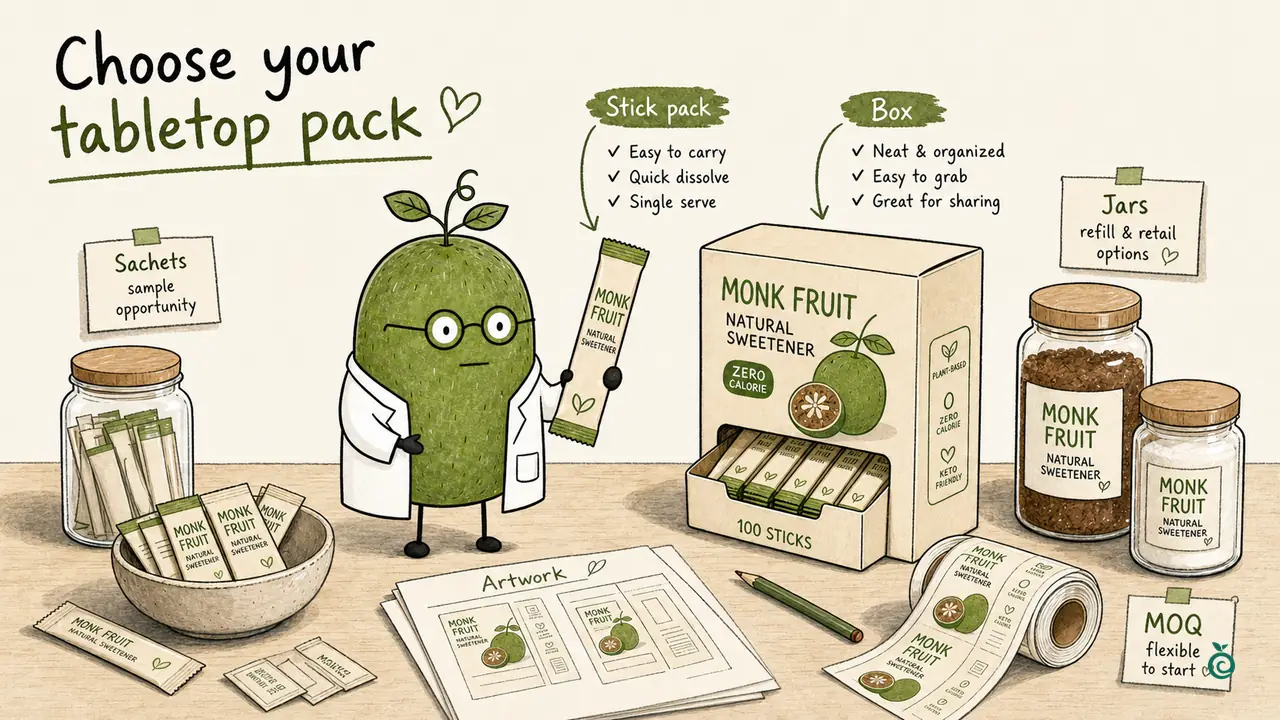
Stick packets and sachets are useful for coffee, tea, hotels, offices, ecommerce bundles and sample packs. They need clear serving weight, sweetness target, film material, box plan, artwork and carton details.
Jars and spoonable sweeteners
Jars are better when consumers measure the sweetener with spoons or use it for baking and daily kitchen use. The formula should be checked for granule size, clumping, flow, scoop behavior and label directions.
Pouches and refill bags
Pouches and refill bags can reduce package weight and support larger sizes, but buyers should review zipper quality, moisture control, shelf display, label area and shipping carton strength.
Tablets and liquid drops
Tablets and drops can be convenient for beverages, but they need different manufacturing, dosage and packaging systems than powder blends. Buyers should confirm whether the supplier can support the required format before planning launch.
Match format to formula
A stevia monk fruit concentrate, allulose blend, erythritol-free powder or 1:1-style sweetener may need different filling and moisture protection. Packaging and formula should be discussed together, not separately.
Compare formats against the buying task
Use the intended serving and purchase channel to narrow the format before preparing artwork. Keep the chosen blend specification attached to the packaging brief.
| Buyer use | Format to evaluate | Questions to resolve |
|---|---|---|
| Coffee, tea or a single serving | Stick or sachet | Target serving, fill weight, opening and emptying the pack |
| Repeated kitchen use | Jar | How the user measures a serving, closure and label directions |
| Larger pack or refill | Pouch | Resealing, refilling, storage and shipping protection |
| Tablet or liquid concept | Separate format review | Confirm the manufacturing and product route before artwork |
Start the packaging discussion before the artwork is finished
Start with the sales market, intended use and the pack you are considering. Add the selected blend or ingredient restrictions if known. You can compare a stick, jar or pouch before every dimension, artwork file or quantity is settled. For a final quotation, identify the product, packaging specification, quantity and document needs together. Add label language, barcode plan and the requested shipment timing as available; unresolved details can be marked for review. Separate the number of finished retail units from bulk kilograms, inner servings and shipping cartons. For inner and outer pack quantities, use the existing packaging-quantity guide and its workbook. Its planning examples do not set the current project’s packaging purchase or production terms.
Confirm each packaging format separately
Even when the ingredient composition stays the same, prepare separate packing records for sticks, jars and pouches.
| Format | Packing record to confirm |
|---|---|
| Sticks | For sticks, record the proposed fill weight, count per retail pack, film and sealing requirements, and the result of a relevant filling trial. |
| Jars | For jars, record net weight, closure, any measuring accessory and the intended repeated-use instructions. |
| Pouches | For pouches, record net weight, closure or resealing needs and dispensing method. |
Confirm the available product form before finalising a scoop or serving illustration. Evaluate the selected material with the intended package and handling conditions; a successful trial in one format does not demonstrate that all three formats will fill or dispense correctly. Keep composition approval, packaging approval and consumer instructions linked to the same project version.
Common questions
Which tabletop format is best for a first launch?
Start with the intended serving and sales channel. Compare the proposed pack with the selected blend, sample needs and expected order quantity; there is no single best first-launch format.
Discuss a private-label packCan one formula work in every package?
Not always. Powder flow, clumping, serving weight, moisture protection and consumer measuring behavior can change by format. Evaluate the actual material with the intended package rather than treating one filling trial as approval of every format.
Discuss a private-label packDoes approving the blend also approve the packaging?
Keep the chosen composition, packing record and consumer directions linked to the same project version. Agree the net weight, closure or film, dispensing method and relevant filling or handling checks for each format.
Discuss a private-label packDo we need finished artwork before contacting Hengliyuan?
No. Start with the sales market, intended use and a pack idea. Add known product, quantity, document and sample needs; mark the remaining details for review. Final production quotation needs the agreed product and packaging specification.
Discuss a private-label packCan tablets or drops use the same route as powder packs?
They require a separate format review because their manufacturing, dosing and packaging systems differ from powder blends. Confirm the available product and manufacturing route before approving artwork or planning a launch.
Discuss a private-label packAre pack sizes, minimum order and lead time fixed by this guide?
No. The formats are planning options. Confirm available product form, sample scope, packaging, quantity, price and timing for the selected project; the illustration is not a catalog or quotation.
Discuss a private-label pack