
Read this guide in
SUGAR-FREE CHOCOLATE TROUBLESHOOTING
Sugar-Free Chocolate Sweetener: Fixing Gritty Texture and Bloom
Fix gritty texture, waxy melt and bloom in sugar-free chocolate: bulk sweeteners, process control and sample briefs.
A sugar-free chocolate sample can be sweet enough and still fail on texture. Buyers may see gritty mouthfeel, waxy melt, bitter finish or a pale bloom after storage.
The issue is usually not one sweetener name. Sugar-free chocolate needs a bulk system, particle control, fat crystallization control and label review before a supplier can quote a useful sample.
Start with the defect, not the sweetener
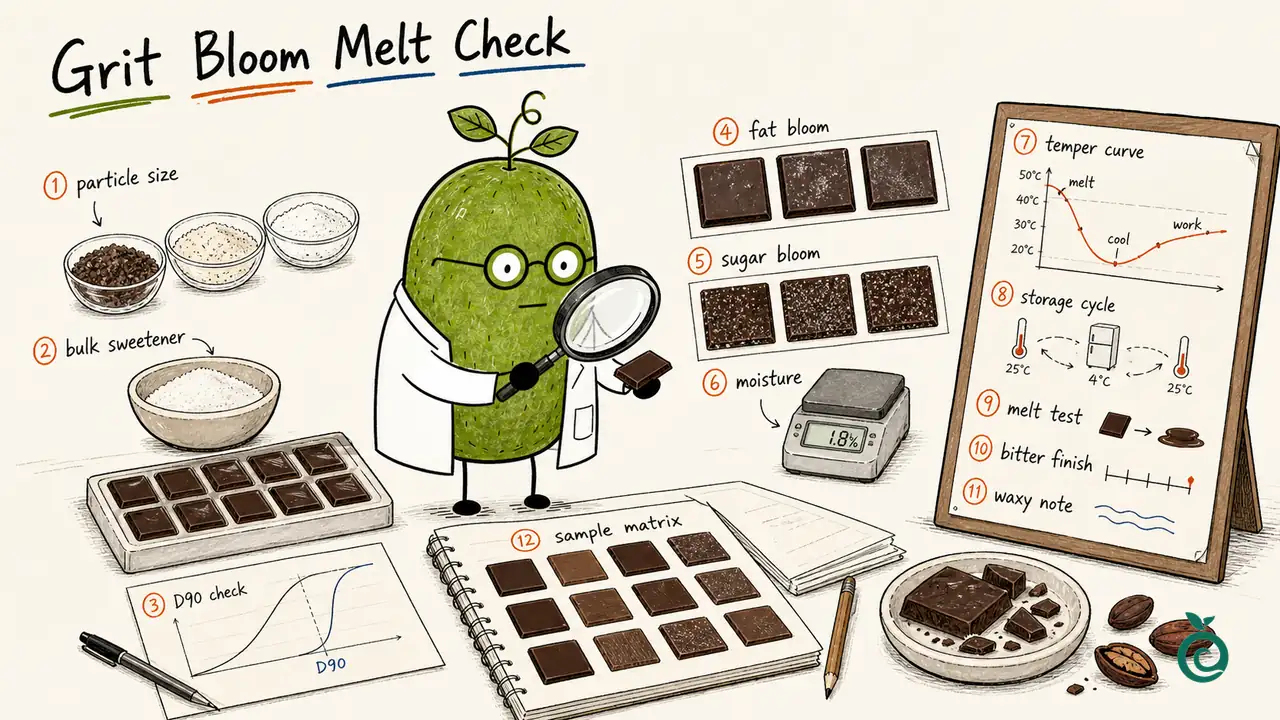
Describe what failed first: sandy particles, dry grit, waxy melt, slow sweetness, bitter finish, fat bloom or sugar bloom. These words point to different causes. A supplier can respond better when the defect is tied to photos, storage condition, process notes and the finished chocolate type.
Separate chocolate, compound coating and filling
Chocolate, compound coating, cocoa filling and nut spread do not behave the same way. Cocoa butter tempering, plant-oil coating systems, filling fat, nut oil and emulsifier choice can all change bloom risk, melt and particle feel. Confirm the format before asking for a sweetener replacement.
Bulk sweeteners change particles and flow
Sugar is also a solid particle in chocolate. When it is replaced, the substitute's crystal shape, hygroscopicity and particle-size distribution can change refining, viscosity and mouthfeel. A 2024 dark compound chocolate study reported that alternative sweetener and carbohydrate-polymer mixtures affected rheology and texture, so buyer testing should include particle size, flow and sensory notes rather than sweetness only.
Allulose and FOS still need process control
A 2026 sugar-free chocolate study compared fructooligosaccharides and allulose systems and measured water activity, color, bloom, melting behavior and sensory response. In that model, the sweetener system changed both physical and sensory results. Higher FOS directions were linked with harder or grittier impressions in the tested samples, while allulose performed better in that specific matrix. This supports sample testing; it is not a universal formula.
High-intensity sweeteners only finish the curve
Monk fruit and stevia can tune sweetness onset, peak and finish at low use levels, but they do not replace sugar's bulk, particle structure or fat-crystal behavior. For sugar-free chocolate, use them as part of a broader system with bulk, fat, processing and storage checks.
Use a storage check before approval
Do not approve a chocolate sample from day-zero taste only. Compare a control and a small sample matrix after normal storage and a stress condition. Record surface photos, bloom area, snap, melt, grit, bitterness, sweetness linger and packaging condition.
Prepare a supplier-ready sample brief
Start with your target market and product idea. Share any known packaging specification, estimated quantity, required certificates/documents and whether samples are needed; we can clarify the remaining details together. For chocolate, also add fat system, cocoa or filling level, refining route, tempering or cooling process, storage target, current defect and whether erythritol-free, allulose-supported or polyol-free positioning is required.
Technical references
Reviewed July 2026. Relevant sources include the 2026 IOP Conference Series paper on sugar-free chocolate with fructooligosaccharides and allulose (DOI: 10.1088/1755-1315/1608/1/012031) and a 2024 PubMed-indexed study on alternative sweetener and carbohydrate-polymer mixtures in dark compound chocolate: https://pubmed.ncbi.nlm.nih.gov/37586229/. These sources support testing variables, not a guaranteed Hengliyuan formula.
Review note
Reviewed October 2, 2026.
Common questions
Why is sugar-free chocolate gritty?
Grit can come from particle size, refining, moisture, hygroscopic bulk sweeteners, fiber systems, fat system, storage or incomplete process adjustment. Sweetness alone does not solve it. Tell us your storage conditions; we will include them in the sample evaluation discussion.
Discuss this requestDoes allulose prevent chocolate bloom?
No single sweetener can be treated as a bloom-prevention guarantee. Allulose can be tested where the target market allows it, but bloom still depends on fat system, moisture, process and storage. Tell us your target market; we will check which product documents we can provide for your review.
Discuss this requestCan monk fruit or stevia replace sugar in chocolate?
They can help sweetness at low use levels, but they do not replace sugar's bulk, particle and texture roles. Chocolate needs a complete sweetener and bulk system. Tell us which material discussed here you want to source; we will check its specification and sample options.
Discuss this requestWhat should buyers send before sugar-free chocolate samples?
Start with your target market and product idea. Share any known packaging specification, estimated quantity, required certificates/documents and whether samples are needed; we can clarify the remaining details together. Add fat system, process route and the main defect if available.
Discuss this request