
Read this guide in
CHOCOLATE COATING FORMULATION
Sugar-Free Chocolate Coating Guide: Particle, Fat and Tempering
Sugar-free chocolate coating guide: particle size, fat phase, sweetener bulk, refining, tempering and storage for sample tests.
A low-sugar chocolate coating can be sweet enough and still fail at the enrober, on the biscuit or after storage. The missing piece is often the matrix: particles, fat phase, emulsification, process and cooling work together.
This guide is for R&D and procurement teams comparing monk fruit, stevia, allulose-supported, erythritol-free or other sweetener directions in chocolate and compound coatings. It focuses on what to record before asking for a sample, not a universal replacement formula.
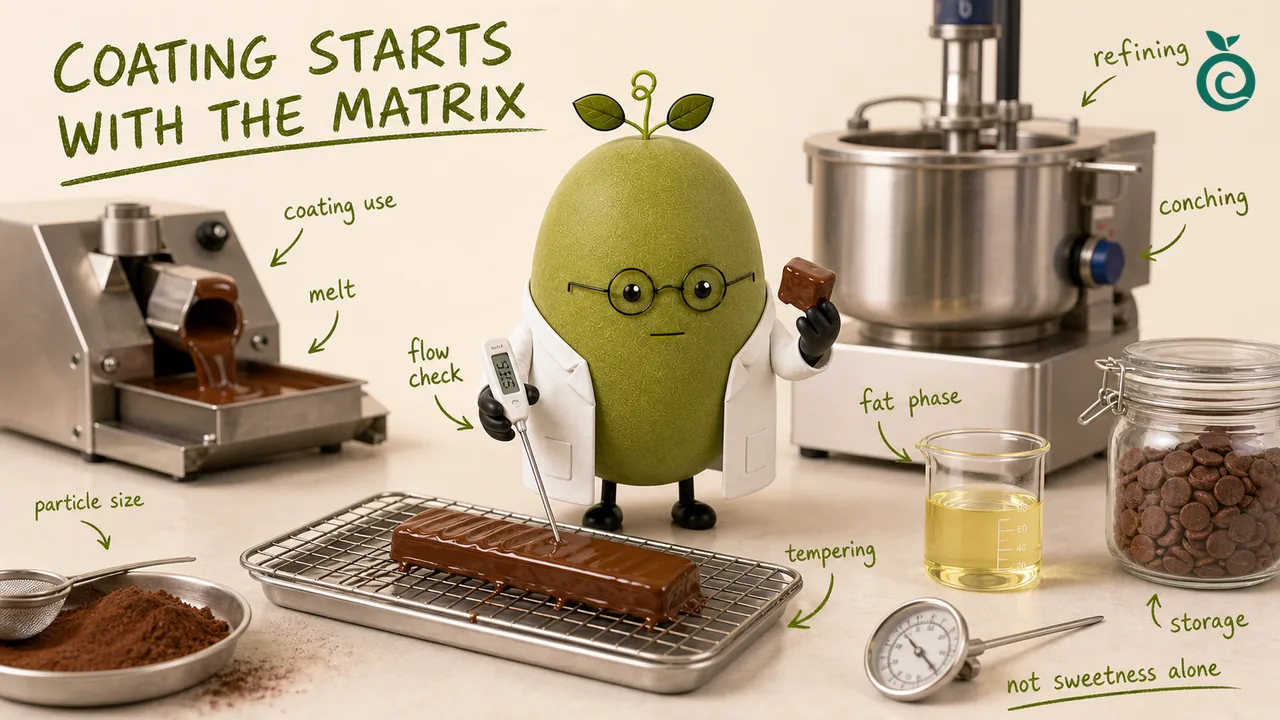
Name the coating job before changing the sweetener
State whether it is real chocolate, compound coating, enrobing, moulding, dipping, chips or a bakery coating. The same viscosity or fineness target should not be assumed across uses. Record coating thickness, substrate, use temperature and the desired snap or melt.
Split sweetness, bulk and flow
Monk fruit and stevia can lift sweetness at low use levels, but they do not supply the same solids or particle role as sugar. Allulose, polyols, fibers or other carriers may change bulk, moisture, cooling and flow, and their market fit must be checked. Keep sweetness direction separate from the physical bulk system in the brief.
Treat particle size as a flow and mouthfeel variable
Particle-size distribution affects surface area, packing and the force needed to move the suspension. Smaller is not automatically better: the target depends on the application, fat level and eating texture. Ask for the measurement method and record fineness or distribution consistently across samples.
Record the fat phase and emulsifier route
Chocolate coating is a suspension of solids in a fat phase. Fat type, total fat, moisture and emulsifier choice can change viscosity, yield behavior, melt and mouthcoating. Do not treat one emulsifier or fat percentage as a fix for every coating.
Separate refining, conching and tempering
Research on dark chocolate shows that mixing, refining, conching and tempering change particles, structure and appearance. For a sample, record the route and thermal history instead of comparing ingredient names alone. A published study can suggest variables; it cannot supply a ready commercial process.
Use storage as part of the coating brief
Compare day 0 with later points under the intended package and temperature. Check gloss, bloom, snap, melt, waxy or gritty mouthfeel, coating adhesion and package condition. A short bench check is not a shelf-life guarantee.
Prepare a focused sample question
The clearest brief names the product position, target market, coating use, current sweetener or bulk direction, fat system, particle or refining target, tempering or cooling route, packaging and main defect. Then use the six buyer fields in the inquiry page to request the next sample.
Technical references
Reviewed August 2026. Sources include Wong et al. (2024) on alternative sweetener and carbohydrate-polymer mixtures in dark compound chocolate: https://pubmed.ncbi.nlm.nih.gov/37586229/; Do et al. (2007) on particle-size distribution in reduced-fat chocolate models: https://pubmed.ncbi.nlm.nih.gov/18034724/; Glicerina et al. (2014) on processing stages and particle structure: https://pubmed.ncbi.nlm.nih.gov/24894569/; Toker et al. (2023) on chocolate flow behavior: https://pubmed.ncbi.nlm.nih.gov/34694187/; and the China GB 2760-2024 notice: https://www.gov.cn/zhengce/zhengceku/202403/content_7001729.htm. These sources support variable selection, not a fixed formula, performance promise or market-wide compliance conclusion.
Review note
Reviewed October 2, 2026.
Common questions
Can a high-intensity sweetener replace the whole chocolate coating system?
No. It can help replace perceived sweetness, but coating flow, particles, fat, melt and storage need a separate matrix.
Should particle size be the same for every chocolate coating?
No. The useful range depends on coating use, fat phase, solids, process and mouthfeel target. Use the agreed method and application-specific control.
Does tempering fix waxy or gritty coating by itself?
Not automatically. Tempering matters, but particle size, fat phase, emulsifier, moisture, refining and storage can also contribute.
What should buyers send before a coating sample?
Send target market, product type, packaging specification, estimated quantity, required certificates/documents and whether samples are needed, plus coating use, fat system, process and main defect.
