
Chocolate formulation
Erythritol in Chocolate: Cooling and Crystal Checks
Chocolate tastes cool, feels gritty or develops bloom? Separate the symptoms, compare erythritol grades at measured refining endpoints, and plan the next trial.
Our first rule for an erythritol chocolate trial is to separate cooling sensation from gritty texture. A smooth chocolate can still taste too cool, and a gritty chocolate does not prove that erythritol alone caused the problem. Record what the taster feels before changing the ingredient.
Erythritol provides bulk as well as sweetness. Choosing a grade therefore means checking its fit with the fat system, refining route and intended mouthfeel—not simply choosing the finest powder. Use the steps below to decide what to change and what to keep fixed.
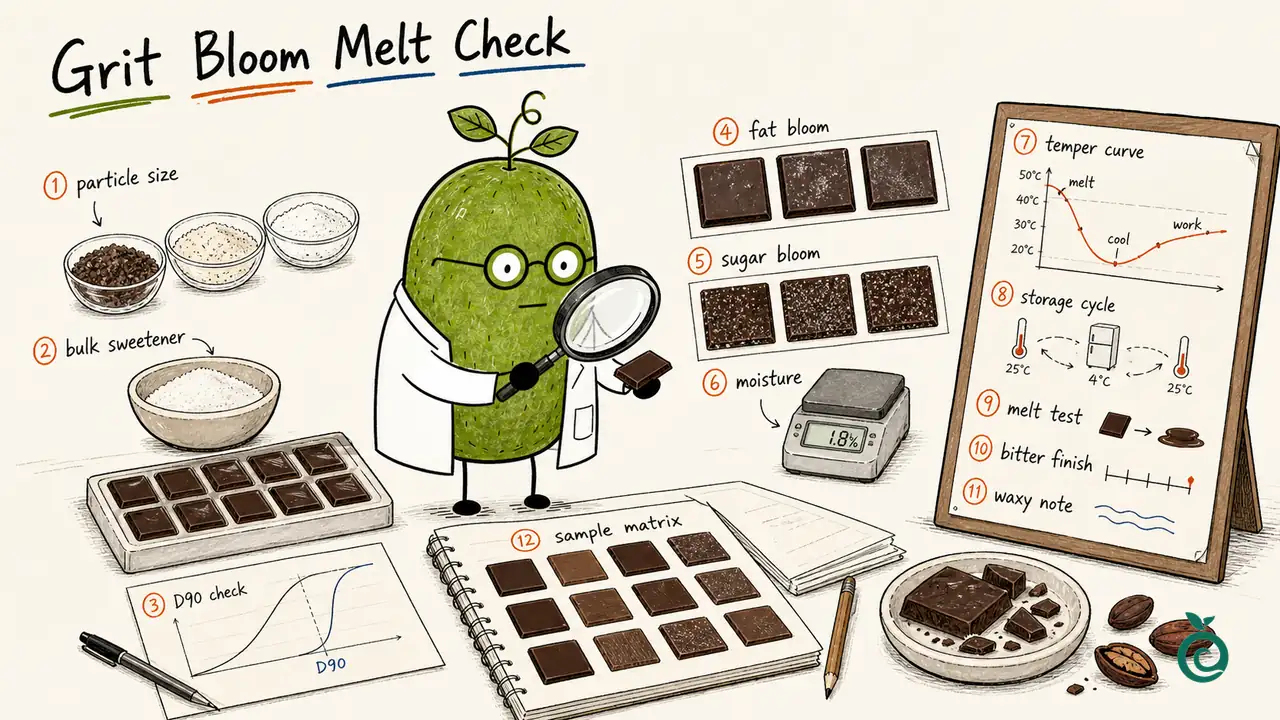
Separate cooling from grit
Erythritol absorbs heat as it dissolves, creating a cooling sensation. This is different from feeling physical particles. Particle size and how the chocolate melts affect the tasting experience, but a fine-powder label alone does not guarantee an acceptable cooling finish. Taste coded samples at the same serving temperature. Record cooling, grit and visible storage changes separately; more than one can occur in the same batch.
| Observation | What to record | Next check |
|---|---|---|
| Cooling sensation | When the cool feeling starts and how long it persists; keep this separate from roughness | Compare the erythritol level and overall bulk system at the same serving conditions |
| Grit or rough mouthfeel | Whether particles are felt as the chocolate melts; record the measured final fineness | Review all solids, agglomerates and refining results—not just incoming erythritol size |
| Bloom or changed surface after storage | Appearance, timing, storage temperature history and moisture exposure | Review the fat system, relevant tempering or setting process, packaging and storage before assigning a cause |
These are observation categories, not three diagnoses. A visible surface change does not identify the crystal type or establish which ingredient caused it.
Hold the chocolate process constant
Keep the cocoa, fat system, other solids, mixing or conching route, and storage conditions comparable between the control and each trial. For cocoa-butter chocolate, record the relevant tempering conditions. For a compound coating, record the setting process required by that fat system; do not assume it uses the same tempering route. Use the same refining objective, but record the time and settings needed to reach it. Equal milling time does not establish equal final particle size. Compare snap, melt, cocoa release, cooling and grit under the same tasting conditions. If you lower erythritol, state how the removed bulk is replaced and log any other formula change. A high-intensity sweetener can adjust sweetness but cannot by itself replace the missing solids. If both the formula and process change, describe the result as a comparison of two systems rather than proof of an erythritol-only effect.
Choose particle size for the refining route
Ask for the particle-size distribution and measurement method, not only “fine powder” or “granular.” A sieve result and a laser-diffraction result describe size differently. The incoming powder specification also differs from a measurement of the finished chocolate. A finer incoming powder may suit a particular line, but smoothness also depends on the other solids, agglomerates, moisture, milling and fat coverage. Granular material may need more refining. Record the actual material form and measured final endpoint for each trial; do not use grade names as substitutes for those records.
| Sample code | Fat / refining record | Actual sweetener dose | Snap / melt / cooling / grit | Storage recheck |
|---|---|---|---|---|
| Control | Record fat system and measured endpoint | Record grams and batch mass | Separate scores with notes | Date and temperature history |
| Fine-powder trial | Same process objective; log changes | Record actual dose | Same tasting method | Same checkpoints |
| Granular-material trial | Record additional refining if required | Record actual dose | Same tasting method | Same checkpoints |
Recheck after storage
Inspect the same batches at planned storage checkpoints for texture changes and visible bloom. Record the storage temperature history, packaging and moisture exposure. Review fat crystallisation and the relevant tempering or setting process before blaming erythritol. If cooling is the main failure, test one defined formulation direction and document the replacement solids. If grit is the main failure, first compare final fineness and process records. A different supplier’s fine-particle grade or blend result does not establish how the offered sample will perform.
Turn the chocolate comparison into a purchasing specification
Repeat the selected direction using the written method and record whether the result can be reproduced. Keep the sample batch number, actual formulation, refining endpoint, tasting conditions and storage observations together. A successful tasting is not a shelf-life or food-safety approval. Turn the accepted trial into a purchasing specification: material form, particle-size method, agreed specification, matching documents and packaging. Check incoming material against that agreement. A change in material form, specification, formula or process may require another comparison; the first successful sample is not a universal replacement ratio.
Send a useful chocolate trial brief
Start by telling Hengliyuan whether you make moulded chocolate, a coating or a filling, and whether the main problem is cooling, grit or a storage change. Share your fat system, current sweetener and refining route if known. You can begin the discussion before every specification is settled. For the next sample, confirm the exact offered erythritol form and specification, then agree which comparison will answer your question. Include the destination market and document requirements when available. Finished-product claims need their own market review.
Review note
Reviewed October 16, 2026. The comparison tables describe a trial method, not measured sample results or guaranteed acceptance limits.
Common questions
How can cooling sensation be distinguished from graininess?
Cooling is a temperature-like sensation as erythritol dissolves; graininess is the physical feeling of particles. Record them separately in coded samples at the same serving temperature. A sample can have either problem or both.
Discuss a chocolate sample trialWill finer erythritol remove the cooling effect?
Do not assume so. Finer material changes dissolution and processing behavior, but it does not remove erythritol’s heat-absorbing dissolution. Compare the actual sample for both cooling and texture rather than approving it from a mesh label.
Discuss a chocolate sample trialShould fine and granular erythritol use the same refining time?
Use a comparable measured endpoint and record the conditions needed to reach it. The same operating time does not prove that both samples reached the same final particle size. Keep the incoming powder specification separate from the finished-chocolate measurement.
Discuss a chocolate sample trialDoes bloom after storage prove erythritol caused the defect?
No. Record the appearance and storage history, then review the fat system, moisture, packaging and relevant tempering or setting process. Visible bloom alone does not identify its composition or cause.
Discuss a chocolate sample trialCan I lower erythritol and replace it only with a high-intensity sweetener?
That may restore sweetness but leaves a bulk change. State how the removed solids will be replaced and record the complete formula. If several ingredients change together, evaluate the whole system instead of attributing the result only to erythritol.
Discuss a chocolate sample trialWhat should I send for a chocolate sample discussion?
Tell us the product type and main defect first. Add the fat system, current sweetener, actual dose, refining endpoint and storage observations if available. We can then discuss the offered grade, documents and next comparison without requiring a completed trial dossier before you contact us.
Discuss a chocolate sample trial