
Read this guide in
CHOCOLATE BULK AND LABEL GUIDE
Sugar-Free Chocolate Sweetener Systems: Bulk, Texture and Label Checks
Sugar-free chocolate sweetener systems: bulk routes, texture, naming and label checks, plus a sample matrix template.
In chocolate, sugar does more than sweeten. It provides bulk, particle structure, solids, process behavior and part of the eating texture.
For sugar-free or reduced-sugar chocolate, buyers should first decide what replaces sugar's bulk role, then use monk fruit, stevia or other sweetness tools to adjust the final curve.
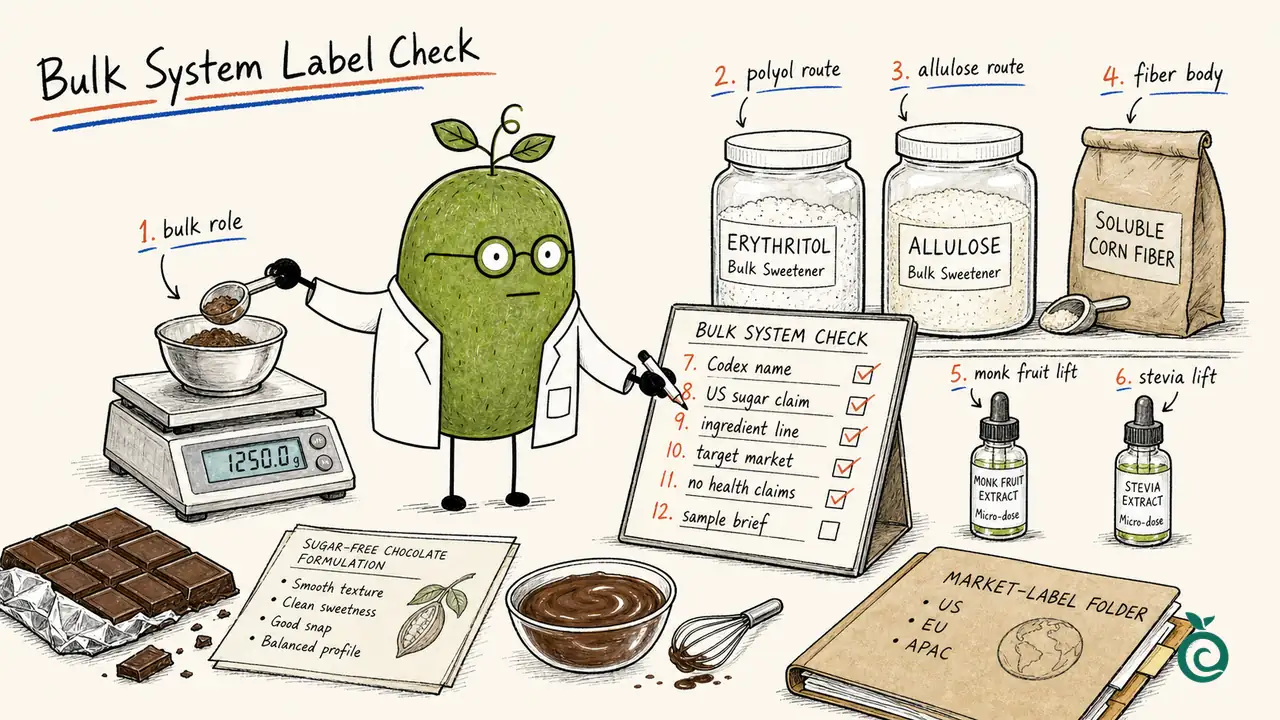
Split the job into bulk and sweetness
A high-intensity sweetener may solve sweetness at a very low dose, but it leaves a bulk gap. A bulk ingredient may improve body but still need taste rounding. Treat these as two connected jobs: build the physical chocolate system, then tune sweetness and aftertaste.
Common bulk routes
Sugar-free chocolate projects often evaluate polyols, allulose where permitted, fructooligosaccharides, inulin, polydextrose, soluble fibers or carrier-supported blends. Each route should be checked for particle feel, moisture behavior, melt, cooling effect, bitterness, label fit and cost-in-use.
Where monk fruit and stevia fit
Monk fruit and stevia are useful when the bulk system still needs sweetness lift or a different sweetness curve. Their role is usually fine-tuning, not replacing all solids. Test them in the finished chocolate, coating or filling rather than approving them in water.
Check chocolate naming before artwork
For international projects, the buyer should check the current chocolate standard and local rules before final artwork. Codex chocolate guidance includes naming considerations when sugars are fully or partly replaced by sweeteners. Treat this as a label-planning checkpoint, not a supplier guarantee of market approval.
For the United States, check sugar claims separately
In the United States, 21 CFR 101.60 includes conditions for sugar-related claims such as sugar free and no added sugar. FDA allulose guidance also gives a specific approach for declaring allulose in Nutrition Facts and Supplement Facts labels, including calories and sugar lines. These are U.S. label references only and should not be copied to other markets.
Build the first sample matrix
A useful first matrix compares a control, one bulk-system route, one sweetness-lift route and one combined route. Record particle size, refining notes, viscosity or flow, melt, snap, bloom, sweetness onset, bitter finish, cooling effect and storage change.
Ask for documents early
Document needs may include specification, COA, allergen statement, halal support, non-GMO information, ingredient statement support and market-specific label notes. The correct file set depends on the chosen formula and launch country.
References and scope
Reviewed July 2026. Useful references include Codex Standard for Chocolate and Chocolate Products CXS 87, U.S. 21 CFR 101.60 on nutrient-content claims, FDA allulose labeling guidance, the 2026 IOP sugar-free chocolate study (DOI: 10.1088/1755-1315/1608/1/012031) and the 2024 PubMed-indexed dark compound chocolate study: https://pubmed.ncbi.nlm.nih.gov/37586229/. Confirm local regulations before commercial launch.
Review note
Reviewed October 2, 2026.
Common questions
What replaces sugar bulk in sugar-free chocolate?
Possible routes include polyols, allulose where permitted, FOS, inulin, polydextrose, soluble fibers or carrier-supported systems. The best route depends on chocolate type, target market, label and process. Tell us your target market; we will check which product documents we can provide for your review.
Discuss this requestIs sugar-free the same as no added sugar?
No. Claim rules differ by market. In the United States, sugar-free and no-added-sugar claims have separate conditions under 21 CFR 101.60. Tell us your target market; we will check which product documents we can provide for your review.
Discuss this requestCan allulose be used globally in chocolate?
No. Allulose status and label treatment are market-specific. U.S. FDA guidance should not be treated as global permission. Tell us your target market; we will check which product documents we can provide for your review.
Discuss this requestWhat should buyers include in a label and sample brief?
Start with your target market and product idea. Share any known packaging specification, estimated quantity, required certificates/documents and whether samples are needed; we can clarify the remaining details together. Add the intended sugar claim and ingredient restrictions if available.
Discuss this request