Read this guide in
PLANT PROTEIN SWEETENER TESTING
Stevia and Plant Protein Drink Sweetener Guide
Choose stevia for soy, pea and oat protein drinks. Compare glycosides, dose calculations, published research, real brand formulations and aftertaste troubleshooting.
Stevia can sweeten a plant-protein drink, but the best choice depends on the exact glycosides, protein ingredient and finished formula. Compare candidates near the same sweetness target, then check bitterness, lingering sweetness, texture and the result after processing; adding more stevia is not a reliable way to fix an unpleasant base.
At Hengliyuan, our view is to start with the drink you want to make and one problem to solve. This guide connects published protein research and named commercial examples to the selection of stevia, monk fruit, allulose or custom sweetener blend samples for plant-based RTD drinks and ready-to-mix powders.
Name the protein base and process first
State the protein source and level, target serving size, fat system, flavor, pH or acidity if known, heat treatment, package format and whether the product is RTD or powder. A sweetener that works in water may read differently in soy, pea or oat protein, so the sample should match the intended base and process.
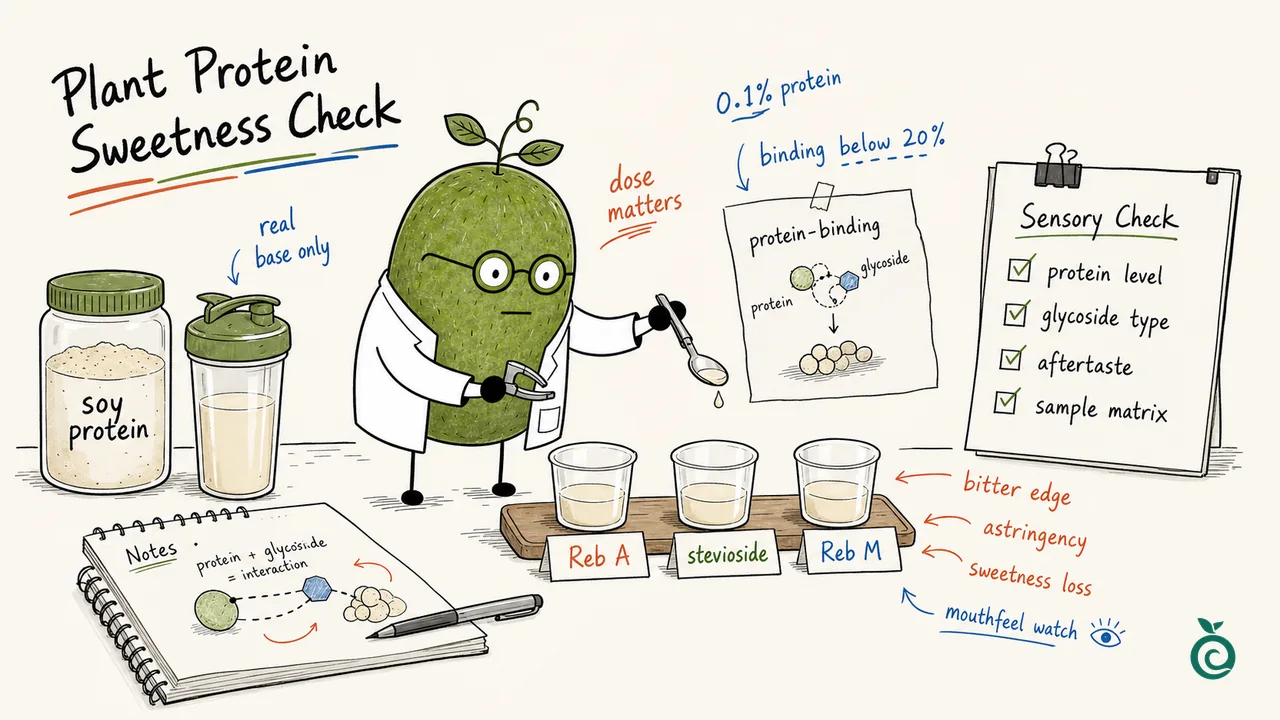
For a ready-to-drink (RTD) product, compare the processed, packaged beverage at the intended serving condition. For a ready-to-mix (RTM) powder, record the complete powder formula, powder-to-water ratio, hydration method and waiting time: that reconstituted drink is the real base, not merely a water screening of the sweetener.
Separate protein concentration from the name on the carton
An oat drink, an almondmilk-based shake and a pea-protein beverage do not necessarily contain the same kind or amount of protein. Read the ingredient list and the finished-product protein declaration separately. A plant milk can provide the liquid base while a different isolate supplies most of the added protein. This matters when the sample brief says only “almond protein” or “oat protein.”
| What is specified | What it describes | What to hold constant in a sweetener comparison |
|---|---|---|
| Protein ingredient identity | Soy isolate, pea isolate, a concentrate, hydrolysate or a multi-source system | Commercial grade, lot, protein content and actual ingredient mass. A hydrolysate is not interchangeable with its parent isolate. |
| Grams of protein per serving | Declared protein in the whole finished serving | Serving mass or volume, recipe and analytical or calculation basis; it is not simply the grams of protein powder added. |
| Plant milk, oil and fiber | The surrounding drink base and its body | Their grades and levels as well as the protein; changing them changes the comparison. |
| RTD or RTM format | Processed liquid versus powder prepared before drinking | RTD heat/package history or RTM powder-to-liquid ratio, mixing and hydration. |
For example, the Premier Protein almondmilk product discussed below names soy protein isolate in its ingredient list. Its almondmilk base does not turn the experiment into a test of isolated almond protein. Use the same care when interpreting commercial examples and published studies.
Compare the exact steviol glycoside in the real matrix
Do not treat every stevia extract as the same ingredient. Reb A, stevioside, Reb M and blends can differ in sweetness timing, bitterness and aftertaste. Ask the specification and batch COA to identify the glycoside profile, then compare candidates in the same protein base, serving condition and process.
Compare glycoside profile, purity and supplied form separately
“Stevia 95%” is incomplete as a taste specification. Total steviol glycosides, the proportion of a named glycoside such as Reb A or Reb M, and the composition of a supplied blend are different fields. A batch COA should identify the measurement basis, not leave the buyer to infer a Reb M content from a total-glycosides number.
| Candidate | Why it may enter the comparison | What still needs to be checked |
|---|---|---|
| Reb A-rich extract | An established direction to compare with the current material | Named assay and other glycosides; sweetness, bitter finish and actual use level in the drink. High purity does not mean zero aftertaste. |
| Reb M direction | A different glycoside profile to screen for the desired finish | Exact grade, production route, dissolution at the trial concentration and the finished taste; the name alone does not guarantee a winner. |
| Stevia plus monk fruit or another sweetener | A way to redistribute the sweetness contribution | Every component, carrier and actual dose. Blending changes composition and cannot be judged by a stevia percentage alone. |
| Liquid preparation or dry premix | A different method of dosing and distributing the ingredient | Active concentration, carrier, stock preparation and uniformity. Liquid is not automatically a different or better-tasting molecule. |
Our stevia ingredient page provides the existing specification routes for a sample discussion. Choose candidates to answer a defined question, such as a cleaner finish at the same target sweetness, rather than ordering all grades or assuming an expensive grade must taste better.
Calculate the actual dose before interpreting a tasting
Record dose as mass of the supplied ingredient per mass of final beverage, together with its assay or blend composition. Keep mg/kg, percent by mass and milliliters distinct. A number of retail drops cannot be carried across brands, dropper sizes or concentrate strengths. Nor is one sweetness multiplier a validated conversion for every protein base.
| Illustrative calculation | Result | Condition to keep with the number |
|---|---|---|
| 100 mg/kg of a supplied ingredient in a final 10.000 kg batch | 1,000 mg = 1.000 g of that ingredient | A hypothetical mass calculation, not a recommended stevia use level or regulatory limit. |
| The same 1.000 g delivered in a 1.00% w/w aqueous stock | 100.0 g of stock, including 99.0 g water | Allow for that carrier water in the final batch mass. The stock must actually dissolve and be suitable for its intended preparation and use. |
| A 0.1% w/w concentration in the soy model cited below | 1,000 mg/kg of the named glycoside | This is the study concentration, not the hypothetical 100 mg/kg above and not a finished-drink recipe. |
If comparing fixed ingredient additions, keep them fixed and score sweetness as a separate outcome. If comparing flavor at a matched sweetness target, adjust and record each dose. These answer different questions. The second comparison is often more useful for a replacement decision, but neither proves a universal ratio. For a dry RTM blend, include a mixing-uniformity check at the intended small serving size; a well-mixed laboratory stock does not establish powder-blend uniformity.
Build controls that answer the taste question
Use an unsweetened base to understand its own notes, then compare the current sweetened control with a coded candidate. Those controls help locate a problem; they do not by themselves prove a molecular cause. Keep the protein grade and lot, full recipe, process, preparation and serving condition with each code.
| Comparison | Keep or record | Decision it can support |
|---|---|---|
| Unsweetened real base | The same protein, flavor and process; record anything removed with the sweetener system | Which notes are already present before the candidate; this is a diagnostic control, not an equally sweet alternative. |
| Current sweetened control and candidate | Exact commercial grades, both actual doses and the intended sweetness target | Compare the finish at matched sweetness; record any dose, stock carrier or formula adjustment. |
| Same fixed addition, where that is the question | The same stated addition basis and actual masses; score sweetness separately | Check what happens without dose adjustment; unequal sweetness can influence the taste judgement. |
| Processed or stored comparison | Actual process, package and checkpoint; preparation, temperature and sample history | Whether the observed taste or physical difference persists after the intended treatment; a fresh cup alone does not answer it. |
Use the observed defect to choose the next change
Describe when and where the problem appears before selecting another sweetener. An earthy smell, a bitter taste after swallowing, a dry mouthfeel and settled particles are different observations. Keeping the unsweetened base and current sweetened control helps avoid changing the sweetener to treat a protein or process problem.
| Observation | Check first | Useful next comparison |
|---|---|---|
| Beany or earthy character is already present in the unsweetened base | Protein grade/lot, base aroma and processing history | Keep the sweetener fixed while comparing the relevant base or flavor change; do not assume all of the note is caused by stevia. |
| Bitterness rises as the candidate dose rises | Actual addition, target sweetness and full glycoside profile | Compare a lower addition or another identified profile near the target sweetness. Measure the resulting sweetness as well as bitterness. |
| Sweetness is acceptable at first but the finish becomes intrusive | Sweet linger versus bitter/metallic aftertaste, and individual assessor responses | Use a consistent aftertaste checkpoint and repeated sips; a first-sip average can miss the issue. |
| Grittiness, sediment or poor re-dispersion | Protein hydration, insoluble material, particle distribution and processing | Compare the physical preparation or stabilizing system with its own measurements. Do not call a higher sweetener dose a stability solution. |
| A new problem appears only after heat or storage | Matched process, package, time, temperature and sample history | Compare the control and candidate after the same treatment. Investigate flavor and physical changes separately. |
Vanilla, cocoa, salt, acid and oil can all be formulation variables, but adding them together hides which change helped. In a protein beverage, an acid adjustment also changes the pH conditions being tested. Keep the intended nutrition, protein compatibility and processing requirements in view rather than copying a household “pinch of salt and lemon” remedy.
Score taste and stability beyond sweetness
Record sweetness onset, peak and linger together with bitterness, astringency, chalkiness, aroma release, sediment and viscosity. Check the hydrated drink after the intended heat and storage conditions, and note changes after repeated sips. A blend can be a test direction, but it does not guarantee a smooth finish or solve every plant-protein issue.
Keep taste intensity, target fit and liking distinct. Record sediment, separation, viscosity and re-dispersion with their own method, units and acceptance criteria rather than hiding them inside a taste total. A better aftertaste score does not close a physical-stability, food-safety or label question.
A soy model shows why the protein fraction matters
Ran and colleagues (2026) compared Reb A, stevioside and Reb M with isolated glycinin (11S) and beta-conglycinin (7S) in prepared aqueous systems. For the selected Reb A comparison below, both Reb A and the protein fraction, where present, were at 0.1% by mass. The study used a trained descriptive panel of 12 people, nose clips and expectoration; three independent repetitions do not mean 36 independent consumers. These were separately prepared ingredients in a pH 7 buffer model, not a finished soy, pea or oat drink.
| Published model sample | Bitter aftertaste: mean ± SD | Original comparison letters |
|---|---|---|
| Reb A alone | 3.45 ± 0.93 | de |
| Reb A + 11S | 2.62 ± 0.77 | c |
| Reb A + 7S | 1.67 ± 0.65 | b |
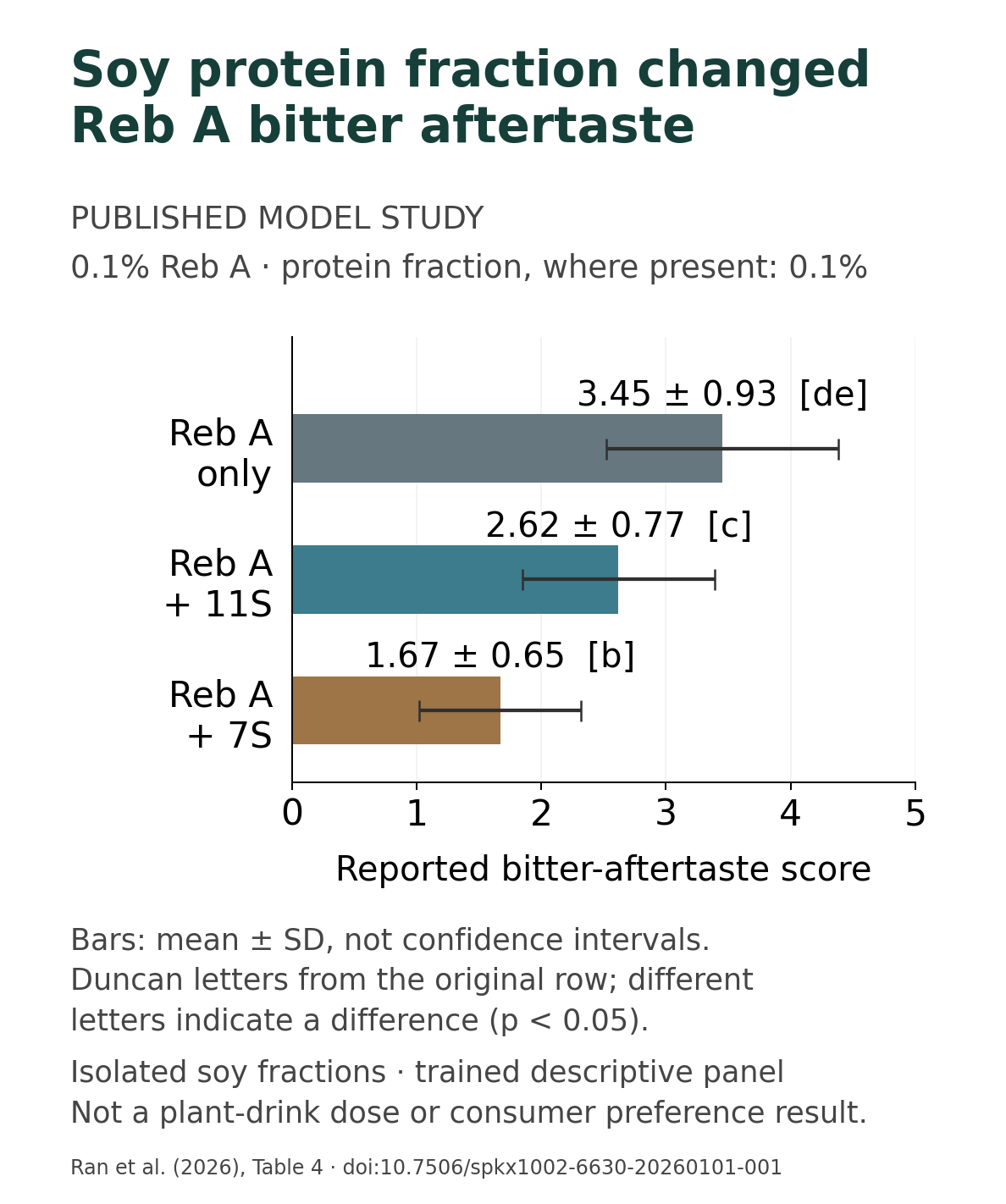
The wider study found concentration-dependent effects; a result for one glycoside and isolated protein fraction does not select a commercial grade for every plant drink. Its below-20% binding result concerns the bound share of glycosides under that model, not the share of bitterness removed. Compare the exact proposed material in the actual drink and keep the observed sensory and physical outcomes separate.
Pea-beverage research separates the base from the sweetener
A 2020 study used 12 pea-protein-based beverages and 16 trained assessors. Protein type, gellan gum, salt and sunflower oil were varied; sugar was present, so this was not a stevia-versus-sugar replacement trial. In the detailed static results, protein type affected bitterness, while protein type and gellan gum affected astringency. This supports checking the base and texture system before attributing every unpleasant note to stevia. The same study evaluated two selected beverages across a 120 mL portion. Beaniness and bitterness became less dominant during repeated intake, while fattiness became more dominant. Dominance is the sensation drawing attention, not liking or an intensity score. The lesson is to observe a serving as well as an isolated sip; adaptation can change the pattern, and not every attribute necessarily builds up.
Use time-based sensory methods without borrowing a dairy result
The cited Harwood and Drake (2021) study used vanilla-flavored ready-to-mix whey-protein-isolate beverages and assessed temporal liking alongside temporal check-all-that-apply. Its useful question is whether an attribute appears when liking falls; that is different from assuming the strongest taste is the least liked. It is a dairy study, so it does not establish the same effect or dose in plant protein. A single early or late score also does not reproduce a continuous time-based test.
An industrial example combines sweetness, hydration and suspension
Ingredion’s published high-protein-beverage demonstration names SIMPLISTICA BV 1369 as a system containing pea protein isolate, stevia leaf extract, gellan gum and acacia. Its transcript describes a typical 20-minute protein-hydration step before processing and discusses a separate PureCircle flavor masker, NSF-04. Sweetness, off-note management and physical suspension have different roles in this example. This is a supplier demonstration, not an independent comparison or a Hengliyuan formula. The 20 minutes belongs to that demonstration; it is not a universal hydration time for every protein grade. The transcript does not disclose enough to reconstruct a complete validated recipe, and its shelf-life language does not verify your heat process or package. What buyers can use is the division of work: identify the sweetener, the protein, the flavor intervention and the stabilizing system instead of asking stevia alone to deliver all four.
What current protein-drink labels show about sweetener choices
The following manufacturer pages were checked on October 22, 2026. They are examples of different formulation directions, not a taste ranking, matched nutrition experiment or evidence that Hengliyuan supplied these brands. The complete recipe and the current label for the selected flavor and pack remain the reference.
- Ensure original Chocolate ingredients and 330 mL nutrient data
- Orgain original 20g Plant-Based Protein Shake FAQ
- Premier Protein original Chocolate Almondmilk ingredients and panels
- ALOHA original protein-drink sweetener FAQ
| Named example | What the manufacturer discloses | What a formulator can learn |
|---|---|---|
| Ensure Plant-Based Protein, Chocolate, 330 mL serving | Fava bean isolate and pea protein concentrate; organic sugar, stevia leaf extract and monk fruit extract. The page declares 20 g protein and 7 g total sugars, including 7 g added sugars, per serving. | A plant-protein product can use sugar and high-intensity sweeteners together. Stevia in the ingredient list does not establish a sugar-free whole drink. |
| Orgain 20g Plant-Based Protein Shake, Creamy Chocolate | The product FAQ says it is sweetened with stevia and made with pea protein. The page declares 20 g protein, 140 calories and 0 g sugar per serving, with a “not a low calorie food” qualification. | A different whole-formula target is commercially used. This FAQ does not identify the glycoside profile or addition rate needed to reproduce it. |
| Premier Protein Chocolate Almondmilk Non-Dairy Shake, listed 11 fl oz panel | Almondmilk and soy protein isolate; sugar, steviol glycosides and monk fruit extract, with guar/gellan gums and soy lecithin. The panel declares 20 g protein, 5 g total sugars and 4 g added sugars. | The milk alternative, protein, sweeteners and texture ingredients are separate parts of the recipe. Do not infer the source of all protein from “almondmilk” in the name. |
There is also a genuine alternative brief: ALOHA’s protein-drink collection states that its drinks contain no stevia and use organic cane sugar with monk fruit. This is a positioning and formulation choice, not proof that stevia cannot work. If the brand brief excludes stevia, clarify that at the start rather than trying to solve the project with a different stevia grade. Compare current labels, not a retailer’s old summary or a review score.
Separate taste work from compliance work
Review the target market and intended use alongside sample work: ingredient identity and production route, allergens, nutrition and claim treatment, and corresponding product documents each need their own review. A good sensory result does not approve an ingredient or finished label. Confirm the selected stevia, monk fruit, allulose or blend direction before treating any general document as applicable. For US use, FDA distinguishes certain high-purity steviol glycosides (at least 95% pure) from whole leaves and crude stevia extracts, which are not permitted as sweeteners. FDA has not questioned the notifiers’ GRAS conclusions for certain preparations under their intended conditions of use; this is not a blanket “FDA approval” of every stevia product. Match the identity and production route to the actual preparation. A supplier’s organic certificate does not replace this review, and a botanical sweetener does not by itself make the entire beverage vegan, allergen-free or suitable for a medical diet.
Compare cost at the accepted dose and through the intended process
The useful sweetener cost starts with the actual addition that meets the taste target, not the lowest price per kilogram of raw powder. Multiply ingredient price per kilogram by kilograms used per kilogram of accepted drink. For a premix, use its complete addition and composition; for a liquid preparation, distinguish the purchased concentration from the concentration of an internally prepared stock. These are cost calculations, not current Hengliyuan quotations. Then include any different flavor, texture ingredient, preparation effort, processing yield and package requirement. A more concentrated glycoside may need a different dissolving or dosing method; an apparently cheaper blend may require a different addition rate. Compare the options only after the finished taste and necessary physical checks pass. Before scaling, retain the approved grade and lot identity, addition basis, weighing and mixing sequence, preparation conditions, process and package. Confirm that operators can dose the small amount consistently and that the RTM portion or RTD batch is uniform. An approved fresh laboratory cup is the starting point for a pilot, not proof of production consistency.
Keep a usable sample record
Use one coded sample, one assessor and one checkpoint per sensory record. The optional Excel records six sensory dimensions and three separate review gates; it has no automatic ranking or ratio calculation. Add the actual ingredient masses and recipe revision to the sample notes. For a physical or storage problem in a soy beverage, use the existing stability guide and its separate paired record instead of treating a sensory sheet as a stability protocol.
Start with the product and the problem you have
Tell us whether it is an RTD drink or an RTM powder, the intended market and the taste or stability issue you want the next sample to answer. Share the protein source, known level, flavor, current sweetener and process information you already have. Missing pH, volume forecasts or a completed spreadsheet need not prevent the first discussion; exact sample identity, documents, packaging, quantity and quotation scope can follow.
Common questions
Does soy protein remove stevia aftertaste?
It can change the result under a defined comparison. The cited model used isolated soy fractions and named glycosides, not a finished plant drink; its Reb A bitter-aftertaste scores were lower with the selected fractions but did not become zero. Compare the actual protein material, dose and process.
Discuss this requestIs below-20% binding a 20% reduction in bitterness?
No. Binding fraction describes the share of glycoside bound in that model. Bitterness and aftertaste are separate sensory measurements; the figure labels cannot be converted into a taste-reduction percentage or a drink recipe.
Discuss this requestCan I use the same stevia sample in soy, pea and oat drinks?
Use the same identified material if that is the comparison you want, but validate it separately in each complete base. Record the actual protein and flavor system, dose, preparation and process; a water screen or a different protein result does not establish the outcome.
Discuss this requestShould I compare fixed doses or match sweetness?
Choose the question first. Fixed addition checks the result at the same stated addition basis; matched sweetness helps compare finish at the intended sweetness. Record the actual masses and any recipe changes so the two comparisons are not confused.
Discuss this requestDoes the whey-protein study establish a plant-protein result?
No. It supports considering time, attributes and liking as separate observations. Its dairy base and specific study formulations do not establish the same outcome or dose in a plant-protein product.
Discuss this requestDoes a better taste score establish stability or shelf life?
No. Keep sediment, separation, viscosity and handling observations with their own methods, samples and checkpoints. Physical stability, food safety, shelf life and market or label review require their corresponding evidence.
Discuss this requestCan I download the sensory sheet without contacting you?
Yes. The article links directly to the Excel file without an email gate. It is an optional record, not an approved formula, automated ranking or physical-stability test; you can discuss an observation without filling it in.
Discuss this requestWhat do you need for the first sample discussion?
Start with the product format, intended market and one problem to solve. Send the protein base and process details you know; sample selection, specification, documents, pack and quantity can be clarified during the discussion.
Discuss this requestIs liquid stevia always better than powder in a protein shake?
No. Compare the exact glycoside composition and actual dose after complete dispersion. A liquid product may also contain carriers or flavors, so comparing it with a different powder does not isolate physical form. Retail drop counts are not universal formulation units.
Discuss this requestCan high-purity Reb A still have a bitter aftertaste?
Yes. The cited isolated-soy model recorded a bitter aftertaste for Reb A alone. Purity, glycoside identity, dose and matrix are different variables; neither a purity claim nor the name of a glycoside guarantees an aftertaste-free finished drink.
Discuss this requestDoes a protein drink containing stevia have no added sugar?
Not necessarily. The current Ensure Chocolate and Premier Protein Chocolate Almondmilk examples contain both sugar and stevia, with added sugars declared on their panels. Evaluate the complete formula and serving, not the sweetener name alone.
Discuss this requestDoes adding stevia preserve an RTD protein drink?
Do not use it as a preservation guarantee. Validate the process, package, microbiological safety and shelf life for the actual formula. A good taste result or a supplier demonstration cannot replace that work.
Discuss this request