Read this guide in
Purchasing cost guide
Sweetener Prices Compared: Cost per Equal Sweetness (Allulose, Erythritol, Stevia, Monk Fruit)
Compare sweetener prices by cost per equal sweetness: a worked formula with dosage, bulk and processing adjustments.
When buying sweetener blends, compare sweetness first. Products that are 1× and 5× as sweet as sugar have different prices per kilogram; the kilogram price alone cannot tell you which costs less. First calculate the ingredient cost of supplying equal sugar sweetness, then assess actual taste and dosage.
A product with a higher price per kilogram may also have a higher relative sweetness and therefore cost less on an equal-sweetness basis. The final comparison is how much sweetener, and how much money, you need to make the same quantity of finished product while meeting its taste and product requirements.
Start here: what does it cost to provide the sweetness of 1 kg of sugar?
Comparing by weight and setting sugar’s sweetness at 1, 1 kg of a 1× product provides approximately the sweetness of 1 kg of sugar; 1 kg of a 5× product provides approximately that of 5 kg of sugar. This compares sweetness, not an equal replacement for sugar’s bulk or other processing functions. Ingredient cost to replace the sweetness of 1 kg of sugar = sweetener price per kilogram ÷ sweetness relative to sugar. The following hypothetical figures illustrate the calculation. They are not Hengliyuan quotations, recommended dosages or customer cases:
| Comparison | 1× sweetness formula | 5× sweetness formula |
|---|---|---|
| Sweetness relative to sugar | 1× | 5× |
| Hypothetical purchase price | CNY 20/kg | CNY 50/kg |
| Quantity providing the sweetness of 1 kg of sugar | 1 kg | 0.2 kg |
| Ingredient cost on an equal-sweetness basis | CNY 20 | CNY 10 |
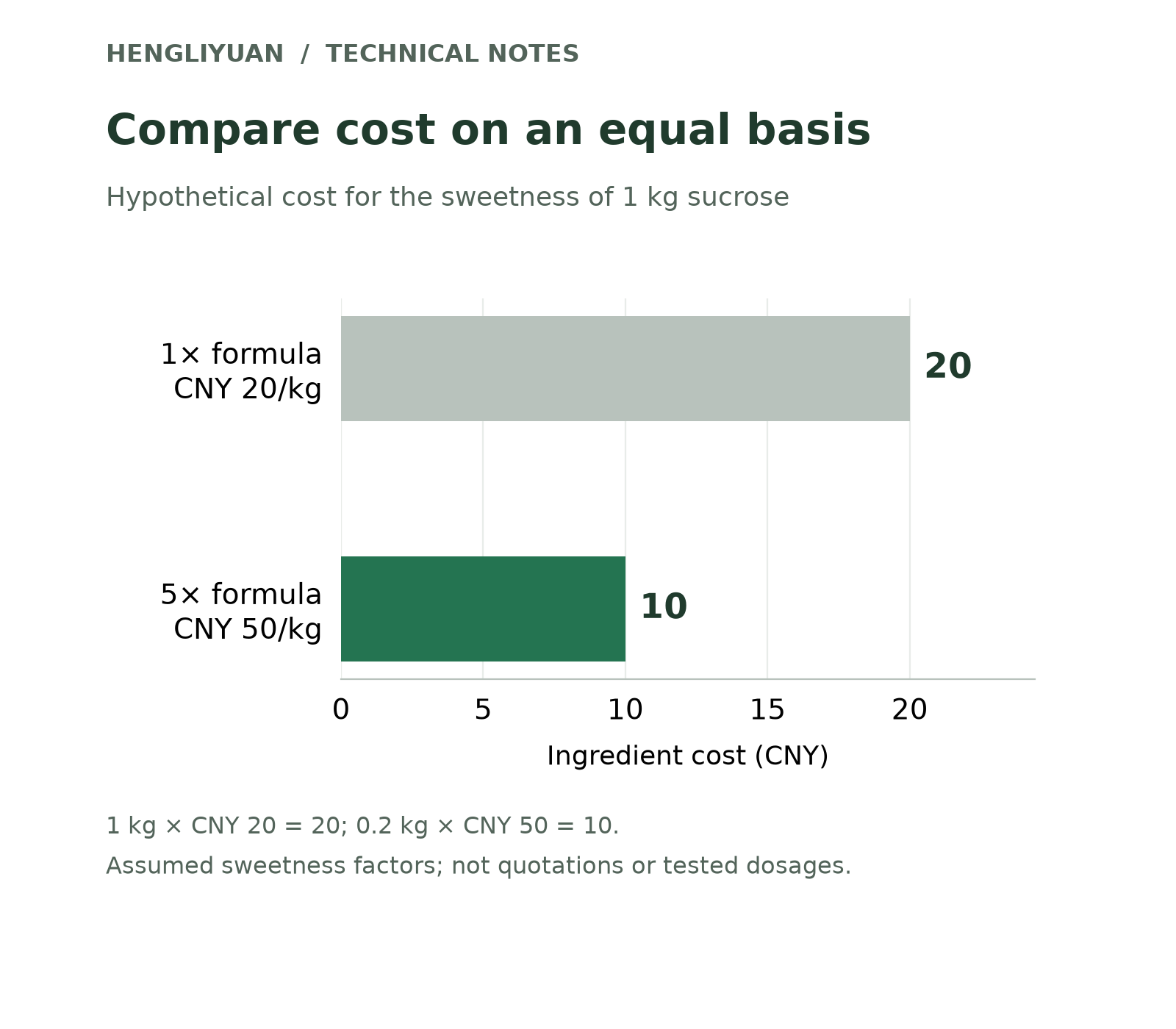
The 5× formula costs CNY 50/kg, higher than the 1× formula at CNY 20/kg, but only one-fifth as much is needed for equal sweetness. Its ingredient cost for replacing the sweetness of 1 kg of sugar is CNY 10: half the cost of the 1× formula in this hypothetical example. When comparing supplier quotations, ask for both the kilogram price and relative sweetness. A high-intensity product is not necessarily more expensive, nor is a 1× product necessarily cheaper to use. Calculate with the relevant quotations; the example’s cost difference must not be applied to every product.
Check that you are comparing the same use
Monk fruit extract, sweetener blends for factories and consumer tabletop sweeteners serve different purposes. They cannot be ranked simply by kilogram price. In Hengliyuan’s selection experience, extracts are better suited to factories with formulation capabilities, as one ingredient in a complete formula. Sweetener blends suit customers needing Hengliyuan’s help to adjust a sweetening formula for addition at an agreed dosage, and can also be used for OEM retail products. When comparing an extract with a finished blend, include the other ingredients, mixing and testing needed for the extract-based approach. The quotation for a single extract is not the cost of a ready-to-use solution.
How do you calculate actual cost in use?
Sweetener ingredient cost per batch = actual dosage (kg) × purchase price (CNY/kg). Sweetener cost per kilogram of finished product = sweetener ingredient cost per batch ÷ finished batch weight (kg). If you buy several ingredients to blend yourself, multiply each ingredient’s quantity by its unit price, then add the results. Using the same hypothetical example, if a finished batch needs the sweetness of 10 kg of sugar, the initial sweetness calculation requires 10 kg of the 1× formula at CNY 200, or 2 kg of the 5× formula at CNY 100. This is a sweetness-cost estimate before trials; calculate the final cost using the actual dosage confirmed by samples. If reducing the sweetener quantity requires additional ingredients for bulk or solids, include those costs too. The calculations above exclude packaging, transport and processing.
After normalizing sweetness, confirm cost in the actual formula
Relative sweetness is an important basis for comparing prices and can establish a starting point for trials. After the initial comparison, confirm dosage through testing in the actual product. When adjusting formulas, Hengliyuan considers initial sweetness, how long sweetness lingers and bitterness. Two products with similar overall sweetness may still taste different; changing a monk fruit extract’s concentration grade affects more than sweetness. If increasing one ingredient’s proportion to reduce dosage makes sweetness linger too long or causes unwanted aftertastes, the calculation alone does not make that formula more suitable. First adjust taste to the requirements, then calculate cost at the confirmed dosage.
The presence or absence of stevia does not determine cost
In Hengliyuan’s formulation approach, adding stevia is mainly about adjusting taste, pairing its initial sweetness with monk fruit’s lingering sweetness. A stevia-free erythritol–monk fruit formula can also achieve a similar taste effect by combining several monk fruit extracts. A blend containing stevia should not automatically be seen as a low-price option, nor should a stevia-free blend be assumed to taste worse or necessarily cost more. First establish whether stevia is acceptable, the ingredient grades, final ratios and dosage, then compare the corresponding quotations.
How do factory ingredients and OEM retail products differ in costing?
| Purchasing purpose | Costs to include |
|---|---|
| Buying a sweetener blend for factory use | Ingredient cost at the actual dosage, plus packaging, transport and necessary processing under the delivery terms |
| Buying multiple ingredients to blend yourself | All ingredient costs, plus on-site weighing, mixing, testing and actual losses |
| OEM finished sticks, pouches or jars | Contents, packaging materials, filling or portioning, outer cartons and agreed transport costs |
Do not count the same cost twice. For example, if packaging is already included in the quotation, do not add it again. When comparing suppliers, check that currency, delivery location and included costs are consistent. Calculate OEM products by the actual retail unit too: cost per stick for sticks and per jar for jars, considering net weight and the recommended amount per use. Equal pack weights do not mean consumers need equal amounts to reach the target sweetness.
Use the same accepted finished output and the existing calculator
Use actual accepted finished output as the finished batch weight in the calculation above. A planned mixing weight is not the same denominator if one route has different drying losses, rejects or usable yield. Divide consistently scoped comparison costs by the accepted output, and record the yield basis before interpreting a saving. Reducing the sweetener amount does not automatically mean adding the same missing weight of a filler. Identify the functions that must be replaced and their actual net costs. The existing allulose–stevia cost guide shows how added costs can consume the saving in a hypothetical equal-sweetness comparison. The existing free Excel calculator has editable currency, prices, sweetness factors, optional tested blend doses and other comparison costs. Its initial values come from the linked dose-and-cost example; replace them with your own quotation basis before using it here. A tested dose can replace the nominal estimate, but the sheet does not confirm taste, normalize differing usable yields automatically or calculate the full cost of a finished food. Download it directly without leaving an email address. You can use your own costing record or contact Hengliyuan before dosage and the cost sheet are complete.
Start a comparable quotation with the product and market
Start with the intended product, final sales market and the cost or taste question. You do not need a finished formula or completed spreadsheet for the first conversation. Add the following as available: - Product use: factory ingredient, tabletop sweetener or OEM retail product. - Ingredient requirements: whether stevia is acceptable and whether a particular option, such as erythritol-free, is needed. - Sweetness and taste targets: equal-weight use compared with sugar or a smaller dosage; what needs improving in the current sample. - Purchasing and packaging requirements: expected quantity, pack format, delivery location and required documents. If dosage is not yet set, select samples for the target product first. Once taste is confirmed, calculate costs at the actual dosage. Customers with a formulation team can discuss ingredients and combinations; those needing a ready-to-use blend or OEM product can ask Hengliyuan to help develop it for the application. Keep the selected commercial material or formula version, currency, quantity tier, packaging, delivery terms, freight scope and quotation validity with a final comparison. Confirm the included costs so a charge is not counted twice.
Common questions
Does a higher unit price always mean a higher cost in use?
No. Divide the kilogram price by relative sweetness for a nominal comparison, then cost the actual accepted dose. In the existing hypothetical example, the 5× formula costs more per kilogram but less for the nominal sweetness of 1 kg of sugar. It is not a tested dosage or a quotation.
Discuss blend samples and comparable costsIs buying ingredients to blend yourself always cheaper?
No. Include all ingredient costs and actual weighing, mixing, testing and losses. Compare a finished blend at its actual dose and the same quotation scope. A single extract price is not the cost of a complete ready-to-use solution.
Discuss blend samples and comparable costsCan a supplier’s recommended dose be used for final costing?
It can support an initial estimate. Use the dose accepted in the actual product for the final comparison, and reconsider it if the commercial material, formulation or processing changes. Sweetness factors alone do not approve the taste or physical performance.
Discuss blend samples and comparable costsDoes the presence or absence of stevia decide which blend is cheaper?
No. Hengliyuan considers the taste target, ingredient grades, final ratios and accepted dose before comparing the corresponding quotations. The factory’s blend-selection observations above are not a price or performance guarantee for every material.
Discuss blend samples and comparable costsWhat if two routes have different usable yields?
Normalize the consistently scoped costs to the same amount of accepted finished product. Record actual output, losses and rejects rather than dividing both routes by the same planned mixing weight. The linked calculator assumes a comparable finished-batch basis; it does not automatically correct a yield difference.
Discuss blend samples and comparable costsDo we need a new calculator or a complete formula to contact Hengliyuan?
No. The linked existing Excel calculator is free to download without an email address and its example inputs can be replaced. You can use your own costing record and begin with the product, market and cost or taste question before dosage, packaging and every commercial detail are settled.
Discuss blend samples and comparable costs