
Read this guide in
SUPPLIER BRIEF GUIDE
Natural Sweetener Supplier Brief: Compare More Than Sweetness
Build a buyer-ready natural sweetener supplier brief: analyte, format, carrier, target market, documents, samples and quotation details.
A natural sweetener quotation can look precise while still comparing different materials. The percentage may refer to Mogroside V or total mogrosides; the product may be a powder, liquid concentrate, carrier-assisted blend or finished retail formula. A procurement brief should make those differences visible before price becomes the anchor.
This guide is for overseas food, beverage and private-label teams sourcing monk fruit, allulose, stevia, erythritol-free systems or broader natural sweetener blends. It turns a short price question into a sample and document request that a supplier can actually answer.
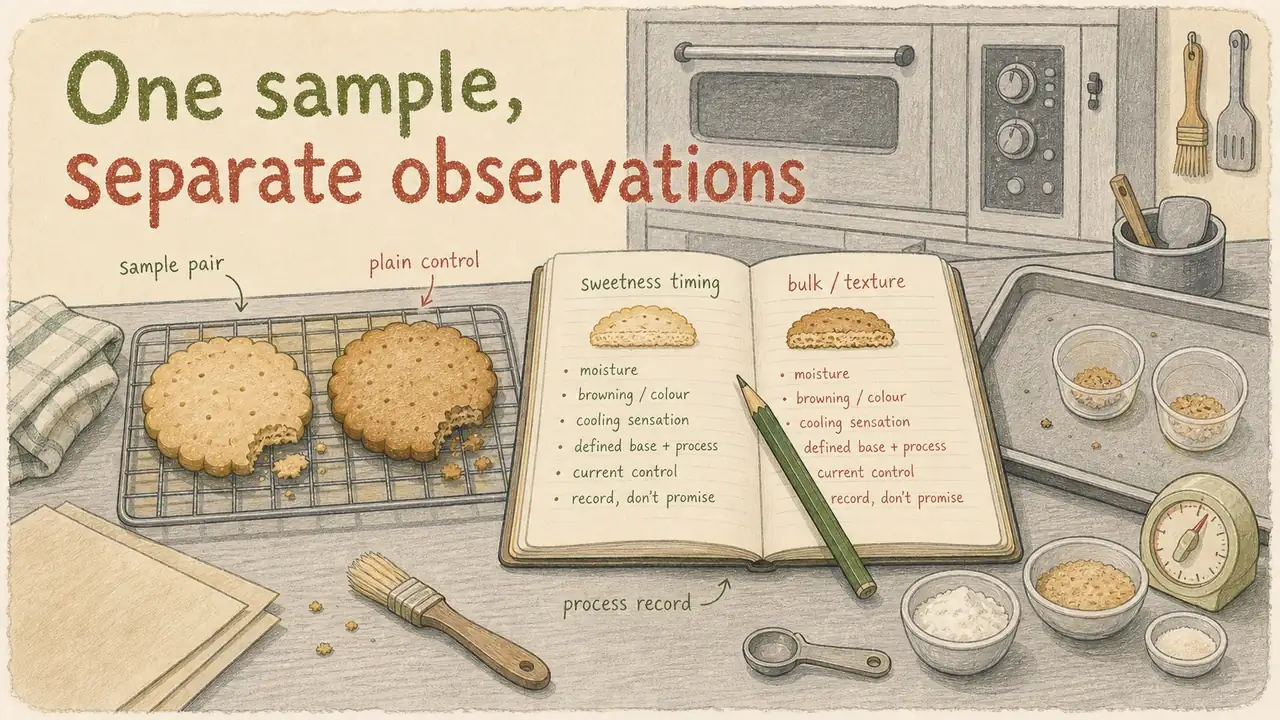
Keep taste and physical observations separate
The bakery illustration shows why sweetness timing, bulk, moisture, browning and cooling observations belong in separate parts of a sample record. The cookies, handwritten notes and dial are illustrative, not measured results or proof of an accepted formula. Use the actual application and control when interpreting a supplier sample; the scene does not establish a recipe, production capability or shelf life.
Start with the buyer's real job
First define what the ingredient must do: add concentrated sweetness, provide bulk, dissolve in a cold drink, fill a stick pack, support a syrup, or become a finished private-label product. A buyer who names only an ingredient may receive a technically correct sample that cannot be used in the target process.
Start with what you know
Start with the product you want to source or develop, your target market and the decision you need help with. Add packaging, quantity, document and sample requirements as they become clear; undecided details can be clarified together. These details help define market checks, sample format and quotation scope. Share serving size, sugar-reduction goals and launch plans if known.
Make the specification comparable
For monk fruit, state whether the requested assay is Mogroside V or total mogrosides, the agreed test method and the acceptance range. Also name the product form, carrier or excipient limits, color tolerance and physical handling needs. A 50% total-mogrosides material should not be written as MV50 without evidence on the COA.
Tell the supplier where the material will go
A beverage, powder premix, bakery formula, syrup, tabletop product and bulk ingredient can need different strength, carrier, Brix, flow or dispersion behavior. Share the real base, process and serving condition when known. Water can be a quick screen, but it should not be the only approval test for a finished food or drink.
Ask for the document set before the quote is final
Depending on the project, request the current product specification, batch COA, TDS, SDS, shelf life, storage conditions, packaging information, origin or traceability files, food-safety certificates and other target-market documents. A supplier page or old certificate is not a substitute for the actual grade and batch documents.
Compare cost-in-use, not only price per kilogram
The lower price per kilogram is not automatically the lower project cost. Assay, inclusion level, carrier, handling, failed trials, packaging and document gaps can change the cost of getting a usable formula approved. Ask for a relevant sample route first, then compare the material on the same application and test basis.
Put each offer on the same comparison basis
Use the same material question for every offer, then keep the supplier's actual answer and its source. A missing answer remains an open question; do not turn it into a zero cost or an assumed match.
| Comparison item | Keep with the offer | What must be clarified |
|---|---|---|
| Material identity | Analyte, grade, form, composition, carrier limits and assay/reporting basis | Are the offers for the same material question? |
| Supply and documents | Supplier role, producer/origin where relevant, COA issuer, specification version and certificate scope | Do the files identify the material and source being offered? |
| Sample link | Sample/lot identity, formula or application reference, process and comparison criteria | Can the quoted grade be linked to the sample tested? |
| Price basis | Currency, price unit, receiving pack, minimum quantity, trade term and delivery destination | Which packing, freight, tax or other items are included or excluded? |
| Timing and terms | Quotation date/validity, quoted lead time, stock or production basis and payment terms | What still needs agreement before the order? |
| Next decision | Actual feedback, unresolved inputs and the next named action | What must the next sample or document answer? |
If the ingredient, formula addition or delivered-cost basis differs, keep that difference visible before comparing cost in use. This checklist records the comparison; it does not supply prices, commercial terms, an automatic ranking or a universal sweetener conversion.
Download the supplier comparison worksheet
The free Excel sheet puts your brief beside two actual offers, with 22 fields covering identity, documents, sample links, packing, quotation basis, timing and open questions. The 66 yellow input cells are blank; fill only what you know and leave unresolved items visible. It has no prices, formulas or automatic supplier ranking, and you do not need to leave an email address to download it.
Turn the brief into sample action
State whether the sample is for sweetness screening, a pilot batch, label review, packaging review or a customer trial. Record the control, test conditions, key sensory or physical checkpoints and the information still missing before commercial approval. This keeps the supplier discussion practical without promising a universal formula or market approval.
Screen sweetness and bulk functions separately
A high-intensity sweetener screen can answer whether the sweetness target and sensory timing are suitable. It does not by itself document bulk, texture, moisture, browning or cooling sensation in a reduced-sugar bakery sample. Record those observations in the real base and process, against the current control, and keep them separate from target-market and document checks. FDA's high-intensity sweetener and sugar-alcohol references explain different ingredient functions in a U.S. food context. Use them to identify questions for the trial; they do not promise a particular material's performance in your recipe.
Technical references and boundary
The public GRN 629 notice describes monk fruit extract identities at different Mogroside V levels. GRN 627 concerns a different liquid fruit juice concentrate, described at approximately 65 degrees Brix. These are examples of why form, composition and analyte belong in the brief; Brix is not the same measurement as Mogroside V assay. A notice about another material or notifier does not establish that the offered grade is the same, that Hengliyuan holds that notice, or that a finished label or another market is cleared. Match the actual material and intended use to the applicable review.
Choose the contact route for the material
For a blend or an existing-product sugar-reduction project, use the blend inquiry linked here. For a single ingredient, open its product page and name the required grade or form in your message. Start with the product, final sales market and the decision to resolve; the downloadable sheet is optional, and a completed specification or order quantity is not required for first contact.
Common questions
What is enough to start a supplier brief?
Start with the product or material, final sales market and the decision you need help with. Add known specification, application, pack, quantity, document and sample details. The worksheet can be completed as the route becomes clear; it is not a condition for contacting Hengliyuan.
Discuss the blend briefAre total mogrosides, Mogroside V and Brix interchangeable?
No. State the actual analyte or physical measurement, test method, reporting basis and acceptance range. A total-mogrosides percentage should not be renamed as a Mogroside V grade, and a liquid's Brix value does not establish its Mogroside V assay.
Discuss the blend briefWhat should stay with each supplier quotation?
Keep the material identity and specification version, the sample/lot link, price currency and unit, pack and quantity basis, trade term, destination, included or excluded costs, quoted timing, validity and terms. Leave missing answers as open questions rather than assuming the offers are equivalent.
Discuss the blend briefHow do I use the supplier comparison download?
Fill the blank yellow fields with your brief and the actual offers, keeping the original documents with each one. It compares two offers beside your requirement, with no preset price, automatic ranking or formula. Download it directly without leaving an email address.
Discuss the blend briefDoes a public GRAS notice or certificate approve the offered material?
Check the identity, manufacturer or issuer, specification, intended use and relevant scope against the material actually offered. A public notice for another material or a certificate outside the applicable scope is not proof that your grade, finished label or destination requirements have been met.
Discuss the blend briefIs a preferred taste sample enough to approve a supply decision?
Keep the taste result with its actual material, lot, base, process and comparison conditions. Resolve the applicable physical, document and commercial questions separately, and link the agreed material and specification to the eventual order. A tasting preference does not settle them by itself.
Discuss the blend brief