Read this guide in
IMPORT DOCUMENTS
Monk Fruit Sweetener Import Guide: Indonesia & SE Asia Buyer Brief
Prepare a monk fruit import request: match the formula, supplier files, batch documents and packaging to the destination and bulk or retail sales route.
For Indonesia, prepare monk fruit import documents in three stages: establish the product and its permitted use, confirm the registration route, then prepare the shipment file. A retail tabletop sweetener and an industrial ingredient can follow different registration paths even when both contain monk fruit.
Our recommendation is to settle the full composition and the Indonesian importer’s classification before approving retail artwork or booking a commercial shipment. A COA answers a quality question; it does not establish market access. “Export-compliant packaging” must describe the actual pack and destination requirements rather than stand in for product authorization.
This guide focuses on Indonesia, with a separate Singapore comparison. Official sources were checked on October 27, 2026, including BPJPH’s recent halal timetable adjustment. Use the linked authorities to confirm the route for your exact product; Indonesian requirements do not transfer automatically to another Southeast Asian market.
The Doctor illustration is a document-comparison aid. Its names, analysis values, dates, quantities, stamps and shipping route are fictional, not Hengliyuan shipment records or approval evidence.
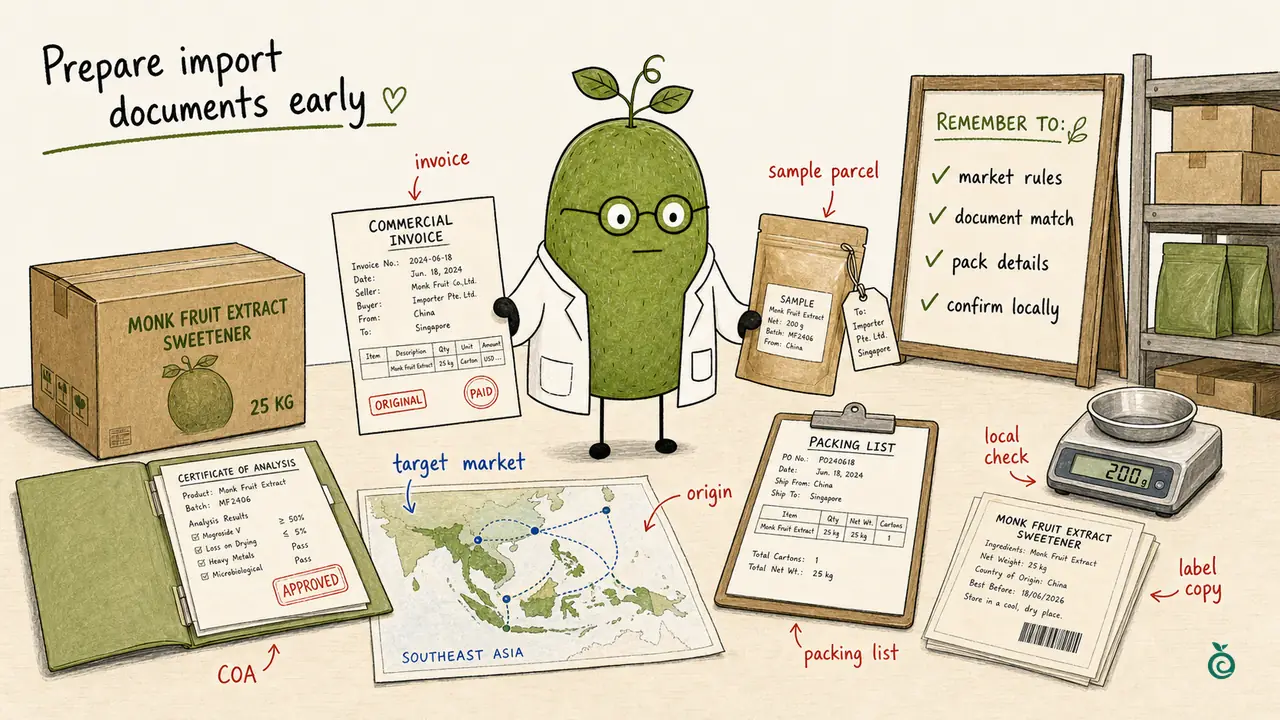
Choose the Indonesian route before collecting certificates
Begin with what will enter Indonesia and who will use it. “Monk fruit sweetener” can mean a concentrated extract, an industrial blend or a consumer pack containing several sweeteners. The trade name alone does not determine the route.
- BPOM: registration exemptions under Article 4 of Regulation 23/2023
- BPOM: determine the food-additive registration route
| Proposed supply | Registration question | Information to settle first |
|---|---|---|
| Bulk ingredient for a food manufacturer | BPOM describes exemptions for further-use raw materials and bulk industrial food/additives not sold directly to final consumers. Confirm that the actual use meets the conditions. | Receiving factory, intended food, full composition and whether any consumer sale is planned. |
| Food-additive preparation | Use BPOM’s BTP classification and registration guidance; establish industrial use versus consumer sale. | Each sweetener/carrier, intended food category and proposed use level. |
| Finished retail jar, pouch or packets | Establish the applicable imported-product authorization and approved-label route. | Exact formula, manufacturer, brand, importer and retail configuration. |
| Small laboratory or research sample | BPOM lists limited laboratory/research imports among registration exemptions. A sample description is not permission for commercial test marketing. | Purpose, quantity, recipient and the applicable import procedure. |
An exemption from independent product marketing registration does not settle ingredient permission, border procedures or the compliance of a finished food made with that ingredient. Record the importer’s confirmed route alongside the product specification.
Check monk fruit against the actual food category
In BPOM’s food-additive database, the entry “Ekstrak Luo Han Guo (Siratia grosvenorii)” appears for category 11.6, tabletop sweeteners. That is a useful starting point for a tabletop project. It does not establish permission for every extract, beverage, nutrition product or blend. Open the intended category and check the listed identity, maximum level and the basis used to express that level. Where a limit refers to an active marker, distinguish marker content from the mass of extract or finished blend. For a blend, check the other sweeteners and carriers too; a monk fruit entry cannot answer the whole formula question. A practical first file contains the complete ingredient list, relevant grade/assay information, the proposed food category and intended use. Resolve any mismatch between the specification and the database description with the importing team before calculating a local use level.
Separate product registration from the shipment SKI
Product registration concerns the product placed on the market. Surat Keterangan Impor (SKI) concerns import entry. BPOM’s food-import guidance distinguishes retail processed foods, raw materials and food additives, and states that an SKI for finished processed food applies to one import/entry. An existing product authorization therefore does not remove the next shipment’s application step. For a retail project, have the importer confirm the applicable authorization and label before preparing the entry file. For an industrial ingredient, confirm the raw-material or additive route rather than requesting a retail ML number by default. Ask the importer to specify the current e-BPOM documents for that classification.
Assign importer and supplier responsibilities
BPOM’s SiRiPO imported-product account guidance lists the importer’s tax identity (NPWP), risk-based business identification (NIB), food-safety management certification (SMKPO), an authenticated appointment letter (LoA), and manufacturing-system evidence such as GMP/HACCP/ISO 22000 or an eligible government audit certificate. The business activity and risk classification affect the supporting business permits. The Indonesian importing company manages its local account and application. The supplier helps identify the actual manufacturer and prepares the agreed product and factory files. Before arranging an authenticated LoA, agree the named companies, products, purpose and required form with the importer. A sales quotation is not that appointment document, and a factory certificate is not a product COA.
Build a product file that the importer can use
Keep one product name, formula revision and manufacturing-site reference across the working file. The table below is our coordination checklist; the importer determines which documents and versions its route requires, and Hengliyuan confirms availability for the selected product.
| File | What the supplier should identify | What the importer should resolve |
|---|---|---|
| Composition and specification | Full material, including carriers and other sweeteners; grade, assay basis, storage and shelf life. | Local classification, intended use and whether the composition fits that use. |
| COA or laboratory report | Named product, batch or submitted sample, test items, methods and actual results. | Whether the report scope and issuing body meet the application requirement. |
| Factory-system evidence | Actual site, certificate holder, scope and validity. | Which manufacturing evidence the account or product route accepts. |
| Process and product information | Manufacturing outline and product/pack description for the agreed version, where available. | Additional technical evidence requested for this classification. |
| Appointment, health/free-sale or other requested document | Issuer, product/site scope and available form; identify unavailable files early. | Whether the specific file is required, acceptable and needs authentication. |
| Draft label and pack specification | Formula-linked artwork, unit/outer pack and supplier/manufacturer details. | Indonesian wording, local importer details, claims and authorization information. |
A reference-batch COA can support early evaluation. Before shipment, identify which report covers the goods being dispatched. A specification limit and a measured batch result are different kinds of information; keep both visible in the review.
Reconcile the actual shipment file before dispatch
For finished processed foods, BPOM’s published SKI checklist includes the invoice, packing list, product authorization, approved label and production/expiry/lot information, with analytical or other supporting evidence as applicable. The importer should also check the remaining-shelf-life rule for the route. Use its current checklist rather than a universal supplier certificate bundle. Run a final cross-check against the purchase order: product and formula revision; seller, manufacturer and buyer; unit/outer packs; quantities and net/gross weights; lot references; and document dates. Record which actual batch COA and any requested origin file accompany the shipment. When one lot becomes several lots, check the report coverage again. Resolve a missing file before dispatch if the entry depends on it. Agree document deadlines separately from the production schedule; a freight booking does not make an incomplete import file usable.
Review the Indonesian label before printing
BPOM’s BTP guidance calls for Indonesian-language information, truthful presentation and consistency with the approved label. Its checklist covers identity, authorization information, net contents, expiry, manufacturer/importer details, ingredients, production code and applicable use information. For a tabletop blend, review the label as the whole blend. A large monk fruit image or “natural” wording does not replace disclosure of other ingredients. BPOM’s guidance includes a laxative-effect warning for polyol-containing products; confirm the wording and applicability for the actual formula. Do not copy warnings for another sweetener simply because both products are sold as sugar substitutes. Obtain the importer’s review of the current label rules, required claims evidence and exact print file. A change in formula or importer details should trigger a fresh label check before the next print run.
Use the updated halal timetable and verify certificate scope
Checked October 27, 2026: BPJPH’s announcement on Government Regulation PP 40/2026, amending PP 42/2024, states that halal obligations for food and beverages originating overseas begin on October 18, 2028, taking into account completion of mutual-recognition cooperation. Older summaries using an October 2026 date should be rechecked. The same announcement distinguishes domestic business sizes and other product groups; it does not give every product the same timetable. Have the Indonesian importing team confirm the category, any current label commitment and the certification route. If using an overseas halal certificate, verify the issuing body’s recognition, the named product/site and any Indonesian registration requirement with BPJPH. A logo on a supplier PDF does not establish those points. This timetable update does not state that a particular Hengliyuan product is halal-certified or authorized in Indonesia. Request the current certificate for the selected product if the project depends on it.
Distinguish bulk ingredient and retail pack requests
For bulk supply, give the receiving factory, intended application and receiving pack. If a local partner will repack the material, identify that activity at the start; the incoming ingredient file and the finished retail product need separate consideration. For retail supply, identify the exact formula, brand owner, individual pack, outer carton and Indonesian artwork. Hengliyuan catalog references include 100 g, 454 g and 150 g containing thirty 5 g packets. These are packaging references, not evidence of approval for a particular formula or destination. A matching pack weight does not prove two blends have the same composition. For private label, settle brand ownership and the print-file version before artwork work proceeds. For Hengliyuan-brand distribution, discuss country, products and channels; distribution rights require their own agreement.
Treat Singapore as a separate importing project
Singapore’s Food Agency requires the relevant food classification and product requirements to be checked, including permitted ingredients and additives. The applicable SFA licence or registration depends on the product category; processed-food imports require an import permit. Singapore Customs explains the company setup: obtain a Unique Entity Number (UEN), activate the Customs Account, and apply through TradeNet, either through an appointed Declaring Agent or the company’s own eligible declaration setup. Follow the issued permit’s clearance conditions. An Indonesian registration or supplier COA does not replace these steps.
- SFA: food import requirements
- SFA: licence and registration requirements
- Singapore Customs: UEN, Customs Account and TradeNet
| Decision | Indonesia | Singapore |
|---|---|---|
| Product route | Confirm BPOM classification, permitted use and applicable registration or exemption. | Confirm SFA classification and product/ingredient requirements. |
| Importer preparation | Confirm local business/account documents and the selected BPOM route. | Confirm UEN, activated Customs Account and applicable SFA licence/registration. |
| Shipment step | Confirm the applicable SKI and entry file. | Arrange the applicable TradeNet import permit. |
| Retail artwork | Review Indonesian label and relevant halal requirements. | Review Singapore label requirements for the exact product. |
For Malaysia, Thailand, Vietnam or another destination, start a separate country review. This comparison is not an ASEAN-wide authorization checklist.
Send a short brief that starts the document review
You can begin with four details: destination, product of interest, bulk or retail use, and the document question. If the importer has already issued a request, share that list. Quantity and final packaging can follow while the product route is being clarified. For example: “We plan an Indonesian private-label tabletop sweetener. Please identify the proposed blend and manufacturer, available product/factory documents, and the 150 g pack configuration. Our importer will confirm the BTP registration route and label requirements before artwork approval.” This is a request template, not a completed approval or customer case. Hengliyuan can discuss the selected extract or blend, packaging and available supporting files. Our Indonesia launch news provides background on reported market activity; use the actual product and partner documents to establish current authorization and commercial rights.
Common questions
Does every monk fruit ingredient need an Indonesian retail ML number?
The route depends on the product and use. BPOM describes registration exemptions for qualifying industrial raw materials and bulk food/additives not sold directly to final consumers. Have the importer confirm whether the actual supply meets those conditions and which import procedures remain applicable.
Discuss import documentsIs monk fruit permitted in every Indonesian food category?
A category-specific database entry is not blanket permission. Identify the exact extract or blend, intended food category, listed conditions and use-level basis. Review the other ingredients in a blend as well.
Discuss import documentsDoes a registered retail sweetener still need shipment paperwork?
Yes. Keep the product authorization and import-entry file separate. BPOM states that a finished-processed-food SKI covers one import/entry; the importer must prepare the applicable file for the next consignment.
Discuss import documentsWhich files should I request before an Indonesian importer reviews the product?
Start with the full composition and specification, the actual manufacturer, available reference COA and factory-system evidence, plus the intended pack and label. Ask the importer which additional files and authentication its chosen route needs before commissioning documents.
Discuss import documentsCan export-compliant packaging establish permission to sell?
Packaging suitability is one part of the project. Agree the food-contact material, moisture protection, seal, markings and destination artwork for the actual product. Those checks do not establish ingredient permission or completed product and shipment approvals.
Discuss import documentsCan the supplier give a guaranteed BPOM clearance date?
Confirm the importer’s application status and outstanding requirements first. Product selection, account preparation, registration, artwork and shipment review are separate tasks. Agree a document schedule and production schedule for the project rather than treating a general processing estimate as a clearance promise.
Discuss import documentsCan I use Indonesian documents unchanged for another Southeast Asian country?
Some supplier files may be reusable if the product and scope match, but the local product, importer, permit and label requirements need a separate review. Singapore, for example, has its own SFA requirements and TradeNet procedure.
Discuss import documents