
Stevia procurement
Stevia Extract Supplier Comparison Guide
Compare stevia supplier grades, assay basis, sample COAs and quotation terms. Use a free Excel sheet, then request the matching stevia or GSG sample.
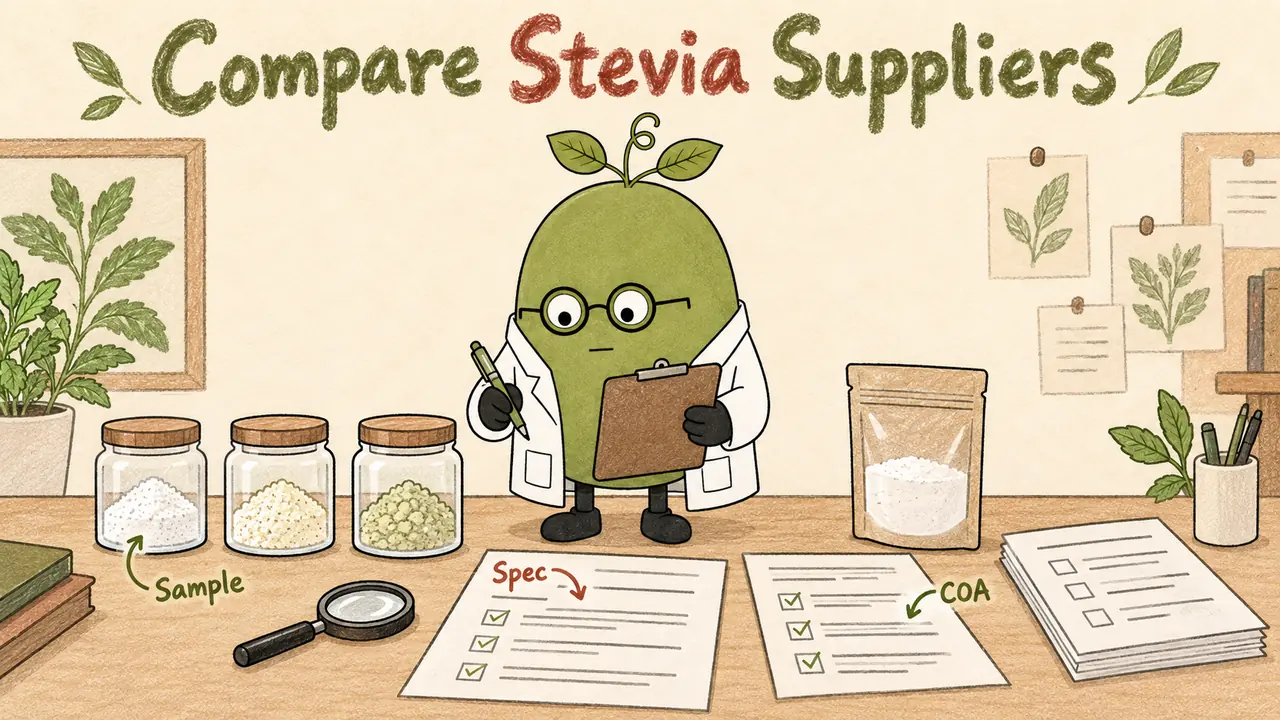
To compare stevia extract suppliers, first make sure they are quoting the same material. A steviol glycoside preparation may be specified by total content and by its Reb A or Reb M composition; a finished stevia blend also contains other ingredients. Price per kilogram cannot resolve a mismatch in composition or product form.
Ask each supplier for the offered grade's specification, analytical method, ingredient declaration and a sample tied to its documents. Then test comparable samples in the food or drink you are making. This guide describes the comparison; it does not imply that every grade is stocked by Hengliyuan.
Identify the material before comparing offers
'Stevia extract' can be used loosely in supplier listings. First confirm whether the offer is a steviol glycoside preparation or a formulated sweetener blend. For a glycoside preparation, compare its production route, total content and named glycoside composition, including Reb A or Reb M where relevant. Ask for the full ingredient declaration, physical form and any carrier. If two sellers quote different materials, they are not competing offers for the same purchasing item.
Read the same measure on both specifications
Total steviol glycosides and the percentage of one named glycoside answer different questions. Compare the analyte, method, reporting basis and acceptance range before using a headline purity number. Request a current specification and a COA for the sample's batch; a sample COA does not establish the result for a later production batch. The original 2021 EU regulation linked below is a historical example of route-specific steviol glycoside specifications. It does not verify any supplier's batch or provide a complete current market approval check.
Check how the offered grade is made
Some steviol glycoside preparations are extracted and purified from stevia leaves; other preparations involve an enzymatic step. The original 2021 EU regulation describes a specific enzymatically produced Reb M ingredient. That example does not identify the route of every material sold as Reb M. Ask each supplier to state the route and provide the documents for the exact grade. If the enquiry is for enzyme-modified stevia, distinguish glucosyl steviol glycosides (GSG) from a named glycoside obtained through enzymatic conversion. Write the requested product identity and assay basis in the brief; do not treat GSG90, SG90 and Reb M as interchangeable offers. Have the buyer's regulatory team review the actual preparation and intended market before label or launch decisions.
Put comparable grade identities side by side
Our first purchasing check is whether the two offers answer the same specification. Use the same fields for every candidate, and keep a missing answer as an open question rather than a zero or a pass.
| Comparison field | Record for each offer | Resolve before treating offers as equivalent |
|---|---|---|
| Material and grade | Supplier product code, glycoside preparation or finished blend, and full ingredient declaration | A stevia name does not identify every component in a supplied blend. |
| Assay and reporting basis | Total glycosides and named glycosides separately, method, basis and specification limits | A total-content result is not the percentage of Reb A or Reb M; a limit is not a measured batch result. |
| Route and exact identity | The offered grade's declared production route and corresponding documents; GSG identity and assay where relevant | The Reb M name alone does not identify its route. GSG90, SG90 and Reb M are not interchangeable grade descriptions. |
| Supplied form and other ingredients | Physical form, carrier or other components, and the actual material used in the trial | A different form or composition changes what one kilogram represents and can require a different comparison. |
Use one real product to screen samples
Keep the base formula, process and agreed comparison question with each coded sample. A fixed-addition comparison and a matched-sweetness comparison are different: retain the actual commercial material amount, unit and finished-product basis for each candidate, including any other formula changes. Assess sweetness onset, peak, lingering notes, bitterness and aroma interaction at the intended serving temperature. A water tasting can reveal an early difference, but the final decision belongs in the actual product; for a complete beverage powder, its prescribed preparation in water is the relevant product. If a candidate is a blend, record its other ingredients rather than attributing the result to stevia alone.
Compare cost on the same application and trade basis
Price per kilogram is useful only after the purchasing item and quotation basis match. Record currency, price unit, pack, order quantity and delivery terms, with freight, tax or other inclusions and exclusions stated separately. Missing costs stay unresolved; do not silently enter zero. For an application comparison, retain the actual material amount needed for the agreed sweetness target in the same finished-product quantity, together with any compensating formula changes. A lower kilogram price can still mean a higher ingredient cost at the tested addition. A matched-sweetness result remains specific to that product and test; it does not establish a universal dose, total production cost or guaranteed saving.
Match the sample, documents and quotation
Before comparing prices, line up the accepted sample code, product specification version, offered form, packaging, quantity and documents in each quotation. Ask the supplier to confirm MOQ, lead time and shipping terms for that exact item. A lower price for a different glycoside profile, carrier or pack is not a like-for-like saving. Hengliyuan can discuss its stevia ingredient range against a defined application and sample brief; the available grade and commercial terms are confirmed for the selected request.
Keep the sample-to-delivery record connected
A comparison becomes useful when the next person can trace which material was tested and which one is being offered. Confirm the supplier's role, the named producer where relevant and who issues each document for the exact grade. Do not assume that a distributor manufactures every item it offers.
| Stage | Keep together | Before moving forward |
|---|---|---|
| Requested specification | Material identity, agreed specification version, intended application and market | List unresolved identity, document or market questions separately from the taste result. |
| Tested sample | Sample code, actual grade and lot, its batch COA, preparation and observations | Check that the documents describe that sample; retain the actual addition and serving conditions. |
| Commercial quotation | The corresponding product code and specification, form, pack, quantity, price basis and terms | Ask for a stated relationship to the evaluated sample; clarify any changed composition, specification or pack. |
| Delivery batch | Delivered identity and lot, its own applicable batch documents and the agreed specification | A previous sample COA does not supply the new batch result. Resolve any difference before treating it as the accepted item. |
Hengliyuan's available grade, supply arrangement, documents and commercial terms are confirmed for the selected request. A range listing or a supplier document does not mean that every grade is in stock or that every offered material is manufactured by Hengliyuan.
Download the free supplier comparison sheet
Use the existing supplier comparison workbook to put your requirements and two actual offers beside one another. Its 22 fields provide 66 blank input cells for identity, specification, application, documents, samples and quotation terms. Add grade-specific assay details or unresolved questions in the relevant fields. The sheet has no prefilled supplier, price, formula, total score or automatic ranking. It downloads directly without an email address or account. Completing it is optional before contacting us; the file is a purchasing record, not a grade recommendation or a market approval.
Start with the grade, application and market you know
Send the stevia or GSG grade you are considering, the food or drink you are making and the intended sales market. If the grade is undecided, share the taste or formulation problem and any current sample or specification. You can contact us before the worksheet, document set or commercial brief is complete. Use the stevia sample link for the ingredient request. As the material becomes clearer, confirm the offered specification, sample reference, packaging, estimated quantity and required documents. A finished sweetener blend is a separate composition discussion; its quotation should identify all supplied ingredients.
Common questions
Can stevia supplier quotations be compared by price per kilogram alone?
Match the actual material, specification, supplied form, pack, quantity, currency and delivery basis first. For application cost, retain the actual tested addition into the same finished-product quantity and any other formula changes.
Request a stevia or GSG ingredient sampleShould I compare total steviol glycosides or Reb A percentage?
Read both where relevant, as separate measures. Keep the analyte, method, reporting basis and specification limit with each value; a total-content result cannot be renamed as Reb A or Reb M content.
Request a stevia or GSG ingredient sampleDoes Reb M identify the manufacturing route?
No. Ask for the exact material identity, route declaration and corresponding specification and market documents. The historical EU example describes a specified route, not every material sold under the Reb M name.
Request a stevia or GSG ingredient sampleAre GSG90, SG90 and Reb M equivalent offers?
No. Identify whether the requested material is glucosyl steviol glycosides, another steviol glycoside preparation or a named glycoside grade. Confirm each product code, assay definition and reporting basis before comparing samples or quotations.
Request a stevia or GSG ingredient sampleDoes a sample COA establish the bulk delivery result?
It reports the identified sample batch. Match the commercial offer to the evaluated material and check the delivery batch's own documents against the agreed specification.
Request a stevia or GSG ingredient sampleDoes a better water tasting establish the best application cost?
No. Compare the actual intended product, agreed sweetness target, actual addition and preparation. For a complete beverage powder, preparation in water may be the intended product; an ingredient-only water screening does not supply every finished-food result.
Request a stevia or GSG ingredient sampleDoes the Excel sheet score suppliers or recommend a grade?
No. It provides 22 fields for your requirements and two real offers, with 66 blank input cells. It has no formulas, prefilled prices or automatic ranking; missing answers remain questions to resolve.
Request a stevia or GSG ingredient sampleMust I finish the worksheet before requesting a stevia sample?
No. Start with the grade or formulation problem, intended product and market you know. Use the stevia or GSG ingredient sample link; specification, pack, quantity, documents and sample arrangements can be clarified afterward.
Request a stevia or GSG ingredient sample