
Read this guide in
REB A VS REB M TESTING
Reb A vs Reb M: Why Real-Base Sensory Testing Matters
Compare Reb A and Reb M in the finished base: sweetness over time, bitterness, preparation and process. Includes published study data and a free sensory record.
Reb A and Reb M can look similar on a sweetness sheet and still behave differently in a finished drink. Protein, fat, acidity, solids, flavor and processing can change what the buyer notices after the first sip.
This guide is for food and beverage teams comparing steviol glycosides in real bases. The practical rule is simple: use water to screen, then use the target product to decide.
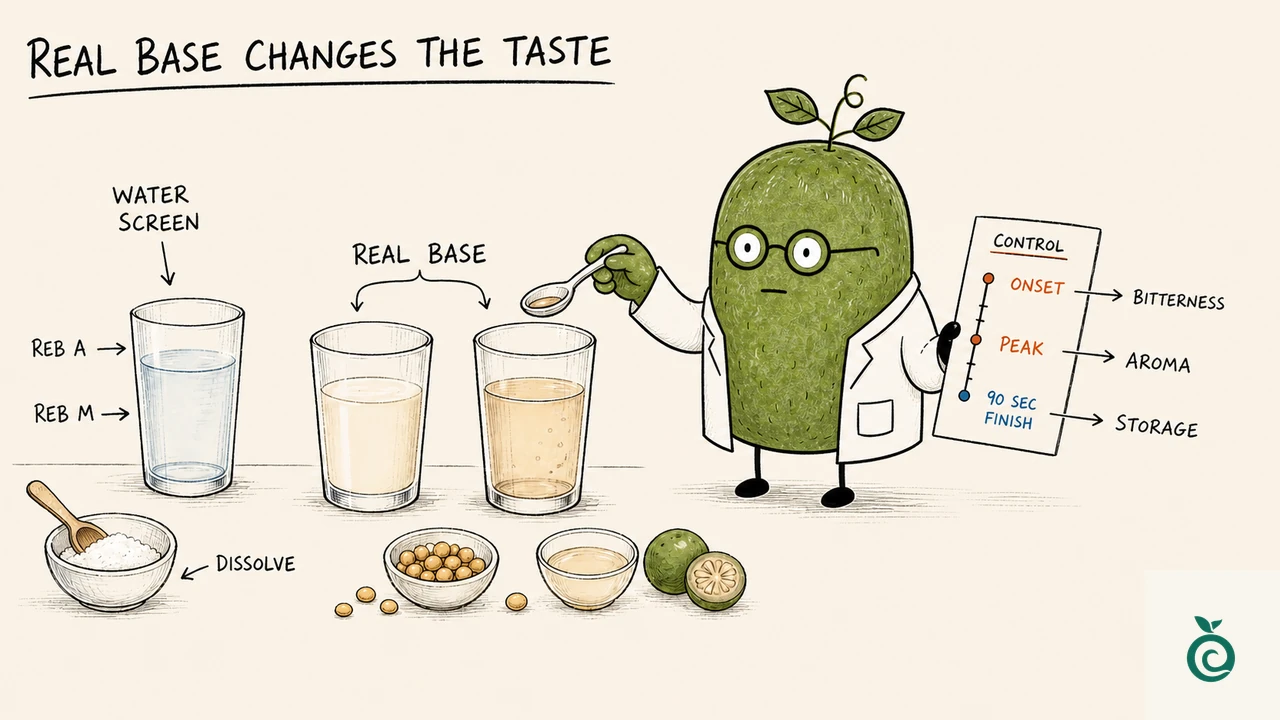
Screen the ingredient, then test the intended product
The illustration separates a neat-ingredient water screen from testing the complete product, where the rest of the formula remains present. Its 90-second note is an example checkpoint to agree before a trial, not the timing used in the published study below. The scene does not show measured factory results or a winning sample.
A water screen is only the first filter
An equal-sweetness water test can help remove an obviously unsuitable sample. It cannot show how a sweetener will interact with milk protein, soy protein, fat, acid, aroma, minerals, viscosity or the finished process. Keep the water screen, but do not treat it as finished-product approval. If the finished product is a complete powder meant to be mixed with water, that full powder at the intended dilution is the real base. Do not remove its protein, flavor or other ingredients and call a neat-sweetener solution the same test.
Name the matrix before the sample
Write down the product before deciding which sample is better: clear beverage, protein drink, soy beverage, milk drink, yogurt drink, coffee, tea or another base. Add pH or acidity, soluble solids, protein or fat level, flavor, serving temperature, heat treatment, mixing order and storage plan. Kim and Hong's 2023 milk/soymilk study found flavor-dependent sensory effects; its chocolate and vanilla results do not establish an improvement for every flavor or formula.
Compare sweetness and bitterness over time
The first sip and the remaining taste are separate observations. Record onset, peak, lingering sweetness, bitterness, astringency, aroma and mouthfeel instead of reducing everything to one preference score. Agree the assessment times, whether the sample is swallowed or expectorated, the serving amount and palate-cleansing procedure before the comparison.
| Study sample | Sweetness: in mouth / 5 s / 60 s | Bitterness: in mouth / 5 s / 60 s |
|---|---|---|
| 14% sucrose | 8.3 ± 0.3 / 7.1 ± 0.3 / 3.6 ± 0.3 | 0.8 ± 0.1 / 0.6 ± 0.1 / 0.4 ± 0.1 |
| 0.1% Reb A | 7.2 ± 0.3 / 6.5 ± 0.3 / 4.3 ± 0.3 | 3.5 ± 0.3 / 3.5 ± 0.3 / 1.6 ± 0.2 |
| 0.1% Reb M | 8.6 ± 0.3 / 8.2 ± 0.3 / 5.3 ± 0.3 | 1.0 ± 0.2 / 0.9 ± 0.1 / 0.6 ± 0.1 |
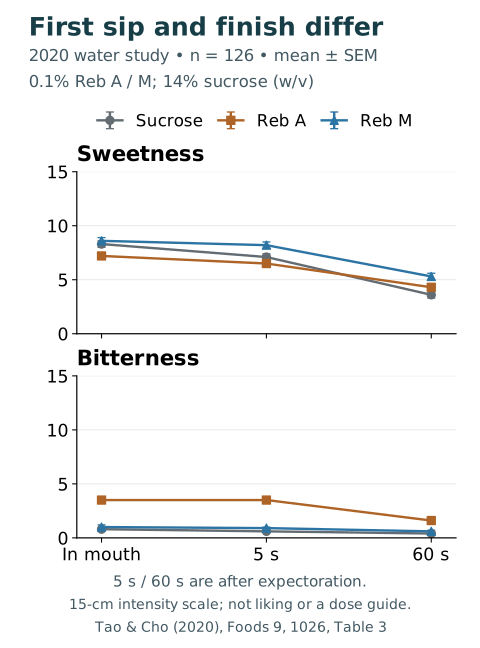
Table values are means ± SEM from Table 3, on the study's 15-cm line scale; 5 s and 60 s follow expectoration. The paper used specific 95% glycoside products in water and also included Reb D, which is not plotted here. Do not convert these intensity results into consumer liking, a universal substitution ratio or an equivalence claim for our supplied grades.
Keep the control and comparison question identifiable
A useful first round can include the current or sucrose control, Reb A, Reb M and a blend only when the blend answers a real formulation question. Choose whether the trial compares the same addition or the amount needed to reach an agreed sweetness, then record the actual addition and its unit for every sample. Those two questions should not be mixed in a single ranking. Keep serving conditions, flavor and process consistent, or record the change explicitly.
| Before comparing | Record for each coded sample |
|---|---|
| Identity and comparison basis | Grade, supplier/sample code and lot, specification reference, actual addition with unit; fixed addition or agreed sweetness target. |
| Complete base | Formula/base revision, liquid or reconstitution ratio where relevant, flavor and relevant pH, solids, protein or fat conditions. |
| Preparation and serving | Mixing order/time, preparation and serving temperatures, actual heat treatment, sample amount, sequence and whether swallowed or expectorated. |
| Individual sensory notes | Panelist code, checkpoint/time, agreed target, sweetness and bitterness separately; keep intensity, liking and target-fit scores distinct. |
| Physical/process result and next step | Dissolution, haze, foam or separation, pack/storage history, observation time, unresolved requirement and one specific change to test next. |
Check the finished process
For a beverage, record dissolution, haze, sediment, separation, carbonation if relevant, heat treatment, filling and storage. For a dairy or protein base, record mixing order, foam, viscosity, protein note and cold storage. A sample that tastes clean before processing may need a second check after the real process and storage window. Keep physical observations separate from taste: a haze or sediment note is not a chemical solubility measurement, and a clean first sip does not establish storage stability.
Use the existing blank sensory record
The free Excel record already supports one coded sample, panelist and checkpoint, with six sensory/preparation dimensions and separate ingredient, safety and document gates. Add actual timed observations in its observation field and keep the study numbers above separate from your own trial. Its optional 1–5 scores describe fit to your agreed target; they are not the study's 15-cm intensity ratings and must not be converted between scales. Leave untested items blank or describe why they do not apply. No email is needed, and there is no automatic total, ranking or approval.
Use market rules as a boundary
JECFA's 2026 Chemical 267 entry is an official evaluation source for steviol glycosides and purified Reb M, including the current ADI expressed as steviol. It is not a blanket approval for every commercial grade or every market. Confirm the target country, food category, glycoside identity, production route, label name and document set before a launch or quotation is treated as final.
Turn observations into the next sample question
Start with the product, market and the taste or preparation issue you want to resolve; share what you already know. A useful feedback note names the sample and base, the comparison control, the actual condition and what happened at the agreed checkpoint. Add packaging, estimated quantity, required documents and sample needs as the project develops. You can contact us before the full brief is complete.
Sources and their scope
Tao and Cho (2020), Foods 9, 1026, supplies the water-study data; Kim and Hong (2023), Journal of the Science of Food and Agriculture, 103, 7445–7454, supports flavor/matrix-specific testing. The WHO/FAO JECFA Chemical 267 entry includes the 2026 evaluation. These are research and evaluation references, not company trial results or approval of a particular finished product.
Common questions
Can Reb M replace Reb A gram for gram?
Do not assume that. Name the grades and compare actual additions in the intended base. A fixed-addition trial and a trial matched to a sweetness target answer different questions.
Discuss this requestIs Reb M always free of aftertaste?
No. Bitterness and lingering sweetness are different attributes. A sample may have little bitterness and still leave more sweetness than the target requires. Describe the issue and when it appears instead of reporting only clean or not clean.
Discuss this requestIs a complete drink powder mixed with water a real-base test?
Yes, at its intended dilution. Keep the full powder and the intended liquid, preparation and serving conditions. A neat sweetener dissolved in water is a different ingredient screen.
Discuss this requestMust we use 30 and 90 seconds?
No. Agree useful times and the swallowing or expectoration procedure for the product question, then apply them consistently. The published data shown here uses in-mouth, 5-second and 60-second assessments, not the illustration's example 90-second checkpoint.
Discuss this requestDo the study error bars show the spread of individual consumers?
No. The plotted errors are the published standard errors of the mean (SEM). They are not standard deviations, confidence intervals or evidence that a sample will satisfy every customer.
Discuss this requestCan we copy the study values into the blank Excel?
Keep them as a separately identified reference if useful, never as your own trial observations. The workbook's optional 1–5 target-fit scores have a different meaning from the published intensity scale. Record your sample code, conditions and actual notes.
Discuss this requestWhat should we send after a first trial?
Send the sample and base references, actual preparation and serving conditions, the main observation and the next question. Missing packaging, order quantity or documents can be clarified later; they do not prevent the first conversation.
Discuss this request