
Read this guide in
PROTEIN BEVERAGE VALIDATION
Protein Shake Sweetener Stability Checklist: Sweetness Timeline & Heat Testing
A checklist for protein shake sweetener stability: sweetness timeline, heat-process and sediment checks for buyers.
A low-sugar protein beverage can be sweet enough in the first sip and still fail later. Bitterness, metallic notes or astringency may appear after the drink leaves the tongue, while protein aggregation, haze, sediment or separation can show up after processing or storage.
The practical answer is to score taste over time and physical stability as two connected but separate workstreams. This checklist is for buyers preparing monk fruit, stevia, Reb-type or natural sweetener blend samples in dairy, whey or plant protein beverages.
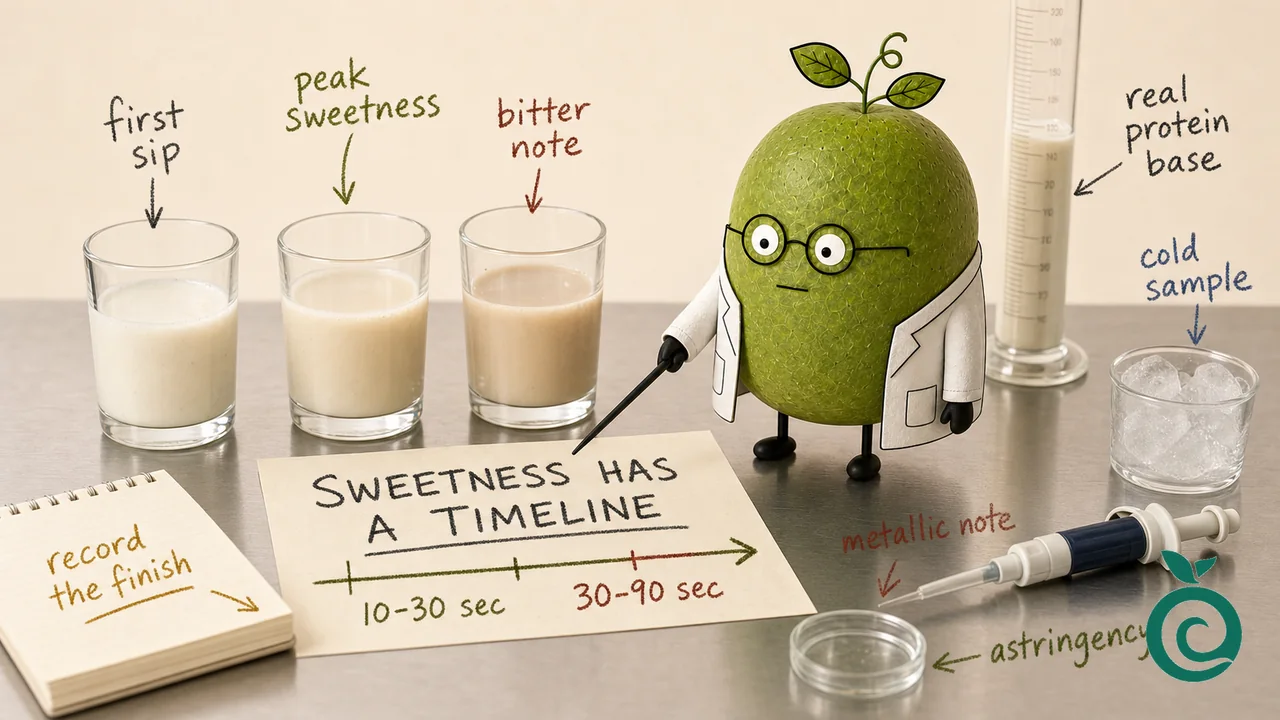
Start with the real beverage base
Name the base before choosing a sweetener: milk protein, whey, casein, pea, soy or another plant protein. Add protein level, flavor, pH or acid system, minerals, oil or fat, gums, fibers and the intended serving temperature. A water screen can find obvious off-notes, but it cannot stand in for the finished drink.
Score the sweetness timeline
Record the first sweetness, the peak, the fade, and what remains after the sip. Add bitterness, metallic note, astringency, protein note and aroma release to the same time line. A simple first screen can separate the first sip, 10 to 30 seconds and 30 to 90 seconds; longer observation may be useful when the finish is especially persistent.
Check stability on its own line
Record viscosity or perceived thickness, haze, particle size where available, foam, sediment and separation before and after the intended heat process. Repeat the physical check through the planned storage window. A sample that tastes clean but settles is not a sensory pass, and a stable bottle with a harsh finish is not a taste pass.
Compare controls before blends
Keep the current or sucrose control beside a monk fruit direction, a stevia or Reb-type direction and a blend direction when appropriate. If the product needs body support, treat allulose, fiber, gum or another carrier as a separate formulation decision. Do not use a blend to hide which variable changed.
Keep market and taste decisions separate
A natural-sweetener label may be attractive to some buyers, but it does not prove that a finished protein drink will taste better. China projects still need the final food category and additive rules checked against GB 2760-2024. U.S. projects can use FDA's high-intensity sweetener page as an entry point, but it does not approve every grade, formula or label.
Prepare a sample-ready brief
Start with your target market and product idea. Share any known packaging specification, estimated quantity, required certificates/documents and whether samples are needed; we can clarify the remaining details together. Add the protein source, serving size, pH, flavor, process, storage target and the exact taste or stability problem so the sample matrix matches the real project.
Technical references
The 2021 Journal of Dairy Science RTD study linked milk protein type and concentration with astringency, sensory viscosity, sulfur or eggy notes, vanillin flavor and changes during 4°C storage: https://pubmed.ncbi.nlm.nih.gov/34304878/. A 2020 Foods study used temporal and multi-intake profiling in pea-protein beverages and found that protein type, gellan gum, salt and oil changed beaniness, bitterness, astringency and persistence: https://www.mdpi.com/2304-8158/9/8/969. These are application-specific studies, not a universal formula or a Hengliyuan performance guarantee.
Review note
Reviewed October 2, 2026.
Common questions
Why is a protein beverage sweet but still unpleasant?
Sweetness is only one sensation. Protein, minerals, flavor, texture and the sweetener system can contribute bitterness, metallic notes, astringency, powderiness or a lingering finish.
Can a water test approve a protein beverage sweetener?
No. Water can screen obvious problems, but final approval should happen in the real protein base at the intended serving size, temperature and process condition.
Should sediment be treated as a sweetener problem?
Not automatically. Sediment or separation may involve protein type, pH, salts, gums, oil, heat history or storage. Record those physical checks separately from the sweetness timeline.
What should buyers send before protein beverage samples?
Start with your target market and product idea. Share any known packaging specification, estimated quantity, required certificates/documents and whether samples are needed; we can clarify the remaining details together. Add the protein base, flavor and process details if available.
