
Read this guide in
PROTEIN BEVERAGE STABILITY
Protein Shake Sedimentation: Sweetener & Stability Testing Guide
Separate protein shake sedimentation from sweetness: a stability testing guide for monk fruit and stevia beverage samples.
When a protein drink settles, it is tempting to add more sweetness or change the sweetener first. That shortcut can miss the real cause. Protein type, pH, salts, gums, oil, heat history and storage can change the drink's particles and mouthfeel before sweetness is judged.
This guide helps beverage buyers build a stability-aware sweetener test for dairy, whey, soy, pea and other plant protein drinks. It keeps the commercial question simple: which variables should be compared in the real bottle, and which should not be confused with sweetness?
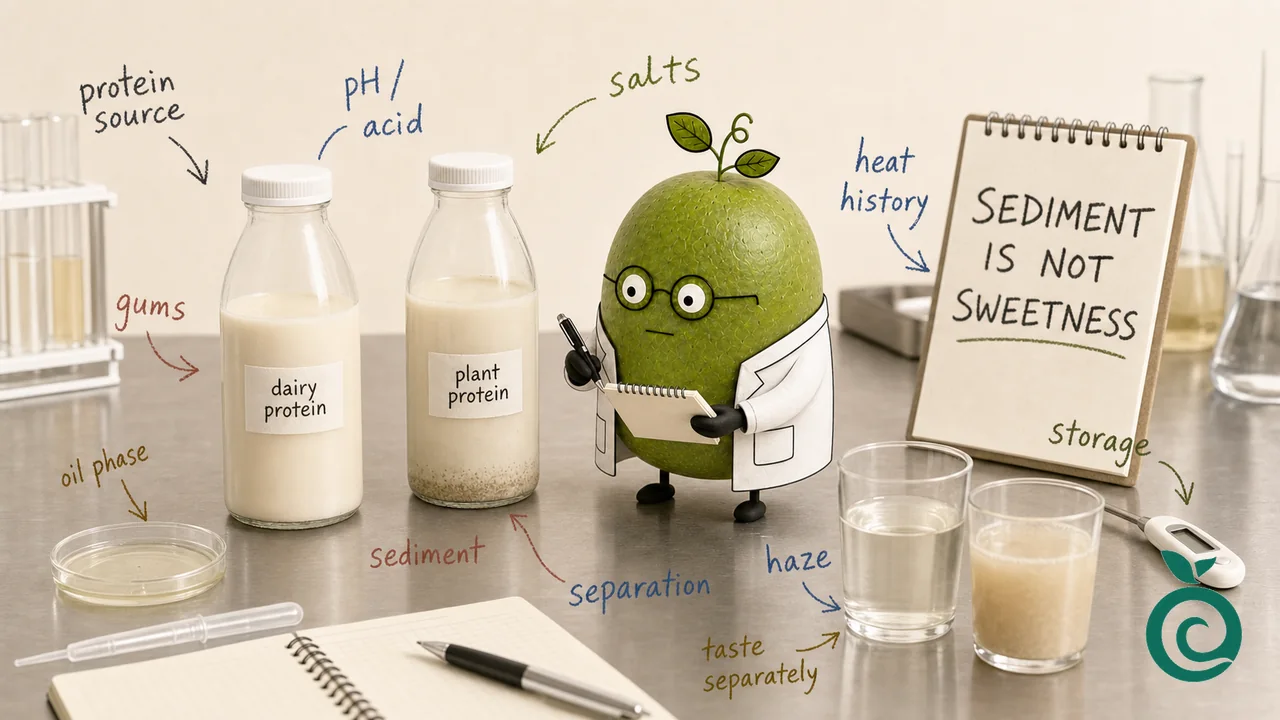
Sediment is not a sweetness score
A drink can be correctly sweetened and still show haze, settling, a ring, flakes or a layered appearance. Start the investigation with the visible and physical defect, then check whether the same sample also has a taste problem. Do not describe a sediment issue as a sweetener aftertaste without evidence.
Record the variables that move stability
For each sample, record protein source and level, pH or acid system, mineral salts, oil or fat, gums, fibers, flavor, mixing or homogenization, heat process, package and storage. These details matter because a pea drink, a neutral dairy shake and an acidic whey drink are different formulation problems.
Use a control and one-change comparisons
Keep the current formula or sucrose control. Then compare a single sweetener direction and a blend only when the project question calls for it. If a stabilizer, carrier, fiber or allulose-supported body route changes at the same time, record it as a new formula rather than attributing the result to monk fruit or stevia alone.
Check the bottle after processing
Taste and inspect samples at the intended serving temperature, then repeat after the planned pasteurization, UHT or other heat route. Look for sediment, separation, haze, foam, viscosity change, aroma loss and aftertaste. A bench result before heat is a screening result, not a finished-drink approval.
Read the physical and sensory results together
A clean sweetness timeline does not prove visual stability, and a stable appearance does not prove a clean finish. Put sweetness onset, peak, 30/90-second finish, bitterness, metallic note and astringency beside viscosity, haze, particle or sediment observations so the next sample has a clear purpose.
Turn the test into a quotation brief
Start with your target market and product idea. Share any known packaging specification, estimated quantity, required certificates/documents and whether samples are needed; we can clarify the remaining details together. Also provide the protein base, current formula direction, process, storage target, known sediment or taste defect and whether an erythritol-free or allulose-supported route is allowed.
Technical references
The 2021 Journal of Dairy Science study evaluated milk protein concentration and type in RTD beverages through heat processing and 4°C storage, then measured sensory and volatile changes: https://pubmed.ncbi.nlm.nih.gov/34304878/. The 2026 study on Reb A, stevioside and Reb M with soy 11S/7S proteins reported concentration-dependent binding and sensory effects in aqueous models: https://www.sciopen.com/article/10.7506/spkx1002-6630-20260101-001. These sources support variable selection, not a fixed stabilizer level, sweetener ratio or shelf-life claim.
Review note
Reviewed October 2, 2026.
Common questions
Does more sweetener fix protein beverage sediment?
No. Sediment can relate to protein, pH, minerals, gums, oil, heat history or storage. More sweetness may only cover the taste while leaving the physical defect.
Should dairy and plant protein drinks share one stability conclusion?
No. Protein source and the surrounding formula can change flavor, viscosity, particle behavior and processing response. Keep the sample results tied to the actual base.
Why test after heat processing?
Heat can change protein interactions, aroma and appearance. If the commercial drink is pasteurized, UHT-treated or otherwise heated, the sweetener decision should be checked in that process path.
What should buyers send before a stability-focused sample?
Start with your target market and product idea. Share any known packaging specification, estimated quantity, required certificates/documents and whether samples are needed; we can clarify the remaining details together. Add the protein source, pH, process, storage target and known defect if available.
