
Read this guide in
PLANT-BASED YOGURT STABILITY
Plant-Based Yogurt Stability & Syneresis: Base, Solids and Stabilizer Checks
Plant-based yogurt stability guide: separate base, solids, stabilizer and fermentation variables to control viscosity and syneresis.
Plant-based yogurt does not have one standard gel. Soy, oat, coconut, almond and mixed bases bring different proteins, fats, fibers and particles. A sample may taste sweet while still showing weak viscosity, rough texture or serum separation because the base and stabilizer system were never defined.
This guide is for buyers testing monk fruit, stevia, allulose-supported or other natural sweetener routes in plant-based yogurt. Start by naming the physical job: body, pourability, spoonable structure, water holding or flavor balance. Then build the sweetener test around that job.
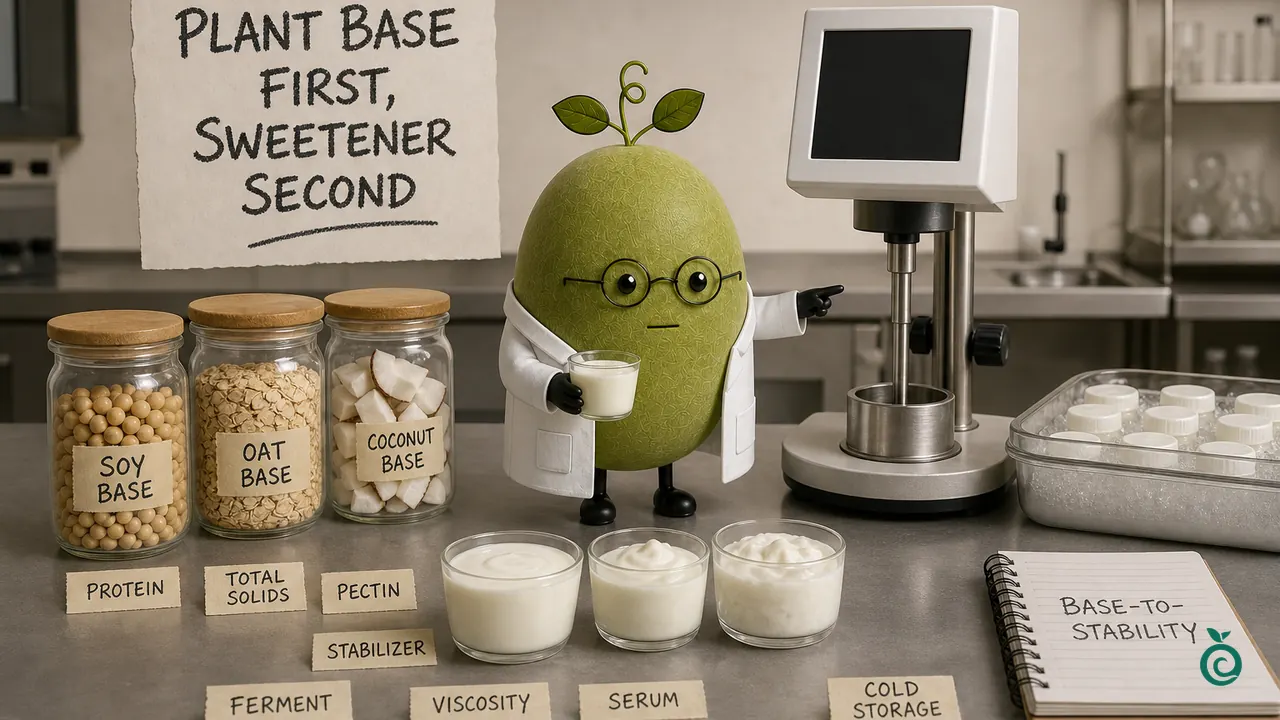
Name the plant base and protein first
State whether the base is soy, oat, coconut, almond, pea, mixed plant milk or another system. Add protein source and level, fat or oil system, fiber, particle treatment and whether the product is stirred, set, drinkable or heat-treated after fermentation. A public plant-based yogurt study and market label example can show possible ingredient roles, but neither can stand in for the buyer's actual base.
Keep sweetness and total solids on separate lines
A high-intensity sweetener can lift sweetness without replacing the solids that affect body and water distribution. Allulose or another bulk direction may be considered where the market and label plan allow it, but it still needs a real-base test. Record sweetener identity, carrier, target sweetness, total solids or Brix and the texture target as separate fields.
Treat stabilizers as matrix variables
Pectin, starch, xanthan, gellan, cellulose or other hydrocolloids can behave differently with plant proteins, acidity, salts, heat and shear. A 2024 coconut-milk yogurt analogue study used response-surface testing for total soluble solids, pectin and emulsifier while observing syneresis, viscosity, firmness and liking. That is a reason to test the actual system, not a reason to copy its ingredient window. Source: http://www.ifrj.upm.edu.my/31%20(04)%202024/16%20-%20IFRJ23621.R1.pdf
Check fermentation and process before blaming the sweetener
Record hydration, heat treatment, homogenization, culture, fermentation time, endpoint pH or acidity, cooling, filling and any post-fermentation treatment. The 2024 yogurt-gel review describes protein-polysaccharide interactions as dependent on pH, ionic strength, concentration and process. In practice, a change in heat history or plant-protein hydration can move viscosity and syneresis even when the sweetener stays the same. Source: https://www.sciopen.com/article/10.26599/FSAP.2024.9240066
Build a plant-based sample matrix
Keep the current or sugar control where one exists. Compare a sweetness-focused candidate with a system candidate that also changes solids or stabilizer support. Keep fruit, flavor, culture, package and storage fixed. Record pH or acidity, viscosity or flow, gel strength if relevant, visible serum, water-holding, mouthfeel, flavor release and day 0/7/14/21 changes. Keep plant-based and dairy results in separate records.
Use public labels only as structure clues
An ingredient list such as Alpro Plain No Sugars can show that a market product uses a plant base, acidity regulator, pectin, salt, flavor and yogurt cultures. It does not reveal the percentages, process, rheology, shelf life or regulatory result for another product. Use public labels to form questions, then ask the buyer for the real specification and test conditions. Source: https://www.alpro.com/en-gb/products/plant-based-alternative-to-yogurt/plain-no-sugars
Technical references and boundary
Reviewed August 2026. Sources include the 2024 yogurt-gel stability review (https://www.sciopen.com/article/10.26599/FSAP.2024.9240066), the 2024 coconut-milk yogurt analogue optimization study (http://www.ifrj.upm.edu.my/31%20(04)%202024/16%20-%20IFRJ23621.R1.pdf), the plant-based yogurt development study (https://jfrm.ru/en/issues/20341/20530/), the 2024 consumer-perception study (https://pubmed.ncbi.nlm.nih.gov/39245170/) and the public Alpro product page above. These sources support sample questions and variable separation; they do not provide a universal plant-based yogurt formula, syneresis limit, shelf-life result or market approval.
Review note
Reviewed October 2, 2026.
Common questions
Why can plant-based yogurt taste sweet but still feel thin?
Sweetness and body come from different parts of the formula. Plant base, protein, total solids, hydrocolloid, acidity, process and storage can all affect viscosity and water holding.
Can one stabilizer system work for soy, oat and coconut yogurt?
Do not assume that. Plant proteins, fats, solids and acidity differ, so the stabilizer and process should be checked in the actual base.
Can allulose replace the body of sugar in plant-based yogurt?
It may be considered for suitable markets and applications, but the finished base still needs testing for sweetness, solids, viscosity, syneresis, label treatment and storage.
What should buyers send before a plant-based yogurt sample?
Start with your target market and product idea. Share any known packaging specification, estimated quantity, required certificates/documents and whether samples are needed; we can clarify the remaining details together. Add plant base, protein, solids, stabilizer, process and the main defect to solve.
