
Read this guide in
YOGURT SAMPLE RELEASE
Low-sugar yogurt: Separate sweetness, gel and syneresis
Release low-sugar yogurt samples with confidence: separate sweetness, acid-gel strength, syneresis and cold-storage checks before approval.
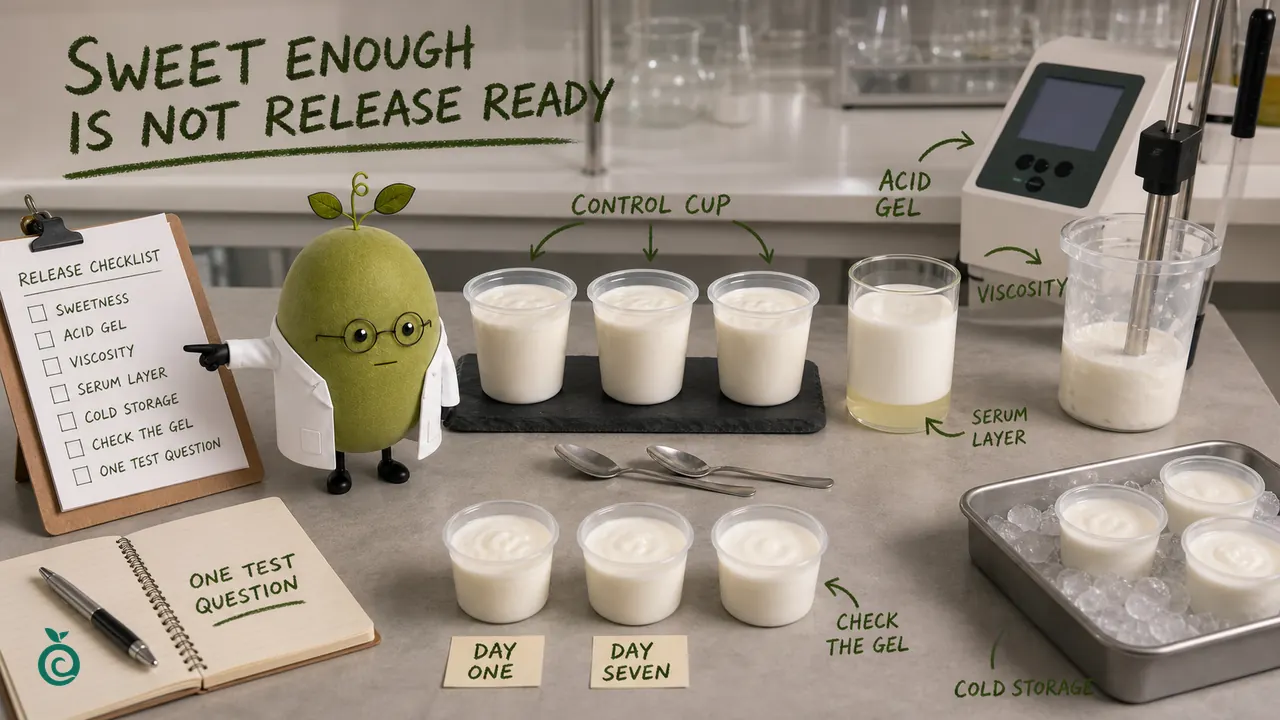
A low-sugar yogurt sample can be sweet enough and still fail release. The sweetener result answers one sensory question; it does not confirm that the fermented protein network is strong enough, that viscosity is right or that the cup will hold water during cold storage.
This guide is for dairy, fermented-yogurt and ingredient buyers comparing monk fruit, stevia, allulose-supported or other natural sweetener directions. The practical decision is to record sweetness, acid gel, water release and storage as separate gates before asking for the next blend.
Start with the job the sweetener must do
Write down whether the candidate is meant to lift sweetness, reduce part of the sucrose, support a more sugar-like curve or fit an erythritol-free brief. Monk fruit and stevia mainly answer sweetness; allulose may be considered for body or a different sweetness curve where the target market allows it. None of these directions should be chosen from sweetness potency alone.
Treat the acid gel as its own release gate
Fermentation, protein level, heat treatment, culture, final pH and acidity shape the yogurt gel. A 2024 low-fat yogurt study compared different protein levels and sweeteners while tracking pH, titratable acidity, rheology, texture and syneresis over refrigerated days 1, 7, 14 and 21. Its result supports a test design: keep the sweetener note next to the gel and acidity record, but do not treat the published model as a universal target. Source: https://www.mdpi.com/2304-8158/13/2/250
Measure syneresis instead of guessing from one spoon
Syneresis means liquid or serum leaves the gel. It may appear as a surface layer, whey-off, watery mouthfeel or a larger change after handling. Use one documented method, the same sample size and the same storage condition, then compare day 0, 7, 14 and 21 or the window agreed for the project. A visible water layer is a useful signal; it is not, by itself, proof of a sweetener cause, food safety problem or shelf-life result.
Use a three-lane sample matrix
Keep the current or sucrose control. Add a sweetness-focused candidate, then add a system candidate that also addresses solids, body or gel support when the application allows it. Keep the yogurt base, fruit level, process and package fixed. This lets the next round answer whether the problem is sweetness, structure, or both instead of changing every variable at once.
Record the fields buyers can act on
In the same sheet, record product type, milk or plant base, protein and fat, total solids, culture, heat and homogenization history, fermentation endpoint, pH or acidity, stabilizer, flavor or fruit preparation, packaging and cold-storage condition. Score initial sweetness, peak and finish beside sourness, bitterness, viscosity, gel strength, visible serum and cold-storage taste. The 2024 yogurt-gel stability review also describes protein, polysaccharide and protein-polysaccharide interactions as matrix-dependent, not as a single stabilizer answer. Source: https://www.sciopen.com/article/10.26599/FSAP.2024.9240066
Release the sample only against the stated question
A useful release note might say: sweetness is acceptable, but day-14 syneresis is still under review; or the gel is acceptable, but the finish needs another sweetener screen. That wording keeps the buyer, formulator and supplier focused on the next variable. It does not turn a bench result into a fixed formula, universal viscosity target, shelf-life guarantee or market-compliance statement.
Technical references and boundary
Reviewed August 2026. Sources include the 2024 low-fat yogurt and natural sweetener study (https://www.mdpi.com/2304-8158/13/2/250), the 2024 review on proteins, polysaccharides and yogurt-gel stability (https://www.sciopen.com/article/10.26599/FSAP.2024.9240066), the 2024 solidified-yogurt sugar-alcohol study (http://zhgry.aiijournal.com/EN/10.12377/1671-4393.23.12.17) and China's GB 2760-2024 food-additive standard notice (https://www.nhc.gov.cn/sps/c100088/202403/bda120e678df4a49a8beb90852559d7c.shtml). These sources support what to measure; they do not prescribe a Hengliyuan formula, a universal pH or syneresis limit, a shelf life or approval in every market.
Review note
Reviewed October 2, 2026.
Common questions
If the yogurt is sweet enough, is the sample ready?
No. Check acid gel, viscosity, water release or syneresis, texture and the agreed cold-storage window in the real yogurt base before release.
Does a watery surface prove that the sweetener caused the problem?
No. It is a useful observation, but protein, solids, fermentation, pH, stabilizer, handling and storage can also affect water release. Keep the cause open until the variables are compared.
Should the control and sweetener sample use the same storage test?
Yes. Keep the product base, process, package and storage condition comparable, then record sweetness and physical changes separately at the agreed time points.
What should buyers send before asking for a yogurt sample?
Start with your target market and product idea. Share any known packaging specification, estimated quantity, required certificates/documents and whether samples are needed; we can clarify the remaining details together. Add the base, process, pH or acidity, stabilizer and main defect to solve.
