
Read this guide in
RICE CRACKER FORMULATION GUIDE
Low-sugar rice crackers: separate sweetness, puffed structure and breakage
Plan rice cracker sweetener trials: compare the rice base, puffing, crispness, hardness, moisture and transport breakage with clear controls and research context.
A low-sugar rice cracker can taste right and still fail the buyer brief. It may puff unevenly, break during transport, lose its first-bite crunch after moisture uptake or become hard while sounding less crisp. These are different questions from sweetness.
For a useful first trial, keep a current-formula control and define the defect you want to solve: weak sweetness, poor expansion, tough bite, moisture softening or broken pieces. Our approach is to test these outputs separately, so a good sweetness score cannot hide a structure or packaging problem.

Identify where sugar enters the process
First separate sugar mixed into the rice dough from sugar added in a coating after puffing. Removing dough sugar can change solids and processing behaviour; changing a post-puff coating is a different trial. Sugar or syrup may contribute sweetness, soluble solids, binding, browning and eating texture. Monk fruit or stevia can restore sweetness at low use levels but contribute little replacement mass. A bulk ingredient or blend must be selected for its actual job and permitted use in the sales market.
Define the rice base and puffing window
Record the rice or starch type, particle size, pre-cooking or hydration, dough moisture, kneading, piece thickness and puffing method. Keep heating, pressure and residence time with the sample code. The 2019 rice-cracker study linked dough viscoelasticity to finished specific volume and structure within its tested process. That makes the dough stage part of the investigation; it does not establish a universal puffing setting.
Keep the sweetener trial separate from the structure trial
Use the three routes below to separate sweetness recovery from physical replacement. Write down the complete mass balance, including water, rather than describing a sample only as a percentage reduction. Keep a common process for the first screen; a process adjustment belongs in a separately identified trial. The 2014 Yukwa study involved fried puffed-rice snacks, so its polyol results should guide observations rather than dictate a ratio for every rice cracker.
| Route | What it contains | Question it answers |
|---|---|---|
| Current-formula control | The existing sugar system, base and process | What sweetness, expansion and texture must the new sample match? |
| Sweetness-restored route | Reduced sugar plus the selected sweetness source; no separate bulk compensation | What changes remain after sweetness is brought near the control? |
| Structure-supported route | The same reduction goal with a named bulk, binding or coating adjustment | Does the physical adjustment address the observed defect? Record all changed ingredients and water. |
Record first-bite crunch and breakage as separate outputs
A hard sample is not necessarily a crisp sample. The 2015 research describes moisture toughening: resistance to deformation can rise while brittle, crunchy behaviour is being lost. Record sensory bite, instrumental texture and handling damage separately, using the same sample size, conditioning and test method for comparisons.
- 2015 research: crunchiness loss and moisture toughening
- 2009 compression study: puffed rice fracture behaviour
| Output | Use a consistent method | Keep this distinction |
|---|---|---|
| Expansion or density | Record thickness and volume/mass using the same method after cooling | A large piece is not automatically low-density or resistant to damage. |
| Crisp bite and texture | Compare first-bite sound and fracture; retain the same instrument geometry and speed | Peak force or hardness alone does not measure crispness. |
| Handling breakage | Agree a broken-piece/fines definition; measure before and after the same packing/transport treatment | Use either count or mass consistently and state the denominator. Compare with a retained unhandled pack. |
| Water and storage | Record moisture method and basis, water activity, temperature, package and storage interval | Moisture content, water activity and surrounding relative humidity are different quantities. |
Treat re-moistening as a food-plus-package question
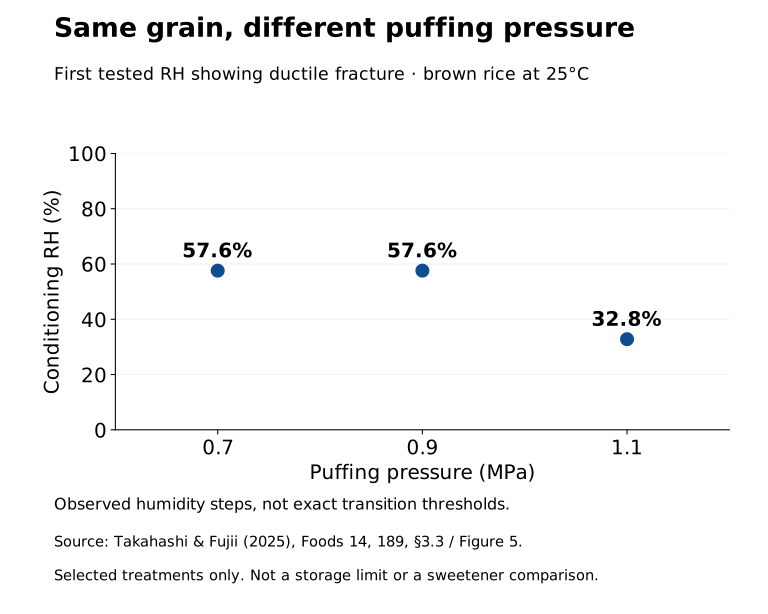
Study the food and its package together. The 2025 puffed-grain experiment shows that the process can change the humidity step at which a sample loses brittle fracture behaviour. It concerns individual puffed grains, not a sweetener trial or a packaged-cracker shelf-life limit. In the 2009 rice-cracker packaging study, the moisture-based shelf-life model also fitted the two cracker varieties differently; moisture alone did not explain every result. Keep composition, barrier, seal and storage conditions in the same review.
- 2025 original study: puffed-grain moisture and fracture, section 3.3 / Figure 5
- 2009 study: shelf-life simulation of packaged rice crackers
Build a short sample matrix and a real storage check
Retain matching control packs and set the storage and handling checks before comparing results. Use the same package fill, case configuration, exposure conditions and transport method. Day 0, 7, 14 and 28 can be screening checkpoints if suitable for the project; they do not establish a shelf-life duration. Repeat promising directions in separate batches before choosing the next pilot step.
Use the research within its tested scope
The linked studies cover rice-dough manufacture, fried Yukwa, compression testing, moisture conditioning and packaging models. They support the separate tests in this guide. They do not approve a sweetener use, set a universal water-activity or breakage number, or validate the finished product’s shelf life. Confirm ingredient identity and use conditions for the target market before sampling.
Common questions
Can monk fruit or stevia replace sugar in rice crackers?
They can help restore sweetness. First identify whether the original sugar was in the dough or a coating, then account for removed solids, binding and other physical functions. Test the candidate in that real process.
Discuss this requestDoes a crisp first bite prove a rice cracker will survive transport?
No. Define broken pieces or fines, measure the initial condition, then compare after the same packing and handling treatment. Keep sensory crispness as a separate output.
Discuss this requestWhy can a cracker feel harder after taking up moisture?
Some puffed foods show moisture toughening while losing brittle crunch. A higher compression force can therefore accompany poorer crispness. Read the force result together with fracture behaviour and sensory observations.
Discuss this requestShould moisture and water activity both be measured?
They provide different information. State the moisture method and wet- or dry-basis reporting, and record the temperature for water activity. Neither value alone supplies a universal quality limit for every rice cracker.
Discuss this requestCan the humidity values in the figure be used as storage limits?
No. They are first observed ductile-fracture steps for selected puffed-brown-rice treatments at 25°C. Different recipes, puffing processes, packages and storage times need their own validation.
Discuss this requestWhat should I send before requesting a rice-cracker sweetener sample?
Send the sales market, rice base, where sugar is added, current sugar amount and reduction goal, puffing process and main defect. Include the package, handling/storage question and available control results. Add quantities and required documents when known.
Discuss this request