
Read this guide in
DRIED FRUIT FORMULATION GUIDE
Low-sugar dried fruit: why moisture migration matters
A practical guide to testing low-sugar dried and candied fruit beyond sweetness: water activity, moisture, texture, packaging and storage checks.
A low-sugar dried-fruit sample can taste sweet enough on day one and still fail after packing. The reason is simple: sweetness is one result, while water movement controls many of the texture and storage questions. A fruit piece can gain moisture from a neighboring piece, a filling, headspace or the outside environment even when the sweetness target has already been met.
This guide is for buyers and formulation teams developing dried fruit, candied fruit or fruit-snack samples. It keeps the sweetener question separate from the drying and package question, so the next sample brief is specific enough to test rather than a request for a universal replacement ratio.
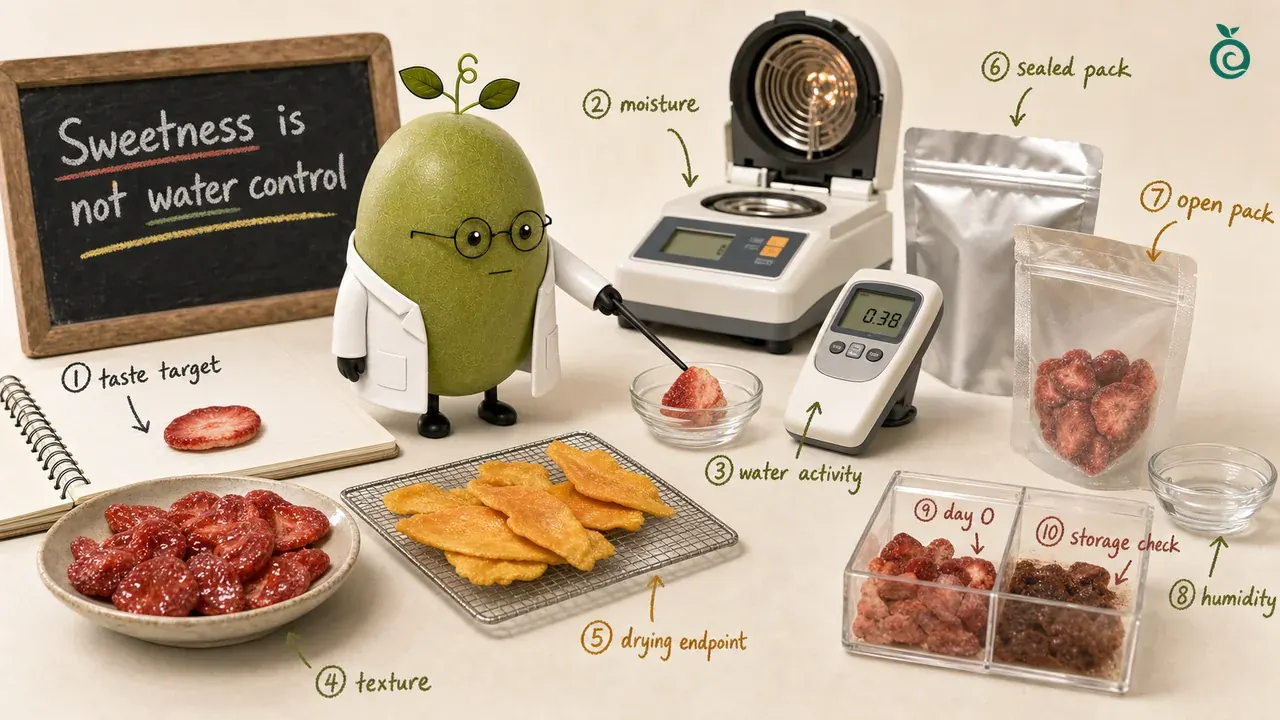
Start with the first principle: sweetness is not water control
Sweetness describes how the sample tastes. It does not tell you how much water remains, how strongly that water is held, or where it will move during storage. In a dried or candied fruit system, sugar and other solids can change tissue, viscosity and the state of water. Replacing part of the sugar can therefore change both sweetness and the physical balance of the product. Treat the sweetness target, moisture result, water activity and texture result as separate fields from the first bench sample.
Keep candied fruit and freeze-dried fruit in different test lanes
Candied or osmotically dehydrated fruit is shaped by water loss, solid gain, fruit tissue and the drying route. Freeze-dried fruit is a porous, low-moisture structure whose crispness is highly sensitive to moisture uptake after drying and packing. A 2019 candied-apple study and a 2025 candied-strawberry study describe application-specific changes in water state, solids and texture; neither proves a universal monk fruit, stevia or allulose formula. Do not transfer a candied-fruit ratio or drying target directly to freeze-dried fruit.
Use a small but complete sample record
For each lot, record fruit identity, cut or piece size, pretreatment, sweetener system, total solids or syrup condition, drying method, process endpoint, package, storage condition and the test date. Add moisture and water activity using the agreed methods, then record stickiness, crispness, softness, chewiness, color, aroma and visible migration. If the sample contains a coating, filling or mixed fruit pieces, identify those components because they can create a local moisture gradient.
Read water activity with the matrix, not as a magic cutoff
Water activity describes how available water is for movement and reactions; it is not the same as total moisture. Sorption studies on dried and candied fruit show that moisture behavior can change with composition and humidity. A 2025 study of vacuum-dried and freeze-dried Barhi dates also found different sorption and hysteresis behavior under its tested conditions. Use the result to compare matched samples, not to claim that one number guarantees crispness, safety or shelf life for every fruit.
Test the package as part of the sample
A dried-fruit sample is not fully defined until the package is defined. Record pouch or bag structure, seal condition, headspace, desiccant or oxygen-control approach if used, case format and storage humidity. Packaging research and procurement specifications treat moisture barrier, finished-pack seals and handling as separate checks. A better film can slow moisture uptake, but it cannot repair a wet process endpoint, a damaged seal or a product that already has an uneven moisture distribution.
Build a time-based decision, not a day-one tasting
Agree the decision before testing: for example, keep the intended bite and appearance through the planned storage screen in the intended pack. At each checkpoint, repeat sweetness, moisture, water activity, texture, color, mass or visible condensation where relevant. Include the current or sucrose control when comparison matters. Day 0 can identify obvious defects; it cannot by itself prove shelf life or commercial stability.
Turn the result into the next supplier brief
When the sample changes, state which variable changed and what it was meant to answer: sweetness, solids, fruit texture, drying endpoint, package barrier or storage behavior. Then send the target market, product type, packaging specification, estimated quantity, required certificates/documents and whether samples are needed, along with the fruit and process details. Hengliyuan can discuss sweetener directions and sample planning; the finished fruit process and package still require project-specific validation.
Technical references and boundaries
Reviewed August 2026 using a 2019 study on osmotic dehydration and hot-air drying of candied apple, a 2025 study on trehalose as a sucrose replacer in candied strawberry, a 2005 dried-fruit sorption study, a 2025 study of vacuum-dried and freeze-dried Barhi dates, and a dehydrated-food packaging study. These sources support test design and caution around water movement; they do not establish a universal sweetener ratio, moisture limit, shelf-life claim or market approval.
Review note
Reviewed October 2, 2026.
Common questions
If the dried fruit tastes sweet enough, can it move to packaging?
Not automatically. Check the agreed moisture, water activity, texture, package and storage fields in the real product before approval.
Is water activity the same as moisture content?
No. Moisture is the amount of water; water activity describes how available that water is for movement and reactions. Use both when they answer different project questions.
Can a candied-fruit sweetener ratio be reused for freeze-dried fruit?
No. The drying route, porosity, moisture sensitivity and package behavior differ. Keep the two applications in separate test lanes.
What should be included in a dried-fruit sample inquiry?
Send target market, product type, packaging specification, estimated quantity, required certificates/documents and whether samples are needed, then add fruit, cut, drying route, moisture or water-activity target and storage conditions.
