Read this guide in
KOMBUCHA VALIDATION SCORECARD
Kombucha pH, Brix and Titratable Acidity: A Buyer's Validation Scorecard
Compare kombucha pH, apparent Brix, titratable acidity and taste at matched stages. Download a free Excel sample record, with no email required.
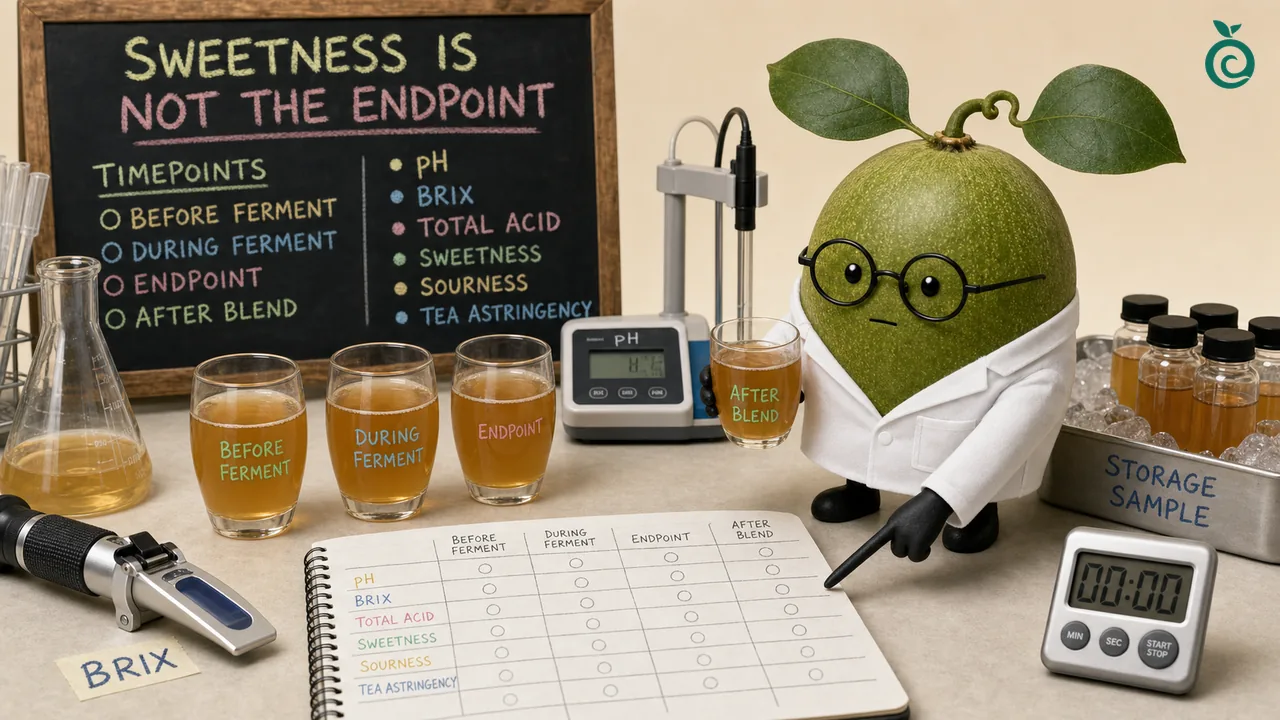
Use a matched control and sample, then record kombucha pH, Brix, titratable acidity and sensory notes at the same defined timepoints. Add a separate row for post-fermentation sweetening. This makes it easier to tell whether a change belongs to the fermentation stage, the acidity endpoint or the finished drink. The scorecard is a test structure, not a universal pass range.
Our factory view: separate the fermentation change from the finished-drink sweetening change. Otherwise, a sharper base can make a useful sweetener look wrong, and extra sweetness can hide the reason a batch changed. Use the free record below to keep those observations together.
Define the control and process lane
Record the tea type and concentration, starter or culture, starting sugar, vessel, time and temperature, control recipe and intended finished format. Give every batch and sample a traceable ID. For a post-sweetening comparison, split the same finished base into a control and candidates wherever practical, so the sweetener is the variable being tested. If fermentation conditions also change, record that as a separate trial. Mark unknown fields as unknown. A tea, culture or process from one study is not a production method for every commercial kombucha.
Download the matched sample record
The free Excel sheet has a control column and two candidate columns, with 27 fields covering the base, process, measurement methods, taste and next action. No email is required. Use one sheet for each matched checkpoint and duplicate it for later timepoints. Yellow cells are editable. Leave unmeasured values blank and attach the method or report where available. The file contains no preset pass limits, invented results or automatic sugar and alcohol conversions.
Read pH, apparent Brix and TA separately
pH describes acidity on a logarithmic scale; titratable acidity (TA) measures the base needed to reach a defined endpoint. Record both. TA also needs its units and reporting basis, such as grams per litre expressed as acetic acid equivalent, before two results can be compared. A refractometer reports a sucrose-equivalent reading. In fermented tea, other dissolved substances and alcohol affect that reading, so record it as apparent Brix. Do not relabel it as measured residual sugar, and do not convert a single reading directly into sugar grams or alcohol content.
| Measure | Record with the result | Do not infer |
|---|---|---|
| pH | Meter, calibration, sample preparation and temperature | Total acid amount or batch release from pH alone |
| Apparent Brix (°Bx) | Instrument, calibration and sample temperature | Exact residual sugar or perceived sweetness |
| Titratable acidity | Method, endpoint, titrant, dilution, units and acid-equivalent basis | A comparable result when methods or units differ |
| Residual sugars, if tested | Analytical method, units and report reference | That an apparent Brix reading is a sugar analysis |
Add the finished-drink rows after the endpoint
After fermentation, record whether the drink is diluted, flavored, carbonated, filtered, chilled or otherwise processed. Then record the sweetening time, sweetness onset, sourness, tea astringency, aroma, carbonation, aftertaste, sediment or separation and storage checkpoint. A finished drink that tastes sweet can still have a different acidity or process history. Keep a checkpoint immediately before sweetener addition and another after mixing. This makes the change caused by dilution or flavor addition visible rather than attributing every difference to the sweetener.
Use the scorecard to choose the next sample
If pH or TA moves unexpectedly, first check the analytical method, sample preparation and fermentation record. If onset or finish changes while the base stays matched, compare the sweetener grade and dose. If apparent Brix moves, check dilution, added ingredients and the process stage. A number is useful only when its measurement basis is known.
| Checkpoint | Matched record | Decision it supports |
|---|---|---|
| Fermentation timepoint | Batch ID, time, temperature, pH, apparent Brix and TA | Whether process changes need investigation |
| Before post-sweetening | Base composition, processing and analytical baseline | Whether candidates start from a comparable base |
| After mixing / finishing | Grade, dose, dilution, carbonation and taste | Which sweetener direction merits another trial |
| Agreed storage checkpoint | Pack, elapsed time, temperature, analytical and sensory notes | Whether the observed difference persists under those conditions |
Compare immediate and rested samples
Compare control and candidates after the agreed mixing or carbonation step, then at the same defined storage intervals. Keep serving temperature and serving volume consistent. Use coded samples and balance the tasting order when practical, rather than always serving the control first. Record each order so that a tasting difference can be reviewed. A short screen does not establish shelf life.
Keep sensory notes next to analytical notes
Record sweetness onset, peak and finish separately from sourness, bitterness or astringency, aroma and carbonation. Include sediment, haze or separation where relevant. Plain descriptions are useful: “more sour than the control after storage” gives the next trial a clearer purpose than an unexplained overall score. If your team uses a numeric scale, define its anchors and use the same scale for every sample. This worksheet does not set safety or release criteria. Keep the project’s required microbiological, alcohol, packaging and shelf-life checks in the appropriate validated procedures; attach relevant report references to the sample record.
Turn the record into a useful sample brief
Send the tea base, target market, sweetening stage and the main difference you want to improve. Add the completed record if available; a partial record is enough to start the discussion. Grade and dose should stay attached to the sample ID. We can then discuss the next sweetener comparison with your actual process in view.
Technical references and boundaries
Cohen, Sela and Nolden (Foods, 2023) monitored pH, Brix and TA and paired analytical measurements with sensory testing. That supports recording these as separate observations; its study conditions do not set limits for your product. Instrument guidance also explains why Brix depends on sample composition and why TA requires an endpoint and acid-equivalent reporting basis. Reviewed October 16, 2026.
Record these fields before comparing kombucha samples
- Tea base and strength
- Starter or culture process
- Current or sucrose control
- Fermentation time and temperature
- pH and titratable acidity
- Apparent Brix and separately tested residual sugars
- Sweetening time
- Sweetness, sourness, tea astringency, aroma, carbonation and storage
Common questions
What should a kombucha validation scorecard measure?
Record the base and process, matched checkpoint, pH, apparent Brix, TA with its method and units, and separate taste observations. Add residual sugars only if actually tested, with the analytical method.
Discuss this requestIs Brix the same as residual sugar in kombucha?
No. A sucrose-equivalent refractometer reading is affected by the fermented matrix. Keep apparent Brix separate from a residual-sugar result obtained by an appropriate analytical method.
Discuss this requestWhy record TA as well as pH?
They describe different aspects of acidity. A pH reading does not give the amount of titratable acid; TA needs its endpoint, method, units and acid-equivalent basis to be interpretable.
Discuss this requestShould pH alone decide when fermentation is complete?
No. Use the product’s validated process and release criteria. This scorecard helps compare samples; it does not supply a universal fermentation endpoint or release rule.
Discuss this requestCan I download the Excel without leaving an email?
Yes. Use the direct download link in the article. The workbook is blank and editable, with a control and two candidate columns. Duplicate the sheet for each matched timepoint.
Discuss this requestDo I need a complete worksheet before requesting a sample?
No. Start with the tea base, market, sweetening stage and the issue you want to improve. Share any measurements you already have; missing details can be clarified during the sample discussion.
Discuss this request