
Read this guide in
FREEZE-DRIED FRUIT BUYER CHECKLIST
Freeze-Dried Fruit in Bulk: Supplier Specification & Packaging Checklist
Compare freeze-dried fruit suppliers on moisture, water activity, piece size, breakage, pack barrier, documents, and storage terms.
A freeze-dried fruit quotation is difficult to compare when one supplier quotes only the fruit name and another includes cut, moisture, water activity, breakage, packaging and documents. The product name is not the full specification. A usable sample brief makes the physical form, quality checks and commercial terms visible before price becomes the only comparison.
Use this checklist for fruit pieces, slices, powders, inclusions and snack formats. It is a buyer-side comparison tool, not a universal procurement standard. The USDA freeze-dried-fruit CID is a useful reference for how a purchaser can specify type, style, analysis and packaging, but it is a U.S. federal procurement document rather than a global commercial target.
Define the fruit form before comparing suppliers
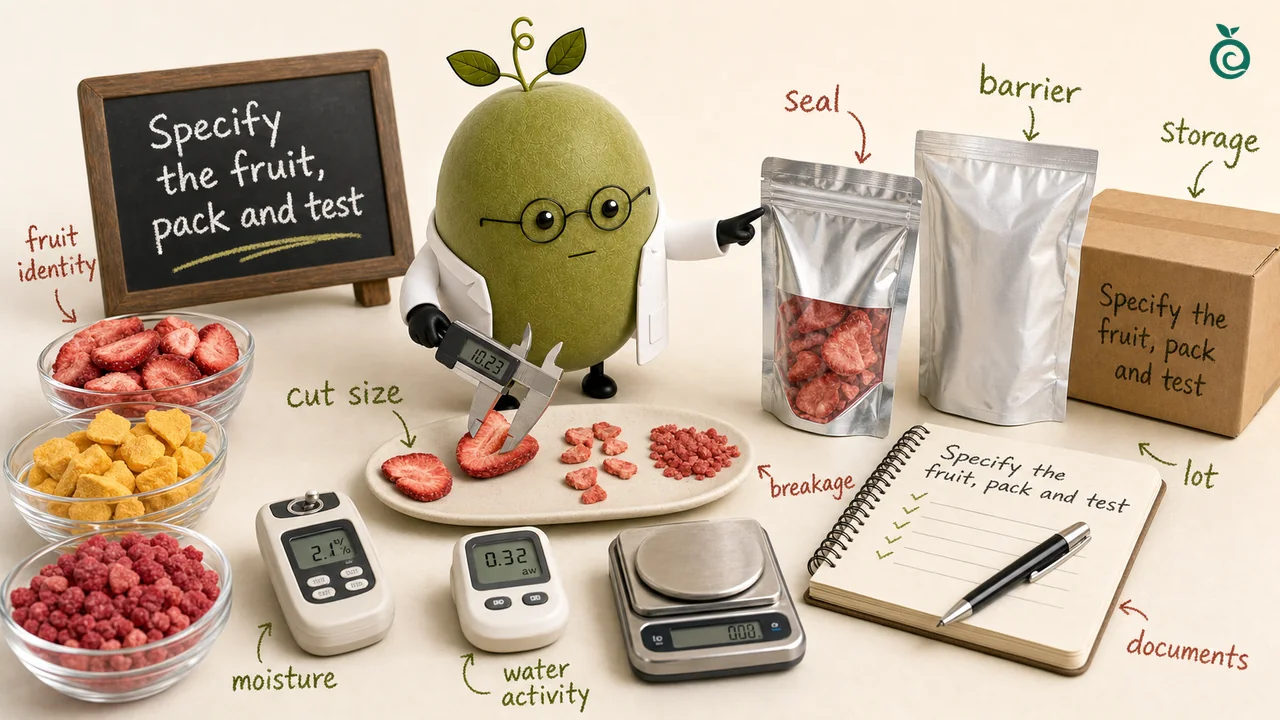
Name the fruit, variety when relevant, agricultural or origin requirement, cut or piece size, whole or broken format, powder or inclusion use, color expectation and any pretreatment. For mixed-fruit products, list each component. A whole slice, small dice, powder and granule can have different surface area, breakage risk and moisture response even when they share a fruit name.
Separate analytical fields from visual fields
Request the agreed moisture method and result, water-activity method and result where used, and the sampling basis. Also define piece-size range, fines, broken pieces, foreign material, color, odor and visible defects. The USDA A-A-20365 CID shows one procurement example that specifies analytical requirements and a composite sampling approach; its stated moisture requirement is specific to that document and must not be copied as a universal target.
Ask what the sample can actually prove
A sample can help compare fruit identity, appearance, bite, piece size, moisture, water activity, breakage and pack condition. It cannot by itself prove long-term shelf life, every production lot, the final food label or performance after you add a coating, sweetener, filling or other ingredient. Ask whether the sample is from a normal lot, a pilot lot or a selected presentation lot, and request more than one lot when the decision is material.
Treat packaging as a finished-pack specification
Record the primary pack format, film or container structure, moisture and oxygen barrier information with test conditions where available, seal width or seal standard, fill weight, headspace, closure, desiccant or oxygen absorber, case packing and transit protection. Inspect the finished pouch or container, not only a film data sheet. Dust in the seal, pinholes, poor closure or rough transit can undo a good barrier material.
Match storage and handling to the buyer's route
State whether the pack will be opened repeatedly, sold as a snack, used as an ingredient, mixed into cereal, added to chocolate or included in a bakery or dairy product. Note temperature, humidity, light, distribution time and whether the product will be repacked. Freeze-dried fruit is especially sensitive to moisture uptake after opening, but the rate depends on the product, package and environment.
Make documents part of the quotation brief
Ask for the documents that match the market and finished use: product specification, COA, allergen statement, microbiological or foreign-material controls, origin information, food-safety files, organic or non-GMO support where applicable, and packaging or storage instructions. A certificate or supplier statement is evidence for review, not automatic approval of a finished food in every country.
Use one comparison sheet for the next decision
Put fruit identity, form, lot, moisture, water activity, size, breakage, package, storage, documents, price basis, quantity, lead time and sample status in one sheet. Add the sweetener direction separately if the fruit is candied or coated. This keeps specification, formulation and commercial questions from being hidden inside a single price request.
Technical references and boundaries
Reviewed August 2026 using USDA A-A-20365 Fruits, Freeze Dried, a 2025 sorption study of vacuum-dried and freeze-dried Barhi dates, and a dehydrated-food packaging study. These sources support specification and test planning; they do not establish a universal moisture or water-activity limit, guarantee crispness, certify a supplier or replace target-market review.
Connect a sweet coating to the fruit specification
If the project includes a sugar or sweetener coating, specify it separately from the freeze-dried fruit. Record full composition, addition method, coating weight where known and the effect on particles, surface stickiness and moisture pickup. Test the coated product in its final pack and intended serving condition. A raw-fruit moisture result does not establish the coated product’s stability.
Review note
Reviewed October 2, 2026.
Common questions
What is the first specification to request for freeze-dried fruit?
Start with fruit identity and form, then request the agreed moisture and water-activity results, piece-size or breakage limits, packaging details and lot information.
Can a USDA freeze-dried-fruit moisture requirement be used for every commercial project?
No. The USDA value belongs to a specific federal procurement CID. Use it as a reference for specification discipline, then set project- and market-specific requirements.
Is a high-barrier pouch enough to guarantee crispness?
No. Product moisture distribution, seal quality, handling, opening frequency and storage humidity also affect texture.
What should a buyer send for a comparable sample quotation?
Send target market, product type, packaging specification, estimated quantity, required certificates/documents and whether samples are needed, plus fruit form, cut, storage route and the required comparison fields.
