
Read this guide in
COFFEE CREAMER VALIDATION SCORECARD
Coffee Creamer Feathering & Flocculation: Emulsion and Heat Validation Scorecard
Compare coffee creamer feathering, clumps, oil layers and taste under matched coffee conditions. Use the practical scorecard and free Excel trial record.
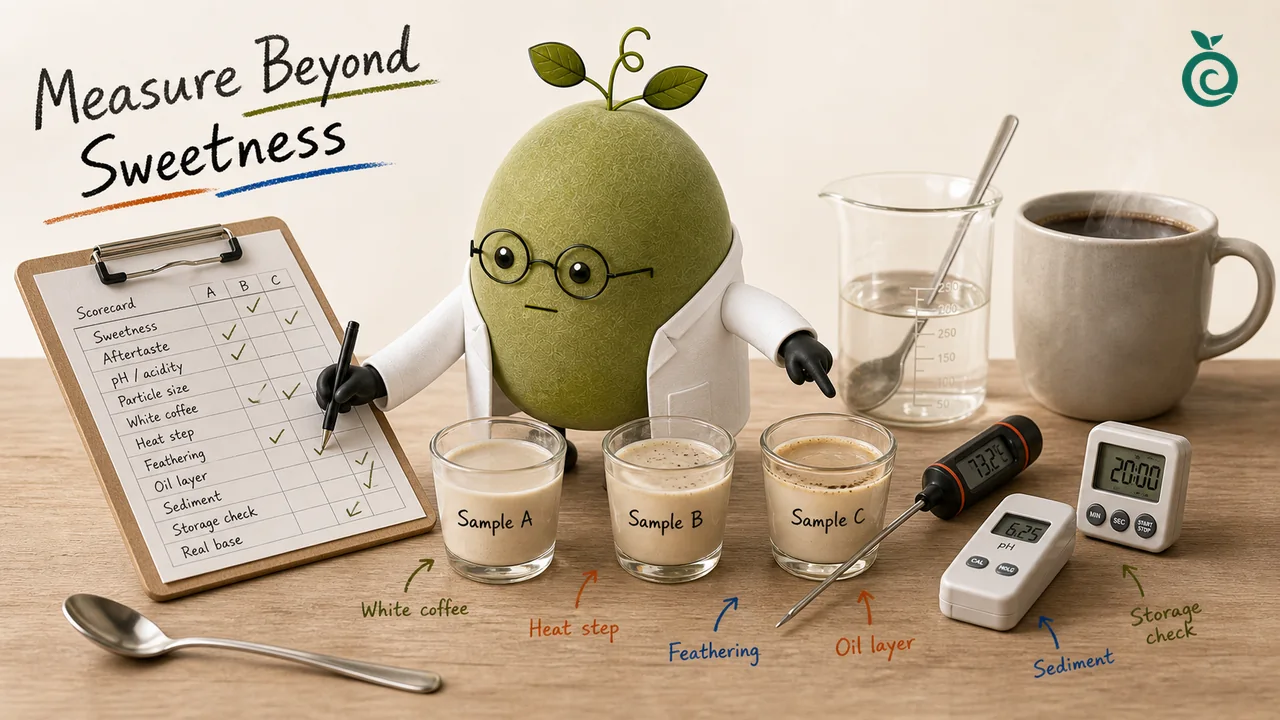
A creamer can taste right and still leave flakes, an oil layer or a deposit in coffee. Our scorecard keeps those physical observations separate from sweetness, so the next sample addresses the failed requirement instead of changing everything at once.
Start with a matched control and trial in the coffee the customer will use. Record the conditions and name each visible defect before assigning a decision. Liquid creamers and powder whiteners can share these headings, but need their own preparation and storage methods.
Download the blank coffee-creamer trial record
The editable Excel has control and trial columns for coffee conditions, visible defects, taste and the next test. Keep one copy per matched observation checkpoint. It has no automatic pass score: agree the acceptance criteria for your product. Download without an email or registration; sharing the completed record is optional.
Define the product lane and control
Record liquid or powder form, dairy or plant-based protein, fat source, carrier, emulsifier or stabilizer direction, coffee base and the current or sucrose control. Do not compare a liquid emulsion with a powder reconstitution result as if they shared one defect definition.
Record sweetness and finish separately
Use a matched tasting order for first sweetness, peak, aftertaste, bitterness, licorice-like notes, aroma fit and mouthfeel. Keep those rows separate from whiteness, foam, dispersion and visible physical change. A pleasant sweetener result does not prove a stable creamer.
Record the coffee stress context
Write down coffee type, roast or flavor system, concentration, serving temperature, acidity or pH when available, salts, creamer addition order, stirring and observation time. A water result can be kept as a screen, but the coffee result should drive the application decision.
Record the emulsion and dispersion variables
Add particle size or droplet-size information when available, homogenization method, wetting or dispersion behavior, viscosity or flow, whiteness and foam. If a variable is unknown, mark it as unknown instead of guessing it from appearance.
Record the defect and the conditions together
Use the same coffee preparation, dose, vessel and observation schedule for the control and trial. Photograph the untouched cup before stirring or tasting. A visual description records what happened; it does not establish the mechanism.
| Check | Record for control and trial | Keep comparable |
|---|---|---|
| Coffee challenge | Coffee type and strength, amounts, coffee and creamer temperatures, measured pH if available. | Coffee batch, addition order, dose and stirring. |
| Feathering or particles | Flakes or curd-like particles, when first seen and photo reference. | Elapsed time, temperature and viewing conditions. |
| Layers and deposits | Cream layer, separate oil, sediment or bottom deposit; name each separately. | Vessel, fill level and undisturbed observation. |
| Powder preparation | Floating powder, incomplete wetting or clumps after mixing. | Reconstitution method; mark not applicable for liquid products. |
| Taste and mouthfeel | Sweetness entry, peak, finish, bitterness, aroma fit and texture. | Serving temperature and tasting order. |
| Decision and next trial | Failed requirement, checkpoint decision and one next variable. | An unchanged control and pre-agreed acceptance criteria. |
Keep immediate, cooled and stored results in separate copies of the record. Do not replace the first observation with a better-looking result after re-mixing.
Name each visible defect
Use separate rows for feathering, curd-like particles, creaming, oil layer, sediment, clumping, incomplete wetting and change after cooling. Photograph the same cup or sample position where practical so the next blend or process change has a clear comparison.
Repeat after heat and storage checkpoints
Define the checkpoints before testing: immediately after preparation, after the intended standing or cooling period, and after relevant storage of the actual liquid or powder product. Record time and temperature at every checkpoint. Re-test the stored creamer in coffee using the same preparation method. A short screen supports the next trial; it does not establish shelf life.
Technical references and boundaries
Brown et al. (2019) examined an organic, unsweetened, long-life soymilk in instant-coffee solutions across composition, temperature and pH conditions. That is a defined soy-coffee system, not a universal creamer specification. It supports documenting the coffee challenge rather than attributing every visible separation to sweetness.
Record these fields before comparing coffee-creamer samples
- Creamer form and coffee base
- Current or control sample
- Sweetness and aftertaste
- pH, acidity and salt context
- Particle size, dispersibility or homogenization method
- Whiteness, foam and flow
- Feathering, creaming, oil layer or sediment
- Heat and storage checkpoints
Common questions
What should a coffee-creamer scorecard record?
Record coffee conditions and dose, mixing, the observation time, each visible defect, sweetness and mouthfeel. Include the acceptance criteria and the next variable to test. The blank Excel keeps control and trial observations side by side.
Discuss this requestAre feathering, an oil layer and sediment the same result?
Record them separately. Flakes or particles, a layer at the top and material at the bottom describe different visible outcomes. Photographs and timing help the team investigate; appearance alone does not establish the cause.
Discuss this requestCan I use the same record for liquid creamers and powder whiteners?
Yes, with the relevant method recorded. Powder products need reconstitution and wetting observations; liquid products need their own preparation and emulsion checks. Mark a field not applicable rather than treating an unperformed test as a pass.
Discuss this requestIs a water test or day-zero taste result enough?
Use water as an initial screen if useful, then evaluate in the intended coffee. Keep the agreed cooling, standing and storage checkpoints separate. A good first taste does not answer whether the visible defect appears later.
Discuss this requestDo I need to complete the Excel before contacting Hengliyuan?
No. Tell us the creamer form, coffee base and main taste or appearance problem. Share any known process, packaging, quantity and document requirements; the trial record and photos are optional aids to the sample discussion.
Discuss this request