Read this guide in
Hengliyuan application and selection
Erythritol in Cold Beverages: Solubility, Cooling Effect, and Crystallization
Erythritol dissolves warm but forms crystals when chilled? Compare cold mixing, cooling and storage, with published solubility data and practical sample checks.
A clear warm drink is not a pass for refrigerated sale. We check three things separately: dissolution during preparation, cooling sensation when drinking, and crystals that appear after cooling or storage. The finished beverage must work at its intended temperature, not only at the mixing bench.
Hengliyuan supplies erythritol in powder and granular forms, with granular mesh specifications available for discussion. Before selecting a form, define whether the beverage is cold-prepared, prepared warm then cooled, or made as a concentrate and diluted; each use route requires its own test.
Why cold beverages need additional dissolution and crystallisation checks
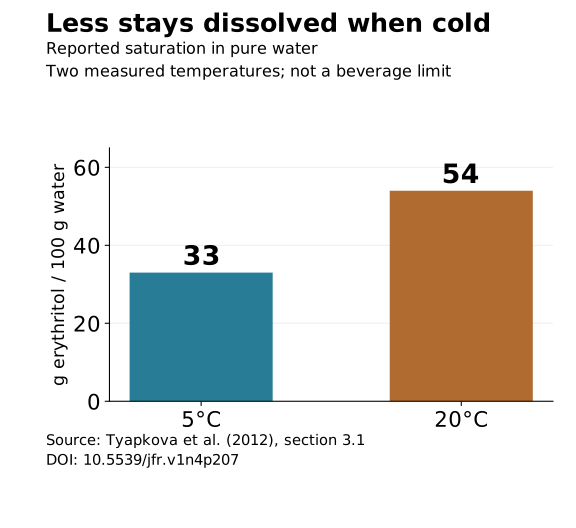
Tyapkova and colleagues reported saturated erythritol in pure water at 33 g per 100 g water at 5°C and 54 g per 100 g water at 20°C. Less remained dissolved at the colder temperature. These values explain why a warm solution needs another check after cooling. The denominator matters: these are grams of erythritol per 100 g of water, not grams per 100 g of finished drink or per 100 mL. Acids, juice, protein and other solids make a beverage different from pure water, so the study does not establish a universal drink inclusion limit.
- Tyapkova et al. (2012): aqueous erythritol crystallization, section 3.1
- View erythritol specifications
Test the preparation route the customer will use
Cold mixing, warm preparation followed by cooling, and concentrate dilution ask different questions. Use the actual preparation instructions and keep a control made by the same route.
| Preparation route | Record during preparation | Recheck before approval |
|---|---|---|
| Mix directly into a cold drink | Actual temperature, addition order, stirring method and time; undissolved material | Clarity or sediment after the intended standing and storage period |
| Dissolve warm, then cool | Warm preparation conditions and the cooling history | Crystals or residue at the intended serving and lowest planned storage temperature |
| Make a concentrate, then dilute | Erythritol level and temperature in both concentrate and final drink | Concentrate storage/transport as well as the diluted drink; dilution does not validate the concentrate |
Heating can help preparation, but it does not resolve an excessive concentration at the final temperature. Define observations and acceptance criteria for the cooled product before comparing samples.
How to assess recrystallisation risk from solubility
Recrystallisation is not only a question of whether erythritol dissolves during preparation. Assess how much can remain dissolved in the finished beverage at the lowest planned temperature. Before sample work, compile: 1. Actual erythritol addition rate in the complete formulation; 2. Water phase and total beverage amount; 3. Preparation temperature and cooling process; 4. The lowest expected storage and serving temperature. Make an initial assessment from published or supplier-provided solubility information, then prepare the actual formulation. Subject samples to planned heating, cooling and storage and inspect for crystal formation at the relevant time points. Where formulation concentration approaches the low-temperature solubility range, reduce erythritol, adjust the sweetener blend, or redesign preparation and use. Choose the adjustment against target sweetness, cooling sensation and finished-product sensory performance; avoiding crystals alone must not override the product positioning.
Powder or granules for cold beverages?
Powder and granules can dissolve at different rates under the same mixing conditions. Particle size also affects dosing and handling, but the grade name alone does not determine how much erythritol can remain dissolved at the final temperature. Compare samples at the same addition rate, beverage mass, temperature, addition order and stirring method. Ask Hengliyuan about the required granular mesh range and verify the offered specification with the sample. A powder that dissolves quickly may still recrystallize during refrigeration. A granule that dissolves more slowly may work if the defined preparation method dissolves it fully. Record initial dissolution, chilled stability and sensory acceptance separately.
How should cooling sensation be assessed?
Erythritol may create a cooling sensation. Whether that is desirable depends on the beverage flavour and positioning; a stronger or weaker effect is not inherently better. A cold beverage itself also feels cool. Keep control and candidate samples at the same consumption temperature when assessing erythritol’s cooling sensation, or the difference cannot reliably be attributed to the formulation rather than temperature. Record separately: - Whether a clear cooling sensation occurs on the first sip; - Whether it fits fruit, mint, tea, coffee or dairy flavour; - Whether it affects the main aroma and finish; - Whether changes in refrigerated temperature make the sensation more pronounced or less acceptable. Keep serving temperature, serving volume and tasting order consistent. Score sweetness, cooling sensation and overall preference separately, so a sweeter sample is not mistakenly judged to have a more suitable cooling sensation.
Do visible particles prove erythritol recrystallisation?
Appearance alone cannot identify the particles. They may be undissolved erythritol, material formed after cooling, or particles from other ingredients and their interactions. Record when they first appear: immediately after mixing, during cooling, or after storage. Compare the control and candidate under the same packaging, temperature history and observation schedule. If the cause remains unclear, use suitable analysis before deciding which ingredient to change. The cited aqueous-solution study examined supersaturation, temperature, storage time and cooling rate. Its results are not a shelf-life guarantee for a juice, protein drink or other complete beverage.
After discovering the problem, what should be changed next?
| Observed situation | What to check first | Comparable adjustment directions |
|---|---|---|
| Undissolved material immediately after cold mixing | Addition rate, temperature, addition order and stirring | Compare the specified grades or preparation methods; check the actual use level |
| Clear warm, crystals appear after cooling | Concentration and final temperature; confirm the particle identity | Compare a lower erythritol level or a different sweetener system |
| No crystals, but cooling sensation is too strong | Same-temperature control, actual dose and flavor fit | Compare a lower erythritol level and rebalance sweetness |
| Sweetness is insufficient near the tested low-temperature limit | Sweetness target and the complete sweetener system | Compare a high-intensity sweetener contribution instead of simply adding more erythritol |
| Unidentified sediment after storage | Control sample, other ingredients and timing | Identify the material before deciding whether to change erythritol |
These are directions for the next sample round, not a general formulation. Change one main condition at a time where possible and retain the original sample as a control, so the adjustment can be assessed clearly.
How can the protocol be adjusted when the dosage of erythritol is high?
Where the project aims to greatly reduce or fully replace sucrose, the erythritol level may rise. Assess dissolution, cooling sensation, mouthfeel and low-temperature storage performance alongside sweetness. If erythritol alone needs a high dose and compromises dissolution, recrystallisation or cooling sensation, compare a blend with sucralose, monk fruit sweetener, steviol glycosides or another sweetener. A high-intensity sweetener can supply additional sweetness and may reduce actual erythritol use while allowing the overall sensory profile to be adjusted. Choose the sweetener and ratio for the beverage base and target flavour. Hengliyuan can discuss a blended-sweetener route from the original sucrose level, intended replacement level and sample results; the final formulation still requires verification in the customer’s actual product.
Request erythritol samples for cold beverages from Hengliyuan
Start with your beverage type and the main issue: slow dissolution, cooling sensation or particles after chilling. Tell us whether it is mixed cold, prepared warm and cooled, or diluted from a concentrate. Share the actual use level, lowest planned temperature and sample observations if available; you do not need every detail settled before contacting us. Hengliyuan supplies powder and granular erythritol and can discuss mesh requirements and blended-sweetener directions. We use the original sucrose level, replacement target and trial feedback to plan the next comparison. Confirm the offered specification, packaging and documents for your project. Current packaging includes 1 kg bags, 25 kg bags and 25 kg drums. Other packaging can be discussed according to project requirements.
Review note
Reviewed October 16, 2026. Published solubility values describe pure water. Sampling guidance must be checked in the actual beverage and storage conditions.
Common questions
Why can erythritol dissolve warm but form crystals after chilling?
Its solubility in water decreases as temperature falls. If the cooled system cannot retain the dissolved amount, crystals may form. Check the complete beverage at the intended cold temperature; warm clarity alone is not an acceptance test.
Discuss cold-drink samplesDo 33 g per 100 g water at 5°C and 54 g at 20°C define a beverage dosage?
No. They are published saturation values in pure water, with water mass as the denominator. They are not percentages of finished drink, and other beverage ingredients change the system. Use them as context, then test the actual formula.
Discuss cold-drink samplesDoes powdered erythritol prevent recrystallization?
No. A smaller particle size may change dissolution speed, but rapid initial dissolution does not establish chilled stability. Compare powder and granules under matched preparation, temperature and storage conditions.
Discuss cold-drink samplesShould I test the concentrate or only the diluted drink?
Test both. Record the erythritol concentration and temperature history of the concentrate and the final drink separately. A clear diluted drink does not establish concentrate stability during storage or transport.
Discuss cold-drink samplesDo particles at the bottom prove erythritol crystallization?
No. Record when particles appear and whether the control also has them. Other ingredients can contribute particles or sediment. Confirm the cause with suitable checks before changing the sweetener.
Discuss cold-drink samplesHow should cooling sensation be compared?
Serve coded control and candidate samples at the same temperature and volume. Record sweetness, cooling sensation, flavor fit and preference separately; the drink temperature itself must not confound the comparison.
Discuss cold-drink samplesCan Hengliyuan help when reducing erythritol leaves too little sweetness?
We can discuss a blended-sweetener direction from the original sucrose level, replacement target, beverage base and trial feedback. The proposed ratio still needs verification in your product, including chilled storage and sensory checks.
Discuss cold-drink samples